Kishimoto didn't invent 口寄せ — he borrowed it wholesale from real Japanese folk religion. The word's actual, older meaning is necromantic: an itako medium at Mt. Osore's Bodai-ji temple performs 口寄せ by entering a trance and speaking a deceased person's words through her own mouth, for a fee, for grieving visitors. That practice still happens today at Osorezan's annual Itako Taisai festival. Naruto keeps the word but swaps its object: instead of channeling a dead relative's voice, shinobi use 口寄せ to instantly pull a living contracted animal — toad, slug, snake, hound — from a separate summoning realm into battle. It's a genre-appropriate repurposing of a real spiritualist term for something closer to portal magic.
The corpus shows one moment where the two meanings collide directly, and it's the darkest use of the word in the whole series: Orochimaru's forbidden reanimation jutsu is literally named 口寄せ・穢土転生 (Vol. 13 p.181, "KUCHIYOSE: EDOTENSEI! SUMMONING: REANIMATION!") — 口寄せ used in its original necromantic sense, to call back the actual dead. Every other use of the word in the manga — Jiraiya's toads, Kakashi's ninja dogs, Tsunade's slug, Sasuke's snakes — is the softened, action-manga version. Only Edo Tensei reaches back to what an itako would recognize as 口寄せ's real meaning.
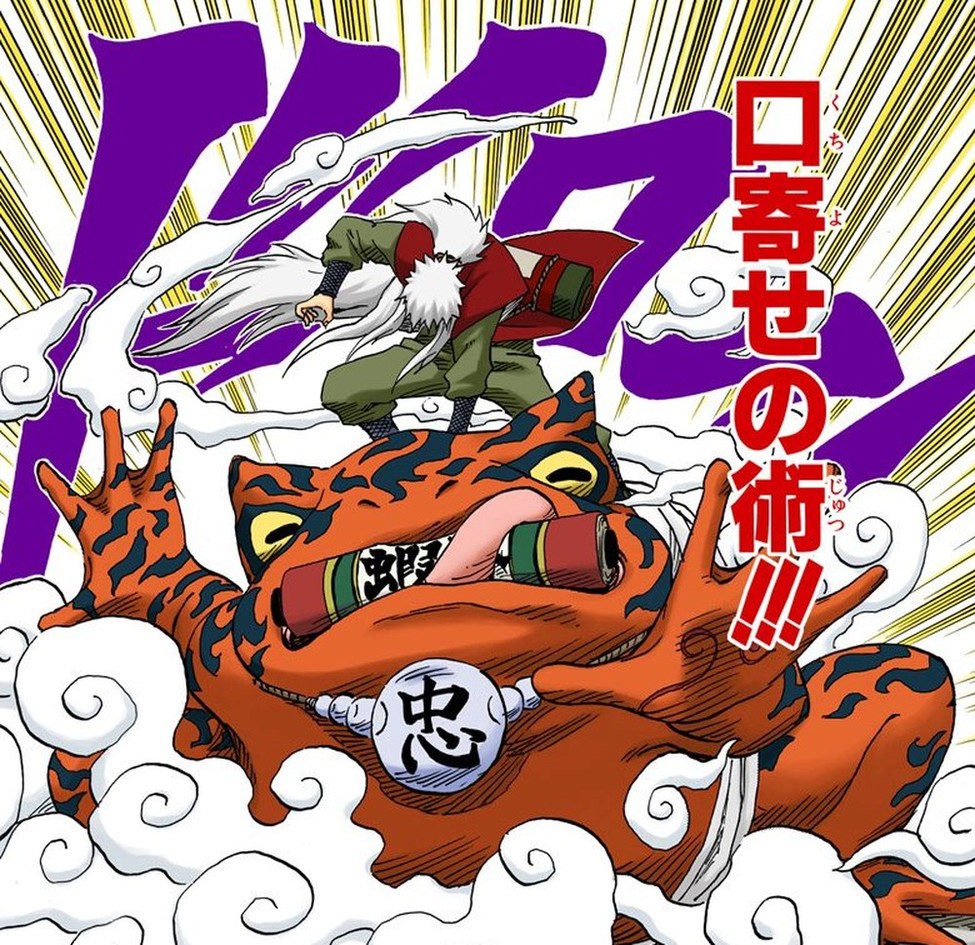
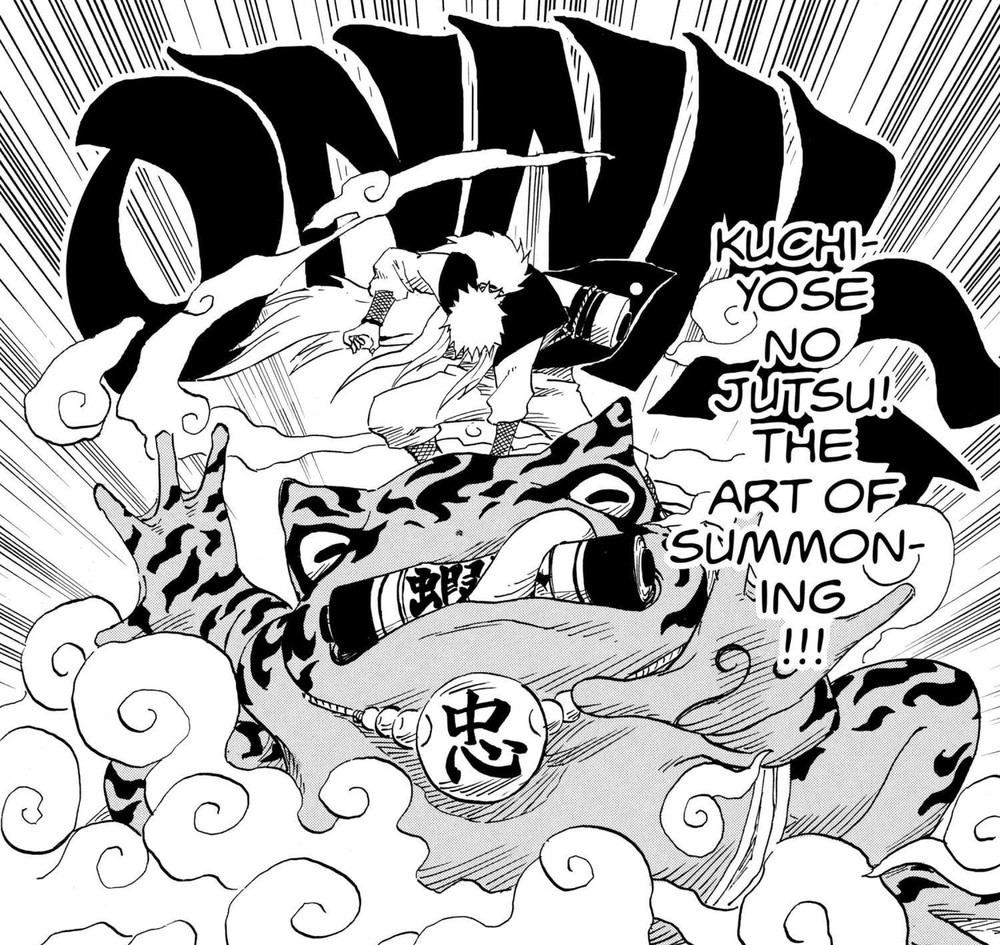
VIZ's translation strategy for the base technique visibly wobbles before it stabilizes. The corpus's earliest hits (Vols. 4, 6, 8) each try something different and never repeat it: "SHINOBI CONJURATION!", "ART OF THE FAMILIAR SPIRIT!", "...A SPELL OF SUMMONING!!" — three unrelated one-off glosses for the same two kanji, suggesting no fixed house rendering existed yet this early in serialization. That changes decisively at Vol. 11 p.43, the double-page splash where Jiraiya rides Gamabunta and teaches Naruto (and the reader) the technique's name for the first time: "KUCHIYOSE NO JUTSU! THE ART OF SUMMONING!!!" — romanized term plus translation, stapled together — and that exact bilingual formula holds through Vol. 26's Sannin summon showdown. By the War arc (Vol. 55 onward) it's often compressed to a bare "KUCHIYOSE SUMMONING!!" or "ART OF SUMMONING!", the full ceremonial phrasing dropped for pacing.
The animal contracts themselves aren't random either — each one tracks its user's characterization. Jiraiya and Naruto's toads (Gamabunta line) code as boisterous, blunt-spoken warriors; Tsunade's slug summon Katsuyu is a healer built for splitting into thousands of medical-support bodies; Orochimaru's snakes carry obvious treachery-and-transformation connotations lifted straight from the white-snake and shape-shifting-serpent strand of Japanese folklore. Jiraiya's own name is itself a reference to Jiraiya Gōketsu Monogatari, a 19th-century kabuki/print legend about a bandit-hero who could transform into a giant toad — meaning the manga's toad-summoning sage is named after a real folk character famous for the exact same trick, centuries before Kishimoto wrote him.