The Moment
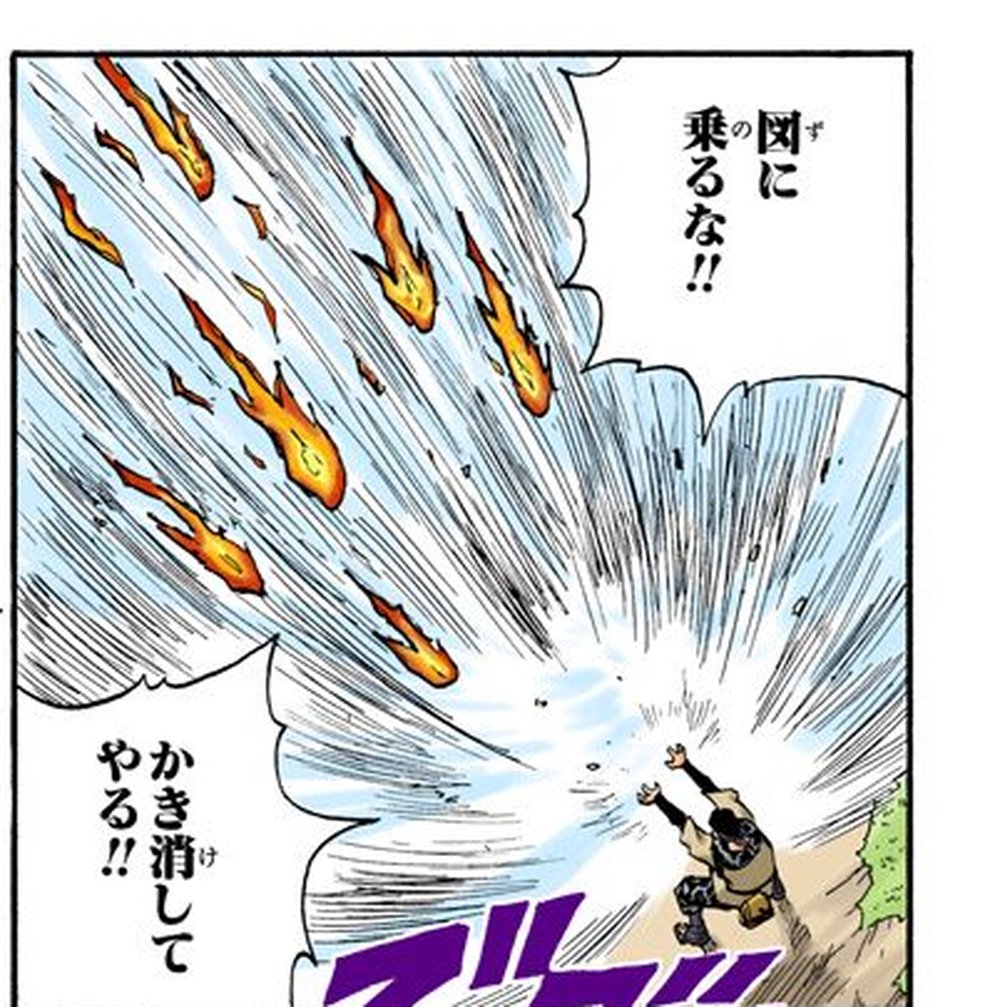
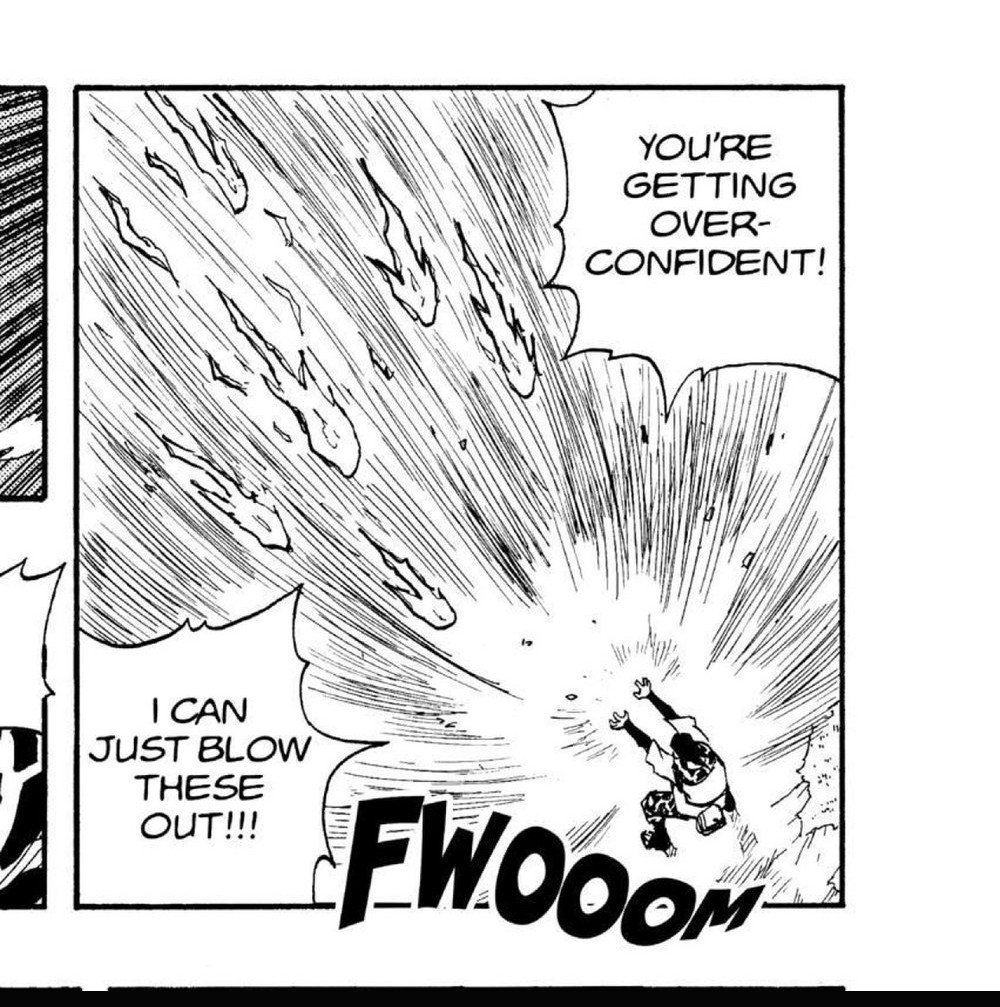
The Forest of Death, midway through the Chunin Exam prelims. Sasuke's cursed seal has crept partway across his skin, and he is trading techniques with Zaku Abumi, the Sound genin who fires compressed air out of tubes grafted into his arms. Sasuke opens with 火遁鳳仙火 — Fire Style: Phoenix Sage Fire — a spray of small fireballs raining down on Zaku from above. Zaku isn't worried: 「かき消してやる!!」 ("I CAN JUST BLOW THESE OUT!!!"), he shouts, already inhaling to blast the flames apart. That is exactly the moment Sasuke answers:
「図に乗るな!!」
Zu ni noru na!!
VIZ's English edition prints: "YOU'RE GETTING OVER-CONFIDENT!" (Vol. 7, p.35).
Grant the rendering its due first: it's clean, it's punchy, and it does the one job a battle-manga taunt has to do in a single breath — land before the hit does. A beat later Zaku's air blast tears through the fireballs and finds the shuriken Sasuke hid inside them; the confidence Sasuke was warning against turns out to be fatal. As a piece of scene-work, "over-confident" earns its keep.
But look at what the word underneath it is actually built from. 図に乗る doesn't mean "confident" in any of its component parts. It means, roughly, "to ride the zu" — and chasing down what 図 is riding on is the rest of this article.
The Original
Start with the easy half. 乗る (noru) is the ordinary verb "to get on, to ride" — the same 乗る in 波に乗る (nami ni noru, "to ride the wave," i.e. to catch a lucky trend at the right moment) and, more to the point, in this idiom's own modern understudy, 調子に乗る (chōshi ni noru, "to ride one's own rhythm/condition"), which today is heard about ten times more often than 図に乗る and means almost exactly the same thing.
Now the hard half. In ordinary compounds, 図 (zu) means "diagram, plan, chart" — 地図 (chizu, "map"), 意図 (ito, "intention"), and, in a piece already published on jpn.fan's One Piece hub, 図星 (zuboshi), the black dot painted dead-center on a traditional archery target. None of those senses explains why "riding a diagram" would mean "getting cocky." For that, standard Japanese dictionaries point somewhere more specific: 声明 (shōmyō), the chanted, melismatic Buddhist liturgy performed in temples since the Heian period. In that vocabulary, 図 named a melodic pattern — a fixed run of pitches a chanter had to land — and 乗る described successfully catching that pattern, chanting it smoothly, staying in the groove.
From "the chant is going well," the idiom drifted into a broader "things are proceeding as intended" (物事が意図した通りに運ぶ) — plan and performance are close cousins, after all — and from that, because things going well has a way of going to a person's head, into the sense every scene in this article actually uses: riding your own success until the ride itself makes you insufferable. A related word, 図太い (zubutoi, "brazen, thick-skinned, shameless"), leans on the same 図 for pure nerve. The whole small family runs on one image: 図 is the track you're on, and 乗る is what happens the moment the ride starts feeling like it belongs to you by right.
Grammatically, the imperative しろ-adjacent な here (図に乗るな) is the bluntest stop-sign Japanese owns — the plain negative command, zero honorifics, the register of a drill sergeant or a rival who's done being polite. 図に乗る itself is commonly filed around JLPT N2 on set-phrase (慣用句) vocabulary lists: common enough that native speakers reach for it constantly, opaque enough that a learner staring at "ride the diagram" gets no help at all from the words themselves.
VIZ's Choice
Every occurrence of 図に乗る in the volumes we have on file, side by side with VIZ's English:
| Vol. / p. | Speaker → Addressee | Japanese | VIZ English |
|---|---|---|---|
| 7 / 35 | Sasuke → Zaku | 図に乗るな!! | YOU'RE GETTING OVER-CONFIDENT! |
| 8 / 155 | Ino → Sakura | 図に乗んなよ泣き虫サクラが――!! | DON'T COP AN ATTITUDE WITH ME, YOU LITTLE CRYBABY. |
| 20 / 50 | Iruka → Naruto (flashback) | な〜に図に乗ってんだ! | DON'T GET TOO WORKED UP! |
| 20 / 72 | Sasuke → Naruto (flashback) | 何図に乗ってんだァ!! | WHO ARE YOU FOOLING?! |
| 20 / 74 | Sasuke → Naruto (flashback, cont'd) | そういうのが図に乗ってるって言うんだ! | I ALREADY ASKED YOU WHO YOU THINK YOU'RE FOOLING?! |
| 21 / 180 | Jirōbō → Chōji | 図に乗るなカスが...! | DON'T PUSH YOUR LUCK, SCUMBAG! |
| 25 / 31 | Sasuke → Naruto (same flashback, replayed) | そういうのが図に乗ってるって言うんだ! | I ALREADY ASKED YOU! WHO YOU THINK YOU'RE FOOLING?! |
| 30 / 32 | Sasori → Deidara | 図に乗るなよテイタラ | IF I WERE YOU, DEIDARA, I WOULDN'T PUSH MY LUCK. |
| 35 / 171 | Deidara → Tobi | いいかトビ図に乗んじゃねーぞ!うん! | LISTEN UP, TOBI. DON'T YOU DARE REST ON YOUR LAURELS, HMMM?! |
Nine appearances, nine different English phrasings, and — unlike a word such as 因縁 that splits along one obvious fault line — there isn't even a rough two-column pattern here. "Over-confident," "cop an attitude," "get too worked up," "who are you fooling," "push your luck" (twice, independently), "rest on your laurels": six distinct idioms doing the work of one.
Some of the scatter is genuinely earned by context. Iruka's line is a proud mentor gently talking down an ecstatic kid who just got his headband — "DON'T GET TOO WORKED UP!" is warm, almost fond, and "cocky" would sound far too harsh for the panel. Jirōbō's line to Chōji, by contrast, is a Sound Four killer sneering at prey — "DON'T PUSH YOUR LUCK, SCUMBAG!" earns every ounce of its venom. Both are excellent local choices. Neither shares a word with the other, and a reader would never guess that Kishimoto wrote the identical two kanji both times.
The most telling row is the repeat. そういうのが図に乗ってるって言うんだ!— Sasuke, needling Naruto about whether they're really equals — appears in Volume 20 as the scene happens, and Kishimoto redraws the same exchange, nearly panel for panel, as a memory in Volume 25. VIZ's two translations are close cousins ("I ALREADY ASKED YOU WHO YOU THINK YOU'RE FOOLING?!" and "I ALREADY ASKED YOU! WHO YOU THINK YOU'RE FOOLING?!") but not identical — a comma's worth of drift that, multiplied across the other seven completely unrelated renderings, shows just how little the English text lets this idiom behave like the same idiom twice.
The Gap
One idiom, nine unrelated solutions. A Japanese reader who has met 図に乗るな once clocks it instantly the next eight times, from a genin brawl to an Akatsuki hideout thirty volumes later. VIZ's renderings share essentially no vocabulary, so the recurring idiom — and the thread Kishimoto is quietly pulling through the entire series, from academy rivalries to S-rank criminals bickering the exact same way — is invisible to an English-only reader.
The riding image never survives the crossing. 図に乗る's whole metaphor is momentum: catch a rhythm, then get swept past the point of good judgment by your own ride. Not one of the nine English lines keeps any trace of riding, waves, or rhythm. The closest, "push your luck," swaps in a gambling metaphor instead — a different kind of overreach, but not the same one.
The callback nearly disappears. Kishimoto quotes his own line — Sasuke's そういうのが図に乗ってるって言うんだ!— verbatim five volumes apart, redrawing the panel as a memory. VIZ's two translations are close but not identical, so even the one moment the manga is deliberately repeating itself barely reads as repetition in English.
The register range gets smoothed toward "attitude." Between Iruka's fond ribbing and Jirōbō's death threat sits an enormous emotional distance that the single Japanese idiom crosses without changing its own two kanji. English's nine solutions are all locally right, but stacked together they suggest nine different concepts rather than one idiom doing very different jobs in very different mouths.
What If
No option here is free; here is the menu and its prices.
- "DON'T GET COCKY!!" — the plainest one-to-one match for the whole idiom family; a reader would recognize it instantly if VIZ used it every time 図に乗る appears. Cost: "cocky" is exactly as dead a metaphor in English as "over-confident" — nothing new is gained except consistency.
- "DON'T GET CARRIED AWAY!!" — "carried away" at least keeps a motion-metaphor, something swept along by its own momentum, close in spirit to 乗る's "riding." Cost: softer than the flat, no-politeness imperative Sasuke's な actually demands here.
- "THAT RIDE'S OVER!!" — tries to keep 乗る's literal verb, "to ride," alive in English, cashing it in as the fireball-and-shuriken combo ends Zaku's confidence. Cost: reads as wordplay a battle taunt doesn't have time for, and risks sounding like it's about a vehicle.
- Keep "OVER-CONFIDENT," but reuse it every time. Instead of a fresh idiom for each of the nine scenes, anchor all of them to one repeated English phrase. Cost: local color is lost — Ino's "crybaby" jab, Sasori's dry warning to Deidara — but the payoff is a reader who can feel Kishimoto reusing his own line, the exact thing nine free translations currently erase.
Take-away
図に乗る asks a translator to choose between nine perfect local jokes and one recognizable recurring idiom — and every VIZ rendering in this corpus picks the joke. That's not a wrong call scene by scene. It does mean the pattern itself, the fact that Sasuke, Ino, Iruka, Sasori, and Deidara are all reaching for the identical two kanji across thirty volumes, is a piece of the book only the Japanese-reading half of the audience gets to notice.
Three rules of thumb to carry off this page:
- 図に乗る is about momentum, not just pride. The idiom's shape — riding a rhythm until the ride runs away with you — is closer to "getting swept up in your own success" than to a static trait like "arrogant." Watch for that motion whenever the idiom appears.
- Track the register, not just the meaning. The same two kanji cover an affectionate mentor's tease and a killer's contempt. If a translation of 図に乗る sounds uniformly harsh across every scene, something has been flattened.
- Repeated dialogue is a signal, not an accident. When a manga redraws a line verbatim — as Kishimoto does with Sasuke's そういうのが図に乗ってるって言うんだ!— that's the author asking you to remember. A translation that renders it two slightly different ways quietly cancels the request.
For 図's other, gentler idiom on jpn.fan — the same character sitting at the heart of 図星 (zuboshi), the dead-center dot on an archery target that Sanji reads on Mr. 2 Bon Kurei in One Piece — see that piece on jpn.fan's One Piece hub. Closer to home, for the flip side of this exact warning — carelessness as the enemy, in the chapter-title idiom VIZ swapped for a line out of the Book of Proverbs — read 油断大敵 and the proverb VIZ swapped in. For more of where Kishimoto's words and VIZ's don't quite rhyme, browse the Naruto translation notes index.
Every Japanese and English line quoted above is a byte-exact capture from the cited editions — NARUTO―ナルト― Vol. 7–35 (Japanese) and Naruto (VIZ Media) at the corresponding panels — via our bilingual page database; see Sources below.