The Moment
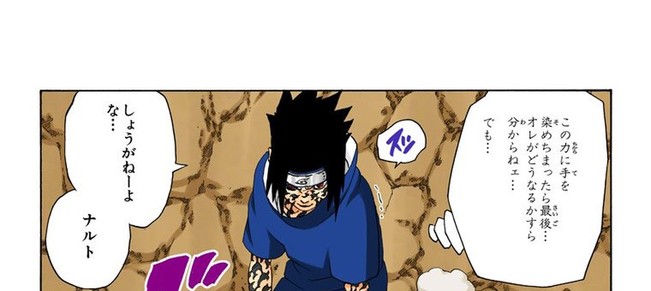
The Valley of the End. Naruto has chased Sasuke this far to drag him back to Konoha; Sasuke has just accepted the power Orochimaru offered him, and in front of Naruto's eyes his cursed seal spreads into its second form — hair bleaching, skin darkening with a creeping pattern, the transformation happening in real time across the panel. Before the fight resumes, Sasuke says, half to Naruto and half to himself:
「この力に手を染めちまったら最後…オレがどうなるかすら分からねェ…でも…」
Kono chikara ni te o somechimattara saigo… ore ga dō naru ka sura wakaranē… demo…
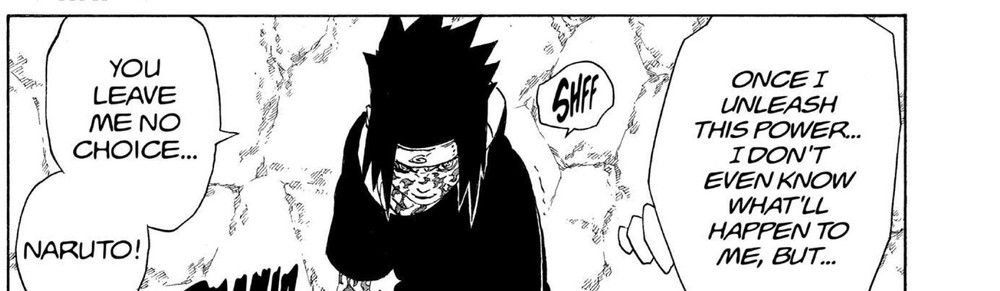
VIZ's English edition prints: "ONCE I UNLEASH THIS POWER... I DON'T EVEN KNOW WHAT'LL HAPPEN TO ME, BUT..." (Vol. 26, p.103), followed a beat later by Naruto's own reply drifting in from the neighboring bubble — "YOU LEAVE ME NO CHOICE... NARUTO!" — before the next panels carry Sasuke's transformation to completion and close the exchange with "TURNS OUT YOU WERE PRETTY SPECIAL. BUT IN THE END..."
Grant the rendering its due first: "ONCE I UNLEASH THIS POWER" is tense, propulsive, exactly the register a shonen climax needs, and the ellipsis-heavy delivery keeps Sasuke's hesitation intact. Nothing about the scene's stakes is lost. But look at the verb VIZ reaches for. "Unleash" describes something moving out of Sasuke — a force released into the world. The Japanese verb, 染める (someru, "to dye"), describes something happening to Sasuke — his own hands taking on a color that, once set, doesn't lift. The manga is already showing this on the page: as Sasuke speaks, his skin is visibly darkening under the curse seal's spreading pattern. The line isn't describing a weapon going off. It's describing a dye taking.
The Original
手 (te) — "hand." No decomposition needed; beginner-level vocabulary on the same shelf as 目 and 口.
染める (someru) — the transitive verb "to dye, to stain [something] with color." Its traditional kanji breakdown is 氵 (water) + 木 (tree) + 九 (nine, here carrying the phonetic value for the on-reading セン) — a character built to picture cloth dipped, again and again, in a water-based dye drawn from tree bark, leaves, or roots, until the color finally sets. That is the same 染 sitting inside 染料 (senryou, "dye, pigment"), 染色 (senshoku, "dyeing" as craft and industry), and 染物 (somemono, "dyed goods" — the word for the kimono-dyer's trade, indigo vats and all).
Put 手 and 染める together and 手を染める reads almost like a stage direction: hands dipped into dye, and marked by it. The idiom borrows the dyer's whole professional logic — this isn't an accidental splash, it's the mark of sustained, skilled contact with a substance that doesn't let go — and applies it to taking up something disreputable: 悪事に手を染める ("to get involved in wrongdoing"), 犯罪に手を染める ("to turn to crime"), 麻薬に手を染める ("to get into drugs"). Every one of those collocations carries dyeing's built-in premise: once the hands take the color, they keep it.
Sasuke's sentence stacks a second construction directly on top of the idiom: 〜たら最後 (~tara saigo, "once X happens, that's the end / there's no turning back"), a fixed N1 grammar pattern that names the point of no return explicitly, in words, the instant the verb lands. この力に手を染めちまったら最後 is doing two jobs in one clause — dyeing the hands, and declaring, in grammar rather than just tone, that the dyeing is final.
As vocabulary, 染める itself sits around N3/N4 — an early, common verb. 手を染める as a fixed idiom, and 〜たら最後 as a grammar pattern, both track at N1: the tier where phrases stop being decoded piece by piece and start being recognized whole, on sight, the way a fluent reader recognizes "cross the Rubicon" without parsing the river.
VIZ's Choice
Only one occurrence of 手を染める turns up across the Naruto volumes on file — this one, at the exact hinge of the story where Sasuke commits to Orochimaru's power over his bond with Naruto. So there's no scatter table to build here, no five renderings to line up side by side. What there is, instead, is a single translation decision worth sitting with, because it's a decision made under real pressure: a manga speech bubble has almost no room, the panel needs momentum, and "ONCE I UNLEASH THIS POWER..." delivers all of that cleanly.
But notice what the choice trades away. "Unleash" is a verb of release — you unleash a dog, a storm, a flood, something that was contained and is now loose in the world. Every use of "unleash" points the reader's attention outward, toward what the power will now do. 手を染める points the opposite way: it's about what happens to the hands doing the dyeing, not what the dye goes on to touch. The scene itself argues for the Japanese reading — Sasuke's own body is what's transforming on the page, panel by panel, skin darkening, hair bleaching. The power isn't the subject of the sentence's real drama. Sasuke is. VIZ's verb, accurate as it is to the line's energy, quietly swaps the subject of the metaphor.
The Gap
The direction reverses. "Unleash" describes force moving outward, away from Sasuke, into the fight ahead. 手を染める describes Sasuke's own hands taking on a permanent mark. The English metaphor exports the danger to the world; the Japanese metaphor internalizes it onto the self — the power isn't what changes here, Sasuke is.
Dye is not dirt, and English keeps confusing the two. The nearest English idioms — "get one's hands dirty," "blood on one's hands" — invoke filth and guilt, categories with a built-in escape hatch: dirt and blood can, at least in principle, be washed off. Pontius Pilate had a basin for exactly this; Lady Macbeth's whole tragedy is that the spot won't come "out, out." 染める is a dyer's verb for a chemical change that doesn't reverse — the entire point of dyeing cloth is that the color stays. English readers get a metaphor with an exit built in; the Japanese metaphor was built specifically to deny one.
A whole grammar pattern goes unmarked. 〜たら最後 is a named construction for the point of no return, and Sasuke's line uses it explicitly — the finality isn't implied by tone, it's spelled out by grammar. VIZ's ellipsis-laden "ONCE I UNLEASH THIS POWER... I DON'T EVEN KNOW..." reads as uncertain, almost tentative. 手を染めちまったら最後 reads like a verdict Sasuke has already handed down on himself, before the fight even resumes.
What If
- "Once I dye my hands with this power, that's the end of who I was..." — keeps both the dye image and the たら最後 finality explicit. Cost: "dye" is an unusual verb to pin on hands and power in English, and risks reading as puzzling before it reads as ominous.
- "The moment I stain my hands with this power, there's no going back..." — trades "dye" for "stain," closer to English's own "stained hands" idiom family while keeping the color image, and spells out the point-of-no-return the grammar marks. Cost: "stain" drifts toward an accidental blemish, softening 染める's sense of deliberate, skilled immersion.
- "Once this power's in my hands, the color doesn't come out again..." — leans fully into the dye metaphor as a self-contained image, trusting readers to feel the idiom's logic without being told its name. Cost: risks landing as a riddle rather than the tense, decisive line Sasuke actually delivers mid-transformation.
- Keep VIZ's "unleash," but repoint the target: "ONCE THIS POWER'S INTO MY HANDS FOR GOOD..." — Cost: still drops the dye image outright, but at least corrects the direction problem, aiming the change back at Sasuke instead of out at the world.
Take-away
手を染める doesn't just report that someone has gotten involved in something bad — it pictures a specific, professional kind of marking: hands dipped in dye, colored the way a dyer's hands are colored after years at the vat, in a way that plain water won't undo. Sasuke's line stacks that idiom on top of a named grammar pattern for the point of no return, so that the sentence is, structurally, making the same argument twice: this doesn't come out.
Three rules of thumb to carry off this page:
- When you meet 染める attached to something abstract, ask what's being permanently marked, not what's being released. The verb's whole logic runs inward — a hand, a life, a reputation taking on a color — never outward, toward some force being set loose.
- Keep 染める's family straight from English's "dirty hands" family. Dirt and blood wash off, at least in the idiom's own logic; dye doesn't. When a translation reaches for "dirty" where Japanese said "dye," ask whether the escape hatch it implies was ever really there.
- Watch for 〜たら最後 riding along with idioms like this one. The grammar pattern and the vocabulary are doing the same job from two different angles — one lexical, one structural — and a translation that catches only one of them still leaves half the sentence's finality on the table.
手を染める belongs to the same body-idiom family this hub has already mapped from other angles — the burned hand of 手を焼く, where Chiyo and Kabuto both admit Orochimaru's orbit is more than anyone can hold onto, and the overloaded hand of 手に負えない, where Jiraiya's hands fail under sheer weight rather than heat or color. Where those two idioms describe hands failing at a task already underway, 手を染める describes the moment a pair of hands first takes on the job — the entry point the other two idioms' hands are already stuck inside. For more of what Naruto's translators quietly set down, browse the full Naruto translation notes index.
Every Japanese and English line quoted above is a byte-exact capture from the cited editions — NARUTO―ナルト― Vol. 26 (Japanese) and Naruto Vol. 26 (VIZ Media) at the corresponding panels — via our bilingual page database; see Sources below.