The Moment
Volume 23, deep in the Sasuke Retrieval arc. Kiba Inuzuka, tracking Sasuke alongside his ninja dog Akamaru, has run into two of Orochimaru's Sound Four: the conjoined twins Sakon and Ukon. Moments earlier, Sakon took a hit meant for his brother and snarled at him for it:
「畜生...右近!オレを盾にしやがったなコラ!」
Chikushō… Ukon! Ore o tate ni shiyagatta na kora!
"YOU... UKON! YOU USED ME AS A SHIELD?!" Ukon peels off to finish the fight alone, and by page 103 he's done something Kiba has never seen a ninja do: broken his own body apart and moved inside his opponent.
「今のお前とオレはちょっとした融合状態にある...」
Ima no omae to ore wa chotto shita yūgō jōtai ni aru…
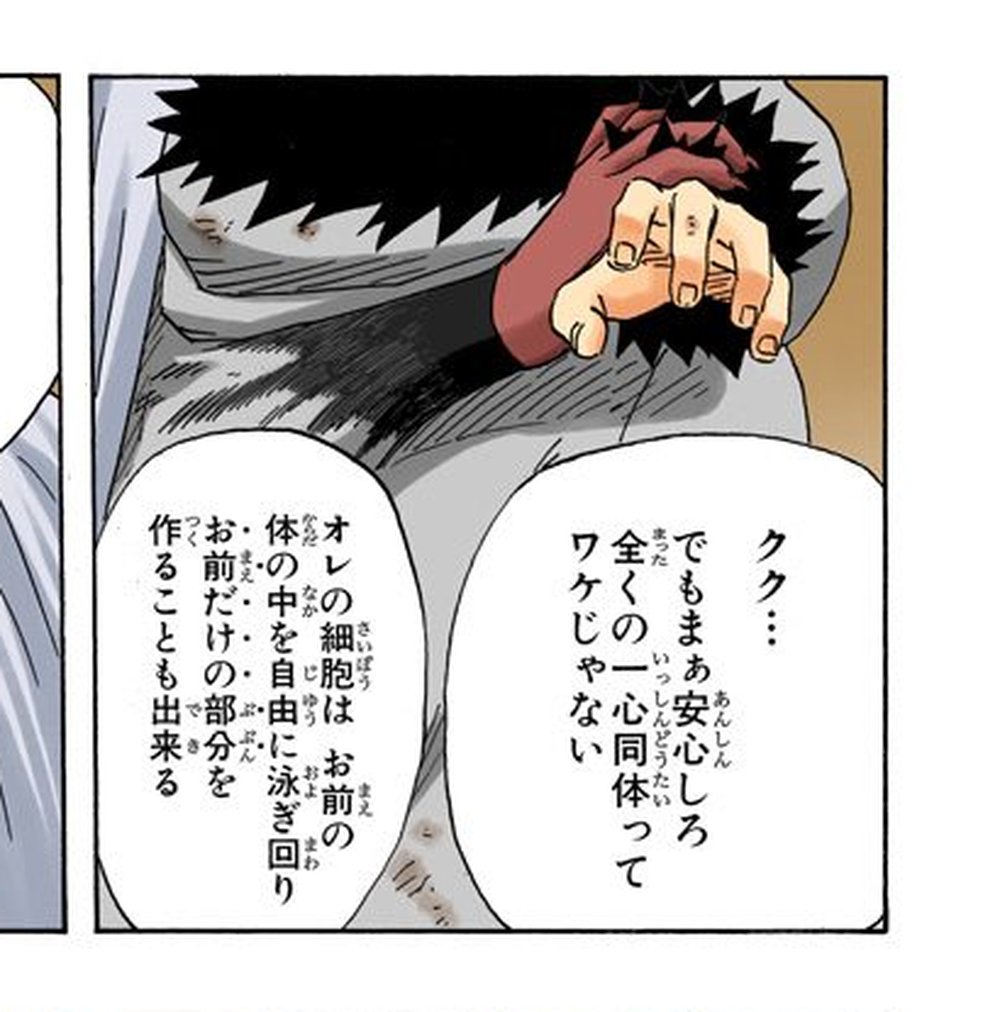
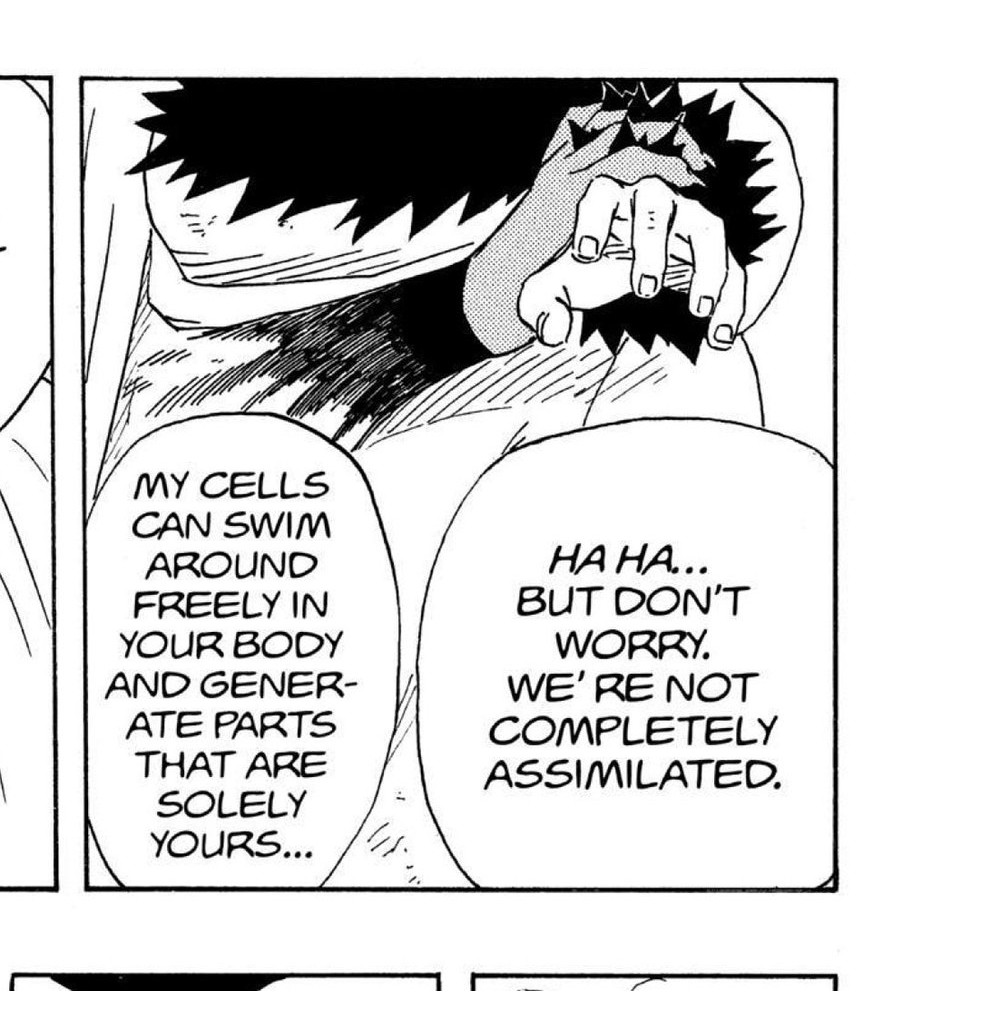
"NOW, YOU AND I ARE IN A MERGED STATE..." Kiba can only choke out the word he's just been told: 「きょうゆう共有!?」 — "SHARING ?!" Ukon spends the next panels explaining, almost lovingly, exactly what that means — he can scrape away the cells that are purely Kiba's, cell by cell, while his own cells swim freely through Kiba's body generating parts that answer to no one but him. Then, with a low chuckle and a raised fist, he offers something that sounds like reassurance:
「クク...でもまぁ安心しろ全くの一心同体ってワケじゃない」
Kuku… demo maa anshin shiro. Mattaku no isshin-dōtai tte wake janai.
VIZ's English edition prints: "HA HA... BUT DON'T WORRY. WE'RE NOT COMPLETELY ASSIMILATED." (Vol. 23, p.103.)
Grant the rendering its due first: "assimilated" is a genuinely good instinct for a body-horror beat like this one. It's a clinical, faintly sci-fi word for hostile absorption — there's an echo of every "you will be assimilated" a genre-savvy English reader has ever heard — and it lands with the right chill. The trouble is what the word can't specify. Ukon isn't describing a vague, partial merger. He's making an exact claim about two different things at once, and English collapses both into one blurry verb.
The Original
一心同体 (isshin-dōtai) is a four-kanji word built from two legitimate two-kanji words standing shoulder to shoulder — the same construction as the sister article's 一部始終, where 一部 and 始終 each carry independent meaning before the compound locks them together.
一心 (isshin) = 一 "one" + 心 "heart, mind, spirit" — the same 心 that sits inside 心配 ("worry," literally "heart-distribution") and 決心 ("resolve," literally "heart-decision"). 一心 alone is ordinary Japanese for "wholeheartedly, with one's whole mind": 一心に祈る is "to pray with one's entire heart," nothing split, nothing held back.
同体 (dōtai) = 同 "same, identical" + 体 "body" — the same 体 in 体重 ("body weight") and 正体 ("one's true form/identity"). 同体 alone means "the same body; one and the same entity," the noun hiding inside 表裏一体 ("obverse and reverse [are] one body," i.e. two sides of one coin, inseparable).
Put them together and 一心同体 doesn't just mean "united" — it specifies unity on two named axes at once: the heart/mind (一心) and the body (同体). That's why the idiom is the go-to phrase for a married couple, an inseparable team, or any bond so total it erases the seam between two people. As vocabulary, every individual kanji here (一, 心, 同, 体) is taught by JLPT N5 — small children learn all four within their first year of kanji study. The difficulty is entirely structural: knowing that this specific four-character combination is a fixed idiom, and knowing what its two halves are each independently promising, is closer to N1.
Grammatically, Ukon's line is compact and colloquial: 全くの一心同体ってワケじゃない takes the adjectival 全くの ("a complete, total [X]"), modifies the noun-phrase 一心同体, and denies it with 〜ってワケじゃない — casual spoken Japanese for "it's not [exactly] the case that…," softer and more conversational than a flat negative. He isn't shouting a denial. He's musing one, almost fondly, the way you'd correct a small misunderstanding.
VIZ's Choice
一心同体 appears exactly once across the volumes on file — no scatter to chart, no table of competing solutions, just one sentence and one translator's single decision to weigh on its own terms.
And the decision has real merits. "Assimilated" keeps the register cold and clinical, which suits a villain lecturing his prey on cellular biology. It correctly reads as a negation of total union — Ukon is indeed telling Kiba that some line hasn't been crossed. And it has just enough genre resonance (hostile absorption, a body no longer fully one's own) to land as menacing rather than clumsy.
What it can't do is specify which line hasn't been crossed. 一心同体 makes a two-part claim, and Ukon is granting one half while denying the other: 同体 (the body) — true, confirmed, literally happening in the panel; 一心 (the heart) — false, and he's the one making sure Kiba knows it. "Not completely assimilated" reads as a matter of degree, as if a little more infiltration might tip them over into full union. The Japanese isn't talking about degree at all. It's talking about which of two specific things is real and which isn't — and that distinction is the whole mechanism of the murder he's about to commit.
The Gap
One blurry verb where the Japanese names two separate things. 一心同体 denies unity on two distinct, labeled axes — heart and body — and "assimilated" answers with a single word that never distinguishes flesh from will. A reader who doesn't already know the idiom has no way to reconstruct that Ukon just made a precise two-part claim rather than a vague one.
The half-truth's cruelty goes flat. Ukon isn't hedging — he's being surgically exact: our bodies, yes, genuinely one now; our hearts, no, never were. That gap isn't incidental color; it's the technical basis for the "cruel way of killing" he described one line earlier — he can tell his cells from Kiba's precisely because they were never truly of one mind, only forcibly of one flesh. "Not completely assimilated" sounds like a modest concession. It's actually a confession of exactly how the murder works.
The idiom's cultural warmth never crosses over. A Japanese reader hears 一心同体 and thinks, however briefly, of wedding vows and inseparable partners — then watches a villain invoke that warmth only to coldly withhold half of it. English has no equivalent everyday idiom for two-bodies-one-heart devotion, so there's no warmth on the English side to withhold in the first place. "Assimilated" just sounds like biology. The irony of a parasite quoting the language of marriage is quietly deleted.
What If
The menu, and what each option costs:
- "WE'RE NOT COMPLETELY OF ONE HEART AND ONE BODY." — keeps both halves of the idiom explicit and named. Cost: long and formal for a single speech bubble, heavier than Ukon's breezy くく….
- "OUR BODIES ARE SHARED. OUR HEARTS AREN'T." — splits the sentence into the exact 2+2 parallel Ukon is actually drawing. Cost: adds a beat the one-clause Japanese doesn't take; edges from translation toward gloss.
- "DON'T WORRY — WE HAVEN'T BECOME ONE. NOT IN SPIRIT." — keeps the false reassurance and gestures at the heart/body split via "in spirit." Cost: "become one" is still vaguer than 一心同体's two named parts.
- Keep "assimilated," add the missing axis: "WE'RE NOT COMPLETELY ASSIMILATED — NOT WHERE IT COUNTS." — cheapest fix, preserves VIZ's word choice and its genre chill. Cost: still doesn't name heart vs. body outright; asks the reader to supply the distinction Ukon spells out for free.
Every option that keeps the line short loses the two-axis precision; every option that keeps the precision needs more room than a single manga bubble comfortably gives. That trade-off is 一心同体 in miniature: the idiom is short in Japanese only because Japanese already has a one-word slot for "united in heart and body both." English doesn't, so any accurate translation has to spend the word count Japanese never needed to.
Take-away
一心同体 looks like a simple intensifier for "united" and is actually a compound claim: one heart (一心) and one body (同体), two conditions that are supposed to travel together. When a villain grants one half and denies the other, the whole point is the mismatch — and "assimilated" can't show a mismatch it never names.
Three rules of thumb to carry off this page:
- Four-kanji words are often two two-kanji words wearing a trench coat. Before translating a yojijukugo as a single mood or intensity, check whether it's secretly making two separate claims, like 一心同体's heart-plus-body or 一部始終's part-plus-whole.
- 一心 and 同体 are worth knowing apart. 一心 alone means wholehearted focus (一心に, 一心不乱); 同体 alone means shared identity or form (表裏一体). Watch for either one showing up solo elsewhere in a text — you'll already own half the meaning.
- When a villain denies unity, ask which half. Japanese fiction loves subverting warm idioms like 一心同体 for exactly this reason: the phrase has two conditions, and a story can satisfy one while pointedly withholding the other.
For another four-kanji idiom built from two independent halves — and the rare case where the whole thing survives translation intact — see the doubled honesty of 正々堂々, or browse the full Naruto translation notes index.
Every Japanese and English line quoted above is a byte-exact capture from the cited editions — NARUTO―ナルト― Vol. 23 (Japanese, colored digital edition) and Naruto Vol. 23 (VIZ Media) at the corresponding panels — via our bilingual page database; see Sources below.