The Moment
The Great Naruto Bridge, deep in the Land of Waves arc. The mist thickens, and out of it walks a dead man: Zabuza Momochi, the Demon of the Hidden Mist, whose "death" at the end of the first encounter fooled no one who was paying attention. Team 7's first meeting with him ended with the genin shaking under his killing intent, and Zabuza remembers exactly which buttons that lets him press. Before a single blade moves, he aims a taunt at the boy whose kunai hand the previous panel draws with a nervous プルプル wobble:
「相変わらずそんなガキを連れて…また震えてるじゃないか…かわいそうに…」
Aikawarazu sonna gaki o tsurete… mata furueteru ja nai ka… kawaisō ni…
"AND I SEE YOU'VE GOT THOSE BRATS TAGGING ALONG, JUST LIKE LAST TIME. AND THE LITTLE BOY IS TREMBLING AGAIN, POOR THING...." (VIZ, Vol. 3, p.101)
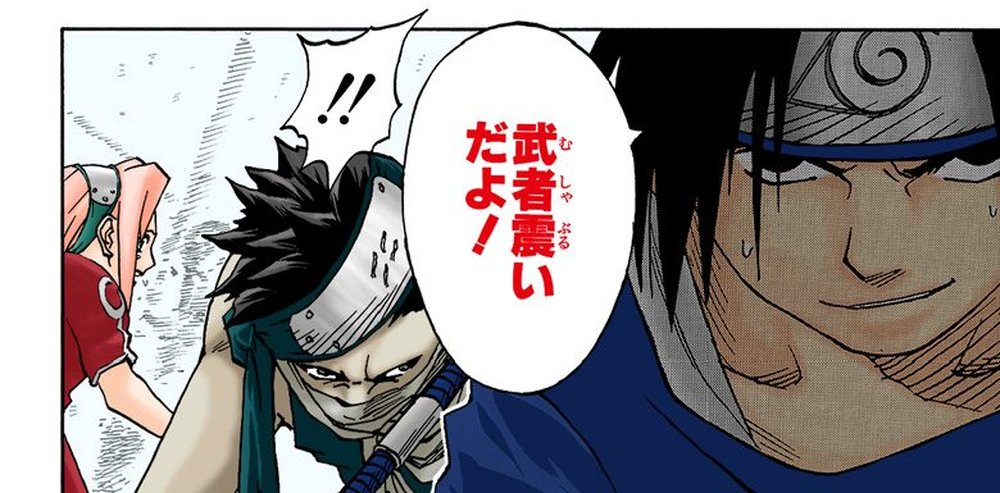
Water clones bloom out of the mist and ring the bridge. And Sasuke — hand still unsteady, sweat on his face, smirk arriving anyway — answers the taunt with seven morae:
「武者震いだよ!」
Musha-burui da yo!
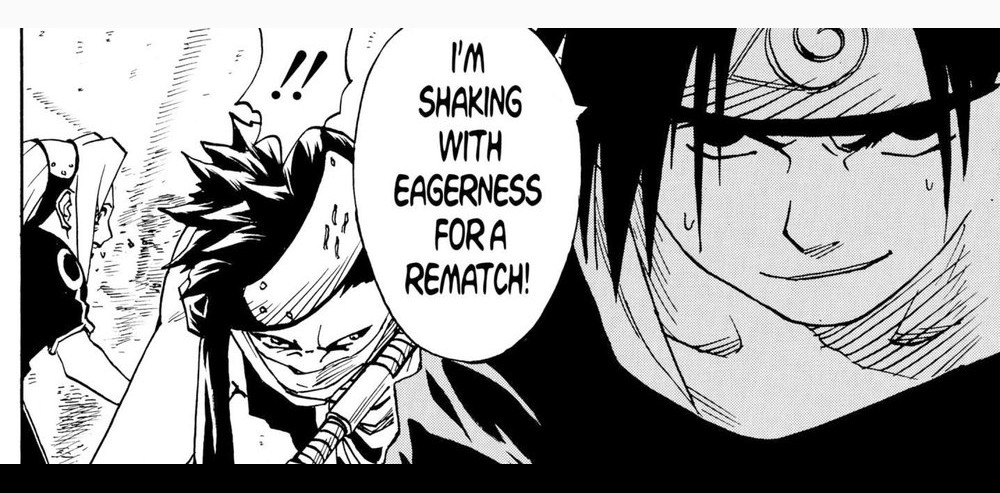
VIZ's English edition prints: "I'M SHAKING WITH EAGERNESS FOR A REMATCH!" (Vol. 3, p.102). Kakashi's reply comes in two clipped bubbles — やれ/サスケ, "GO AHEAD... ...SASUKE." — and the kid is loosed into the clones.
Give the translation its due before we take it apart: every piece of the meaning is present. Shaking — yes. Positive excitement rather than fear — yes. A reason for the excitement — supplied, free of charge. The reader misunderstands nothing. What the reader never feels is that Sasuke answered a taunt with a word — because in English he answers it with an explanation.
The Original
武者震い (musha-burui) is built from two pieces, and both do work.
武者 (musha) is 武 "military, martial" + 者 "person": the warrior, and specifically the armored warrior of samurai imagery. It is the 武者 of 武者絵 (warrior woodblock prints), 落ち武者 (a routed warrior fleeing the battlefield), and 武者修行 (the warrior's training pilgrimage — the old practice of wandering the country to test your art against strangers). The word smells of lacquered armor. It does not mean "soldier" and it does not mean "fighter" in the gym sense; it means the figure on the folding screen.
震い (burui) is the noun form of 震える (furueru), "to tremble" — voiced from furui to -burui by rendaku, the compound-internal sound change that also turns すし into 巻きずし. The same kanji 震 anchors 地震 (jishin, earthquake) at one end of the scale and goosebumps at the other.
Japanese already had a plain word for the shudder: 身震い (miburui), "body-trembling" — what cold, disgust, or awe does to you. 武者震い is that word with one morpheme swapped, and the swap smuggles in an entire folk physiology: when a warrior's body shakes before battle, that isn't fear — that's the body arming itself. The claim long outlived the samurai because the experience did. Modern Japanese reaches for 武者震い before finals, debuts, title matches, and job interviews; athletes tell the press 武者震いがします and it reads as confidence, never as nerves. The word's connotation is always squared shoulders.
So when Sasuke says 武者震いだよ, the grammar is N5 — noun, casual copula, final particle — but the move is sophisticated: he concedes the physical fact (yes, shaking) while reclassifying it under the proudest label the language offers. He doesn't say I'm not scared. He says this trembling is the warrior kind — and by picking the word, files himself under 武者, a twelve-year-old declaring the Demon of the Hidden Mist the sort of opponent a warrior is glad to meet. The vocabulary does the characterization. (JLPT-wise, 武者震い sits on no official list — call it N1-territory assembled from N3 parts.)
VIZ's Choice
This is the only appearance of 武者震い in our Naruto corpus — one word, one shot at it. Here is the full three-beat exchange as printed in both editions:
| Vol. 3 | Japanese | VIZ English |
|---|---|---|
| p.101, Zabuza | 相変わらずそんなガキを連れて…また震えてるじゃないか…かわいそうに… | AND I SEE YOU'VE GOT THOSE BRATS TAGGING ALONG, JUST LIKE LAST TIME. AND THE LITTLE BOY IS TREMBLING AGAIN, POOR THING.... |
| p.102, Sasuke | 武者震いだよ! | I'M SHAKING WITH EAGERNESS FOR A REMATCH! |
| p.102, Kakashi | やれ/サスケ | GO AHEAD... ...SASUKE. |
VIZ's strategy on the middle line is translation by definition: unpack the idiom into its meaning and print the meaning. Open a J-E dictionary to 武者震い and you will find something very close to "trembling with excitement (before battle)." That is what's in the bubble — plus "FOR A REMATCH," an interpolated motive that ties the shiver to this specific grudge.
It is worth saying that the translator's options were thin. English has no noun for the proud pre-battle shake. "Battle fever" is close but florid; "adrenaline" is accurate but clinical; "the shakes" belongs to withdrawal, not glory. Faced with a lexical hole, explaining is a defensible fill. But notice what the strategy costs in a dialogue — because this line isn't narration, it's a counterpunch.
The Gap
The retort becomes a report. The Japanese line is seven morae thrown back in Zabuza's face — the verbal equivalent of the smirk it shares a panel with. The English is an eight-word account of the speaker's inner state. Cocky characters don't narrate their feelings; the moment Sasuke says "WITH EAGERNESS," he's doing the emotional bookkeeping a Japanese reader watches him refuse to do.
The warrior vanishes. 武者 is the load-bearing kanji: it promotes Sasuke from Zabuza's ガキ ("brat") to combatant in a single morpheme, and it borrows four centuries of samurai iconography to do it. "EAGERNESS" is appetite with no armor on. The one-word identity claim — I am the kind of person whose body does this — simply has no English carrier.
The echo snaps. Zabuza: また震えてるじゃないか. Sasuke: 武者震いだよ. The riposte repeats the taunt's own root — retort by repetition, dialogue's oldest judo. VIZ renders Zabuza's verb as "TREMBLING" and Sasuke's as "SHAKING," so the English exchange never rhymes; the reader hears two statements instead of a volley and return.
"For a rematch" welds a free idiom to one plot beat. Nothing in 武者震いだよ mentions a rematch; the word is general-purpose — the same noun serves a rookie before a piano recital. The addition isn't false in context, but it converts a portable body-idiom into a bespoke plot line, and the learner who meets 武者震い here leaves thinking it means something about revenge.
What If
The menu, with prices:
- "It's a warrior's shiver!" — compact, noun-shaped, and the warrior survives. Cost: English has no such idiom, so the reader parses a coinage mid-fight; some will blink.
- "I'm trembling because I can't wait." — repeats Zabuza's exact verb, so the counterpunch lands as one. Cost: still a sentence-long self-report, and the samurai is gone.
- "This isn't fear — my body's just ready." — states the idiom's whole argument, fear reclassified as readiness. Cost: spells out what the smirk already says, at twice the length.
- "Just adrenaline!" — the nearest one-word seat English owns, and it fits the bubble beautifully. Cost: clinical where 武者震い is heroic; folk poetry becomes biochemistry.
Every option pays somewhere, because the Japanese word is doing three jobs at once — conceding the shake, reversing its meaning, and claiming a lineage — and English asks for a separate clause per job.
Take-away
Three rules of thumb to carry off this bridge:
- When an official translation sounds like a dictionary entry — an emotion, a cause, and a preposition all spelled out — suspect a single idiom underneath, and back-translate the beat, not the words.
- Collect the 震 family as a set: 地震 (earthquake), 震える (to tremble), 身震い (the shudder), 武者震い (the warrior's shiver). One kanji runs from tectonic plates to goosebumps — and only one member of the family is proud of itself.
- When a character renames a body-state instead of denying it, the vocabulary is the characterization. Sasuke never says "I'm not scared"; the noun says it for him. Watch for words doing the work of speeches.
Naruto's Japanese keeps score on the body — the stomach that growls its own opinions in 腹の虫, the liver you engrave orders onto in 肝に銘じる — and English keeps having to relocate the anatomy into plain emotion-talk. For a body idiom One Piece's translators had to paraphrase the same way, see our One Piece piece on 手も足も出ない — or browse the Naruto translation notes index.
Every Japanese and English line quoted above is a byte-exact capture from the cited editions — NARUTO―ナルト― Vol. 3 (Japanese) and Naruto Vol. 3 (VIZ Media) at the corresponding panels — via our bilingual page database; see Sources below.