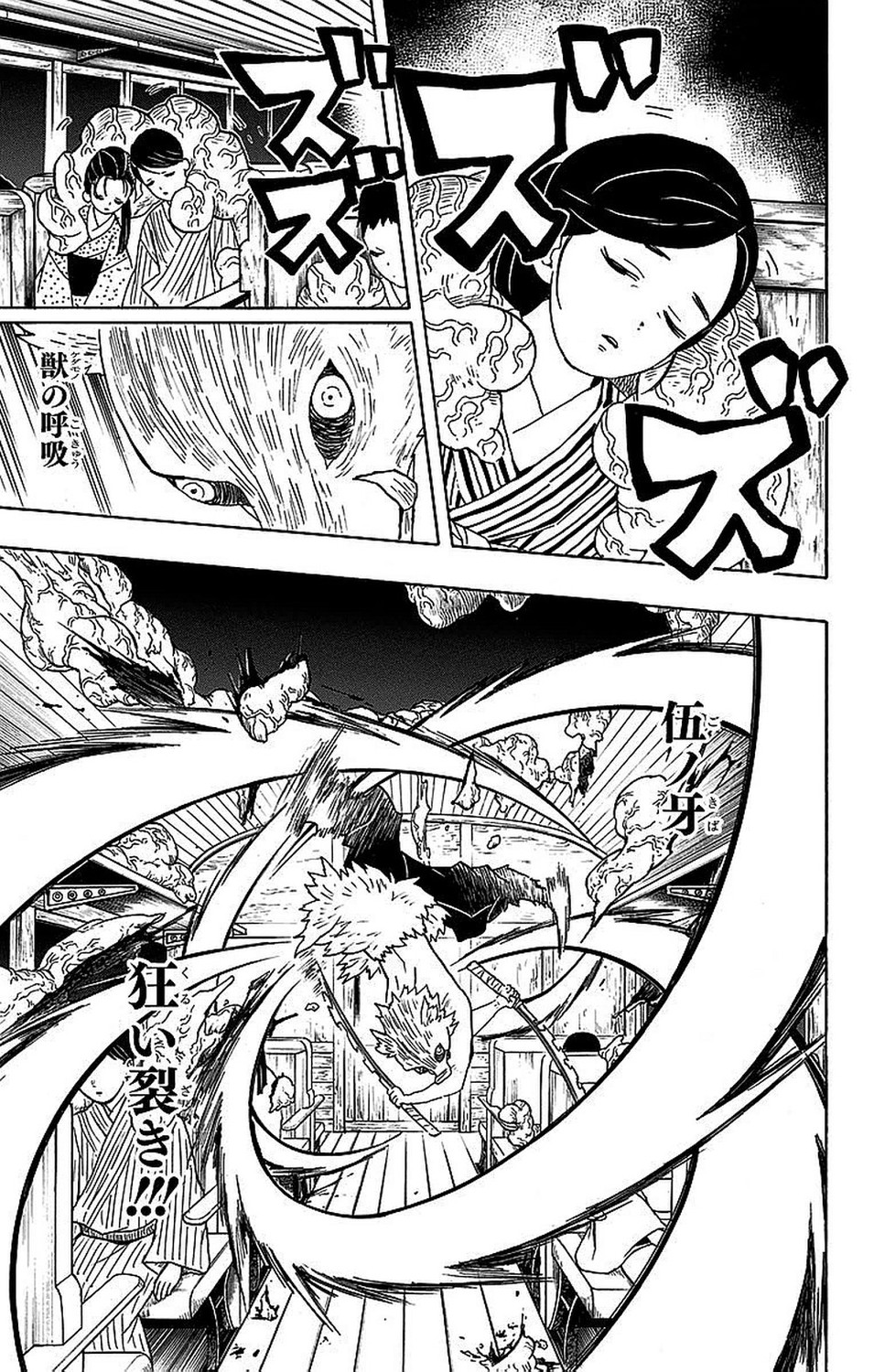
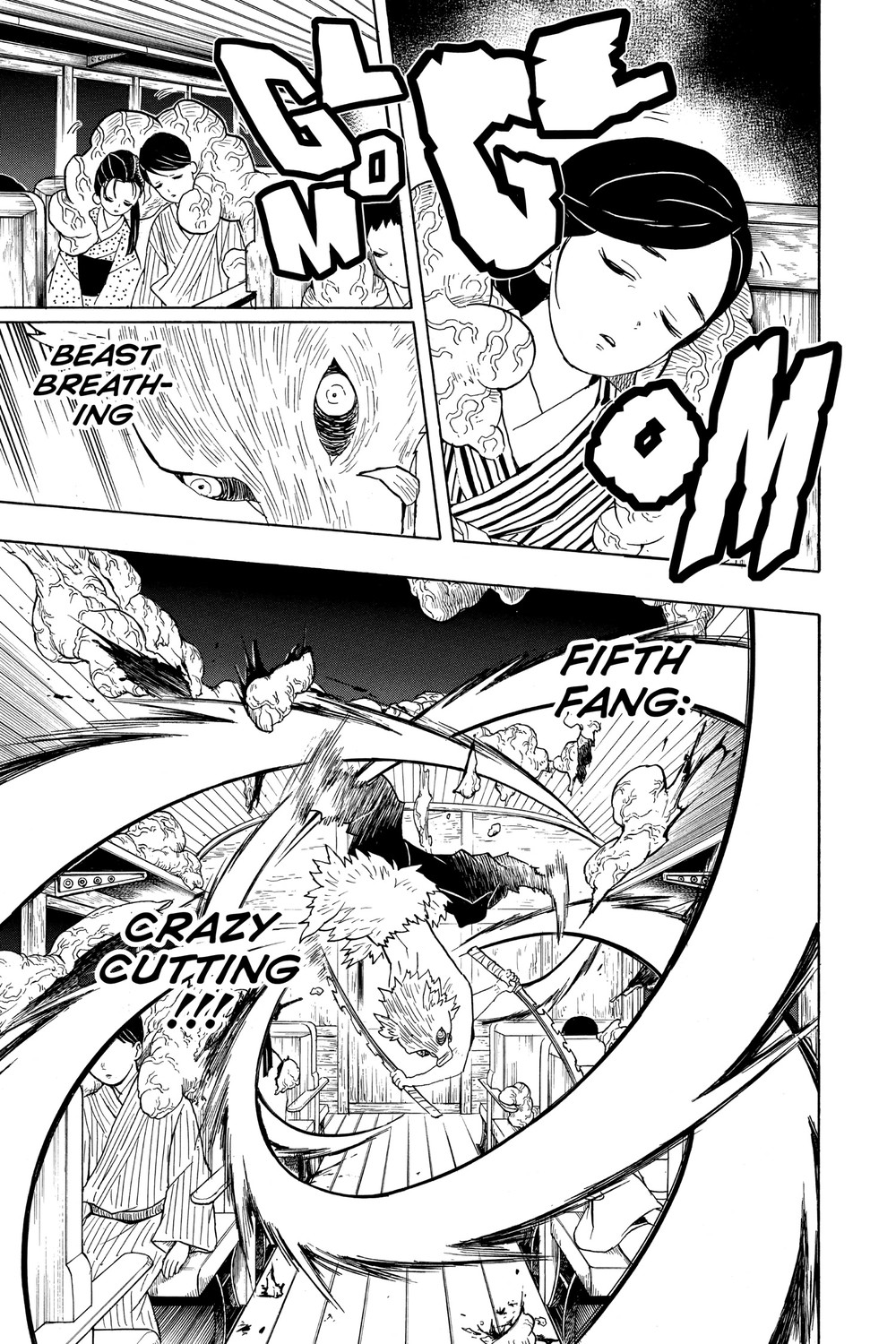
狂う (kuruu) is a heavier word than English "crazy" makes it sound — it's the verb for someone genuinely losing their mind, used for mental breakdown, for a broken machine spinning out of control, for a plan going catastrophically wrong. Attaching it to a sword technique frames Fifth Fang as a loss of control rather than a display of skill: Inosuke isn't aiming this attack so much as unleashing it and letting the blade go wherever a full-body spin sends it. VIZ's "CRAZY CUTTING" keeps that sense reasonably well — "crazy" carries some of the same connotation of abandon in English — though it trades 狂い's clinical, almost medical weight for a more casual, playground-insult register.
What makes this entry unusual among Beast Breathing's Fangs is that the manga stops to explain itself. One page after the attack lands, a narration box spells out exactly what the move is for: "狂い裂き〟とは四方八方に斬りつける技、敵に囲まれた時などに最適である" — "Crazy Cutting is a move that involves swinging in all directions; it is most effective when surrounded by the enemy." No other Fang in this style gets an on-page tactical footnote like this one. Its placement matters: this is the technique used specifically against the sleeping-carriage demons that have possessed dozens of ordinary passengers simultaneously, a fight that is explicitly about volume of enemies rather than any single dangerous opponent. The manga is telling its reader, in plain prose, that Fifth Fang exists because Second and Third Fang — precise, single-target strikes — don't scale to a mob.
The reveal panel itself carries a small OCR footnote worth flagging for anyone cross-referencing this hub's underlying corpus: the bubble reading 「伍ノ牙」("Fifth Fang") sits directly beside the reveal panel in the printed page but was never captured as its own line by this corpus's automated text-extraction pass — only the adjacent 「獣の呼吸」and the fragment of 「狂い裂き」were recorded as machine-readable pairs. It's confirmed by direct inspection of the page image, not by the underlying database row, which is exactly the gap this hub's page-image verification step exists to catch.