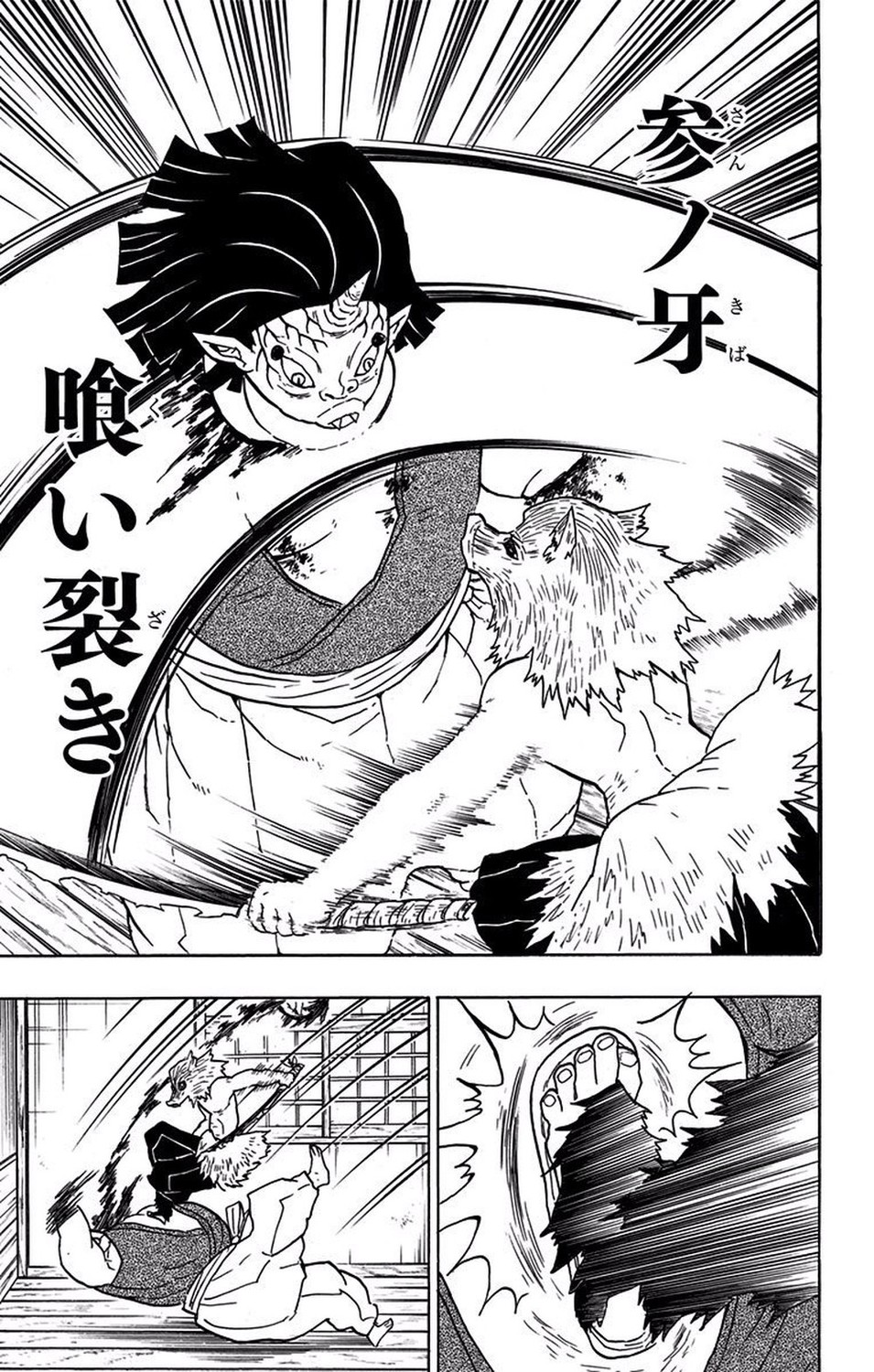
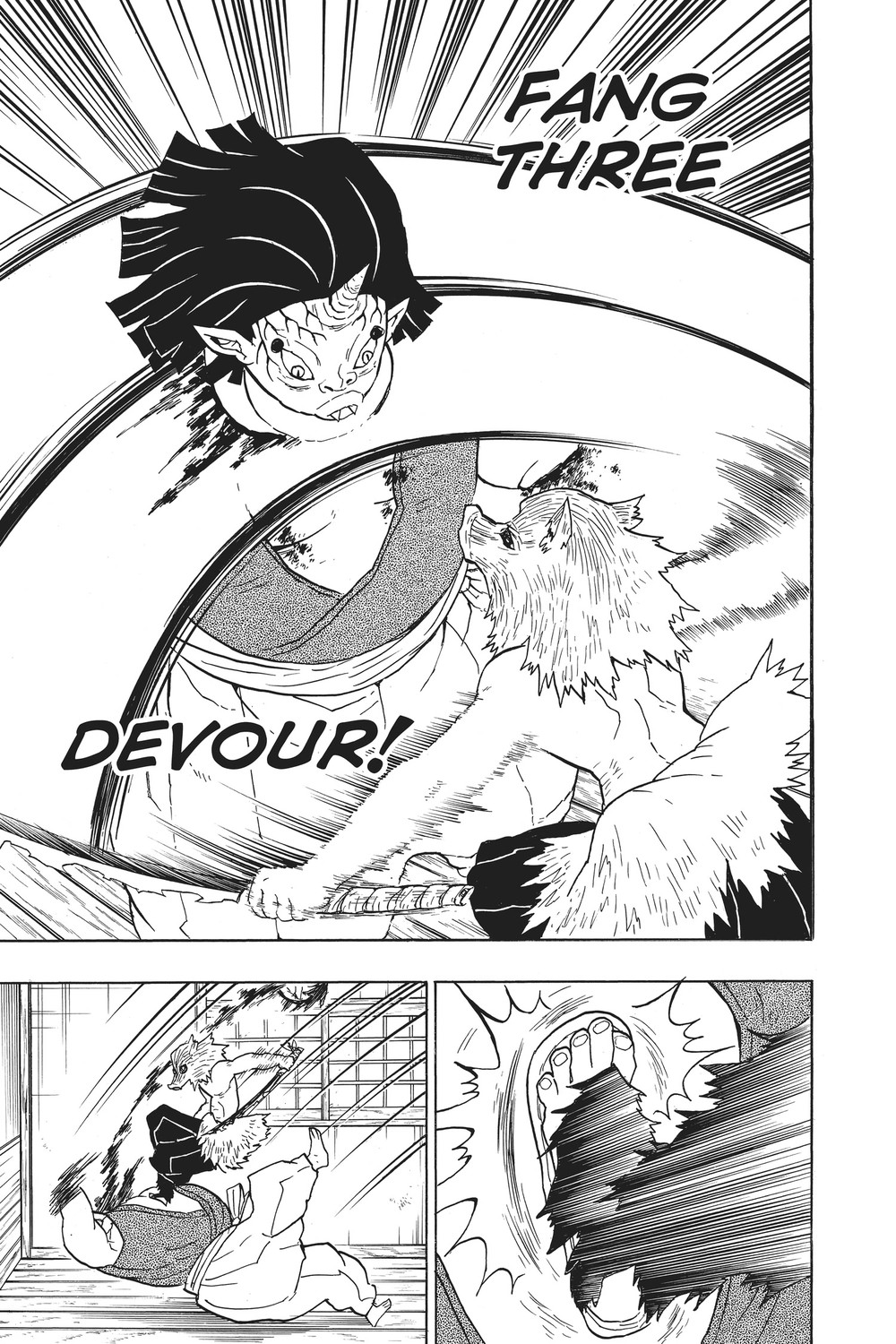
Japanese has two common verbs for eating, and the gap between them is the whole joke of this technique's name. 食べる (taberu) is what a person uses for a meal — neutral, polite, the word in every restaurant and every textbook. 喰う (kuu) is what's left for everything else: an animal gorging on carrion, a monster consuming its prey, or a person deliberately talking like one. Inosuke's mask is a boar's skull; he was raised in the mountains believing he himself was a boar until humans corrected him; and when his third technique needs a verb for "to eat," the manga reaches straight past the polite option for the one that puts him on the same side of the sentence as the demons he's fighting. "Devour" isn't a metaphor about ferocity here — it's Inosuke narrating an attack the same way he'd narrate finishing off prey.
VIZ's rendering splits Kuizaki (喰い裂き, literally "devour-tear") across two separate shout panels rather than one compound English word: "FANG THREE" on its own beat, then "DEVOUR!" landing alone on the strike itself. That staging matters more than it looks — English could easily compress the whole thing into one bark ("DEVOURING SLASH!" or similar), but VIZ instead gives "DEVOUR" its own panel, its own breath, its own moment to land, which is closer to how a predator's kill-bite actually reads on the page: not a flashy special move, just a single word for a single, final motion. The Japanese drops the "tear" (裂き) half almost silently by comparison — its own turn just confirms what "devour" already implied.
This Fang gets used against two very different opponents across the corpus — Susamaru, a named Twelve Kizuki subordinate with her own drum-based technique arsenal, and later an unnamed rank-and-file demon Inosuke dispatches without ceremony — and VIZ's translation doesn't flinch or vary either time. "Devour" reads the same whether the target is a boss fight or a nobody, which is itself a small, consistent statement about how Inosuke sees every demon: not as an individual threat to be respected differently case by case, but as the same category of prey, every time.