Count the exclamation points. Across the twelve lines on this page, nearly every one of Rengoku's sentences ends in ! or !! — not because he's constantly enraged, but because volume is his resting state. 「うまい!」, "DELICIOUS!", shouted eight times in a row over a train-station bento in his very first scene, uses the exact same terminal punctuation and the exact same register as 「俺は俺の責務を全うする!!ここにいる者は誰も死なせない!!」, "I WILL FULFILL MY DUTY! I WON'T LET ANYONE HERE DIE!", shouted mid-battle against an Upper Rank demon. Most characters shift gears between a lunch scene and a life-or-death vow; Rengoku's Japanese doesn't. That flatness of register across wildly different stakes — 明朗な断定調, bright declarative certainty — is the single most important fact about how he talks, and it's the reason his dying words land the way they do: he tells Tanjiro to keep his heart burning in the identical tone he used to praise a rice ball.
That tone survives contact with grammar built for much heavier content. 「俺は如何なる理由があろうとも鬼にならない」, "no matter what reason there might be, I will not become a demon," uses 如何なる〜があろうとも — a formal, almost legalistic concessive construction, the kind of grammar that shows up in oaths, not action-manga taunts — to reject Akaza's offer of immortality. He doesn't sound rattled or grim delivering it; the sentence has the same forward-leaning certainty as his bento review. Likewise 「老いることも死ぬことも人間という儚い生き物の美しさだ」, "growing old and dying are what make the fleeting creature called a human being beautiful" — a full philosophical claim about mortality, aimed at an enemy who has renounced aging entirely, delivered as flatly assertive as a fact about breakfast. VIZ's "IS WHAT GIVES MEANING AND BEAUTY TO THE FLEETING SPAN OF A HUMAN LIFE" is accurate and dignified, but English's more elaborate phrasing can't help sounding a half-step more solemn than Gotouge's short, declarative Japanese — the gravity is doing more work in the English sentence structure than in the original, where the gravity comes entirely from what is being said, not how.
His formality is the same instinct wearing different clothes. He introduces himself to a demon mid-fight with his full title and name — 「俺は炎柱煉獄杏寿郎だ」, "I am the Flame Hashira, Kyojuro Rengoku" — and elsewhere refers to himself in the third person by surname, 「この煉獄の赫き炎刀が」, "this Rengoku's bright red flame blade," a vow-register habit that could read as cold self-importance in a quieter character. In Rengoku it reads as ceremony: he is naming himself the way a herald announces a duel, not distancing himself from the people he's protecting. The same warmth shows up structurally in 「俺は君の妹を信じる鬼殺隊の一員として認める」, "I believe in your little sister; I acknowledge her as a member of the Corps" — a Hashira's formal ruling, stated to Tanjiro as a gift, in the same breath as an admission he'd normally have every institutional reason to withhold. His vow after killing the demon controlling the Mugen Train, 「罪なき人に牙を剥こうものならばこの煉獄の赫き炎刀がお前を骨まで焼き尽くす」, runs through the full mechanics of that idiom and its 〜ものならば conditional at 牙を剥く: the idiom English translates perfectly by accident.
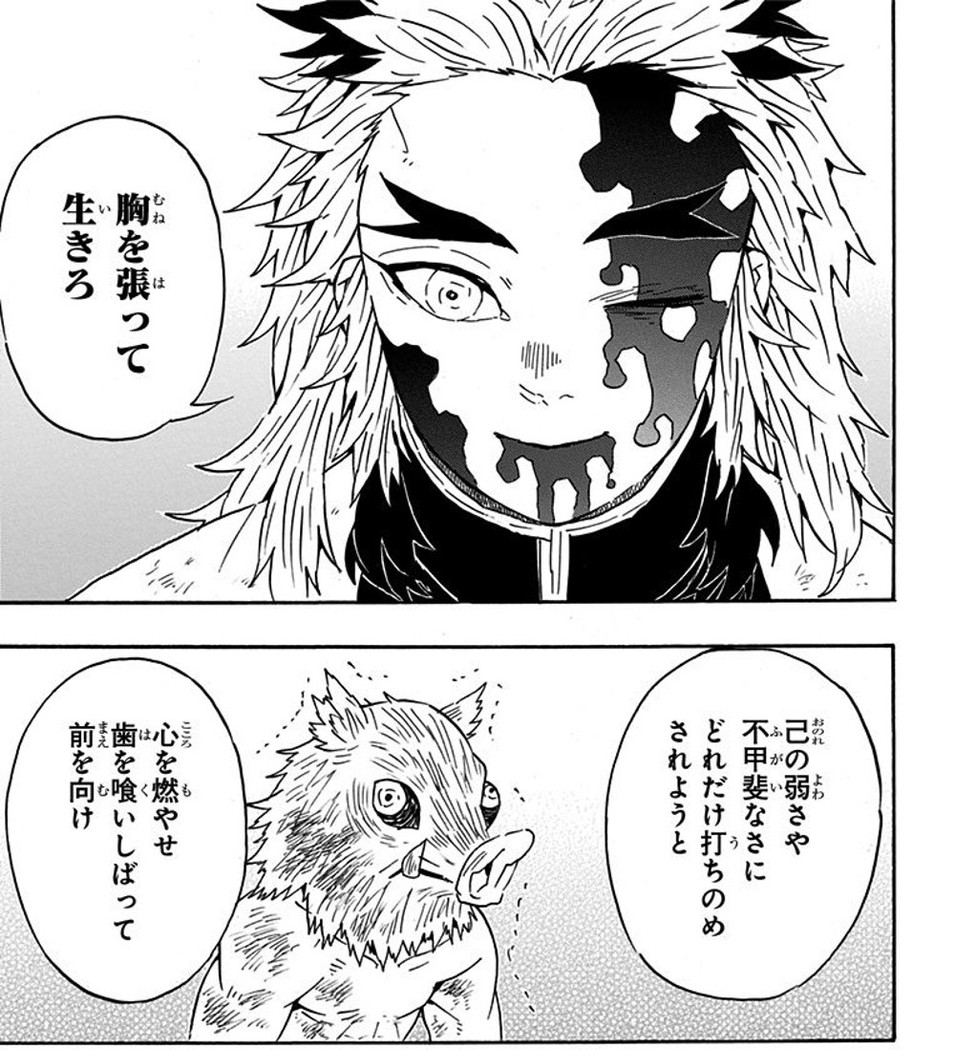
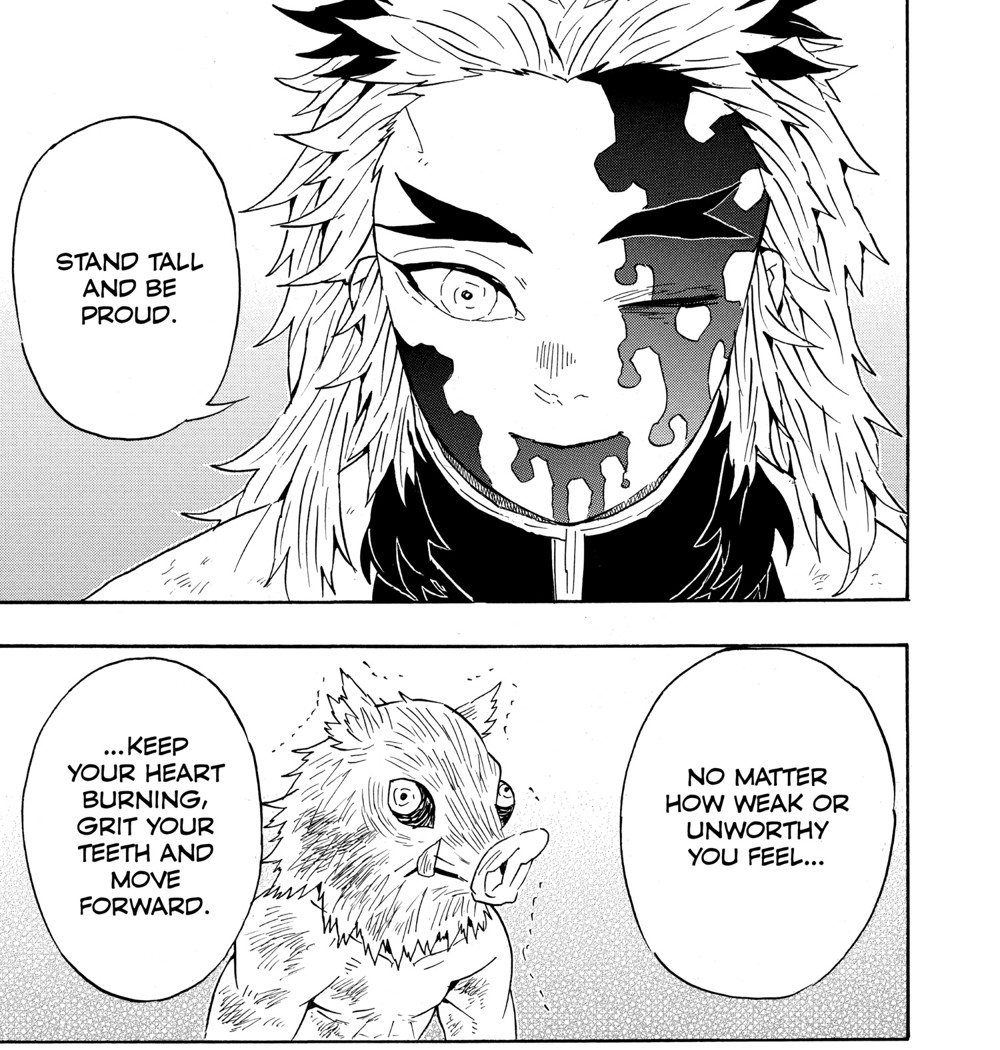
The dying speech on Vol. 8, p.93 is where all three habits converge, and it's worth reading as one continuous unit rather than two separate quotable lines. 「胸を張って生きろ」, "stand tall and be proud," opens it — VIZ's rare doubled rendering (posture verb plus abstraction) of an idiom that usually collapses to a bare "be proud" elsewhere in the corpus, examined in full at 胸を張る: the posture VIZ only translates once. Then comes the line: 「心を燃やせ歯を喰いしばって前を向け」, "KEEP YOUR HEART BURNING, GRIT YOUR TEETH AND MOVE FORWARD." 燃やす means "to burn, to set ablaze" — the same verb family behind 心の炎 ("the flame in my heart"), a phrase he uses earlier, alive, to his younger brother Senjuro. VIZ's "keep your heart burning" is close to literal, and it's the correct call: English "burning" carries the same double sense Japanese 燃える does, a fire that consumes and a fire that drives. The imagery isn't softened in translation here the way idioms elsewhere on this hub get flattened — it's one of the cleaner transfers in the corpus, in no small part because Rengoku's whole persona (Flame Hashira, flame breathing, a heart that's described as literally on fire since page one) has already trained an English reader to take "burning" literally by the time this line arrives. Tanjiro carries the line forward almost immediately, screaming 「煉獄さんの悪口言うな!!!」, "don't insult Rengoku's memory," at a fellow Hashira a few pages later — see Tanjiro's own quotes page — and Zenitsu and Inosuke, who hear the same dying charge to "keep growing" (もっともっと成長しろ), have their own voices collected at Zenitsu's quotes and Inosuke's quotes.
Read across all twelve lines, Rengoku never once lowers his volume or softens his certainty to match the size of the moment — he simply applies the same bright, formal, exclamation-heavy register to a bento box, a battlefield vow, and his own death, and trusts the content of the sentence to carry whatever weight the scene needs. That refusal to modulate is not a limitation of his Japanese; it is the entire character.