The Moment
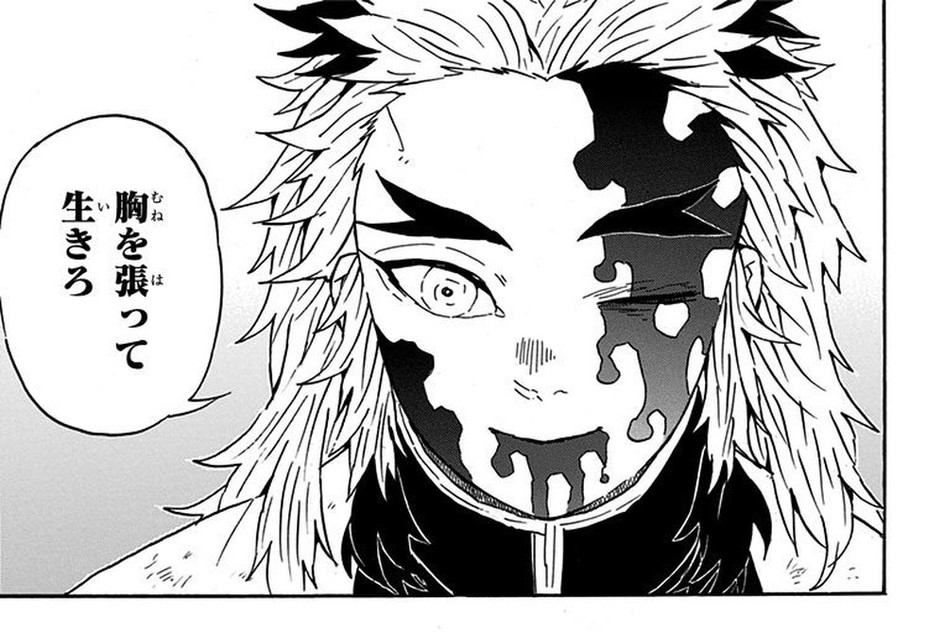
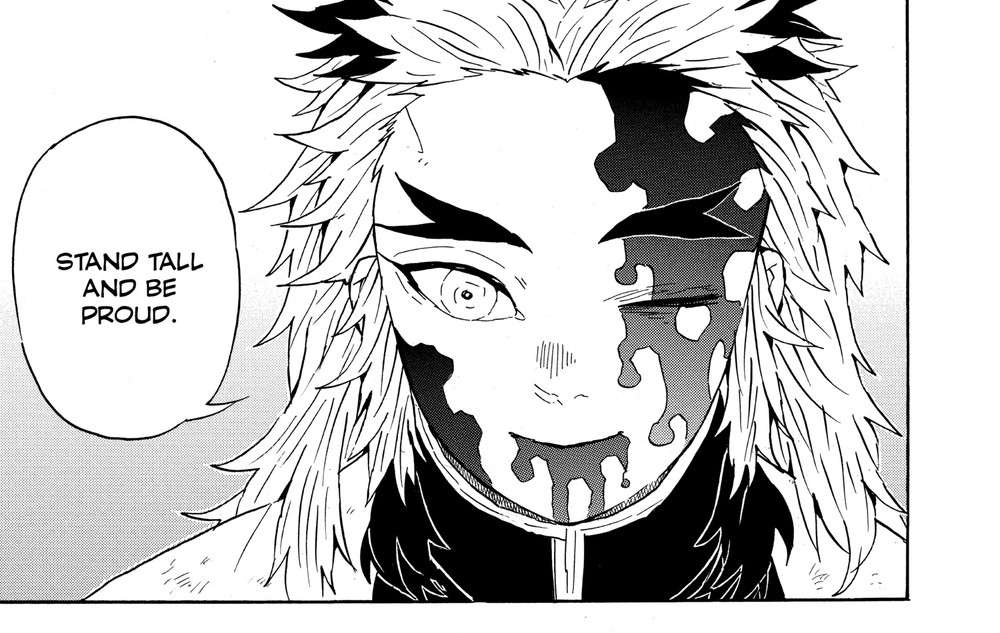
The Mugen Train arc ends the way it has to end, and does not end kindly. The Flame Hashira Kyojuro Rengoku has just gone blow for blow with the Upper Rank Three demon Akaza through an entire night, and won the fight in the only sense that matters — Akaza flees rather than finish him — but the wound is fatal anyway. Tanjiro kneels over him as the sun comes up. Rengoku's face is already half marked by the injury that is killing him, and what he spends his last coherent words on is not fear, or regret, but a direct charge to the boy in front of him:
「胸を張って生きろ 己の弱さや不甲斐なさにどれだけ打ちのめされようと 心を燃やせ 歯を喰いしばって前を向け 君が足を止めて躊っても時間の流れは止まってくれない 共に寄り添って悲しんではくれない」
Mune o hatte ikiro. Onore no yowasa ya fugainasa ni dore dake uchinomesareyou to, kokoro o moyase, ha o kuishibatte mae o muke. Kimi ga ashi o tomete tamerattemo jikan no nagare wa tomatte kurenai. Tomo ni yorisotte kanashinde wa kurenai.
VIZ's English edition prints: "STAND TALL AND BE PROUD." followed by "NO MATTER HOW WEAK OR UNWORTHY YOU FEEL... ...KEEP YOUR HEART BURNING, GRIT YOUR TEETH AND MOVE FORWARD. IT WON'T STOP FOR YOU WHILE YOU WALLOW IN GRIEF. IF YOU JUST CURL UP IN A BALL AND HIDE, TIME WILL PASS YOU BY." (Vol. 8, p.93).
Grant the rendering its due first, because it deserves it: "STAND TALL AND BE PROUD" is genuinely good work. It is short, quotable, and rhythmically strong enough to have become one of the most repeated lines to come out of this franchise in English — printed on merchandise, clipped into video edits, quoted back by readers who have never opened the Japanese text. But sit the two lines side by side. The Japanese carries one idiom, 胸を張る — literally "stretch the chest taut." The English carries two clauses stitched together with "and." VIZ didn't just translate the idiom; the translator doubled it, giving English a posture verb (stand tall) and the idiom's abstract payload (be proud) as two separate gifts. That doubling is a real translation choice, and — as the rest of this idiom's history in the corpus shows — not one VIZ makes twice.
The Original
Take 胸を張る apart. 胸 (mune) is "chest, breast," written with the flesh radical ⺼ (a compressed form of 肉, "meat, body") beside 匈, an old phonetic element that itself once pictured the chest cavity. The same 胸 turns up in 度胸 (dokyō, "nerve, guts, courage" — literally "a measure of chest," the same instinct English follows when it calls courage "guts") and 胸騒ぎ (munasawagi, "a bad feeling, a sense of foreboding," literally "the chest stirring"). Chest-as-seat-of-courage is not a uniquely Japanese metaphor, but Japanese built a whole cluster of vocabulary on it.
張る (haru) is "to stretch taut, to spread, to put something up under tension." It's the verb in 弓を張る ("to string a bow"), テントを張る ("to pitch a tent"), and 気を張る ("to steel yourself, to stay keyed up") — always that same image of pulling something to its full extension. Put the two together and 胸を張る is, with total literalism, "to pull the chest taut": the specific physical motion of squaring your shoulders back and inflating your chest, the universal body language of someone who has nothing to hide and isn't going to duck his head. From that one concrete gesture the phrase generalized into the abstract meaning VIZ is chasing across the corpus — "to be proud, to hold your head high, to have nothing to apologize for."
One cousin worth naming so it doesn't get confused for a synonym: 威張る (ibaru), "to swagger, to throw one's weight around, to be full of oneself." It's built from 威 ("authority, might, dignity") plus the identical 張る — literally "to stretch out one's authority." 胸を張る and 威張る share a stretching verb and almost nothing else morally: one is pride you have earned and are simply allowing to show; the other is self-importance you are performing for an audience. A learner who conflates them will misread confidence as arrogance, or the reverse.
As vocabulary, 胸を張る sits in the large family of N3-level 慣用句 (kanyouku, set idioms) built on body parts — the same shelf as 肝が据わる ("the liver/guts have settled" = nerves of steel) and 腰が引ける ("the hips pull back" = to flinch, to lose your nerve). Grammatically it is nothing exotic — [BODY PART を VERB] — but the corpus shows the idiom flexing through three different registers without changing its four characters: a blunt imperative (胸を張れ), an imperative stacked onto another verb (胸を張って生きろ, "stretch your chest AND live"), and a polite request (胸を張ってください, "please be proud"). Same idiom, three different social temperatures.
VIZ's Choice
Every occurrence of 胸を張る in the volumes on file, with the speaker and addressee identified from the page art:
| Vol. / p. | Speaker → Addressee | Japanese | VIZ English |
|---|---|---|---|
| 8 / 93 | Kyojuro Rengoku → Tanjiro Kamado (dying words) | 胸を張って生きろ | STAND TALL AND BE PROUD. |
| 23 / 80 | Obanai Iguro → Mitsuri Kanroji | たくさんの人の心をも救済してる胸を張れ | ...HAVE SAVED MANY PEOPLE, SO YOU SHOULD BE PROUD. |
| 23 / 224 | Obanai Iguro → Mitsuri Kanroji (same farewell, later beat) | 胸を張ってください | BE PROUD. |
Three occurrences, and the pattern is stark once you line them up. Only the headline line — the one carrying the weight of a beloved character's death — gets the doubled treatment, "STAND TALL AND BE PROUD," with an explicit posture verb standing in front of the abstraction. The other two, both from a quieter scene fifteen volumes later — the story's final chapter, where fallen Hashira appear at peace among drifting petals before passing on, and Obanai Iguro tells a tearful Mitsuri Kanroji that she has saved countless people and should hold her head high — collapse straight to the bare abstraction. "SO YOU SHOULD BE PROUD." "BE PROUD." No posture, no chest, no stretching. Twice in the same short scene, in fact, using the identical idiom at two different registers (rough 胸を張れ, then gentle 胸を張ってください, an echo Gotouge clearly placed on purpose), and VIZ answers both with the same three words.
None of these choices is a mistranslation — "be proud" is accurate, every time. But the scatter shows something worth noticing: the doubling strategy that makes Rengoku's line so quotable in English is not VIZ's default answer to this idiom. It is what a translator does when a line is carrying that much weight, and doesn't do when it isn't.
The Gap
English has no single idiom that is both a posture and an abstraction at once. "Stand tall" describes a body; "be proud" describes a feeling. 胸を張る is one word for both, simultaneously — the feeling made visible in the body. VIZ's headline solution splices two English idioms together to cover ground one Japanese idiom covers alone, and that splice costs length; it is not a fix that scales to every panel, which is exactly why it doesn't recur.
The command to live can hide inside the command to stand. 胸を張って生きろ is grammatically two stacked imperatives — "stretch your chest" and, separately, "live" (生きろ, ikiro, a hard, urgent form of "to live"). "STAND TALL AND BE PROUD" folds "live" into implication rather than stating it; a reader gets the charge to carry himself with pride, but the explicit charge to keep living, specifically, is carried by the sentence's momentum rather than its words.
Register drops out of the Iguro–Mitsuri pair entirely. 胸を張れ is blunt — the same rough, protective register Iguro used seconds earlier insisting he'd never let anyone say a word against her. 胸を張ってください is soft, deferential, almost formal for how the scene is playing emotionally. That is a real shift in how the character is speaking, panel to panel, and "BE PROUD" / "SO YOU SHOULD BE PROUD" doesn't preserve the difference — both come out sounding like the same voice.
The chest itself never appears in English at all — anywhere in the corpus. Three occurrences of a body idiom about the chest, and the word "chest" shows up zero times in the English. That's not a failure exactly — English's own idioms for pride don't route through the chest the way Japanese's does — but it means a reader who only has the VIZ text has no way to know this is, underneath, a body idiom at all.
What If
For the headline line specifically, the menu and its prices:
- "Live with your chest held high." — the closest literal image, keeping both the chest and the command to live in one clause. Cost: "chest held high" reads stiffly instructional in English — a posture coach's line, not a dying Hashira's.
- "Hold your head up and live." — swaps chest for head, English's own reflexive image for pride, keeping "live" explicit. Cost: trades one body part for another; the specific puffed-out-chest image the panel is drawing (Rengoku's own posture, half-collapsed, still upright) goes unmatched.
- "Walk tall and never be ashamed." — mirrors VIZ's doubling strategy but swaps "stand" for "walk" (motion, a life going forward rather than a body holding still) and states the idiom as a negation of shame rather than an assertion of pride. Cost: quietly moves the target from confidence to absolution — forgiving Tanjiro rather than charging him.
- Keep VIZ's "STAND TALL AND BE PROUD" for the death scene, but let the two Iguro–Mitsuri lines diverge from each other the way the Japanese does — a fuller "hold your head high, you've earned it" for the line still carrying its supporting clause (救済してる, "you've saved so many"), a bare "be proud" only for the line that is bare in Japanese too (胸を張ってください). Cost: breaks the tidy visual echo of VIZ's current paired "BE PROUD" / "BE PROUD," but restores the register gap between blunt and gentle that the original scene is built on.
Take-away
胸を張る is not a hard idiom to gloss — "be proud" gets the plot across in all three scenes without confusing anyone. What the gloss can't do by default is decide, panel by panel, whether the moment has earned the extra work of keeping the posture in the sentence alongside the pride. VIZ's most famous line in this franchise did that extra work once. It's worth knowing that once is the exception.
Three rules of thumb to carry off this page:
- When you meet a body idiom like 胸を張る, ask what the literal gesture is doing in the scene before you reach for the abstract gloss — the panel is usually drawing the gesture right there on the page, and a translation that keeps it earns something a pure abstraction can't.
- Watch for register riding on an unchanged idiom: 胸を張れ and 胸を張ってください are the same four characters at two different emotional temperatures. If the English collapses both to one flat phrase, a real shift in how a character is speaking has gone missing.
- Keep 胸を張る apart from its shadow cousin 威張る (ibaru): same stretching verb, opposite moral weight — one is pride you've earned, the other is authority you're performing.
胸を張る joins this hub's small cluster of body-part idioms that English keeps flattening into plain adjectives — the settled liver of 肝が据わる (nerve, courage), the buckled hips of 腰抜け (cowardice), and the pulled leg of 足を引っ張る (to hinder, not to tease) — four different body parts, four different virtues and vices, all routed through gestures English translates as feelings instead of bodies. For more of them, browse the Demon Slayer translation notes index.
Every Japanese and English line quoted above is a byte-exact capture from the cited editions — Demon Slayer: Kimetsu no Yaiba Vol. 8 & 23 (Japanese) and Demon Slayer: Kimetsu no Yaiba (VIZ Media) at the corresponding panels — via our bilingual page database; see Sources below.