The Moment
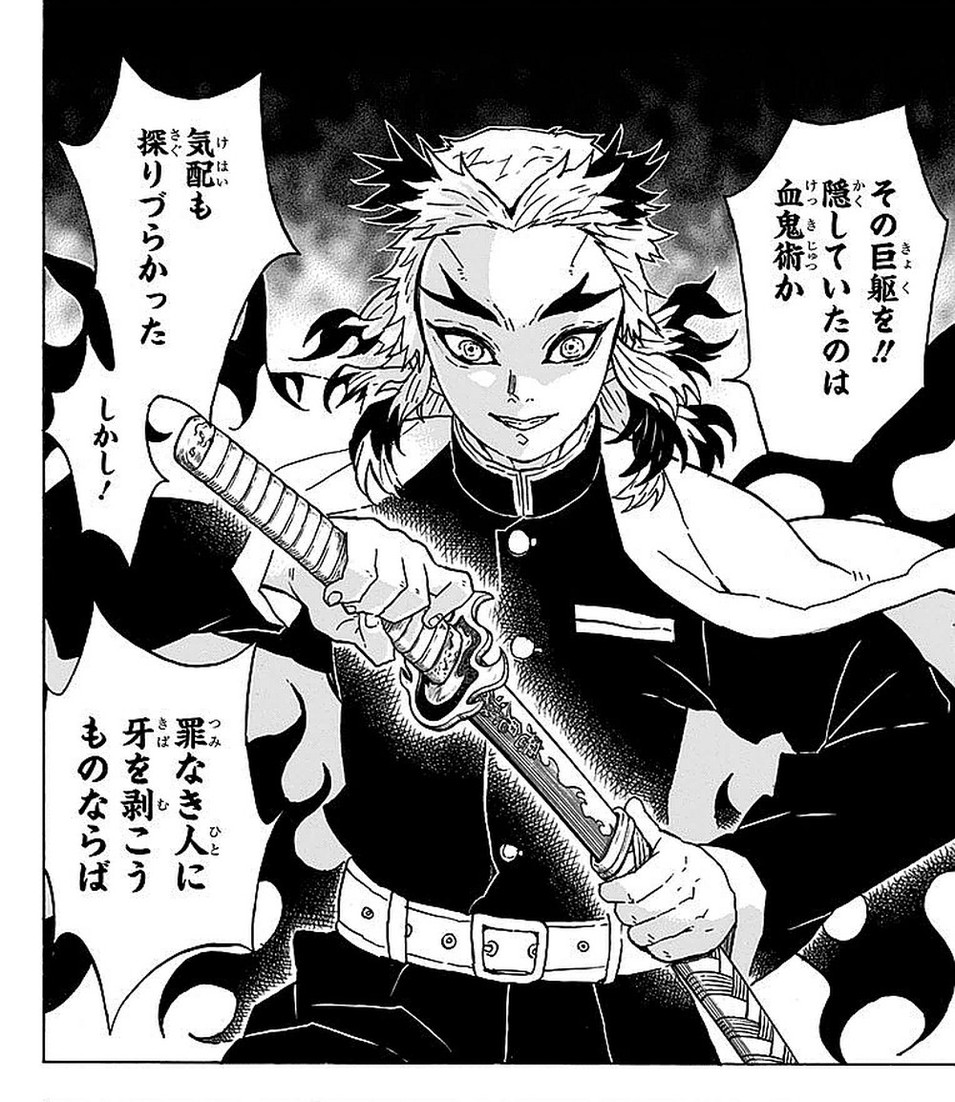
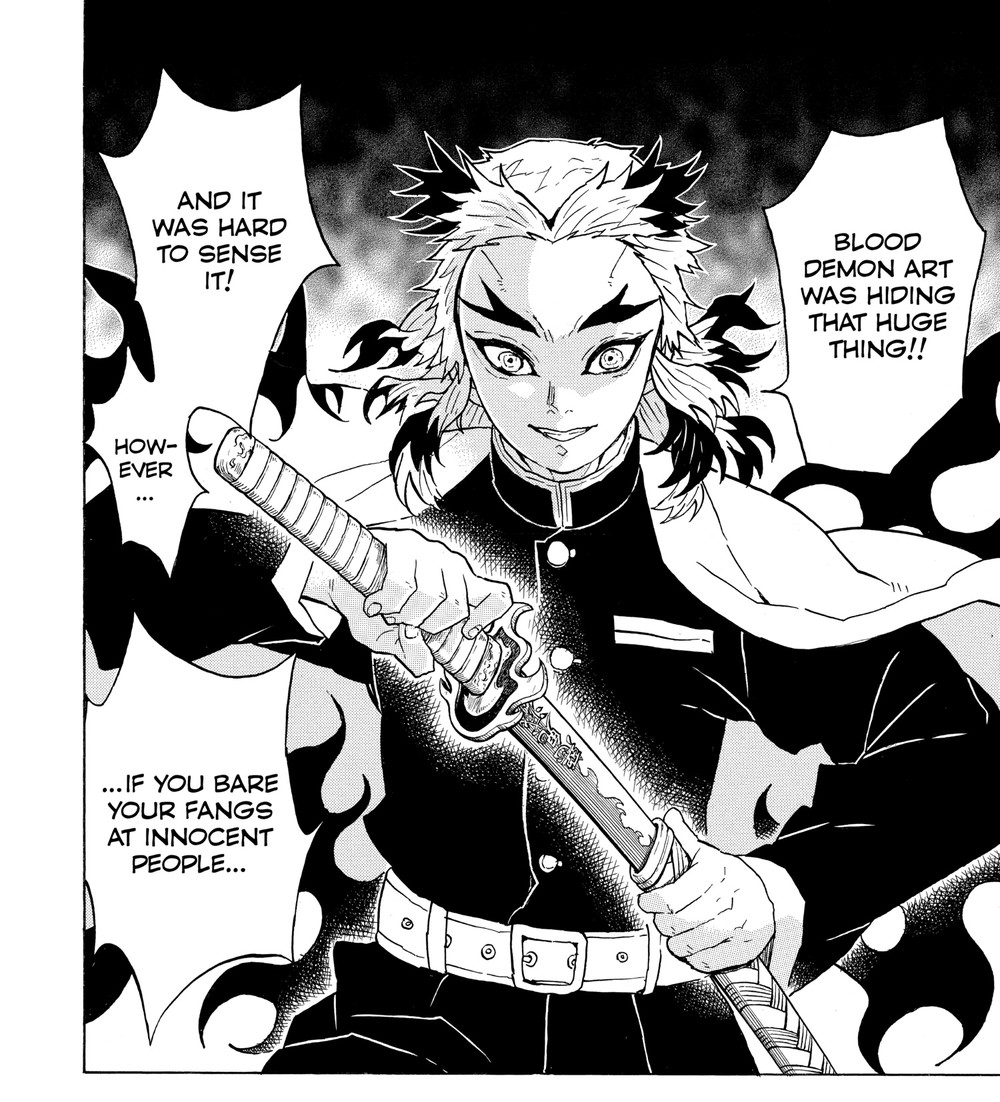
Volume 7 opens on a swordsman the story hasn't named yet. We don't know who he is — only that he has just dispatched, off-panel, a demon large enough to have been terrorizing a train car full of passengers a page earlier, its mouth cracked open in a grin thick with pointed teeth. Now he raises his blade, still smiling, and thinks through what almost happened:
「罪なき人に牙を剥こうものならばこの煉獄の赫き炎刀がお前を骨まで焼き尽くす!!」
Tsuminaki hito ni kiba o mukō mono naraba, kono Rengoku no akaki entō ga omae o hone made yakitsukusu!!
VIZ's English edition prints: "...IF YOU BARE YOUR FANGS AT INNOCENT PEOPLE... ...MY BRIGHT RED FLAME BLADE... ...WILL BURN YOU TO THE BONE!!" (Vol. 7, p.42).
Grant the rendering its due immediately: this is about as clean a transfer as this hub ever gets to report. 牙を剥く means, almost letter for letter, "to bare one's fangs," and English happens to own the identical idiom, sharpened by the same predator image. No scatter, no flattening, no adverb bolted on to cover a gap — the phrase drops into English as if it had been waiting there the whole time.
Except the man saying it is Kyojuro Rengoku, the Flame Hashira, referring to himself in the third person by his own surname — a vow-register habit, not a translation quirk — and the "you" he's warning is a demon whose actual fangs we watched bared at a train car of screaming civilians one page earlier. In most contexts 牙を剥く is a dead metaphor — nobody pictures a real animal when a headline says a rival party 「政権に牙を剥く」, "bares its fangs at the ruling party." Here, the metaphor and the anatomy are the same sentence.
The Original
牙 (kiba) is the specific word for a predator's weapon-tooth — the tusk, the fang — as opposed to 歯 (ha), the neutral word for "tooth" a dentist would use. Where English lets "tooth" cover everything from a molar to a shark's, Japanese keeps 牙 in reserve for teeth built to kill: 毒牙 (dokuga, "venomous fang," also figurative for a schemer's trap), 象牙 (zōge, "ivory," literally "elephant fang"), 牙城 (gajō, literally "fang-castle," the everyday word for a "stronghold" or power base, as in 敵の牙城を崩す, "to break the enemy's stronghold"). Reach for 牙 instead of 歯 and the subject is already framed as a predator, before the verb even arrives.
剥く (muku) is "to peel, to strip bare" — the same verb behind 皮を剥く (kawa o muku, "to peel a fruit," "to skin something") and 目を剥く (me o muku, "to bug one's eyes wide," literally "to peel one's eyes open"). Its root sense is removing a covering to expose what's underneath: skin off a fruit, eyelid off an eye, lip off a fang. 牙を剥く, then, is built from two words each doing real, separate work — not a frozen four-character compound but a live verb phrase, the exact half-second an animal's lips curl back before it strikes.
Grammatically, the sentence dresses the idiom in a formal, almost legal conditional: 〜ものならば (mono naraba) is the "if [someone] should ever dare to..." construction, reserved for hypotheticals too serious to state as a plain if-clause — closer to "should you ever be so bold as to..." than an ordinary なら. And 罪なき (tsuminaki, "without sin, without guilt") keeps a fossil of classical Japanese alive in the negative suffix なき, ない's literary ancestor: "the sinless," "the innocent," a phrase met more often in law and scripture than in casual speech. Rengoku's line isn't talking like a shonen hero — it's talking like a vow, and an old-fashioned one. As pure vocabulary, 牙を剥く sits around N2; the ものならば conditional wrapped around it here pushes the line into N1 territory.
VIZ's Choice
牙 turns up attached to real fangs and claws all over this manga's monster roster, but the idiom itself — 牙 as a live verb phrase, not just a body part on display — surfaces clean only twice on record, four volumes apart:
| Vol. / p. | Context | Japanese | VIZ English |
|---|---|---|---|
| 3 / 127 | Chapter 23 title card | 猪は牙を剥き善逸は眠る | CHAPTER 23: THE BOAR BARES ITS FANGS, ZENITSU SLEEPS |
| 7 / 42 | Kyojuro Rengoku, mid-vow | 罪なき人に牙を剥こうものならば | ...IF YOU BARE YOUR FANGS AT INNOCENT PEOPLE... |
(A note on the top row: the bilingual corpus OCR misreads this title-card banner rather badly — 猪/牙/善逸 come back as 海/分/声性 in the raw scan. The corpus record carries its own corrected_jp field, 「第23話 猪は牙を剥き善逸は眠る」, which matches the printed page exactly on visual inspection; that is the text quoted above and throughout this article. rawCapture in this article's Sources/References preserves the raw OCR string byte-for-byte, as required.)
Two different translation passes — a volume title four chapters into the book, dialogue mid-chapter five volumes later — landed on the same three-word English idiom independently. That is not what usually happens on this hub: 因縁 splits five ways across One Piece, 申す disappears and reappears as four unrelated verbs, 骨を折る collapses into "punishment." Here the idiom is stable enough to look less like a translator's choice and more like the only sane option on the shelf — worth noticing precisely because it's rare. When English happens to own the same metaphor, the scatter this hub keeps finding elsewhere simply doesn't happen.
Look closer, though, because the identical English phrase is covering two different jobs. The Chapter 23 title sets up a joke through parallel structure: "the boar bares its fangs, Zenitsu sleeps" pairs Inosuke — perpetually feral, permanently masked in carved boar tusks — against Zenitsu, perpetually unconscious. 牙 is doing double duty: it's the idiom for "turns aggressive," and it's a literal description of the mask stitched, tusks and all, onto Inosuke's head, visible in the same splash panel the title sits over. Rengoku's line has no pun to carry — 牙 names an actual demon's actual mouth, glimpsed in literal close-up two pages earlier. One occurrence is wordplay about a costume; the other is a report of a fact. "Bares its fangs / bare your fangs" can't tell them apart; it renders the pun and the plain fact in the identical three words.
The Gap
The idiom's literal reading disappears without the art. English "bare your fangs" is pure metaphor to a reader meeting the sentence cold — nothing in the words says "and in this particular story, some of the people this applies to have actual fangs." A Japanese reader arrives at 牙を剥く already primed by a lifetime of oni iconography where 牙 is the default visual marker of "monster." The idiom and the genre are already in conversation before Gotouge draws a single panel; in English, idiom and iconography never formally meet.
The Inosuke pun needs the picture to land. "THE BOAR BARES ITS FANGS" reads, alone, as a slightly odd but serviceable chapter title. It becomes a joke only once a reader clocks that "the boar" is a teenage boy in a mask with real carved tusks, drawn directly under the title. VIZ's translation is accurate and even keeps the animal noun that preserves the joke's shape — but the punchline depends on art doing labor the English prose can't carry alone.
A two-time coincidence risks reading as the rule. Because "bare your fangs / bares its fangs" lands clean twice, a reader could reasonably conclude English handles Japanese animal idioms just fine — that this hub's usual scatter is the exception here, not the pattern. It's the reverse: this is the exception. English happens to keep the same predator-threat-display image on file, for the same reason Japanese does (people everywhere have watched a dog's lip curl back), but that overlap isn't guaranteed, and it isn't why either translation succeeds. It's luck the choice never had to be tested against a harder case.
"Fangs" over-monsterizes what is often mundane Japanese. In ordinary usage — political reporting, sports commentary, corporate profiles — 牙を剥く is a fairly dry, all-purpose idiom for "turned openly hostile," about as gothic as English "showed its teeth." "Fangs" in contemporary English skews toward vampires and wolves. The translation works beautifully here because Demon Slayer's fangs are, structurally, real — export the same English choice to a business-page 牙を剥く and it reads needlessly monstrous where the Japanese read as unremarkable.
What If
For Rengoku's line specifically, the menu and its prices:
- "Should you turn your teeth on the innocent…" — keeps a threat-display image in a plainer register closer to how 牙を剥く usually reads outside horror fiction. Cost: "teeth" undersells 牙's specific predator-weapon meaning, ironic given the literal demon fangs two panels earlier.
- "If you so much as show your fangs to an innocent soul…" — a softer verb, same predator noun. Cost: "show" loses 剥く's violent, stripping-back physicality — a covering pulled away, not just a thing appearing.
- Keep VIZ's "bare your fangs" — the rare direct hit, predator image intact, and literally true of the "you" being addressed. Cost: none inside this scene — but see The Gap; the same English choice would overstate a mundane Japanese idiom anywhere the fangs aren't real.
- "If you dare unsheathe those fangs on innocent people…" — "unsheathe" echoes the sword Rengoku is drawing in the same panel, and gestures at 剥く's stripping-away sense. Cost: imports a weapon metaphor that isn't in the Japanese; the fangs were hidden, never sheathed.
Take-away
牙を剥く is the rare entry on this hub where the honest verdict is "VIZ nailed it, twice, independently" — and that verdict is worth sitting with exactly because it's rare. The interesting question isn't whether the translation is accurate (it is); it's what the accuracy quietly hides: that Japanese reaches for this idiom in dry, ordinary contexts where the English cognate sounds two shades more gothic, and that a manga about literal fanged monsters is the one setting where that gap between registers happens to close to zero.
Three rules of thumb to carry off this page:
- When an idiom translates "for free" — same image, same words, no visible cost — ask what genre made it free. 牙を剥く and "bare your fangs" match because Demon Slayer supplies real fangs; the same match isn't guaranteed in a boardroom or a ballot-box story.
- Keep 牙 (a predator's weapon-tooth) separate from 歯 (any tooth) the way Japanese does — reaching for 牙 is itself a small act of framing, calling the subject a beast before the sentence finishes.
- Watch for 剥く's other appearances — 目を剥く (bug one's eyes out), 皮を剥く (peel) — and the same "strip back the covering" logic keeps showing up underneath all of them, 牙を剥く included.
For two more places this hub has tracked a figurative idiom re-literalize inside a story about monsters, see 鬼畜 and the two lowest hells VIZ squeezes into "brutes" and 骨を折る and the passive voice VIZ collapses into "punishment" — the same demon-vocabulary current also runs under 餓鬼 and the hungry-ghost hell behind every "brat" — or browse the Demon Slayer translation notes index.
Every Japanese and English line quoted above is a byte-exact capture from the cited editions — Demon Slayer: Kimetsu no Yaiba Vol. 3 & 7 (Japanese) and Demon Slayer: Kimetsu no Yaiba (VIZ Media) at the corresponding panels — via our bilingual page database; see Sources below.