The Moment
The Baratie arc is ending. Zoro has just lost the worst fight of his life — a single duel against the world's greatest swordsman, Dracule Mihawk, that leaves his chest cut open and his pride nearly buried with it. Bleeding out on deck, barely able to speak, he makes Luffy a promise instead of an apology: from now until the day he beats Mihawk and becomes the world's greatest swordsman himself, he will never lose again. It's the kind of vow a story usually lets sit in silence for a beat.
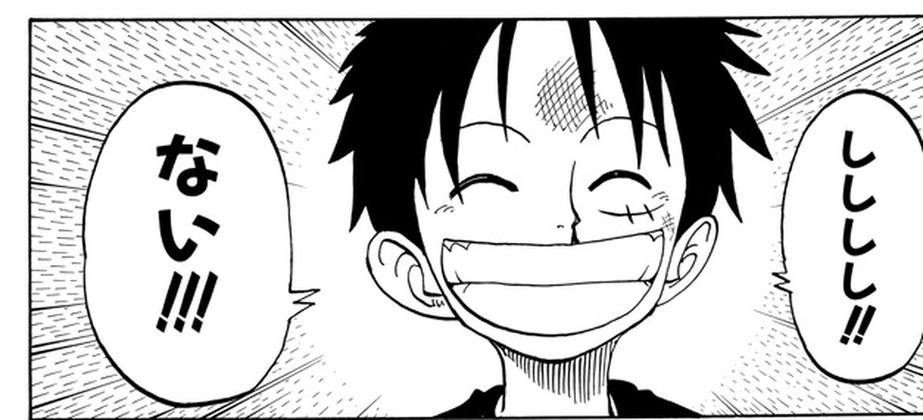
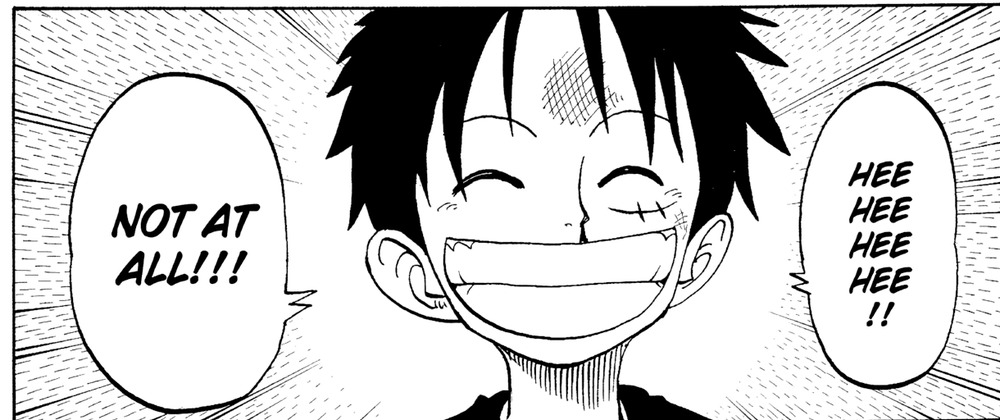
One page later, Luffy — also bandaged, also flat on his back after his own battle with Don Krieg's armada — answers it his own way. Someone, incredulous, echoes the size of what he's just heard: 「海賊王!!」, "KING OF THE PIRATES!!?" Luffy doesn't blink:
「文句あるか」…「ない!!!」「ししし!!」
Monku aru ka… Nai!!! Shishishi!!
VIZ's English edition prints: "GOT A PROBLEM WITH THAT..." / "NOT AT ALL!!!" / "HEE HEE HEE HEE!!" (Vol. 6, p.161).
Grant the rendering its due first: "HEE HEE HEE HEE!!" is a perfectly serviceable laugh in the flow of an English sentence, sitting right where it should, doing the job a laugh does at the end of a boast. But look at what's actually printed in the Japanese bubble. Where the corpus record behind this article's citation reads ししし!! — three repeated し — the panel itself draws five: し, し, し, し, し, then the exclamation marks. (We caught the mismatch by eye while confirming the panel for this very article; even automated transcription, it turns out, can lose count of Luffy's own laugh — which is, in its way, exactly the point this piece is about to make.) Oda is not a careful bookkeeper of his own sound effects. What he is careful about is that the sound stays his: whether it's drawn three times or five, ししし is the one laugh a reader can pin to Luffy on sight, silhouette or not, in a cast where nearly everyone gets a signature sound of their own.
The Original
ししし has no kanji to open up — it's giongo, Japanese's onomatopoeia layer, built from the mora し (shi) repeated for emphasis the same way くすくす repeats く for a snicker or げらげら repeats げら for a guffaw. That much is uncontroversial. What makes ししし worth a whole article is that し is not phonetically empty in Japanese. It's a real, working morpheme, and at least two very different words live inside that single repeated sound.
The one this piece follows: 肉 (niku, "meat") has an older, native Yamato reading that modern dictionaries still record — written 宍 or しし — the word Japanese used for meat and huntable game before the Chinese-derived にく reading took over everyday speech. That older しし survives, hiding in plain sight, inside two extremely common words: 猪 (i, "boar") + しし ("flesh") = いのしし, "wild boar," literally "boar-flesh(-animal)" — a word every Japanese speaker knows and almost none consciously parses. Its counterpart, 鹿 (ka, "deer") + しし = かのしし, was the old word for deer, now mostly retired except in place names and old texts. The word never fully died, either: mountain restaurants today serve wild-boar hot pot as シシ鍋 as often as its more famous name, ぼたん鍋 ("peony pot"). Say ししし quickly, with that word already loaded in the back of your head, and it is entirely possible to hear "meat, meat, meat" riding underneath a giggle — which would make Luffy's laugh, quite literally, the sound of the thing he loves most.
Hold that thought next to its rival, because honesty requires it: し alone is also the reading of 死 (shi, "death"), and a repeated ししし can just as easily be heard echoing that instead — a reading some fans reach for first, given how much of this manga's stakes are life and death. Oda has never explained, in an SBSK column or anywhere else on the record, why Luffy's laugh sounds the way it does. Both the meat reading and the death reading are real, live words riding the same three morae; neither is confirmed authorial intent, and this article is not claiming otherwise. What it is claiming is narrower and, we think, sturdier: a boy defined almost entirely by his appetite for meat happens to laugh in a sound that is also an old, still-living word for meat — a resonance any reader is free to notice, whether or not Oda ever noticed it first.
One more thing worth knowing before the translations: Oda doesn't spell this laugh consistently even within his own hand. Across the pages we sampled for this article, the same laugh appears as ししし (three), しししし (four), にししし (four, with a fronting に), and — on the very page above — what the art shows as five strokes where the transcription recorded three. The repeat-count is expressive, not fixed; it scales with how hard Luffy is laughing, the same way an exclamation point count does, and no two panels are obligated to agree.
VIZ's Choice
Here are all seven occurrences of Luffy's ししし we found and verified panel-by-panel against both editions, spanning five volumes of the early manga:
| Vol. / p. (JP → EN) | Japanese | VIZ English |
|---|---|---|
| 1 / 15 | ししし | HEE HEE |
| 1 / 80 | しししし! | HA HA HA! |
| 1 / 186 | ししし! | HA HA HA! |
| 6 / 161 | ししし!! (page art shows five strokes) | HEE HEE HEE HEE!! |
| 13 / 135 | しししし!!来るか? | HEE HEE HEE!! WANNA COME? |
| 17 / 114 | にししし食ってみろ | HEE HEE HEE... JUST TRY AND EAT ME! |
| 27 / 84 → 82 | ししし!! | TEE HEE HEE!! |
Read down the right column and three unrelated English families appear: a HEE HEE cluster (Vol. 1 p.15; Vol. 6; Vol. 13; Vol. 17), a HA HA HA cluster (Vol. 1 p.80 and p.186), and a single outlier, TEE HEE HEE (Vol. 27). The HA HA HA choices both land early, within the same volume, on the same laugh, in scenes where young Luffy is beaming at Coby and at the crew of the Baratie in turn — VIZ's earliest instinct for this laugh was the single most generic English laugh-word that exists. From Vol. 6 onward the HEE HEE family takes over and mostly holds, including for にししし in Vol. 17, which tells us VIZ isn't tracking Oda's own spelling variants any more closely than it's tracking its own: a four-stroke ししし and a に-fronted にししし both simply become "HEE HEE HEE," so neither Oda's variation nor VIZ's is doing any signaling work by the time it reaches an English reader.
The Vol. 27 outlier is worth a second look. In context, Luffy — captured, tied up mid-fight against Foxy's crew — is taunting an opponent who can predict his movements: you can read our moves all you like, but if you can't dodge them, what good is reading them? — then he laughs. It's a cocky, masculine battle-taunt. "TEE HEE HEE," in English, is not that; it's the register of a private, girlish giggle, closer to how English marks a schoolyard tease than a fighter's sneer. VIZ's translators were reaching for a laugh that fit the letters available, not this laugh specifically — and the mismatch shows exactly how much work ししし is quietly doing in Japanese that no single English stand-in can also do.
The Gap
No brand survives the crossing. ししし is unmistakably Luffy's in Japanese — recognizable on sound alone, the way ヨホホホ is unmistakably Brook's. "HEE HEE," "HA HA HA," and "TEE HEE HEE" are common property; none of them can become any one character's, because English readers already associate all three with everyone and no one.
The scatter erases the little consistency VIZ does have. Once the translation had settled into a rough HEE-HEE default, Vol. 27 breaks it for no evident reason beyond word choice in the moment. A reader tracking Luffy's voice across volumes has no way to notice that ししし is one recurring thing in Japanese, because it is never one recurring thing in English.
A register can flip by accident. "TEE HEE HEE" for a bound, taunting pirate reads soft and giggly where the Japanese reads cocky and combative — not a mistranslation of meaning, exactly, but a genuine mismatch of who's allowed to sound like that in English versus in Japanese.
Whatever echo しし carries toward meat has nowhere to land. Even bracketing the authorial-intent question entirely, the possibility of the resonance — thanks to English "hee hee" sharing no sound, no letter, and no history with "meat" — cannot survive translation in any form. It isn't lost in a specific rendering choice; it's structurally unreachable no matter which English laugh-word gets picked.
What If
- Keep "Shishishi!!" itself, italicized — treat it as an SFX brand the way some translations leave signature sounds untranslated. Cost: unfamiliar on first contact, and a bare romanization risks reading as a typo before it reads as a laugh.
- Standardize one invented spelling — "SHEE HEE HEE!!" — every time. Cost: not a real English laugh-word, so it reads as stylized rather than natural, but it would finally become recognizably Luffy's through repetition, the one thing none of VIZ's actual choices achieve.
- Footnote it once as "Luffy's laugh," then fix the spelling afterward. Cost: breaks the normally invisible hand of the translation, and the meat echo specifically would still need its own separate note to survive at all.
- Keep VIZ's case-by-case matching, but audit it within a volume. Cost: still sacrifices the cross-volume fingerprint; it's optimizing sentence by sentence, never character by character.
Every option that gives Luffy a fixed English sound costs naturalness; every option that stays natural costs the fingerprint. That is the whole shape of translating a sound this loaded: something has to give, every single time it's drawn.
Take-away
ししし looks like the simplest thing in this whole series of articles — three (or four, or five) repeated syllables, no kanji, no grammar, nothing a dictionary would even try to define. That simplicity is exactly what lets it carry so much quietly: an identity fingerprint consistent enough to name a character by sound alone, and — arguably, unconfirmed, worth noticing anyway — an old word for the food that character can't stop thinking about.
Three rules of thumb to carry off this page:
- Don't assume onomatopoeia is translation-neutral. A laugh, a cry, a footstep-sound in Japanese can be doing character work — consistency, identity, tone — that a same-meaning English stand-in doesn't automatically inherit just because both make a similar noise.
- Watch for しし wherever it hides. Once you know いのしし is boar + meat and not one indivisible word, a whole layer of old vocabulary about hunting and eating opens up across place names, dialect, and menu Japanese.
- Hedge authorial intent, always. A resonance you can hear is not the same claim as a fact you can cite. This article follows the meat echo carefully and tells you plainly where the evidence stops and the observation begins.
For two more places where this same laugh-and-word-family logic shows up on the site, see how VIZ handles a different animal-based pun in 猫の手 and the proverb VIZ's "cat claws" never hints at, and how a Buddhist curse word scatters across a dozen different English exclamations in 畜生 and the curse word English turns into "&%$!!!!". For Luffy's own vocabulary elsewhere on the hub, see 諦める and the Buddhist truth English buries under "give up", or browse every Luffy line we've collected on the One Piece quotes index. Or see the full One Piece translation notes index.
Every Japanese and English line quoted above is a byte-exact capture from the cited editions — ONE PIECE Vol. 1, 6, 13, 17, 27 (Japanese) and One Piece (VIZ Media) at the corresponding panels — via our bilingual page database; see Sources below. Two of the seven captures (Vol. 6 p.161 and Vol. 13 p.135) print more repeated し strokes on the physical page than the transcription recorded — a small, honest reminder that even careful automated capture can lose count of a laugh, the same way this whole article argues a translation can.