The Moment
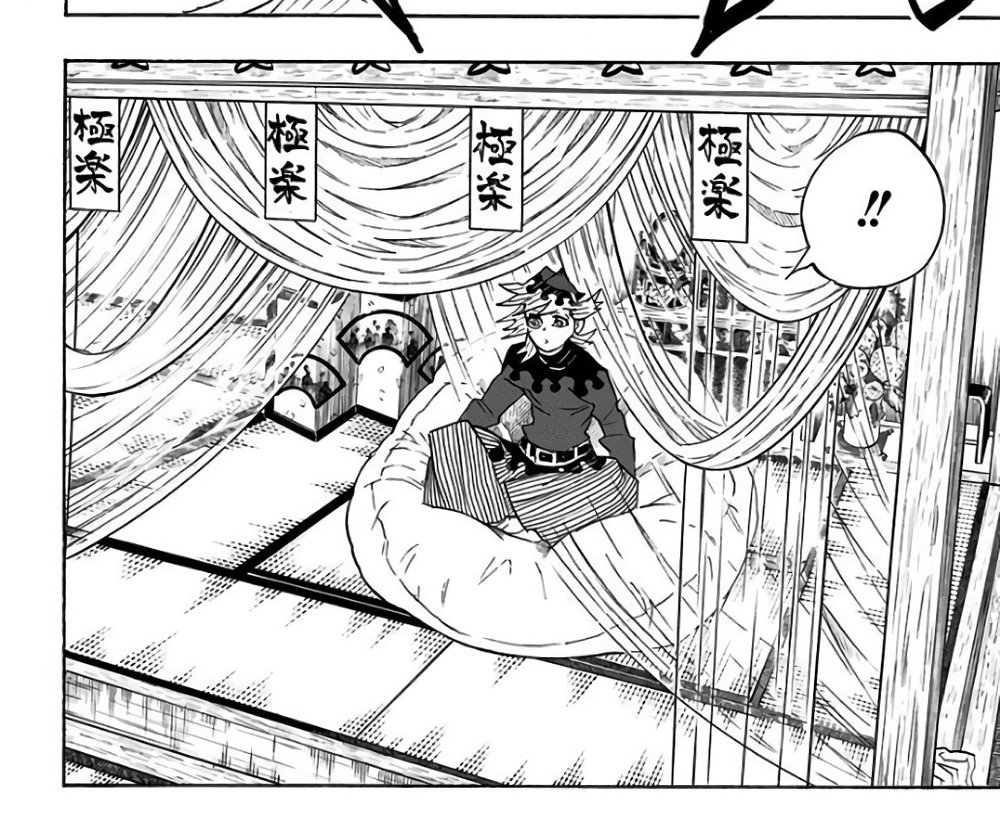
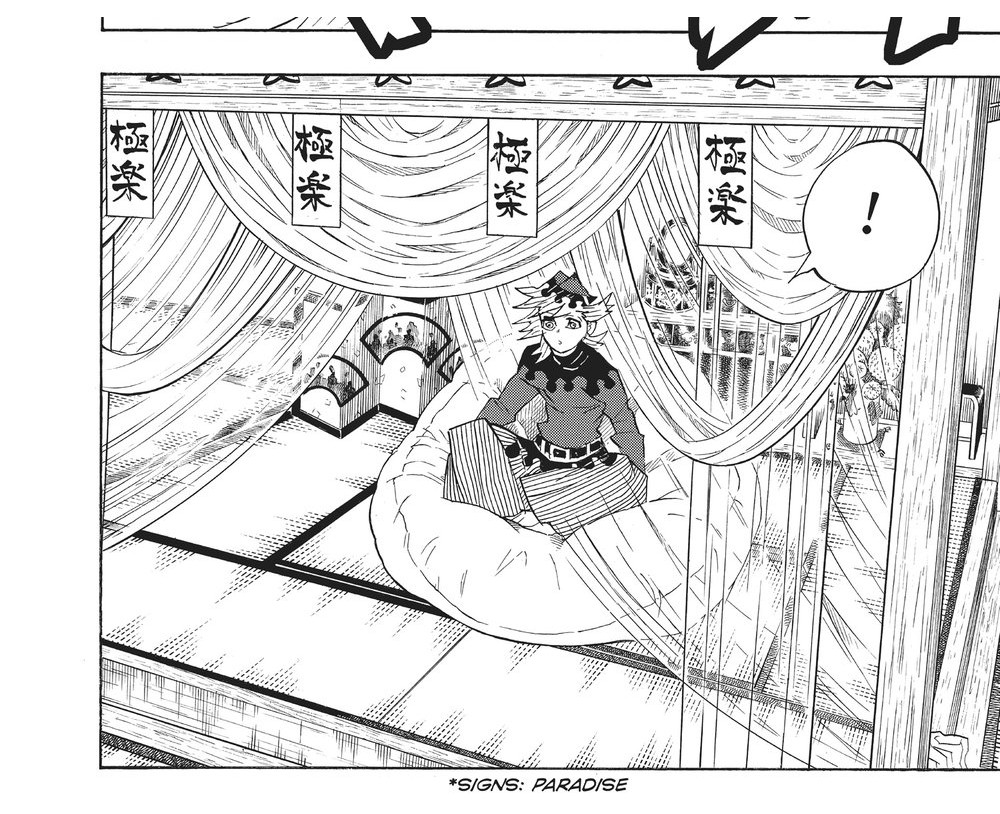
Volume 12, the climax of the Entertainment District arc. Gotouge is mid-reveal: a page earlier, a wordless close-up of a stranger's eyes — the same slow unveiling the series gives every Upper Rank demon before it commits to a name. Then the page turns, and the mystery gets a room. Four banners hang from the rafters, each lettered in the same blunt calligraphy:
極楽 極楽 極楽 極楽
Gokuraku. Gokuraku. Gokuraku. Gokuraku.
Underneath them, on a cushion shaped like a half-opened flower, sits a pale, elegant figure — legs folded, fan in hand — who has clearly been waiting for someone to walk in on him. A visitor's shocked gasp interrupts (「!!」, simply "!!"), and the figure sighs, bored: 「むうう…だわ誰も彼もつれないなァ」 — "UGH... NO ONE'S ANY FUN."
Open VIZ's printed page and the four banners are still there, kanji intact, exactly as Gotouge drew them — and beneath the panel, in small italics, a single translator's note: *SIGNS: PARADISE.
Grant the choice its due: there is no obvious alternative sitting unused. The word is drawn into the art, not lettered into a bubble VIZ can redraw; a caption is the standard, professional way to handle text baked into linework a localization team can't touch. What the caption cannot do is make four looming, repeated declarations of gokuraku feel like anything other than a vocabulary gloss — background texture a reader can, and mostly will, read straight past on the way to the dialogue.
The Original
Take the compound apart. 極 (goku) means "utmost, extreme" — the same 極 in 極端 (kyokutan, "extreme") and 積極的 (sekkyōteki, "proactive," literally "positively extreme"). 楽 (raku) means "ease, comfort, pleasure" — the everyday 楽 of 楽しい (tanoshii, "fun") and 気楽 (kiraku, "carefree, relaxed"). Put together, 極楽 is, with almost brutal literalism, "utmost bliss."
That is not a vague compliment; it is a place name. The full doctrinal term is 極楽浄土 (gokuraku jōdo, "the Pure Land of Utmost Bliss") — the standard Japanese rendering of Sukhāvatī, the western paradise that Amida Buddha vowed to build for anyone who calls his name with true faith (the nenbutsu, 南無阿弥陀仏, covered in our companion piece on Gyomei Himejima's one un-Buddhist outburst). Reach it, and you are guaranteed freedom from suffering and — eventually — Buddhahood itself. It is a real address inside a cosmology, not a synonym for "nice afterlife."
Centuries of ordinary use wore the doctrine down to its two most portable syllables. 極楽 alone drifted into everyday speech as a stand-in for any blissful comfort — お風呂は極楽だ ("this bath is heaven") — and spun off its own idiom, 極楽とんぼ (gokuraku tonbo, "paradise dragonfly"), the fully secularized image of someone so carefree they never notice trouble coming. And the word survives whole inside 極楽往生 (gokuraku ōjō), "to die peacefully and be reborn in the Pure Land" — pairing this article's noun with the verb 往生 (ōjō, "to go and be reborn"), which we've covered elsewhere in its snarled imperative form, 往生しやがれ. Every time this series has a character talk about someone finally passing on well, gokuraku is the unstated destination — the place ōjō is a verb for.
Grammatically, the banners carry none of that machinery; they're a bare noun, no particle, no verb, printed four times over like a slogan. That bareness is itself information: this is signage, not sentence — the kind of placard a shrine, a festival stall, or (tellingly, given where we are in the story) a pleasure house might hang to promise customers a night of bliss. Individually, 極 and 楽 are unremarkable kanji — 楽 is standard N4 vocabulary, taught in a first-year textbook. The compound's real weight is cultural, not lexical: a specific coordinate in Buddhist cosmology, invisible to any JLPT list, impossible to reconstruct from the parts alone.
VIZ's Choice
Every occurrence of 極楽 we could confirm in the volumes on file, Japanese beside the English VIZ actually printed:
| Vol. / p. (JP) | Context | Japanese | VIZ English |
|---|---|---|---|
| 12 / 36 | Banners in Doma's private chambers | 極楽 ×4 (signage) | (kanji retained) — caption: *SIGNS: PARADISE |
| 16 / 159 | Doma, introducing himself to Shinobu | 俺は『万世極楽教』の教祖なんだ | I AM THE FOUNDER OF THE ETERNAL PARADISE FAITH. |
| 16 / 172 | Doma, mocking his own parents | 極楽教などという(つまらない宗教) | THEY EVEN CREATED THE RIDICULOUS PARADISE FAITH RELIGION. |
| 16 / 173 | Doma, on his childhood followers | どうか極楽に導いて欲しいと頭を下げられた | ...THEY WOULD BOW AND SAY THEY WANTED ME TO LEAD THEM TO PARADISE. |
| 16 / 173 | Doma, the confession | 極楽なんて存在しないんだよ | ...THAT PARADISE DOES NOT EXIST. |
| 17 / 4 | Character-guide caption | "万世極楽教"の教祖でもある | ...also the leader of the "Eternal Paradise Faith." |
| 18 / 176 (VIZ p.177)* | Doma, flashback about a girl he "saved" | 俺がつくった極楽教は…可哀想な人を保護してあげていた | I created the Paradise Faith in order to protect pitiful people like her. |
*Pagination and wording note on the last row: our bilingual database pairs this Japanese page with the English string "The Eternal Paradise Cult I founded was meant to protect poor souls like her," recorded against Vol. 18, p.176. Reading both printed editions directly shows that pairing is off by one page: the actual VIZ dialogue for this line sits on p.177, and it reads "I created the Paradise Faith in order to protect pitiful people like her" — same content, "Faith" in place of "Cult." We've used the confirmed printed wording in the table above and kept the corpus string, byte-for-byte, in this article's Sources/References for traceability.
Read down the column and the finding is almost total consistency: every dialogue occurrence renders 極楽 as "paradise," and every occurrence of the compound noun 極楽教 — four of the seven rows — renders 教 as "Faith," "Eternal Paradise Faith," held steady across two different volumes and scenes years apart in the story. That's a genuinely different result from the scatter we usually document on this site: VIZ's translators plainly treated 極楽 as a stable, one-word problem with a settled, one-word solution, and held the line on it.
The signage is the one place the pattern breaks, and it breaks for a structural reason, not a stylistic one: banners baked into linework can't be relettered the way a bubble can. The two translation strategies in this table — "paradise" as dialogue, kanji-plus-footnote as background art — never actually meet on the printed page. In Japanese, the repetition is doing real work: readers see gokuraku before they know Doma's name, see it again in his self-introduction, a third time in the origin of the cult, and watch it collapse in his own confession — one word, tracked by eye, tightening into an ever more bitter joke. The English reader gets the same information in the same order but never the same word twice: "PARADISE" (footnote), then "PARADISE FAITH," then "PARADISE" again, then "PARADISE" a third time, then "PARADISE FAITH" again — close enough to follow by ear, but with no fixed kanji anchoring it visually the way it does on the Japanese page.
The Gap
The destination collapses into a mood. "Paradise" in English covers Eden, Valhalla, Elysium, and generic heaven interchangeably — anywhere blissful will do. 極楽 names one specific place, reached by one specific vow to one specific Buddha. When Doma calls himself 教祖 of the "万世極楽教," the doctrine underneath the brand name is exactly what makes the con work: he is promising verifiable membership in a named cosmology, not vague good vibes. English's generic noun can found a cult, technically, but it can't explain why grieving strangers found this particular promise credible enough to bow for it.
The translation happens off the page. Because the banners are art, not text VIZ can touch, the caption strategy pushes the word's most visually insistent appearance entirely outside the panel, into a margin note a large share of readers will never read. This isn't a wrong word choice — it's translation declining to compete with the artwork at all, which means the single most repeated occurrence of 極楽 in the whole corpus (four banners, looming, before the villain even speaks) is also its least legible in English.
The thread goes dark between volumes. A Japanese reader who noticed the banners in Volume 12 meets the same two kanji again in 万世極楽教 four volumes later, and again in Doma's flashback confession two volumes after that — three separate scenes, one unchanging visual anchor, connectable at a glance. An English reader meets a footnote, then "Eternal Paradise Faith," then "paradise does not exist," three separate translation events with no shared surface to recognize by eye. The irony Gotouge is building — a demon selling paradise on banners while privately certain it doesn't exist — depends on the reader noticing the same word recur. English asks the reader to remember a plot point instead of simply recognizing a symbol.
What If
The menu and its prices, starting with the headline caption:
- **"SIGNS: PURE LAND"* — swaps the generic noun for the specific Buddhist destination, still short enough for a margin note. Cost: "Pure Land" is unglossed jargon to a reader with no background in Buddhism, and may read as more confusing than "paradise," not less.
- Letter "PARADISE" directly into the banners, redrawn to match the vertical placard shape, instead of leaving the kanji and footnoting it — keeps the payoff visible in the art itself rather than a caption most readers skip. Cost: redrawing hand-lettered signage is slow, expensive work, and an English banner in an Edo-styled interior risks reading as a design error rather than a deliberate choice.
- **"SIGNS: PARADISE (AMIDA'S PURE LAND)"* — a slightly longer footnote that plants the specific doctrine early, primed for when 万世極楽教 and Doma's confession arrive later. Cost: a longer caption is still a caption; readers who skip footnotes skip this one too, however much information it carries.
- *Transliterate: "SIGNS READ 'GOKURAKU'" — extends VIZ's own established policy toward untranslated Buddhist vocabulary elsewhere in this series (南無阿弥陀仏 stays NAMU AMIDA BUTSU; see our companion piece) to this case. Cost: without further gloss, a reader meeting the word for the first time learns nothing at all — the strategy only works when transliteration gets repeated, and a single background sign gets no second chance.
Take-away
極楽 looks like a throwaway two-kanji decoration and turns out to be the hinge the entire Doma arc swings on: a demon builds a religion, a room, and a personality around a word he privately considers fiction, and the story trusts readers to notice the same word recurring in the art long before anyone explains it in dialogue.
Three rules of thumb to carry off this page:
- When kanji show up in the art, not the bubbles, ask what the localization team could actually do about it. A footnote is often the honest, professional answer — but it also means the word's visual repetition, which is doing real narrative work in the original, becomes a single easy-to-skip caption in English.
- 極楽 always names a place, not a mood. Whenever you meet it — alone, in 極楽浄土, in 極楽往生, in a cult's name — a specific Buddha and a specific vow are standing behind it, even when the sentence around it sounds as casual as "this bath is heaven."
- Watch what a villain builds a religion's name out of. Demon Slayer keeps doing this: a hungry ghost's word for insatiable greed becomes a schoolyard insult (餓鬼), an execution ground becomes a proverb about pressure (土壇場), and here, the specific promised afterlife becomes a con artist's brand name. The doctrine hiding inside the everyday word is usually the point.
For the verb this noun is a destination for, see Inosuke's snarled 往生しやがれ and Tanjiro's gentler 成仏してください; for the prayer that's supposed to get you here, see 南無三 and the one prayer VIZ chose to translate; and for the opposite realm on the same six-fold wheel, see 餓鬼 and the hungry-ghost hell behind every "brat". Or browse the full Demon Slayer translation notes index. For this exact compound turning up as background theology one hub over, see the One Piece pieces on 因縁 and the karmic tie English splits five ways and 往生しろ and the tombstone pun VIZ reached for — both mention 極楽往生 in passing on their way to a different word.
Every Japanese and English line quoted above is a byte-exact capture from the cited editions — 鬼滅の刃 Vol. 12, 16, 17 & 18 (Japanese) and Demon Slayer: Kimetsu no Yaiba (VIZ Media) at the corresponding panels — via our bilingual page database; see Sources below. One line carries a correction: the Vol. 18 English dialogue is recorded against p.176 in our database but actually prints on VIZ p.177, one page later, with "Faith" where the database's OCR shows "Cult"; both editions' page images were checked directly and the printed wording above is the confirmed one.