The Moment
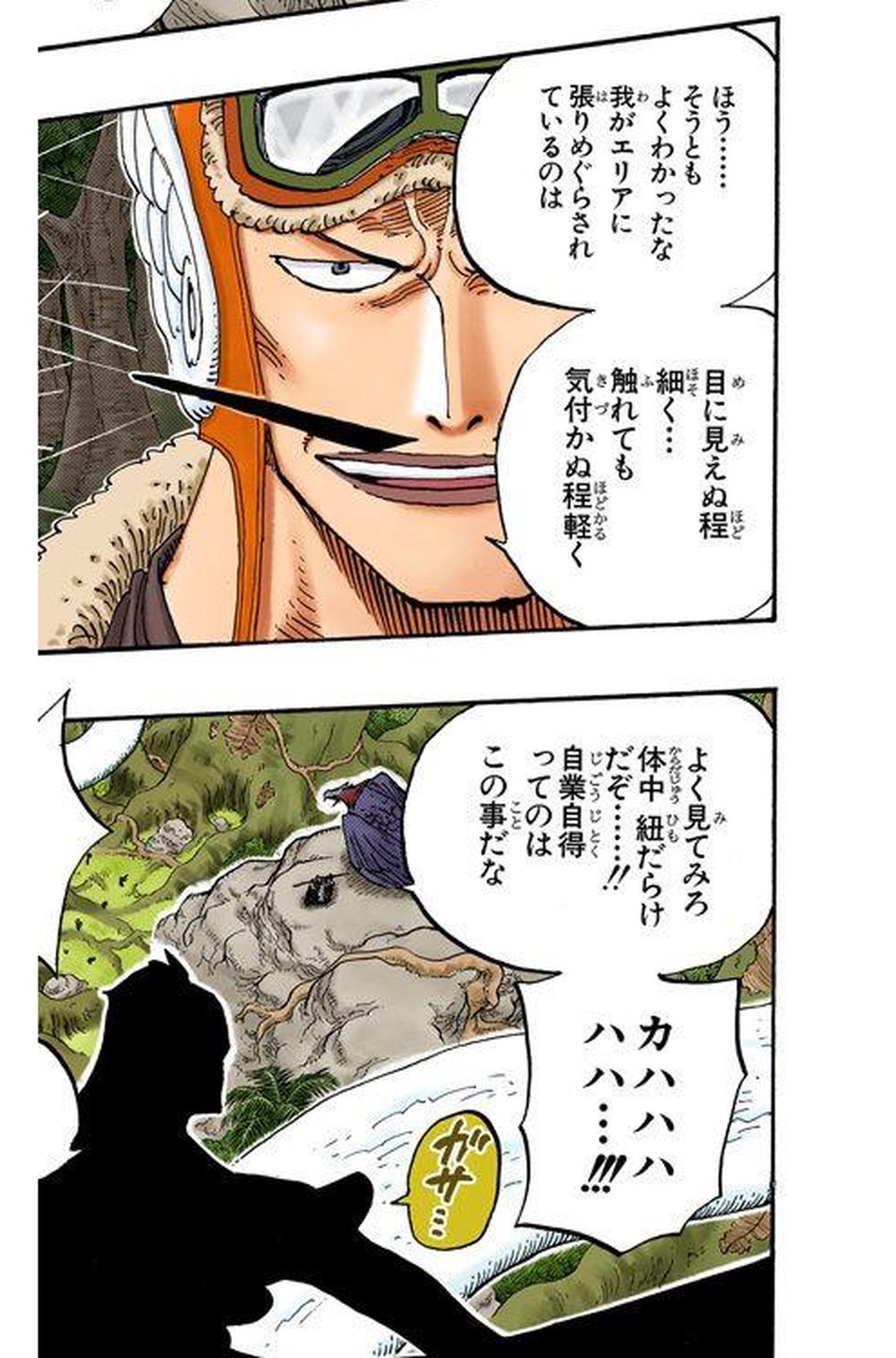
Skypiea, the sky island, where trespassers are put through "Ordeals" administered by the island's priests. This one is a trap of strings — clouds spun into threads so fine you cannot see them, 「だが束になれば大の男をも動けぬ程縛りつける強靱な〝紐雲〟」 — "...AND YET SO STRONG THAT ONCE YOU'RE SNARED, YOU'LL NEVER BREAK FREE!" And the cruelest part, the priest explains, is that his victims have been collecting the threads themselves: 「そいつをお前ら...島の入口から自分で手繰り集めてきたわけだ」 — "YOU'VE BEEN WRAPPING YOURSELF IN THEM SINCE YOU MADE IT TO THE ISLAND."
Then he delivers the verdict:
「よく見てみろ体中組だらけだぞ.....!自業自得ってのはこの事だな」
Yoku mite miro, karadajū ito-darake da zo…! Jigō-jitoku tte no wa kono koto da na.
(A note on our capture: the 組 in that line is an artefact of text extraction — the character on the page reads 紐, himo, "string": "your whole body is covered in strings." It is the same 紐 as the arc's 紐雲, the "string clouds," and the priest's own trial, the 紐の試練 — the Ordeal of String.)
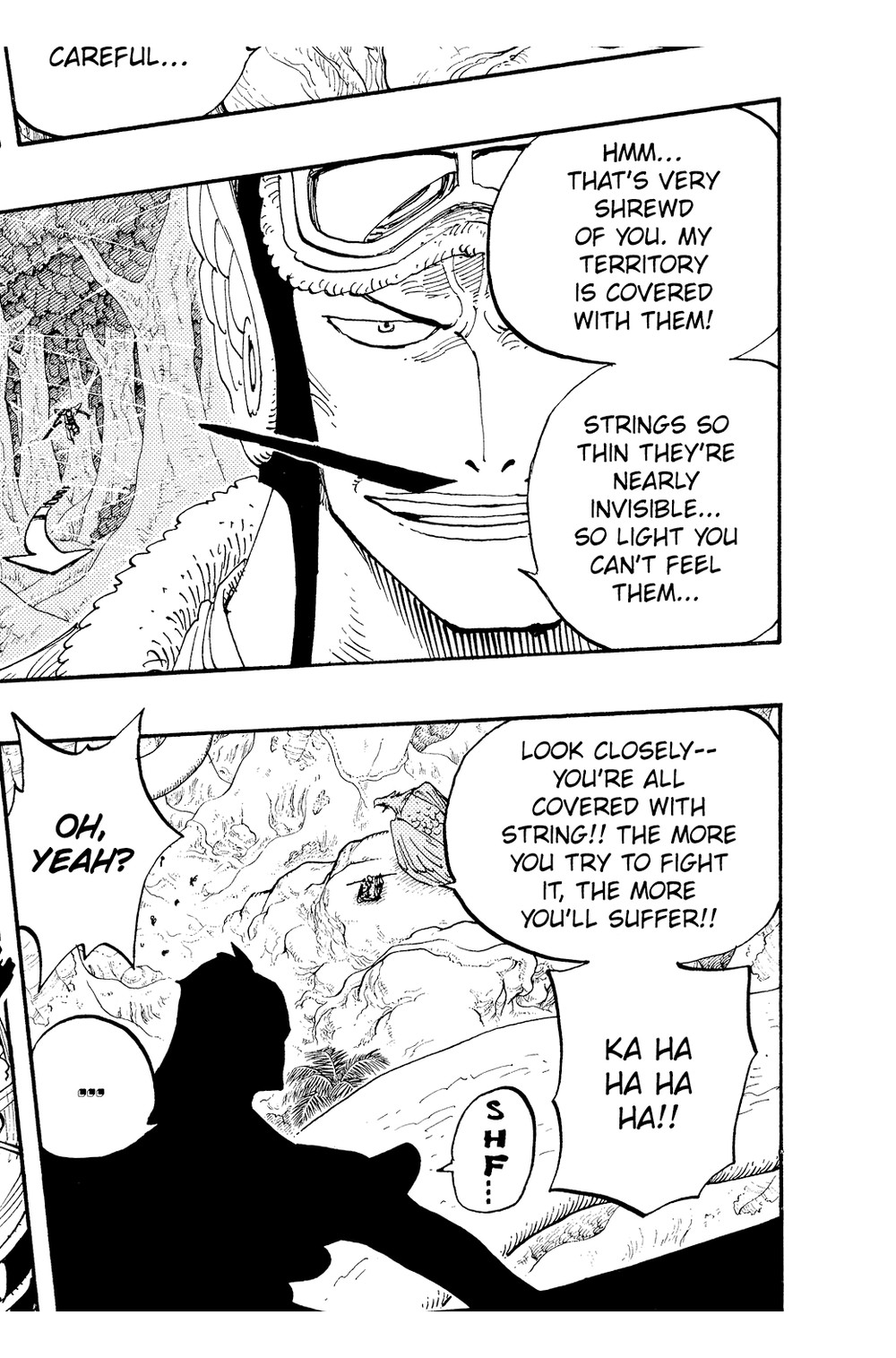
VIZ's English edition letters it: "LOOK CLOSELY-- YOU'RE ALL COVERED WITH STRING!! THE MORE YOU TRY TO FIGHT IT, THE MORE YOU'LL SUFFER!!" (Vol. 28, p.16; VIZ p.21) — and then the priest laughs: 「カハハハハハ...!!!」 "KA HA HA HA HA!!"
Read the two halves of that VIZ bubble again. The first half is a faithful match. The second half — where the Japanese says this is what they call reaping what you sow — has become a piece of tactical advice: struggle and you'll suffer more. The villain stopped philosophizing and started coaching.
The Original
自業自得 (jigō-jitoku) is a 四字熟語 — a four-character compound, the class of fossilized aphorisms Japanese quotes the way English quotes proverbs. Like most of them it splits 2 + 2:
- 自業 (jigō) — 自 "self" + 業 "deed." And here is the buried treasure: 業 read gō is THE Japanese word for the Buddhist concept of karma. Not "karma-ish," not an association — it is the standard translation of Sanskrit karman, the deeds whose consequences attach to their doer across this life and the next.
- 自得 (jitoku) — 自 "self" + 得 "gain, obtain."
So the whole thing reads: one's own deeds, one's own gain — what your karma produces, you and no one else will receive. The compound comes straight out of Buddhist teaching, and though modern speakers use it for everything from hangovers to lost phones, it is almost always for bad outcomes: the "gain" is ironic, a payout of exactly what you had coming.
The grammar around it is friendly N3 territory. 〜ってのは is the colloquial squash of 〜というのは ("what is called ~"), and 〜ってのはこの事だ is the set frame for a proverb coming true before your eyes: "THIS is what they mean by ~." The final な is the speaker savoring his own observation. Put together: "'Reap what you sow' — well, would you look at that. Here it is." The priest is not merely insulting his victims; he is citing scripture at them while they discover they've been tying themselves up since they arrived.
That's the register trick to hear: in a family kitchen, 自業自得だろ is a shrug — "your own fault." From the mouth of a winning enemy, framed as a proverb fulfilled, it is a karmic verdict: I didn't do this to you. You did. The universe is merely paying out.
VIZ's Choice
Here is every appearance of the compound in the volumes we have on file, side by side with the official English:
| Vol. / p. | Japanese | VIZ English |
|---|---|---|
| 16 / 53 | だめだ自業自得だろ | NO WAY. YOU BROUGHT THIS ON YOURSELF. |
| 28 / 16 | よく見てみろ体中組だらけだぞ.....!自業自得ってのはこの事だな | LOOK CLOSELY-- YOU'RE ALL COVERED WITH STRING!! THE MORE YOU TRY TO FIGHT IT, THE MORE YOU'LL SUFFER!! |
Look at Vol. 16 first, because it is a small triumph. The scene is as unheroic as One Piece gets: Nami lies sick, and one crew member is begging another for his things — 「いやだね」 "NO WAY." — 「...じゃ靴...!!」 "YOUR SHOES, THEN!!" — 「だめだ自業自得だろ」 "NO WAY. YOU BROUGHT THIS ON YOURSELF." For the everyday register, English has a ready-made seat, and VIZ sits the phrase right in it. "You brought this on yourself" is exactly what 自業自得 means across a dinner table. Grant the rendering its due: this is the compound translated correctly.
So why does the same compound, twelve volumes later, come out as string-trap physics? Because the priest's line isn't using 自業自得 to assign everyday blame — it's performing it, staging the proverb as cosmic justice mid-Ordeal. And for that use, English has no seat. "You brought this on yourself" would still be accurate, but it's a flat accusation where the Japanese is a quotation of doctrine; "you reap what you sow" quotes doctrine, but the wrong doctrine. Faced with a bubble that needed to gloat, philosophize, and fit over a laughing face, the translator reached for something that at least fits the fight: struggling tightens the strings. Locally reasonable. But the two renderings side by side show the pattern: the conversational use of 自業自得 crosses English intact; the philosophical, gloating use slides into tactics. The compound's everyday face survives translation. Its Buddhist face doesn't.
The Gap
Moral causality becomes mechanical advice. The Japanese line is a verdict about the past: you gathered these threads yourself; your deeds have paid out; behold. VIZ's line is a warning about the future: fight and you'll suffer more. Those are different speech acts — a judge pronouncing sentence versus a captor stating the rules. The whole point of the priest's word choice — the trap only worked because of what you yourselves did — is deleted, and with it the little philosophy lecture that makes the villain a priest rather than a thug.
The four-character punch is unpaid for. Even where VIZ gets the meaning right (Vol. 16), "you brought this on yourself" is seven words of plain prose standing in for four characters of canonized aphorism. A 四字熟語 lands like a gavel — closed form, no wasted syllable, the weight of every previous speaker who ever said it. The frame ってのはこの事だな only works because there is a fixed, quotable thing to point at. English can say the sentence; it cannot cite the proverb.
業 carries a cosmology, and it evaporates. Inside 自業自得 sits 業 (gō), karma — deeds as a ledger the universe keeps, payable only to the account holder. "Fault" and "blame" are social words; 業 is a mechanism of reality. It is the same quiet phenomenon as the Buddhist death hiding inside a villain's "give up" — see the Buddhist death buried in 往生際が悪い, from the very same arc: Skypiea's god and priests keep reaching for Buddhist vocabulary, and English keeps translating around it.
What If
No rendering is free; here is the menu and its prices.
- "THIS IS WHAT THEY CALL REAPING WHAT YOU SOW!!" — keeps the proverb-citing frame and the moral causality; the victims stay the authors of their fate. Cost: "reap what you sow" is agricultural and Biblical (Galatians, not the sutras) — the cosmology changes robes on the way across.
- "YOUR OWN KARMA, WRAPPED ALL AROUND YOU!!" — the only option that keeps 業 audible in English, and it fuses with the string imagery beautifully. Cost: pop-English "karma" runs flippant — Instagram-caption karma, not doctrine.
- "YOU DID THIS TO YOURSELVES — EVERY LAST THREAD OF IT!!" — moral causality intact, scene-specific, and it gloats properly. Cost: a taunt rather than a citation; the gavel-drop of the four-character form is gone.
- Keep VIZ's tactical line and let the previous bubble ("YOU'VE BEEN WRAPPING YOURSELF IN THEM...") carry the you-did-this logic across the page. Cost: the philosophy survives on the page but leaves the priest's mouth — and it is precisely his saying it that characterizes him.
Take-away
When a Japanese villain reaches for 自業自得, hear a verdict, not a taunt: your own deeds, your own harvest — the universe's bookkeeping, recited by the winning side. English can match the everyday register perfectly ("you brought this on yourself") but has no seat for the doctrinal one, so translators slide toward whatever the scene needs — here, tactics.
Three rules of thumb to carry off this page:
- Split every 四字熟語 2 + 2 before you reach for the dictionary. 自業自得 → 自業 + 自得, "own deeds / own gain." Most four-character compounds parse this way, and the halves usually tell you the story.
- When 業 is read ごう, you are in Buddhist territory. It is the karma word — file it beside 往生 (ōjō) as vocabulary that smuggles a cosmology into everyday speech.
- 〜ってのはこの事だ is the "so THIS is what they mean by ~" frame — a colloquial squash of 〜というのは. When you see it wrapped around a proverb, the speaker is watching that proverb come true.
Want another line where the English keeps the scene and loses the scripture? See the One Piece translation notes index.
Every Japanese and English line quoted above is a byte-exact capture from the cited editions — ONE PIECE Vol. 16–28 (Japanese) and One Piece (VIZ Media) at the corresponding panels — via our bilingual page database; see Sources below.