The Moment
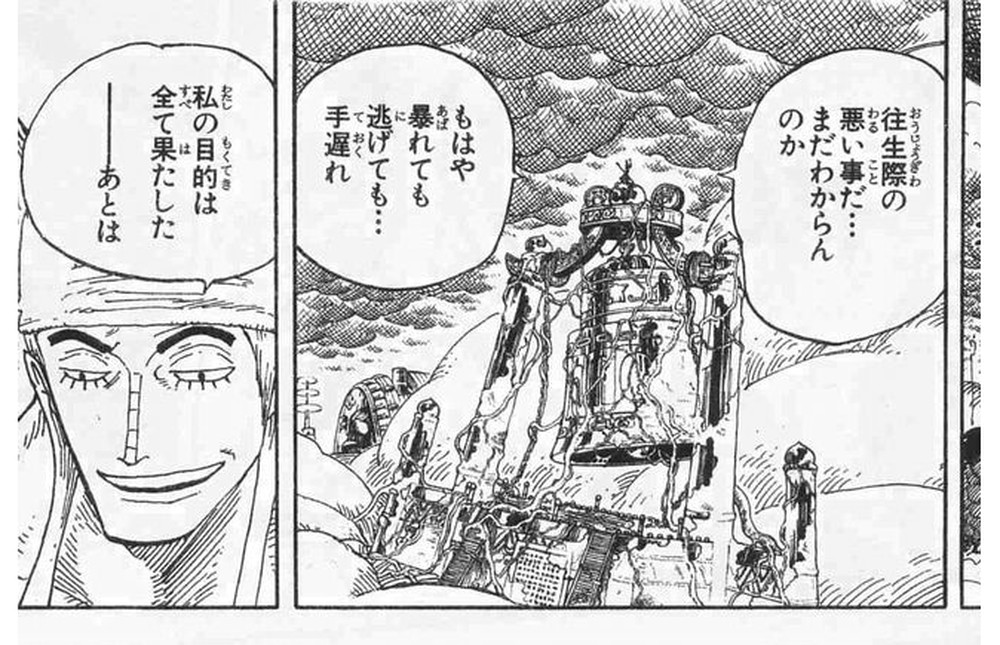
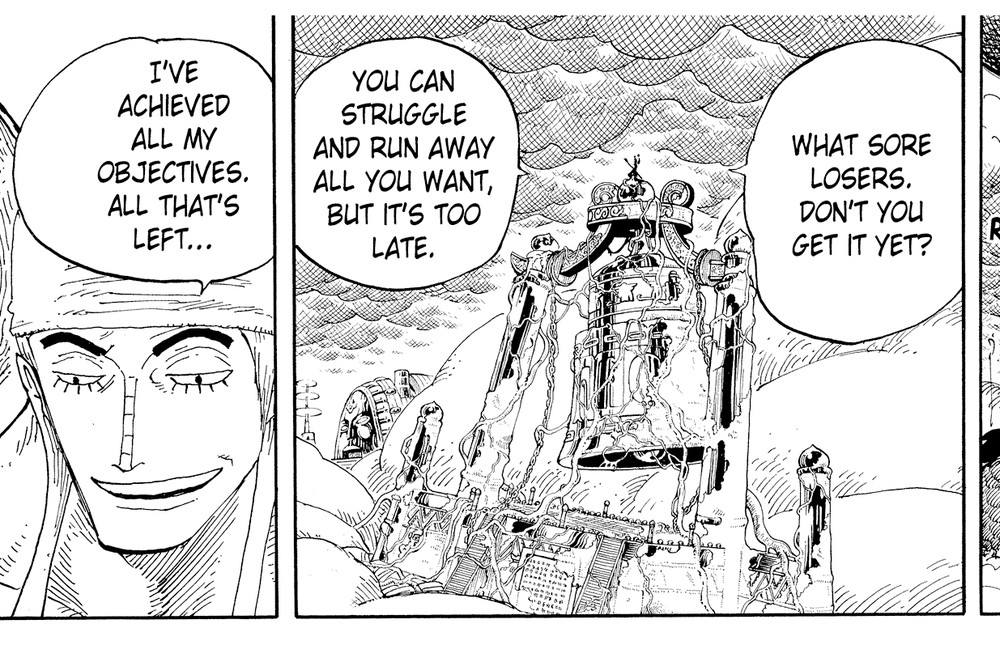
Skypiea, the sky island. The self-proclaimed god Enel — a man who intends to erase a whole country from the clouds and ascend alone to a "boundless land" — stands over opponents who keep getting back up. He is not angry. He is disappointed, the way a god is disappointed in ants, and he says:
「往生際の悪い事だ...まだわからんのか」
Ōjōgiwa no warui koto da… mada wakaran no ka.
VIZ's English edition renders it: "WHAT SORE LOSERS. DON'T YOU GET IT YET?" (Vol. 32, p.14).
Four volumes earlier, mid-fight, he had already used the same word on Luffy:
「往生際の悪い...」 → "YOU DON'T KNOW WHEN TO GIVE UP!!" — 「空中までもおれの領域!!まだわからぬか!!」 → "WHEN WILL YOU LEARN?! THE SKY IS MY TERRITORY!!" (Vol. 28, p.135).
Same four-syllable word, 往生際 (ōjōgiwa). Two completely different English sentences. Neither of them contains the thing the Japanese is actually about — which is dying, and doing it badly.
The Original
Take the word apart, because every piece teaches something.
往生 (ōjō) is a Buddhist term. The characters are 往 "to go" and 生 "to be born": to go and be born again — to depart this life and be reborn in the Pure Land. The full phrase is 極楽往生 (gokuraku-ōjō), "rebirth in paradise." Over centuries it wore down into an ordinary, softened word for "to die," the way English uses "to pass away." (It has a second colloquial life, too: 往生した can mean "I was completely stuck / at my wits' end" — the feeling of having no move left, as if cornered by death.)
際 (giwa, from きわ kiwa) is "the edge, the very brink, the moment of." You meet it all over the language: 別れ際 (wakaregiwa) the moment of parting, 死に際 (shinigiwa) the moment of death, 今わの際 one's dying breath. Learn 〜際 as a suffix meaning "right at the instant of ~," and a whole shelf of words opens up.
Put them together. 往生際 (ōjōgiwa) is literally "the brink of one's passing" — the moment of death — and, by a short extension every native speaker feels, one's conduct at that moment. How gracefully you meet your end.
So:
往生際が悪い = "bad at the moment of death" = unable to accept that it is over; thrashing, clinging, making an unseemly scene when you should bow out.
Its mirror image, 往生際がいい, is a compliment: you accept defeat cleanly and go quietly. The grammar is friendly to learners even if the vocabulary isn't — [NOUN + が + いい/悪い] is the basic "this trait is good/bad" frame (N4-level), and 往生際の悪い〜 is just its adnominal form gluing onto a noun: 往生際の悪い奴 = "a guy whose dying-moment conduct is bad." What's hard is not the syntax; it's that 往生 is N1-and-beyond cultural vocabulary, and the whole thing is stored in the head as one idiom (慣用句), not built from parts on the fly.
VIZ's Choice
Here is every place the phrase surfaces in the volumes we have on file, side by side with the official English. Read down the right-hand column and watch the translator improvise a new solution each time:
| Vol. / p. | Japanese | VIZ English |
|---|---|---|
| 16 / 133 | 往生際の悪い奴だ…いいかい!? | SHUT UP AND LISTEN!! |
| 28 / 135 | 往生際の悪い… | YOU DON'T KNOW WHEN TO GIVE UP!! |
| 30 / 154 | えーい往生際の悪い… | (untranslated in our capture) |
| 32 / 14 | 往生際の悪い事だ…まだわからんのか | WHAT SORE LOSERS. DON'T YOU GET IT YET? |
Four appearances, three different English renderings, zero shared vocabulary between them. That scatter is itself the finding: when a translator solves the same phrase a different way every single time, it is a reliable sign that the phrase has no fixed seat in English — no idiom sitting ready to be dropped in. Compare a phrase that does have a seat, like 「いただきます」→ "thanks for the food": you'll see the same handful of solutions reused. 往生際が悪い gets a fresh guess each time because English never built a word for it.
The Gap
Three things fall through the cracks.
"Sore loser" is the wrong failure. A sore loser is bad at losing — poor sportsmanship, sulking, resentment after the whistle. 往生際が悪い is bad at ending — refusing to accept the finish while it is still happening. The sore loser complains once it's over; the person of bad 往生際 is the one still swinging when everyone can see it's decided. English aims the insult at the aftermath; Japanese aims it at the refusal.
The contempt flips to praise. "You don't know when to give up" is, in most English mouths, admiring — the never-say-die, hero's-honor compliment. But 往生際が悪い is contempt, top to bottom, and it frames persistence itself as embarrassing. This is where the shonen irony lives and dies: Luffy's single defining virtue is that he never quits, and the god-villain's word for that virtue is "you don't know how to accept your death." In Japanese the sneer is unmistakable. In English "you don't know when to give up" can read as the narrator quietly siding with the hero — the exact opposite of what Enel means.
The Buddhism evaporates. Under 往生 is a whole cosmology of dying and being reborn, and a man who calls himself 神 (kami, God) and plans to send a nation to "heaven" choosing that word is committing a small, deliberate blasphemy — the false god telling mortals they don't know how to die. "Sore losers" carries none of it. The theology, and Enel's character note inside the insult, are simply gone.
What If
No rendering is free; here is the menu and its prices.
- "You just can't accept it's over, can you?" — keeps the true nucleus (accept your ending) that the idiom is built on. Cost: it's long, and it loses the death picture.
- "Still won't lie down and die?" — restores both the death image and the sneer, and it's short and mean. Cost: a touch more brutal than Enel's cool, superior register.
- "No grace in your defeat, I see." — mirrors the literal sense (ungraceful at the very end), and the faint formality actually suits a man playing god. Cost: it reads a little stately for a fight scene.
- Keep "you don't know when to give up" — but stage the panels so the contempt is unmistakable, and don't let the line stand alone where English will hear it as a compliment.
The useful thing for a learner is why every option costs something: English simply has no single word for "grace at the moment of ending." We have "sore loser" (bad at losing), "can't take a hint" (bad at reading the room), "never say die" (won't quit — and note, approvingly). We do not have one word that means you are handling your own finish badly, with a whisper of the afterlife under it. So the translator has to pick which face of 往生際が悪い to show, and hide the rest.
Take-away
When a villain calls a shonen hero 往生際が悪い, hear it as "you don't know how to die" — how to accept that you are finished and bow out — and notice that he is aiming this at the one trait the story most admires. English has no seat for it, so translators reach for the nearest attitude idiom ("sore loser," "give up") and the Buddhist floor quietly drops away.
Two rules of thumb to carry off this page:
- When you meet 〜際 (giwa/-giwa), read it as "the very moment of ~" — 別れ際, 死に際, 往生際. It's a compact, high-flavor suffix worth collecting.
- When you meet 往生, remember there's a death — and a rebirth — hiding under the everyday sense of "give up" or "be stuck."
Want another line where the English keeps the words and loses the fingerprint? See the One Piece translation notes index.
Every Japanese and English line quoted above is a byte-exact capture from the cited editions — ONE PIECE Vol. 16–32 (Japanese) and One Piece (VIZ Media) at the corresponding panels — via our bilingual page database; see Sources below.