The Moment
Volume 12 sits at the emotional peak of the Entertainment District arc — Tanjiro's brutal, nearly fatal fight against the Upper Rank Six pair, Daki and Gyutaro. But the page in question isn't that fight. It's a few pages later, inside one of Gotouge's recurring bonus strips: a lighter, chibi-adjacent aside that periodically stops the story to report some true, odd detail about a character. This one opens by cataloguing exactly what the fight cost Tanjiro's body — a fearsome amount of exertion, almost no water, no food, no sleep — before dropping its punchline in the same flat register as everything before it:
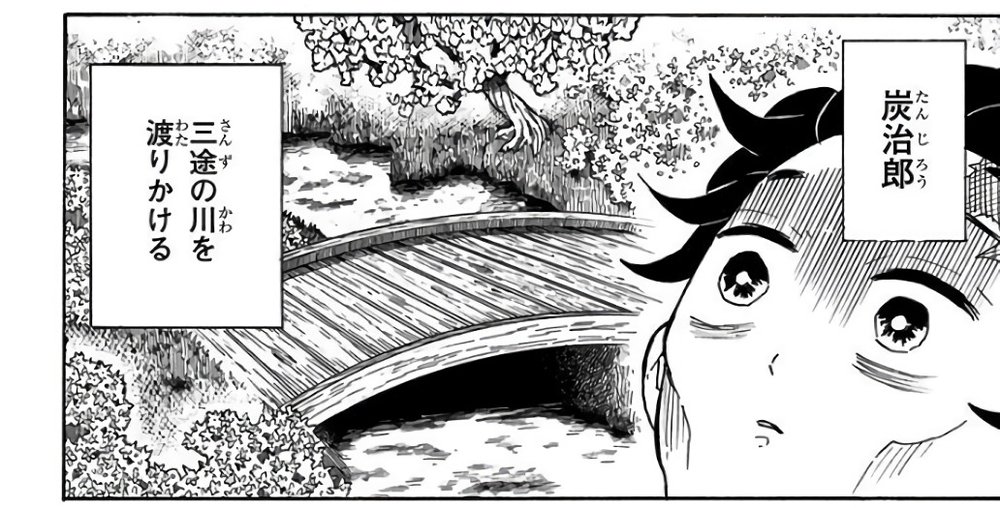
「三途の川を渡りかける」
Sanzu no kawa o watarikakeru.
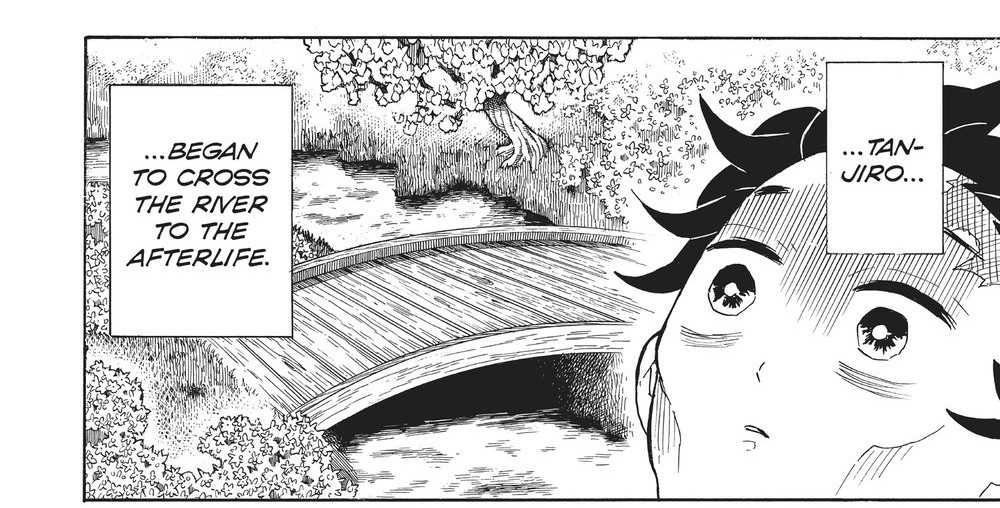
Our bilingual corpus has no English recorded against this line at all — the automated aligner, working panel by panel, left the pairing blank, most likely because a narration box spanning a panel break gave it nothing obvious to latch onto. Opening VIZ's actual printed page settles what's really there: "...BEGAN TO CROSS THE RIVER TO THE AFTERLIFE." (Vol. 12, p.136).
Grant the rendering its due first: the one piece of grammar doing the heaviest lifting in the Japanese — かける, "began to X, but didn't finish" — survives the trip intact as "began to cross." That distinction is the entire joke. A few panels later, the strip pays it off: Tanjiro's face, startled awake, labeled just "...TANJIRO...", followed by "WITH AN INDESCRIBABLE GIDDY FEELING... HE WAS CROSSING THE BRIDGE." and then "BUT HE WAS DIZZY FROM HUNGER..." — the rain that opens the whole sequence arrives just in time, and, per the strip's very first line, 途中雨が降ったため炭治郎の命は繋がった — "TANJIRO'S LIFE WAS SAVED BY THE FACT THAT IT STARTED RAINING."
Worth pausing on that first line for a second reason: "partway" is 途中 (tochū) — the same 途 about to reappear one panel later, in different company, inside 三途 (sanzu). Gotouge's narration boxes are quietly playing with the same kanji twice on one page; the translation, working sentence by sentence, has no way to preserve that echo.
The Original
Take the compound apart. 三 (san) is simply "three." 途 (to) means "path, route, way" — the kanji inside 途中 (tochū, "on the way, partway," already on this page), 前途 (zento, "the road ahead"), and 用途 (yōto, "purpose, use"). Add the possessive の and 川 (kawa), "river," and 三途の川 comes out, almost brutally literally, as "the river of three paths."
That is not poetic flourish. It's a name that encodes a doctrine: this river doesn't have one way across. It has three, and which one a soul is assigned depends on how that soul lived — a detail the rest of this article's Cultural Context section unpacks in full. For now, notice what the name is already doing grammatically: 三途 functions as a fixed compound noun, effectively a proper name (much like how English capitalizes "the Styx" without needing to gloss it every time), even though every syllable in it is ordinary, decomposable Japanese.
The verb stacked onto it is the other half of the lesson. 渡る (wataru) is the everyday verb "to cross" — bridges, streets, rivers, borders. Drop to its ます-stem, 渡り, and attach かける, the auxiliary (JLPT N3 grammar) that turns almost any verb into "began to X, but didn't complete it": 食べかける is "took a bite and stopped," 死にかける is "came close to dying." 渡りかける applies that exact grammar to the one crossing a person isn't meant to survive. Structurally, it's a completely ordinary N3 pattern. Applied here, it's a euphemism for "nearly died" precise enough to specify exactly how close.
VIZ's Choice
三途の川 appears exactly once across the Demon Slayer volumes in our corpus, so there's no scatter table to read here — only one translator, one caption box, one decision, worth sitting with on its own. It's also, unusually for this site, a decision our own database can't show you: the automated jp↔en alignment recorded nothing for this pair, so the only way to know what VIZ actually printed was to open the physical page.
That page shows "...BEGAN TO CROSS THE RIVER TO THE AFTERLIFE." — a clean, literal rendering of the verb ("began to cross," not "crossed") paired with a generic destination noun for the object. This wasn't corner-cutting under deadline pressure with no good options available; it's a caption box with room to spare, in a low-stakes comedy aside, and the translator still reached for the plainest possible English. That's a real, defensible choice: "the river to the afterlife" reads instantly, costs no footnote, and doesn't ask a reader mid-gag to absorb an unfamiliar proper noun. The price of that plainness is the entire subject of this article — but it's worth being honest that a fancier rendering would have slowed down a joke that depends on speed.
The Gap
The "three" disappears. 三途 doesn't just mean "the river of the dead" — it names a specific triad of crossings, graded by conduct, judgment built into the river's geography before any court convenes. "The river to the afterlife" is accurate about the destination and mute about the mechanism. Nothing in the English tells a reader that which ford a soul receives was ever a live question.
It invites the wrong myth. An English reader reaching for a nearest analogue will likely supply the Styx: Charon, a coin under the tongue, one channel, judgment handled afterward by three separate judges on the far shore. Sanzu no Kawa's judgment happens at the river itself — which crossing you're assigned is the verdict, delivered before anyone is questioned. "The river to the afterlife" doesn't just under-translate the doctrine; it primes exactly the cross-mythology substitution that makes two genuinely different afterlife systems feel interchangeable.
The bridge stops being a clue. Because the English destination is generic, nothing marks that the specific crossing Gotouge draws — a bridge, not a ford, not a deadly current — is folklore's reward for a blameless life. A Japanese reader who knows the belief clocks the bridge as a quiet character note about exactly who is (barely) making this crossing. In English it reads as scenery a cherry tree happens to be growing next to.
What If
The menu and its prices:
- "...began to cross the River of Three Crossings..." — keeps the defining number visible in the name itself. Cost: reads like invented fantasy nomenclature with no gloss attached, and doubles "cross" awkwardly in one clause.
- "...began to cross the Sanzu, the river of the dead..." — transliterates and glosses lightly, extending VIZ's own established policy toward untranslated Buddhist vocabulary elsewhere in this series (南無阿弥陀仏 stays NAMU AMIDA BUTSU; see our companion piece). Cost: still drops the sin-graded-crossing doctrine entirely — a reader learns "there's a river," nothing more.
- "...began to cross Japan's river of judgment..." — trades the proper noun for its function, at least hinting something is being weighed. Cost: invites the Styx comparison anyway, and "judgment" stages a courtroom the artwork — a boy wobbling across a pretty bridge — doesn't visually support.
- "...and it was the easy crossing..." — folds the bridge-equals-sinless doctrine into description instead of naming a river at all. Cost: abandons the proper noun completely; a reader who already knows 三途の川 from other manga, games, or anime loses the chance to recognize it here.
Every option pays for its gain in speed or clarity — which is exactly the trade the actual translator made, just further toward "clarity" than any of these.
Take-away
A one-panel gag about a boy who nearly starved himself walking across a river turns out to be carrying a whole cosmology: which of three crossings you get is itself the verdict on how you lived, and the bridge Gotouge draws Tanjiro on isn't a random one.
Three rules of thumb to carry off this page:
- 三途の川 is a place with rules, not a mood. Whenever it appears, three graded crossings and a judgment already rendered are standing behind it, even in a throwaway comedy panel.
- Don't let the nearest Western myth do the translating for you. "The river of the dead" invites the Styx by default — but the Styx's judgment happens after the crossing, by separate judges; the Sanzu River's judgment happens at the ford itself. The resemblance is real and still misleading.
- When Gotouge draws a specific detail from a folk doctrine — a bridge, a banner, a set of banners — ask what the doctrine says about that specific detail before assuming it's just scenery.
This river belongs with a small cluster of Buddhist death-vocabulary running through this series that English keeps having to improvise around: the verb Tanjiro uses to send his first kills onward, in 成仏してください and the epitaph that points the wrong way; the specific paradise a villain privately doesn't believe in, in 極楽 and the footnote VIZ used when the kanji wouldn't move; the hungry-ghost hell hiding inside a schoolyard insult, in 餓鬼 and the hungry-ghost hell behind every "brat"; the heaven Muzan is certain isn't watching, in 天罰 and the impersonal heaven English keeps personifying; the one prayer VIZ chose to translate, in 南無三 and the one prayer VIZ chose to translate; and the execution ground buried inside an everyday idiom for pressure, in 土壇場 and the execution ground English only hits by accident. Or browse the whole Demon Slayer translation notes index.
Every Japanese line quoted above, and three of the four English lines, are byte-exact captures from the cited edition — 鬼滅の刃 Vol. 12 (Japanese) and Demon Slayer: Kimetsu no Yaiba (VIZ Media) at the corresponding panels — via our bilingual page database; see Sources below. The one exception is this article's headline: our database's automated jp↔en alignment left the English side of 三途の川を渡りかける blank, with no VIZ line recorded against it. The rendering quoted and analyzed throughout this piece, "...BEGAN TO CROSS THE RIVER TO THE AFTERLIFE.", was confirmed by reading VIZ's printed English page directly (Vol. 12, p.136); rawCaptureEn is kept as the database's empty string in Sources/References for traceability, not because VIZ printed nothing.