The Moment
Water Seven, outside the Galley-La Company mansion. Iceberg — introduced on the page just before ours with his full title, Water Seven's mayor and the president of the Galley-La shipbuilding company — is having an ordinary morning: fussing over a jam-packed schedule his secretary is reading back to him, naming a stray pet mouse "Tyrannosaurus," grumbling いやだ!!! ("I don't want to!") about a lunch meeting. Luffy and Nami are watching. Luffy, unimpressed, mutters that the man is 市長失格じゃねェか完全に — "a total failure as a mayor." It is said just loudly enough, apparently, for the wrong person to hear it.
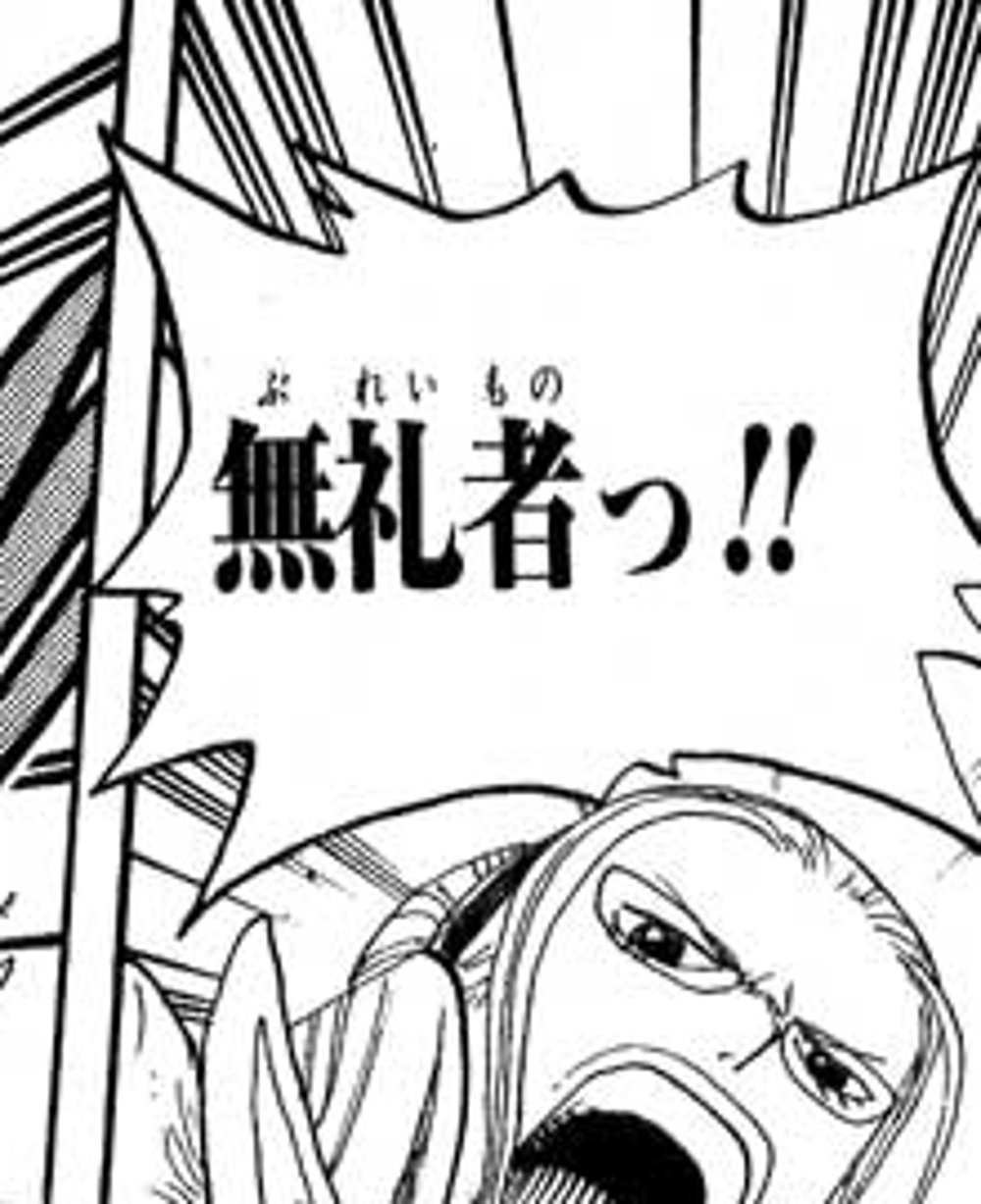
That person is Kalifa — Iceberg's secretary, drawn as the picture of composed professionalism: glasses, headband, a portfolio clutched to her chest. Composure lasts exactly as long as it takes her to close the distance. A flying kick sends Luffy tumbling through the panel — うわわっ!!! — and Kalifa's face fills the next box, teeth bared behind her glasses, with one word:
「無礼者っ!!」
Bureimono'!!
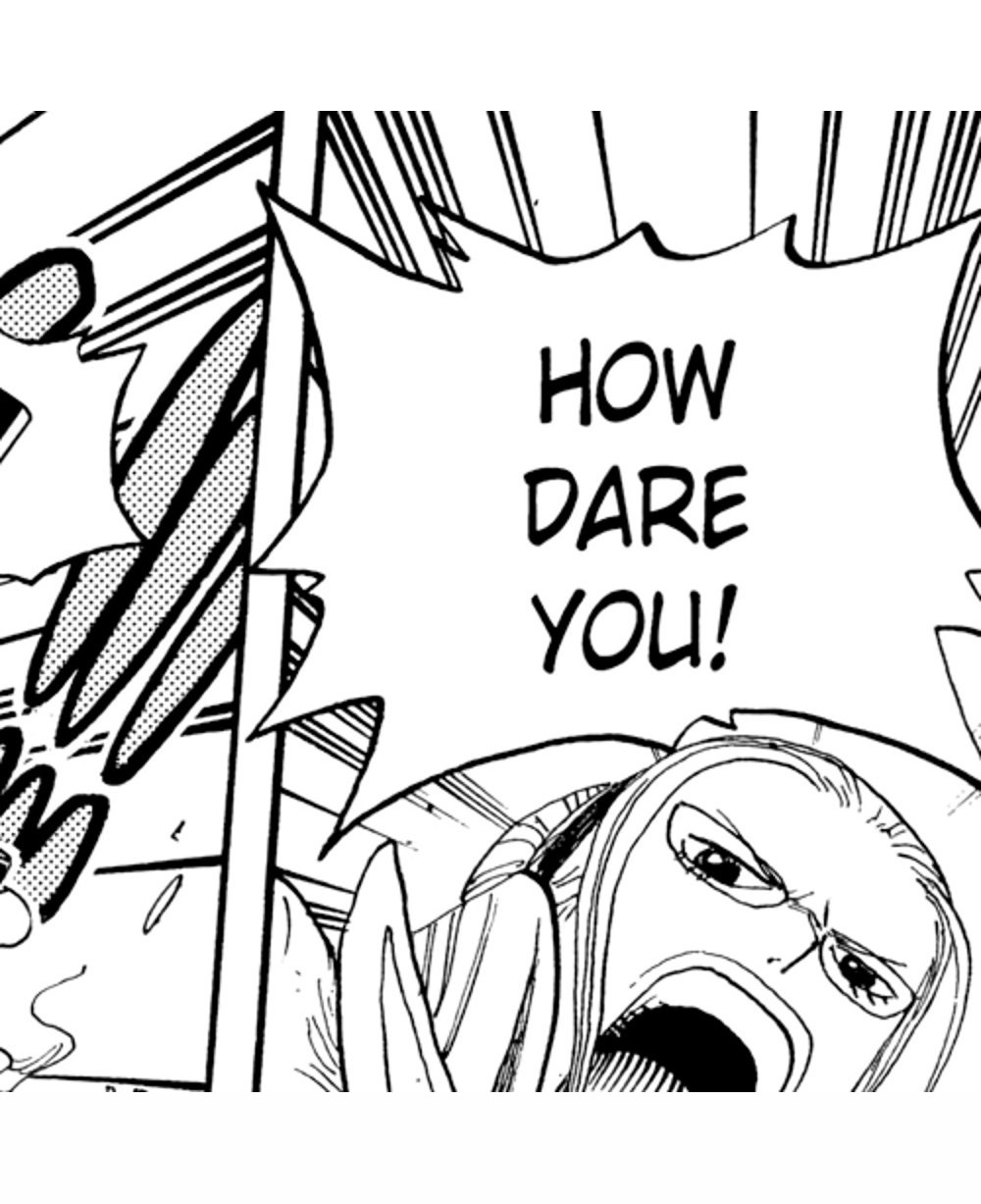
VIZ's English edition prints: "HOW DARE YOU!" (Vol. 34, p.200).
Grant the rendering its due: "HOW DARE YOU!" is a genuinely good four-word punch for the panel — it's outraged, it's clipped, it lands exactly where the Japanese bubble sits. The problem isn't that it's wrong. It's that it's available to anyone. A child could shout it at a parent; an employee could shout it at a boss. What Kalifa actually says can only be said in one direction.
Worth noting: the poise comes back almost as fast as it left. One page later, Kalifa catches herself — 「はっ!!失礼つい取り乱してしまいました」, "AHEM! PARDON ME, I GOT CARRIED AWAY" — and explains, in the same breath, why she reacted the way she did: アイスバーグさんは市民の憧れ…あまり無礼のない様に!! — Mr. Iceberg is beloved by the citizens here, so please don't be too 無礼 (rude) toward him. The scene runs the whole word family in miniature: 無礼者 hurled outward, 失礼 turned back on herself the instant she remembers that a secretary, of all people, is supposed to embody the very propriety she's just been screaming about.
The Original
Take 無礼者 apart, because each piece is doing real work.
礼 (rei) is the load-bearing morpheme: the old Confucian concept of correct ritual form, the same 礼 sitting inside 礼儀 (reigi, "manners"), 敬礼 (keirei, "salute"), and お礼 (orei, the formal gift or thanks that repays a debt of propriety). It is not politeness as a feeling; it is propriety as a form — the right bow, the right word, the right distance kept from the right person.
無 (mu) — here irregularly read ぶ — simply negates it: without rei.
Then comes 者 (mono), the bare noun-suffix for "person," and this is where the grammar turns dangerous. 者 doesn't describe an action; it manufactures a category of person out of a quality. It's the same 者 that turns 忍ぶ ("to endure, to conceal oneself") into 忍者 (ninja, "one who endures"); that turns 悪 ("evil") into 悪者 (warumono, "villain"); that turns 曲 ("crooked") into 曲者 (kusemono, "a shifty one"). Stack 無礼 and 者 together and the sentence stops being a review of behavior and becomes a verdict on identity: not "you acted without proper form just now," but "you are, categorically, a person devoid of proper form."
That verdict has never been neutral. 無礼者 belongs to Japanese's oldest formal register — throne-room and dojo vocabulary, the stock accusation of every jidaigeki lord catching a commoner out of line. As a headword, 無礼 sits at roughly JLPT N1: formal, mostly literary, the kind of word you meet in period drama and legal writing more than daily conversation. Its everyday cousin 失礼 — "excuse me," "that was rude of me" — is taught at N4 and gets used dozens of times a day. Same root, opposite direction: one you say about yourself to smooth a small breach; the other you say about someone else to name a large one.
And the stakes were once literal. Under Edo-period samurai law, 無礼打ち (bureiuchi) was the codified right of a samurai to cut down a commoner on the spot for a sufficiently serious breach of etiquette toward him — a real legal doctrine, not a stock threat. Even the culture's escape hatch proves how load-bearing the concept is: 無礼講 (bureikō) is the specific word for a banquet where rank is formally set aside for the night, precisely because ordinary Japanese social life is assumed to run on knowing where you stand. 無礼者 is what you're called the moment you forget.
VIZ's Choice
無礼者 surfaces three times in the volumes we have on file — all three inside the same Water Seven arc, all three swinging the same word at someone who has stepped out of line with a person of standing:
| Vol. / p. (JP → EN) | Speaker | Japanese | VIZ English |
|---|---|---|---|
| 34 / p.191 → p.200 | Kalifa, Iceberg's secretary, to Luffy | 無礼者っ!! | HOW DARE YOU! |
| 34 / p.214 → p.223 | An elder Water Seven shipwright, to Luffy | 無礼者っ!!! | Rude!!! |
| 35 / p.173 → p.178 | Iceberg, newly conscious after an assassination attempt, to his own rowdy foremen | 無礼者!!みんな大人しくなさい!!! | YOU IDIOTS! BE QUIET, ALL OF YOU! |
(A note on the middle row: the English-edition scan for p.223 is missing from our local page-image archive, so this row rests on the bilingual database's high-confidence text extraction — 0.98 — rather than a personally verified panel crop, unlike the headline pair, which we confirmed against both page images directly. The line itself is short and low-ambiguity, and it fits the surrounding dialogue exactly: the shipwright is mid-sentence, listing how many shipwrights the island has, when Luffy's casual "wanna join my crew as a pirate?" cuts him off — そりゃ船大工はごまんといるがー…無礼者っ!!!, "sure, there are plenty of shipwrights here, but— how DARE you!!!")
The pattern across all three: 無礼者 only comes out of the mouths of people with something to protect. Kalifa is protecting her employer's dignity. The shipwright is protecting his own — Water Seven's craftsmen, we're told a few pages earlier, 海賊にも権力にも屈しない…「They won't bow to pirates or authority...」, and a casual pirate's recruitment pitch reads to him as exactly that kind of disrespect. And in Volume 35, Iceberg — freshly awake after being shot, testimony already given, foremen crowding loudly into his sickroom — is protecting the last thing a convalescent authority figure has left: quiet, and being listened to. Three different people, three different things at stake, one word for all of it. VIZ's answers scatter from formal indignation ("HOW DARE YOU!") to a shrug ("Rude!!!") to a full swap of insult category ("YOU IDIOTS!" — the bilingual database itself flags this pair for role_language loss, its highest-confidence tag on any 無礼者 occurrence in the set).
The Gap
Rank-blindness. "How dare you!" is available to absolutely anyone, in either direction, for any offense that feels like a violation. 無礼者 is not: it can only be aimed downward, or spoken in defense of someone positioned above the target. The word itself asserts the ladder before it says anything about what happened on it. None of VIZ's three renderings — outraged, dismissive, or insulting — reproduce that one-way street.
A noun collapsed into an adjective. 無礼者 doesn't describe conduct; it labels a person, the same move as calling someone 悪者 rather than saying they "did something bad." "Rude!!!" is exactly the adjective 無礼者 refuses to be — a passing description of behavior, not a branding of identity. The heavier, slower accusation — you ARE this — quietly becomes the lighter, faster one — that was rude.
The wrong crime, once. In Volume 35, "YOU IDIOTS! BE QUIET, ALL OF YOU!" doesn't just soften 無礼者 — it changes what the foremen are being accused of. The Japanese charges them with disrespect toward a recovering superior; the English charges them with stupidity. Different offense, different social shape, and the corpus's own pitfall annotation flags exactly this swap.
The self-correcting twin goes missing. 無礼者 and 失礼 share a root, and the Kalifa scene uses both — one thrown at Luffy, the other turned on herself one page later. English's "HOW DARE YOU!" and "pardon me, I got carried away" don't share so much as a syllable. The Japanese reader watches the same moral vocabulary swing from accusation to self-correction in the space of a page; the English reader meets two unrelated phrases and never feels the symmetry.
What If
No option is free; here's the menu Kalifa's line could have ordered from instead.
- "YOU INSOLENT WRETCH!!" — keeps the archaic hauteur and the noun-as-label feel ("wretch" brands a type of person, the way 者 does). Cost: reads as costume-drama in a contemporary manga panel — more Shakespeare than shipyard.
- "KNOW YOUR PLACE!!" — makes the hierarchy explicit, which "HOW DARE YOU" never does. Cost: trades the noun-insult grammar for a command; it no longer labels the addressee, it just orders him.
- "INSOLENCE!!" — a single formal word English still reaches for in exactly this kind of rank-based rebuke (guards, courtiers, drill sergeants). Cost: a half-step more Anglo-aristocratic than jidaigeki, and it drops the 者 — it names the offense, not the offender.
- "WHO DO YOU THINK YOU'RE TALKING TO?!" — restores the missing half of the equation by forcing the rank question into the open. Cost: long for a single bubble, and it becomes a rhetorical question instead of an accusation.
Every option trades something specific for something else — the label, the hierarchy, the period-drama register — because English simply never built a single word that does all three jobs at once.
Take-away
無礼者 is what a person with standing to defend calls someone who has just forgotten there's a ladder at all. It is a noun before it is an insult, a verdict before it is an emotion, and it only ever points one way.
Three rules of thumb to carry off this page:
- When you meet a 者-suffixed insult, ask what identity it's manufacturing. 無礼者, 悪者, 曲者 — all of them turn a quality into a category of person. English's closest move is calling someone "a rude one" or "a villain," not describing what they did.
- Track 無礼 and 失礼 as a pair, not two separate words. One thrown outward at a violation, one turned inward to repair a small one — the same root doing opposite jobs depending on who it's aimed at.
- Watch for words that presuppose a ladder before they describe a feeling. 無礼者 tells you who's on top before it tells you what happened; "how dare you" tells you someone's angry and stops there.
This word runs in tandem with another register-loaded piece of Japanese confrontation vocabulary, the contemptuous pronoun 貴様 (kisama) — a companion study for another day. For now, see the One Piece translation notes index for more places where a single Japanese word carries a whole social structure English has to leave at the door.
Every Japanese and English line quoted above is a byte-exact capture from the cited editions — ONE PIECE Vol. 34–35 (Japanese) and One Piece (VIZ Media) at the corresponding panels — via our bilingual page database; see Sources below.