The Moment
Gaara is dying. Akatsuki has extracted the One-Tail, and the retired Sunagakure elder Chiyo — the only person left with the poison expertise to try to save him — is running out of road. Ebizo, her brother, has just floated the one name that might still help: someone even more versed in antidotes than Chiyo herself. Chiyo answers with visible reluctance:
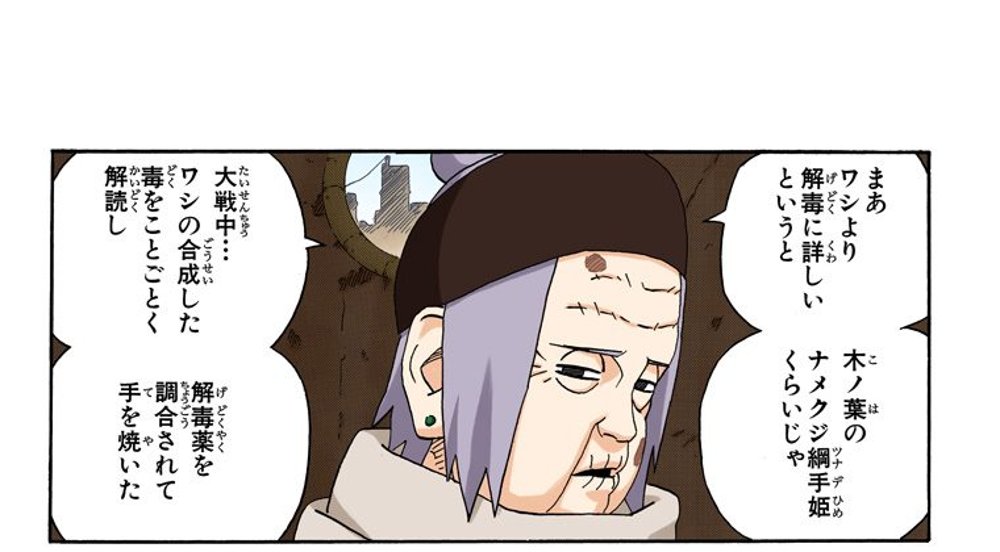
「まあワシより解毒に詳しいというと..木ノ葉のナメクジ綱手姫くらいじゃ」
Maa washi yori gedoku ni kuwashii to iu to… Konoha no namekuji Tsunade-hime kurai ja.
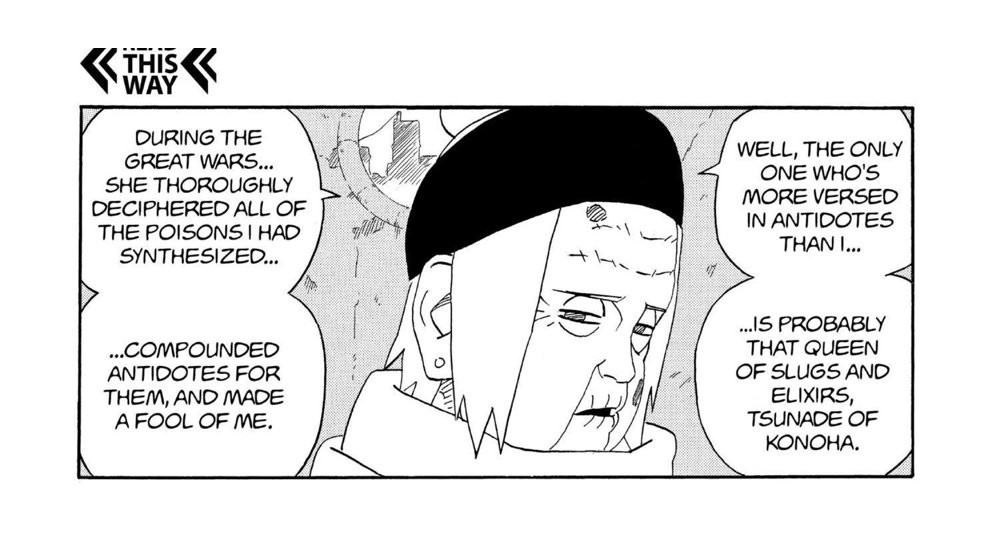
VIZ: "WELL, THE ONLY ONE WHO'S MORE VERSED IN ANTIDOTES THAN I... ...IS PROBABLY THAT QUEEN OF SLUGS AND ELIXIRS, TSUNADE OF KONOHA."
Then, before anyone can savor the compliment, Chiyo undercuts it with a memory:
「大戦中..ワシの合成した毒をことごとく解読し..解毒薬を調合されて手を焼いた」
Taisenchuu… washi no gousei shita doku o kotogotoku dokudoku shi… gedokuyaku o chougou sarete te o yaita.
VIZ's English edition prints: "DURING THE GREAT WARS... SHE THOROUGHLY DECIPHERED ALL OF THE POISONS I HAD SYNTHESIZED... ...COMPOUNDED ANTIDOTES FOR THEM, AND MADE A FOOL OF ME." (Vol. 28, p.175)
Grant the rendering its due: "made a fool of me" lands the exasperation, keeps Chiyo's grudging respect intact, and reads naturally in a manga bubble. Nothing about the plot or the character beat is lost. But 手を焼いた isn't "made a fool of me" — it's my hand got burned [handling this], a specific, physical admission from a woman whose entire craft runs through her hands: mixing poisons, compounding antidotes, and — as this arc's climax reveals — puppeteering chakra threads. The joke Chiyo isn't quite making, but that the idiom is quietly making for her, is that her hands, of all things, are what Tsunade got the better of.
The Original
手 (te) — "hand." No tricks, no compound; beginner-level kanji learned in the first weeks of study.
焼く (yaku) — "to burn, scorch, roast, grill." A workhorse transitive verb with a completely consistent physical logic: 焼き魚 (grilled fish), 目玉焼き (fried egg — literally "eyeball-fry"), 日焼け (suntan — literally "sun-burn"). Every compound pictures the same event: something meeting heat and changing because of it, usually not comfortably.
Put them together and 手を焼く reads almost like a stage direction: the hand meets something too hot, and burns for it. Unlike English idioms that have drifted far from their literal roots, this one still shows its work — the picture is a hand reaching for something (a boiling pot, a hot coal, in this idiom's case: a rival's poisons) and getting scorched, then having to keep working the problem anyway because the job isn't finished. Grammatically it's a simple transitive frame, [X は/が 手を焼く], "X burns a hand [managing something/someone]" — and its tense carries real information. Chiyo's 手を焼いた (past, closed) reports a finished defeat. Kabuto's 手を焼いている / 手を焼いてる (progressive) reports an ongoing, unresolved scorch — the burn hasn't stopped.
As vocabulary, 焼く itself is elementary — N4/N5, one of the first verbs a learner meets attached to food. 手を焼く as a fixed idiom sits a tier up, around N2: everyday enough that native speakers use it without consciously picturing a burn, rare enough that most learners meet it as a whole unit rather than by parsing 焼く first.
VIZ's Choice
Every appearance of 手を焼く in the Naruto volumes on file, spoken by two different characters about the same troublesome center of gravity — Orochimaru's orbit:
| Vol. / p. | Speaker | Japanese | VIZ English |
|---|---|---|---|
| 28 / 175 | Chiyo, on Tsunade | 解毒薬を調合されて手を焼いた | ...COMPOUNDED ANTIDOTES FOR THEM, AND MADE A FOOL OF ME. |
| 33 / 093 | Kabuto, on the Akatsuki vs. Orochimaru | "暁"の連中も大蛇丸様には手を焼いてるからね | ...THE AKATSUKI IS STILL REELING FROM LORD OROCHIMARU'S DEFECTION, YOU KNOW. |
| 40 / 071 | Kabuto, on Orochimaru vs. Manda | 大蛇丸でさえ手を焼いていたこいつをどうやって.. | I KNOW EVEN HE HAD TROUBLE CONTROLLING THE SERPENT, SO HOW DID SASUKE... |
Chiyo's line closes a sentence about a war-era rivalry. Five volumes later, Kabuto — freshly introducing himself to Sakura and Sai on a bridge, laying out why Sasori bothered revealing their location — uses the same idiom about the same man: 「“暁”の連中も大蛇丸様には手を焼いてるからね」, "even the Akatsuki are having a hard time with Lord Orochimaru." VIZ restructures the whole beat: "...THE AKATSUKI IS STILL REELING FROM LORD OROCHIMARU'S DEFECTION, YOU KNOW." The Japanese describes an ongoing struggle (still, right now, they can't manage him); the English describes the aftermath of a single past event (his defection happened, and they're still shaken by it). Close in spirit, but the tense — and the hand — both slip.
Seven volumes later still, watching Sasuke's Sharingan bring the giant summon Manda to heel in seconds, Kabuto reaches for the idiom a third time, mid-thought: 「大蛇丸でさえ手を焼いていたこいつをどうやって..」. VIZ: "I KNOW EVEN HE HAD TROUBLE CONTROLLING THE SERPENT, SO HOW DID SASUKE..." — the most literal of the three renderings, and the only one where "trouble" survives at all. But "trouble" is a fact about the situation; 手を焼く is a fact about a hand.
Three correct translations. Zero surviving hands. Zero surviving burns. And because the English vocabulary never repeats, no reader of the VIZ edition ever notices that Chiyo's old grudge and Kabuto's two asides are all the same four-mora idiom talking about the same unmanageable center of gravity.
The Gap
The heat disappears. "Made a fool of me," "reeling from... defection," and "had trouble controlling" are all accurate, but none of them is about a hand meeting something hot. 手を焼く never lets go of the burn; every VIZ line here quietly sets it down. English isn't even short a candidate — "too hot to handle" is sitting right there, the closest true cousin this idiom has, and it goes unused in all three lines.
The aspect goes flat. Kabuto's two lines use the -ている form, an ongoing, still-unresolved scorch — "is having a hard time," present and continuing. "IS STILL REELING FROM... DEFECTION" quietly reframes that ongoing struggle as the aftermath of one finished event; "HAD TROUBLE CONTROLLING" resolves it into simple past. Chiyo's own line is genuinely closed (焼いた, not 焼いている) — but "MADE A FOOL OF ME" pushes past plain difficulty into something closer to embarrassment, a shade the Japanese doesn't quite claim on its own.
One idiom, three unrelated sentences. Chiyo and Kabuto never share a scene, but they're both reaching for the identical fixed idiom to describe the identical gravitational pull of Orochimaru's world being more than anyone can hold onto — a war-era rival, a criminal organization, a summoned monster. A Japanese reader catches that rhyme on sight. An English reader gets three sentences that share no vocabulary and advertise no connection whatsoever.
What If
- "SHE LEFT MY HANDS SINGED, COMPOUNDING ANTIDOTES FOR EVERY POISON I MADE." — keeps the burn and the exasperation in one image. Cost: too long for a single manga speech bubble; doubles up where VIZ's line only needed to land once.
- "SHE GAVE ME NOTHING BUT BURNED FINGERS." — compact, keeps the heat, reads like an idiom even though English doesn't actually own this exact one. Cost: readers may take it as a literal injury rather than recognize the figurative exasperation.
- "EVEN THE AKATSUKI CAN'T HANDLE HIM — HE'S TOO HOT TO TOUCH." (for Kabuto's Akatsuki line) — reaches for "too hot to handle," English's nearest true cousin to 手を焼く. Cost: "too hot to touch" risks reading as literal danger — poison, jutsu — rather than the specific sense of "impossible to manage."
- Keep VIZ's plain "trouble," restore a hand: "EVEN HE COULDN'T KEEP A GRIP ON THIS ONE." (for the Manda line) — trades the burn for a grip. Cost: "grip" quietly borrows from 手に負えない's weight-and-carrying logic instead, blurring the two idioms this article is trying to keep apart.
Take-away
手を焼く doesn't just report that something is hard to manage — it reports a specific injury sustained in the trying: a hand reaching for something too hot, getting burned, and having to keep working the problem anyway. Chiyo's old rivalry with Tsunade, the Akatsuki's frustration with Orochimaru, and Orochimaru's own trouble leashing Manda are three very different scales of unmanageable, and Japanese describes all three with the same scorched hand.
Three rules of thumb to carry off this page:
- Whenever you meet 焼く attached to something intangible, look for heat doing quiet metaphorical work — 手を焼く (burned by difficulty), 世話を焼く (tending, not burning, a positive labor with the same root), 焼き餅を焼く (jealousy, via a homophone pun on 妬く) — one sound, several very different temperatures.
- Check the aspect, not just the verb. 手を焼いた (past, closed) and 手を焼いている (ongoing, unresolved) are reporting two different states of the same burn — English's "had trouble" tends to flatten both into simple past.
- Don't let 手を焼く collapse into 手に負えない. Both put a hand at the center of a failure, but the physics differ: 手に負えない is about weight (負う, "to carry"), 手を焼く is about heat. One hand fails by dropping something; the other fails by letting go.
Naruto's hand-and-body idioms keep circling this same insistence that the body try, and fail, before the verdict arrives: see the sister article on 手に負えない, where Jiraiya, an unnamed shinobi, and Kankuro all admit something is too heavy for their hands rather than simply "out of control," and 歯が立たない, where Rock Lee's teeth fail to bite before he'll say the word "defeat." Sakura gets the limb-based idiom rerouted the other direction in 足手まとい, where being "tied hand and foot" becomes simply being "in the way." For more of what Naruto's translators quietly set down, browse the full Naruto translation notes index.
Every Japanese and English line quoted above is a byte-exact capture from the cited editions — NARUTO―ナルト― Vol. 28, 33 & 40 (Japanese) and Naruto Vol. 28, 33 & 40 (VIZ Media) at the corresponding panels — via our bilingual page database; see Sources below.