The Moment
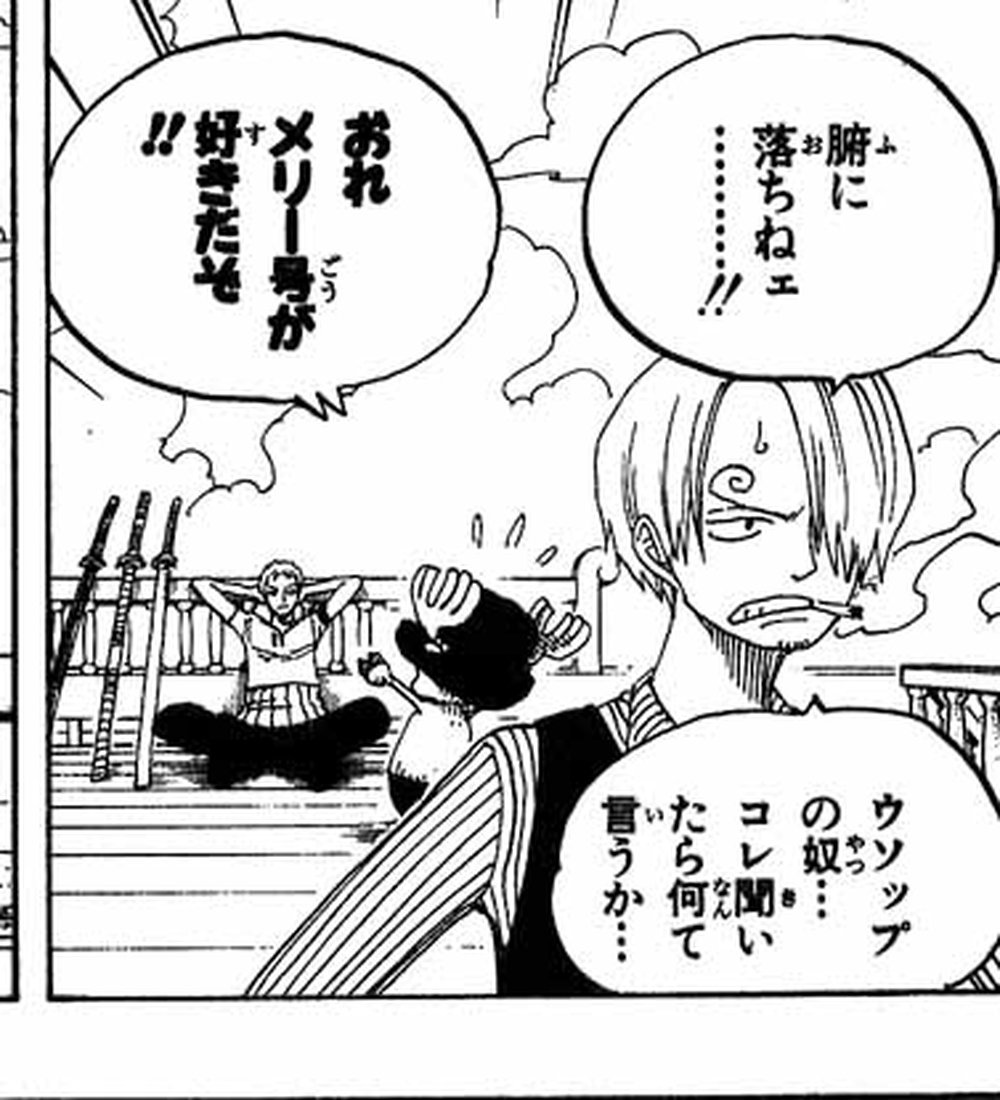
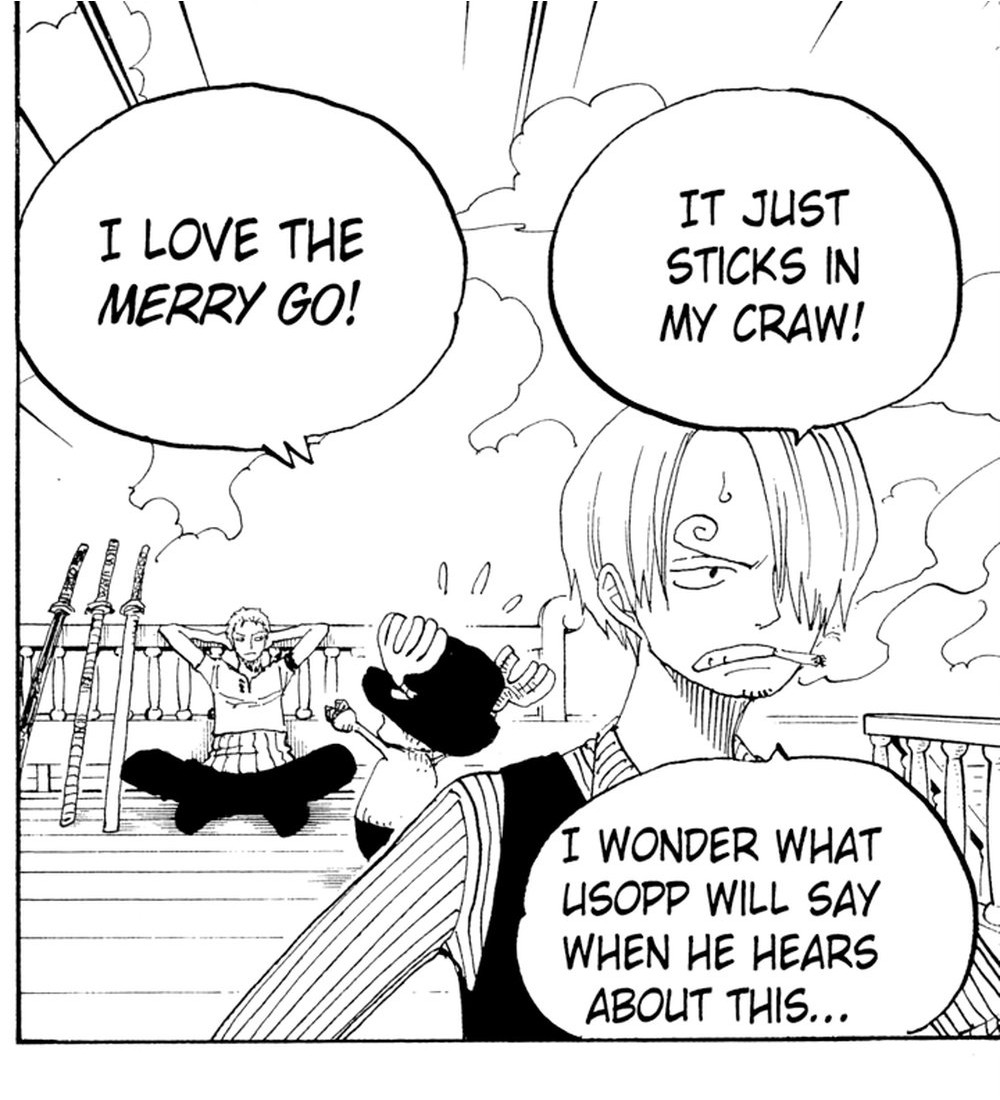
Volume 35. The Straw Hats have hauled their battered ship into Water Seven, the city of shipwrights — and the word that comes back aboard is the one word no crew wants to hear. Zoro, arms behind his head against the rail, relays it with the grammar of hearsay: 「全員そうさ…」「だが現状打つ手はねェそうだ」 — "WE ALL FEEL THAT WAY... BUT WE CAN'T CHANGE REALITY." The Going Merry, they're told, is beyond saving. Chopper flails in protest — 「おれメリー号が好きだぞ!!」 ("I LOVE THE MERRY GO!") — and in the foreground Sanji, cigarette clamped, a sweat bead on his temple, growls the line this article is about:
「腑に落ちねェ……!!」
Fu ni ochinē……!!
VIZ's English edition prints: "IT JUST STICKS IN MY CRAW!" (Vol. 35, p.32).
Usually this is where we grant the translation its due before showing what it lost. Not today. Today the headline rendering is the win — one of the cleanest idiom-for-idiom conversions in the run — and the loss sits twelve volumes earlier, where the very same Japanese expression came out as weather. Same word, one hit, one miss: a controlled experiment in what happens to a gut idiom on its way into English.
One more bubble from the scene, because it hurts: Sanji's next line is 「ウソップの奴…コレ聞いたら何て言うか…」 — "I WONDER WHAT USOPP WILL SAY WHEN HE HEARS ABOUT THIS..." The man who will take the ship's death hardest doesn't know yet.
The Original
腑 (fu) is anatomy — but anatomy from the Chinese medical chart that came to Japan with the kanji. That tradition splits the innards in two. The 臓 (zō) are the five solid, storing organs — heart, liver, lungs, kidneys, spleen: the 五臓. The 腑 (fu) are the six hollow, processing organs — stomach, intestines, gallbladder, bladder and company: the 六腑. Together they make 五臓六腑 (gozō roppu), "the whole of one's insides," the phrase Japanese drinkers still use when the first sip of the evening 染み渡る — soaks through — everything. So 腑 is not vaguely "the gut"; it is specifically the plumbing that food passes through.
Now bolt on 落ちない, the negative of 落ちる, "to fall — to drop and settle." Literally: "it won't fall into my viscera."
The picture is precise. An explanation is something you swallow. Hearing it is only the first stage — the ears are an intake valve. Real acceptance happens lower down, when the thing drops the rest of the way and settles in the organs that actually process what comes in. 腑に落ちない says the drop never happened: the story has been heard, parsed, even repeated back — and it is still lodged somewhere between ear and stomach, undigested. That's why the idiom is epistemic, not emotional: it is a verdict on evidence ("this doesn't add up for me"), delivered in the vocabulary of digestion.
Japanese keeps a whole family of these torso-thoughts: anger is a rising belly (腹が立つ), scheming is a black belly (腹黒い), total frankness is splitting the belly open (腹を割って話す), grief severs the intestines (断腸の思い). And 腑 itself doubles as the seat of character: 腑抜け (funuke) — "with the innards taken out" — is the standard word for a spineless coward. The gut is where both conviction and courage live; 腑に落ちない reports a failure of the first, 腑抜け a failure of the second.
Grammar notes for the two speakers we're about to compare: Sanji's ねェ is rough male speech for ない, the small-katakana ェ spelling a snarl. Igaram's 落ちん uses the stiff, old-fashioned ん-negative — a palace official's grammar — softened by どうも, "try as I might, somehow." Same idiom, cook's growl and courtier's murmur. As vocabulary, 腑に落ちない is JLPT N1 territory built on N4 grammar; the only hard part is the organ, and the organ is the point.
VIZ's Choice
Both occurrences in the volumes we have on file:
| Vol. / p. | Japanese | VIZ English |
|---|---|---|
| 23 / 173 | ん~~~どうも腑に落ちん | HMM... I HAVE AN UNEASY FEELING. |
| 35 / 33 | 腑に落ちねェ……!! | IT JUST STICKS IN MY CRAW! |
Vol. 23 first — the miss. Alabasta, late at night, after the Straw Hats have slipped away from the palace. Down the page, Princess Vivi lies awake telling her duck Karoo how quiet the halls are — 「ここには冷蔵庫荒らしと格闘するコックさんも」…「…誰もいない」 ("NOW THERE'S NO COOK TRYING TO PREVENT MIDNIGHT REFRIGERATOR RAIDS... IT'S JUST US."). Up in the corridor, Captain Igaram paces with his guards trailing — 「我々は…何をすれば…」 ("WHAT SHOULD WE DO?") — and mutters:
「ん~~~どうも腑に落ちん」
Nnn… dōmo fu ni ochin.
And then, crucially, he shows his work: 「……?あっさりしすぎている…」 — VIZ, reading the unstated subject as the princess: "SHE'S TAKING THIS TOO CALMLY." That second line proves the first was a deduction. Igaram has data — Vivi's suspicious composure — and a conclusion that refuses to settle. VIZ prints "HMM... I HAVE AN UNEASY FEELING.": a premonition, a shiver, weather. The evidence-shaped idiom became a mood, and the palace's shrewdest worrier became a man with a bad vibe.
Vol. 35 — the hit. A craw is a bird's crop: the pouch in the gullet where food sits before digestion. To say something sticks in your craw is centuries-old English farm vocabulary for swallowed but refusing to go down — a thing you cannot accept, lodged in the pipe. Set the two idioms side by side and they align joint for joint: an organ of digestion, standing in for the mind; a piece of unwelcome fact, treated as food; and a blockage — the fact will not pass through the body's acceptance machinery. Even the register matches: "sticks in my craw" has the same rough, spoken, slightly barnyard flavor as Sanji's ねェ. If there is any daylight at all, it's that the craw idiom skews resentful — closer to "it galls me" than "I'm not convinced" — but Sanji's line is resentful non-acceptance: he isn't disputing the shipwrights' evidence, he's refusing to let the verdict settle. The choice doesn't just survive the nuance; it lands on it.
Same translator's problem, twelve volumes apart. Once the English went looking for a feeling and came back with fog; once it went looking for an organ and came back with the exact anatomical counterpart. The difference is the whole craft.
The Gap
A deduction dissolves into a hunch. 腑に落ちない asserts something about the world: this story, as told, does not add up. "I have an uneasy feeling" asserts something about the speaker: my nerves are acting up. Igaram's next line ("SHE'S TAKING THIS TOO CALMLY") only makes sense as evidence backing a verdict — evidence backing a mood is just fretting. English readers get a fusspot; Japanese readers get a bodyguard running the numbers on a princess he has known since her birth.
The organ is deleted with English's own gut shelf in easy reach. This is what makes Vol. 23 instructive rather than forgivable-inevitable. English shares the digestion-as-cognition metaphor: hard to swallow, can't stomach it, doesn't sit right, gut feeling, sticks in the craw. The Vol. 35 rendering is the receipt — the shelf was stocked all along. The miss wasn't a gap between languages; it was a hand reaching past the right jar.
Two scenes rhyme in Japanese and not in English. A Japanese reader hears the same idiom from a courtier in a midnight palace and a cook on a doomed ship, and the echo does quiet work: both men are loyal retainers of something they're about to lose, both refusing to swallow a verdict about it. "UNEASY FEELING" and "CRAW" share not one word. The rhyme — like 因縁's five-way scatter in our article on the karmic tie English splits five ways — never reaches the English reader at all.
What If
The Vol. 35 line needs no rescue — so the menu is mostly for Igaram:
- "Hmm... something about this doesn't add up." — keeps the line an inference about evidence, which is what 腑に落ちん asserts. Cost: the body vanishes; the idiom becomes pure arithmetic.
- "Hmm... I can't quite swallow this." — organ for organ, and "swallow" is exactly the refused digestion of 腑に落ちない. Cost: in English it can imply the speaker suspects an outright lie — a shade more accusatory than the Japanese.
- "Something about this doesn't sit right with me." — "sit right" is digestion cooled into idiom, and the register suits a courtier. Cost: the anatomy is nearly invisible; no learner would ever find 腑 behind it.
- For Sanji, the one plausible rival: "I just can't stomach this!" — keeps the guts and adds violence. Cost: "can't stomach" leans toward disgust at a thing, where 腑に落ちねェ is refusal to accept a verdict. The craw — food swallowed, stuck, not going down — was the sharper anatomical match. VIZ picked right.
Take-away
腑に落ちない is a fair fight that English only sometimes shows up for. The Japanese image — understanding as digestion, the gut as the court of final acceptance — has full counterparts on the English shelf, which is precisely why the Vol. 23 fog is worth cataloguing and the Vol. 35 craw worth celebrating.
Three rules of thumb to carry off this page:
- Read 腑に落ちない as a verdict, not a mood. It says the explanation won't digest — a claim about evidence. Translate the inference first, and only then the feeling that rides on it.
- Learn the torso as a set. 腹 (belly: anger, scheming, candor), 腸 (bowels: grief), 肝 (liver: nerve), 腑 (viscera: comprehension and spine — 腑に落ちる, 腑抜け). When one appears, try English's own gut shelf — swallow, stomach, sit right, craw — before reaching for an abstract feeling-word.
- Watch the polarity. The negative 腑に落ちない is the everyday form; the affirmative 腑に落ちる — and its boardroom cousin 腹落ち — is the click of something finally settling all the way down. English splits these across unrelated idioms, so the single Japanese picture is yours to reassemble.
For another line where Japanese does its thinking with the body — and VIZ had to decide whether to keep the limbs — see the paralyzed hands and feet of 手も足も出ない, or browse the One Piece translation notes index.
Every Japanese and English line quoted above is a byte-exact capture from the cited editions — ONE PIECE Vol. 23 & Vol. 35 (Japanese) and One Piece (VIZ Media) at the corresponding panels — via our bilingual page database; see Sources below.