The Moment
Swordsmith Village. Upper Rank Four, Hantengu, has spent this entire fight doing what he always does when pressed: splitting a fresh, fully powered demon off his own body for every strong emotion, while his true body — small enough to hide inside a closed fist — stays clear of the real fighting. A page earlier, that true body was hit hard enough to draw blood, and one of the demon's own emotion-clones — a horned, long-haired figure the art keeps marking with the kanji 憎 ("hatred") — turns the fight into a tribunal. First it levels the charge plainly:
「先程貴様らは手のひらに乗るような『小さく弱き者』を斬ろうとした」
Sakihodo kisama-ra wa te no hira ni noru yōna "chiisaku yowaki mono" o kirō to shita
VIZ: "YOU TRIED TO KILL A WEAKLING SMALL ENOUGH TO FIT IN THE PALM OF YOUR HAND!" Then, staring down at the Demon Slayer standing over him, it delivers the verdict:
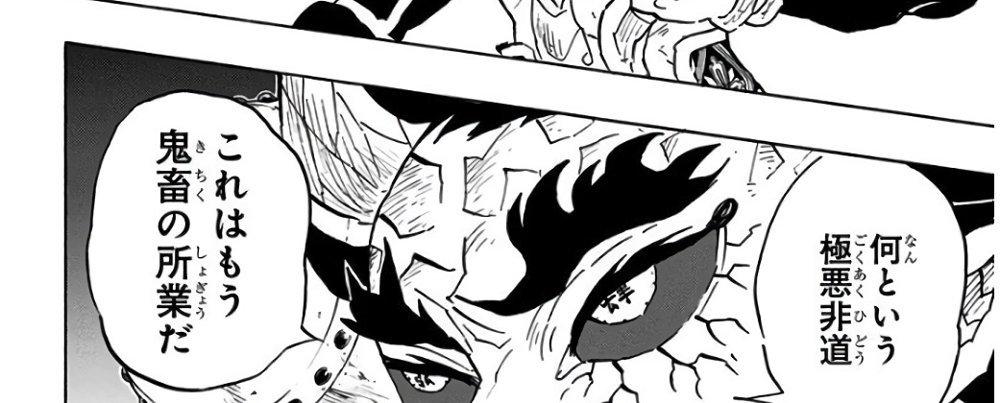
「何という極悪非道」
Nan to iu gokuaku-hidō
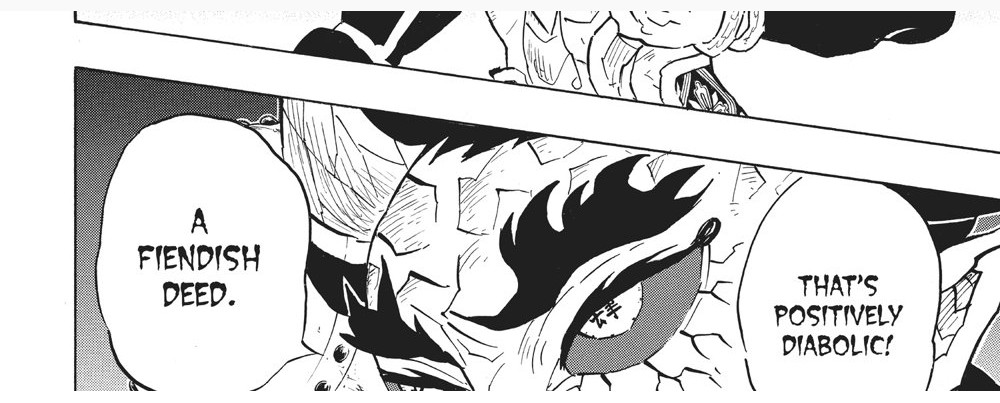
VIZ's English edition prints: "THAT'S POSITIVELY DIABOLIC!" (Vol. 14, p.24).
Give the line its due. "Diabolic" is a real word doing real work in a real speech bubble: it's short, it's punchy, it lands the outrage the panel needs in the half-second a reader's eye spends on it, and it sets up the next bubble's escalation — 「これはもう鬼畜の所業だ」, "A FIENDISH DEED." — without breaking rhythm. As comic-book dialogue, this is a clean hit.
But listen to what "diabolic" quietly does. It reaches into English's own theology and pulls out a devil — diabolos, the Adversary, a being. The Japanese never mentions one. 極悪非道 is a compound about a road, not a creature, and the demon reaching for it is not accusing his hunters of consorting with evil spirits. He's accusing them of having left the path entirely — which, spoken by an actual demon, a human being who left that same path first, is a considerably stranger and better joke than "diabolic" lets an English reader in on.
The Original
Take the phrase apart in the order it's built. 何という (nan to iu) is an exclamatory frame — literally "what one would call [it]" — the grammar behind ordinary outbursts like 何ということだ, "what a thing to happen." It doesn't carry meaning on its own; it's a slot built to hold a noun and detonate it. Here the noun dropped into that slot is 極悪非道 (gokuaku-hidō), and it splits cleanly into two separately damning halves.
極悪 (goku-aku) is 極, "utmost, extreme" — the same intensifier behind 極上 ("the very finest") and 極端 ("extreme") — plus 悪, "evil, wickedness." Evil at its ceiling; nothing subtle here.
非道 (hidō) is the half doing the interesting work. 非 is the negating prefix "non-, not, wrong" (the same 非 that opens 非常識, "lacking common sense" — literally "non-common-sense"). 道 (dō, also read michi) is "road, path, Way" — the same 道 that closes 剣道 (kendō, "the way of the sword"), 茶道 (sadō, "the way of tea"), and — most relevant here — 仏道 (butsudō), Buddhism's own name for its path to enlightenment. In the Confucian-Buddhist ethical picture this vocabulary comes from, there is a moral 道 everyone is meant to walk: a road of right conduct, filial duty, and compassion, distinct from any specific religious doctrine but soaked in centuries of both traditions. 非道, "not-the-Way," doesn't call someone a bad traveler on that road. It says they aren't on it. Not a wrong turn — an absence of any road walked at all.
Put the two halves back together and 極悪非道 reads, literally: evil at its absolute ceiling, and off the moral path entirely. As a yojijukugo — a fixed four-character compound, the kind Japanese reaches for when it wants maximum judgment in minimum syllables — it's built to be shouted, printed on a headline, or read out in a sentencing. Grammatically it's a bare noun phrase, slotted straight into 何という's exclamation frame with no verb needed: the accusation is complete the instant the noun lands.
VIZ's Choice
Across the volumes of Kimetsu no Yaiba in our corpus, 極悪非道 appears exactly once — this line, this panel, this demon. There's no scatter to chart and no table to build; there's one translator's single decision under one deadline, which makes it worth looking at closely rather than statistically.
"Diabolic" is, on its own terms, a reasonable swing. It's a real English word for extreme wickedness, it fits a small bubble, and — unlike a flatter option such as "wicked" or "evil" — it still gestures at something structured, a specific supernatural register, rather than generic badness. The translator clearly felt the line needed more weight than a plain adjective, and reached for the shelf of English words that carry inherited theological charge.
What's worth noticing is that this reach happens twice in one breath. The very next bubble, 「これはもう鬼畜の所業だ」, becomes "A FIENDISH DEED." — a companion piece on this site (see Take-away, below) covers that word, 鬼畜, in full. "Diabolic" and "fiendish" are near-synonyms in English; both summon the same general neighborhood of supernatural evil. But 非道 and 鬼畜 are doing structurally different work in Japanese: 非道 is about a road not walked, 鬼畜 is about which of Buddhism's six realms of rebirth you've been demoted into. Two distinct moral architectures, one Japanese demon, one panel — and English answers both with variations on the same devil-adjacent register. The words converge in translation precisely because English's vocabulary for "extremely evil" clusters around a Christian devil the way Japanese's clusters around a departed path. It isn't a translator's mistake so much as a structural fact about where each language keeps its intensifiers for wickedness.
The Gap
The metaphor changes species. 非道 pictures evil as a direction — a road left behind. "Diabolic" pictures evil as an agent — a being, a devil, acting on you. Neither is wrong as a general idea of wickedness, but they are not the same idea, and a reader who only ever meets 非道 through "diabolic" will never learn that Japanese has an entire vocabulary of pathless evil that doesn't route through a personified tempter at all.
The double structure collapses to a single note. 極悪 (superlative intensity) and 非道 (a specific moral claim about direction) are two separately loaded charges; "diabolic" delivers only intensity-flavored-supernatural, with nothing left of "off the Way" once the sentence is spoken.
The register drops a full notch. 極悪非道 is formal, legalistic, verdict-vocabulary — the register of a judge's summation, not a punchline. "THAT'S POSITIVELY DIABOLIC!" reads as pulpy comic-book outrage. The panel still works, but the specific solemnity of a demon reaching for courtroom Japanese mid-fight is gone.
The self-indictment goes silent. This is the real loss. A Japanese reader who knows 道 hears an actual demon — a human who sold his humanity for power, who has by the manga's own premise already left the human path — accuse his hunters of having no path at all. That irony is legible only if 道 is visibly sitting inside the insult. "Diabolic" carries no 道. The joke, if it's a joke (and Gotouge writes Hantengu with enough self-serving cunning that it plausibly is one), cannot survive translation into a word with no road inside it to have left.
What If
The menu and its prices, for the headline line:
- "WHAT UTTER INHUMANITY!" — "inhuman" gestures at the same off-the-human-path charge 非道 makes, and keeps the exclamatory shock of 何という intact. Cost: loses the compact four-character punch and the formal, courtroom-grade register of the original.
- "SUCH A CRIME AGAINST THE VERY WAY OF THINGS!" — keeps 道 alive, literally, as "the Way." Cost: far too long for a single gasped panel, and "the Way" reads as abstract philosophy rather than a gut-level accusation shouted mid-fight.
- "WHAT BOUNDLESS DEPRAVITY!" — "boundless" nods at 極 (utmost, extreme) without importing a devil. Cost: still drops 非道's specific "off-the-path" architecture entirely; reads as generic Western moral vocabulary rather than a Confucian-Buddhist verdict.
- Keep VIZ's punch, lose the theology: "THAT'S FLAT-OUT MONSTROUS!" — avoids naming a specific Christian devil while keeping the panel's exclamatory energy. Cost: "monstrous" undersells 非道's doctrinal precision, and — spoken by a literal monster — quietly cancels even the partial irony "diabolic" leaves intact.
Notice the shared trade-off: every option that keeps 道 visible sounds too long or too philosophical for a single explosive panel, and every option short enough for the bubble has to sacrifice the road metaphor entirely. That's not translator error. That's English simply not owning a compact word for "off the moral path" the way it owns "devilish."
Take-away
極悪非道 doesn't just mean "very evil" — it accuses its target of having left the road entirely, a specifically Confucian-Buddhist way of picturing wrongdoing that has no ready-made English seat. When a translation reaches for "diabolic," it isn't wrong to reach for intensity; it's reaching into the wrong cosmology to find it.
Three rules of thumb to carry off this page:
- When 道 hides inside an insult, ask what road is being invoked. 非道 (off the Way entirely) and 外道 (on the wrong Way) are not synonyms — one denies a path was ever walked, the other just disputes which path is correct.
- Watch for accusers who match their own accusation. A word meaning "left the human path," shouted by a demon who left the human path to become one, is doing double duty whether or not the speaker means it to.
- Yojijukugo compress a whole clause into four characters. 極悪非道 is really two claims — maximum evil, zero path — welded into one noun. When English needs a full sentence to unpack what Japanese does in four syllables, that's not verbosity; that's the compound working as designed.
This word belongs to a small family of four-character verdicts Kimetsu no Yaiba reaches for whenever a fight turns into a trial — see the same panel's other charge, 鬼畜 and the two lowest realms English squeezes into "brutes", leveled by this same demon eleven pages earlier; Kokushibo's 一刀両断, one stroke ending an argument outright; Tanjiro's 縦横無尽, covering every direction at once; Tamayo's 自暴自棄, turning self-abandonment into a Mencius idiom; and Akaza's 正々堂々, a dying demon's highest compliment. For the 道-vocabulary this article's compound belongs to, see One Piece's companion piece on 外道 at /japanese/gedo/ — same axis, opposite claim. Browse the full Demon Slayer translation notes index for more.
Every Japanese and English line quoted above is a byte-exact capture from the cited editions — 鬼滅の刃 Vol. 14 (Japanese) and Demon Slayer: Kimetsu no Yaiba Vol. 14 (VIZ Media) at the corresponding panel — via our bilingual page database; see Sources below.