The Moment
The end of the Kazekage Rescue arc, Volume 31. Gaara lies in the grass, and Elder Chiyo of the Sand — the old puppet master who began this arc as an enemy of everything Konoha stands for — has poured what remains of her life into the reincarnation jutsu bringing him back, Naruto's hands stacked on hers to lend the last of the chakra. Now she spends her final breaths handing out futures. To Naruto: 「今までにない火影になってな」 — "BECOME A HOKAGE THE LIKE OF WHICH HAS NEVER BEEN SEEN!" To Sakura, kneeling beside her, first a mirror — 「お前は…ワシと良く似ておる」, "YOU'RE... A LOT LIKE ME..." — and then the highest compliment the old woman owns:
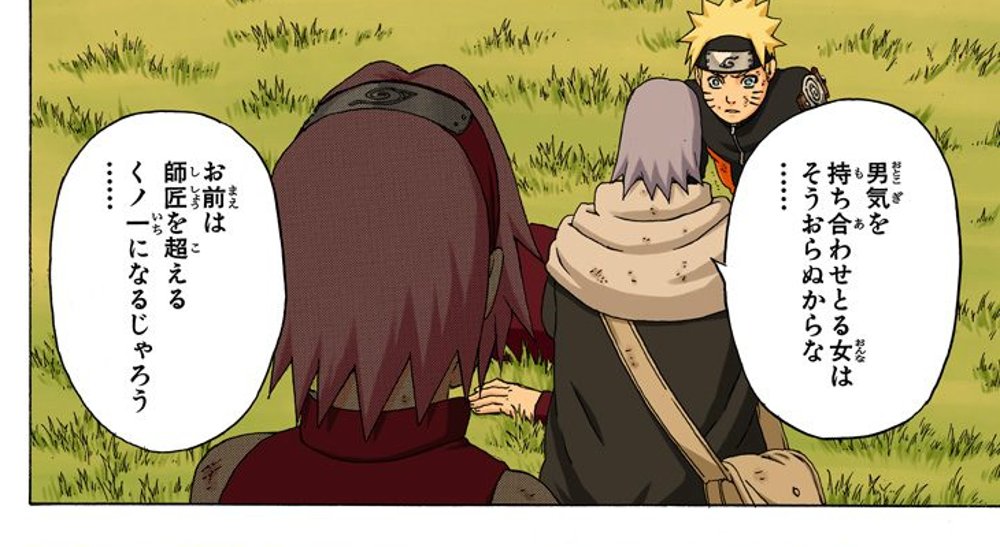
「男気を持ち合わせとる女はそうおらぬからな……」
Otokogi o mochiawasetoru onna wa sō oranu kara na…
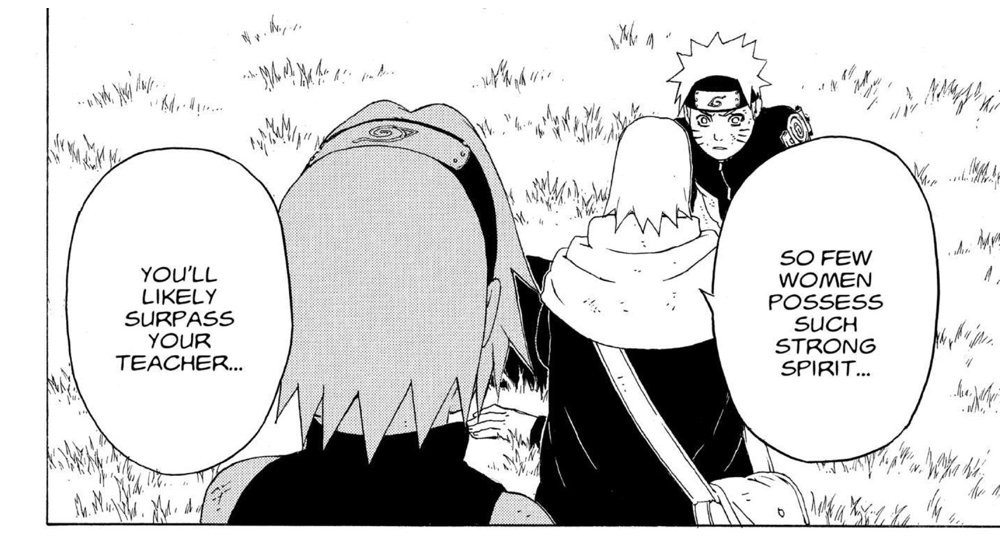
VIZ's English edition prints: "SO FEW WOMEN POSSESS SUCH STRONG SPIRIT..." (Vol. 31, p.156).
Grant the rendering its due: it is dignified, it fits the hush of a deathbed scene, and it keeps half the gender — "WOMEN" is right there. What it quietly removes is the other half, the half doing all the work. 男気 (otokogi) is not "strong spirit." It is, letter for letter, a man's spirit — and Chiyo, a woman, is finding it in Sakura, another woman, while performing the most selfless act in the entire arc. The word crosses a line on purpose. The translation tidies the line away.
The Original
The compound could not be simpler: 男 (otoko), "man," plus 気 (ki), "spirit; temperament." But Japanese dictionaries are precise about which manly quality 男気 names, and it is not muscle. It is the temperament that accepts a loss to itself for the sake of someone weaker — the readiness to step in, pay up, or take the hit without being asked. The man who covers a stranger's debt has otokogi; the man who merely wins fights does not.
That definition has a pedigree. Otokogi is the street virtue of the 任侠 (ninkyō) tradition — the chivalric code of Japan's yakuza films, in which the tough shelters the weak and eats the cost himself. Its scholarly twin is 侠気 (kyōki), "chivalrous spirit" — and 侠気 can itself be read otokogi, which tells you how completely the two ideas fused. Long since domesticated, the word now praises bosses who take the blame for subordinates and friends who show up at 3 a.m. It is warm, admiring, a little rough — a toasting word.
The machinery around it is doing quieter work:
- 持ち合わせとる — 持ち合わせる (mochiawaseru) is "to happen to have on one; to be endowed with," as if otokogi were pocket money some people simply carry. The 〜とる ending is the contracted 〜ておる of western-flavored speech.
- おらぬ — the archaic negative of おる: "(such women) do not exist." Modern standard would be いない.
- からな — a musing, self-directed "...you know," praise delivered sideways.
おらぬ, とる, plus the surrounding ワシ, じゃ, and じゃろう make this textbook 老人語 (rōjingo) — "old-person language," the fictional elder register linguists file under role language (yakuwarigo): a stage costume stitched from western Japanese that instantly paints a speaker as old, wise, and half out of their own era. No real dialect map required — every Japanese reader hears "storybook grandmother." As vocabulary, 男気 sits off the JLPT lists (call it N1-plus as a cultural item, though its parts are N5 kanji); the elder grammar is something no test teaches — you learn it from fiction's grandmothers, of whom Chiyo is a textbook case.
VIZ's Choice
男気 appears exactly once in all 72 volumes of our bilingual database — this line. But the page it lands on genders itself three times in two bubbles, so line them up:
| Vol. 31, p.156 | Japanese | VIZ English |
|---|---|---|
| Bubble 1 | 男気を持ち合わせとる女はそうおらぬからな…… | SO FEW WOMEN POSSESS SUCH STRONG SPIRIT... |
| Bubble 2 | お前は師匠を超えるくノ一になるじゃろう | YOU'LL LIKELY SURPASS YOUR TEACHER... |
Three gendered items go in: 男気 (a man's spirit), 女 (woman), くノ一 (kunoichi — female ninja). One comes out: "WOMEN." The manliness inside the virtue is neutralized to "strong spirit," and the kunoichi vanishes altogether — 「師匠を超えるくノ一になる」, "you will become a kunoichi who surpasses her teacher," compresses to "SURPASS YOUR TEACHER," a bubble-sized cut that costs the sentence its noun. (The teacher, for the record, is Tsunade — the Fifth Hokage, herself the most famous kunoichi alive; Sakura being told she will out-grow her is no small blessing.)
None of this is napping. "Manly spirit" in an English deathbed scene risks sounding either comic or insulting, and "kunoichi" is a loanword VIZ's early-2000s house style used sparingly. Each cut is locally defensible. But watch what the page loses as a system: Japanese spends this scene threading gender through its praise — a man's virtue, found in a woman, who will surpass the greatest woman in the profession's female branch. English hands back one all-purpose "WOMEN" and calls it even.
The Gap
The crossing is the compliment. 男気を持ち合わせとる女 sets 男 and 女 six characters apart and lets them grind against each other: a male-coded virtue, surfacing where the culture least expects it. That friction is what Chiyo admires — not spirit in general, but the take-the-hit chivalry her world files under men, carried by a girl. "Strong spirit" is frictionless. The praise survives; the point of the praise does not.
Neutralized, the line aims wrong. The Japanese marks the virtue as the rarity — otokogi is scarce among women because the culture coded it male, not because women lack spirit. "SO FEW WOMEN POSSESS SUCH STRONG SPIRIT..." re-aims the sentence at women themselves: read cold, it says women rarely have much spirit at all — a more dismissive claim than the Japanese, arrived at by trying to be less gendered. Deleting the gender from a sentence about gender doesn't neutralize it; it just moves the target.
The self-portrait fades. Two pages earlier: 「お前は…ワシと良く似ておる」 — "you're a lot like me." Chiyo is not describing Sakura from a distance; she is naming a spirit she claims for herself, while spending her own life on Gaara — otokogi's textbook definition, performed as it is spoken — and honoring the girl who, in the Sasori fight, nearly spent hers on a 死にかけのババア, a "dying granny." In Japanese the word 男気 bundles all of that into one shared medal between two women. In English, "strong spirit" is a pleasantry.
The grandmother's grammar dies in standard prose. おらぬ and 〜とる are costume grammar — the fictional elder register that makes Chiyo sound like every wise grandmother in Japanese storytelling, a voice from an older world blessing a newer one. English has no grammaticalized old-person speech, so VIZ's line comes out ageless and placeless. The information survives; the voice — croaky, western-tinged, affectionately gruff — is gone without residue.
What If
No rendering is free; here is the menu and its prices.
- "Not many women come equipped with a man's spirit..." — keeps the crossing, and "come equipped" preserves 持ち合わせる's carry-it-or-you-don't flavor. Cost: explicit "a man's" reads louder and more provocative in English than the fossilized compound does in Japanese.
- "So few women have that kind of gallantry..." — "gallantry" is English's nearest male-coded virtue noun, and the praise stays warm. Cost: gallantry is courtly — doors held, cloaks over puddles — where otokogi takes blades for people.
- "Takes a rare woman to out-man the men..." — restores the crossing with idiomatic bite. Cost: stages an explicit contest between the sexes that the Japanese leaves as quiet cultural background.
- Keep VIZ's noun, re-aim the sentence: "NOT MANY WOMEN CARRY A FIGHTING SPIRIT LIKE THAT..." — Cost: the spirit stays genderless, but at least the rarity lands on the spirit rather than on women, and "carry" nods at 持ち合わせる.
Notice the shared bill: English can gender a virtue only by saying so out loud — "a man's," "out-man" — at triple the Japanese volume, or drop the gender and lose the compliment's engine. 男気 is quiet about it because the coding is baked into the word; English has to choose between shouting and silence.
Take-away
男気 is not hard vocabulary — a five-year-old can read 男 and 気. It is hard culture: a virtue with a gender baked into its spelling, awarded across the gender line by a dying woman who means it as the finest thing she can say. Translation that keeps the spirit but drops the man keeps the sentence and loses the scene.
Three rules of thumb to carry off this page:
- When a gendered virtue word crosses the line, the crossing is the content. 男気 in a woman, 男勝り as praise, 女々しい flung at a man — in each, the gender coding isn't decoration to scrub out; it's the claim being made.
- おらぬ, 〜とる, じゃ, ワシ = role language, not geography. Fiction's elders speak a stage dialect every Japanese reader decodes as "old, wise, another era." When the English sounds ageless, know that a whole voice was standing in those verb endings.
- Some gender lives in the writing itself. くノ一 is, by the popular account, the character 女 taken apart into strokes — く, ノ, 一. A translation can carry meaning across and still leave the calligraphy behind.
For another word that hides a warrior's body inside everyday praise — and the shudder VIZ had to untangle — see the battle-thrill inside 武者震い, or the old-man's patience jar that cracks in 堪忍袋 — or browse the Naruto translation notes index.
Every Japanese and English line quoted above is a byte-exact capture from the cited editions — NARUTO Vol. 31 (Japanese) and Naruto (VIZ Media) at the corresponding panels — via our bilingual page database; see Sources below.