The Moment
Baratie arc. Roronoa Zoro — a bounty hunter with a schoolyard boast about becoming the world's greatest swordsman — has finally gotten what he asked for: a real duel with Dracule Mihawk, the man the whole East Blue calls the strongest swordsman alive. Mihawk doesn't even draw Kokutou Yoru, the black sword taller than he is. He answers Zoro's whole arsenal with a knife the size of a fruit-parer:
「あいにくこれ以下の刃物は持ちあわせていないのだ」
Ainiku kore ika no hamono wa mochiawasete inai no da
VIZ: "SORRY, BUT THIS IS THE SMALLEST KNIFE I'VE GOT." (Vol. 6, p.129) — courtly, unbothered, faintly apologetic. That register never slips, not even while he's humiliating a teenager.
Zoro throws himself across the water with everything he has left:
「死んで後悔すんじゃねェぞ!!」
Shinde koukai sun ja nee zo!!
VIZ: "YOU'LL FEEL STUPID WHEN I KILL YOU!!!"
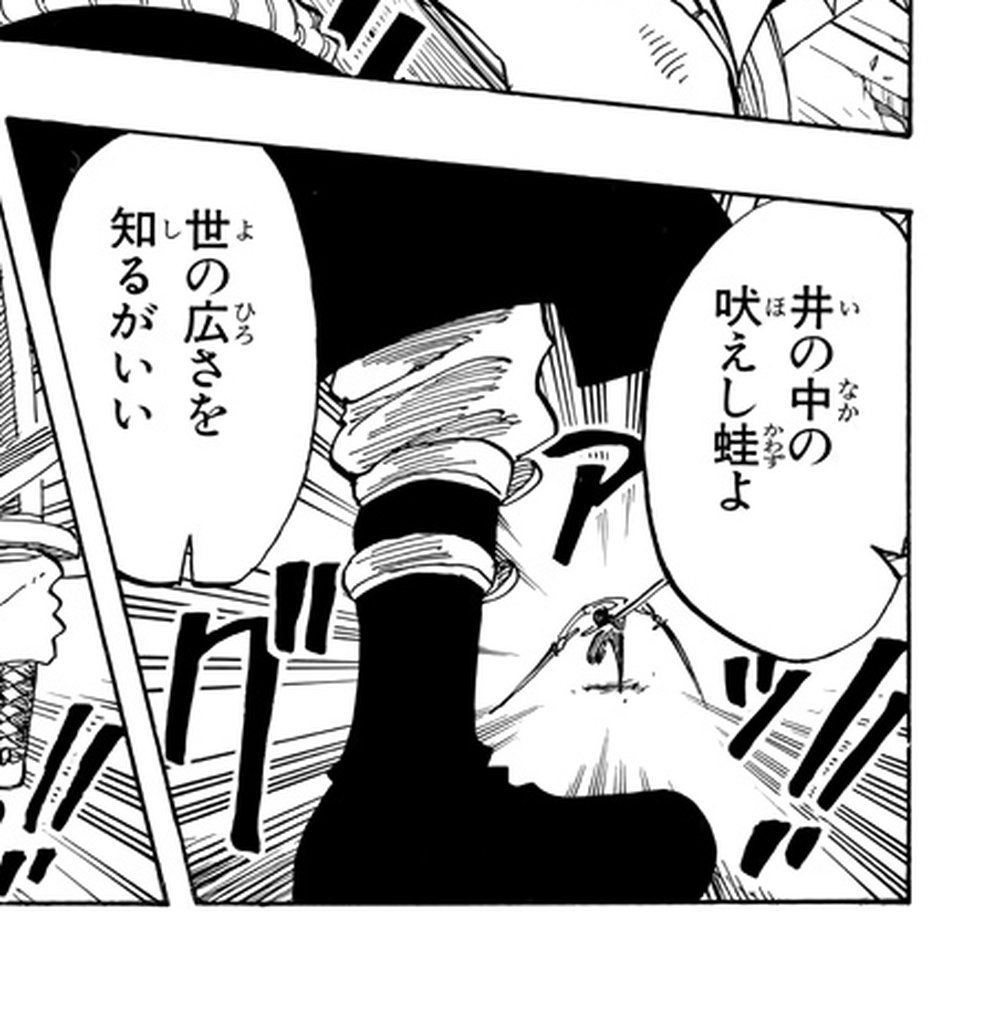
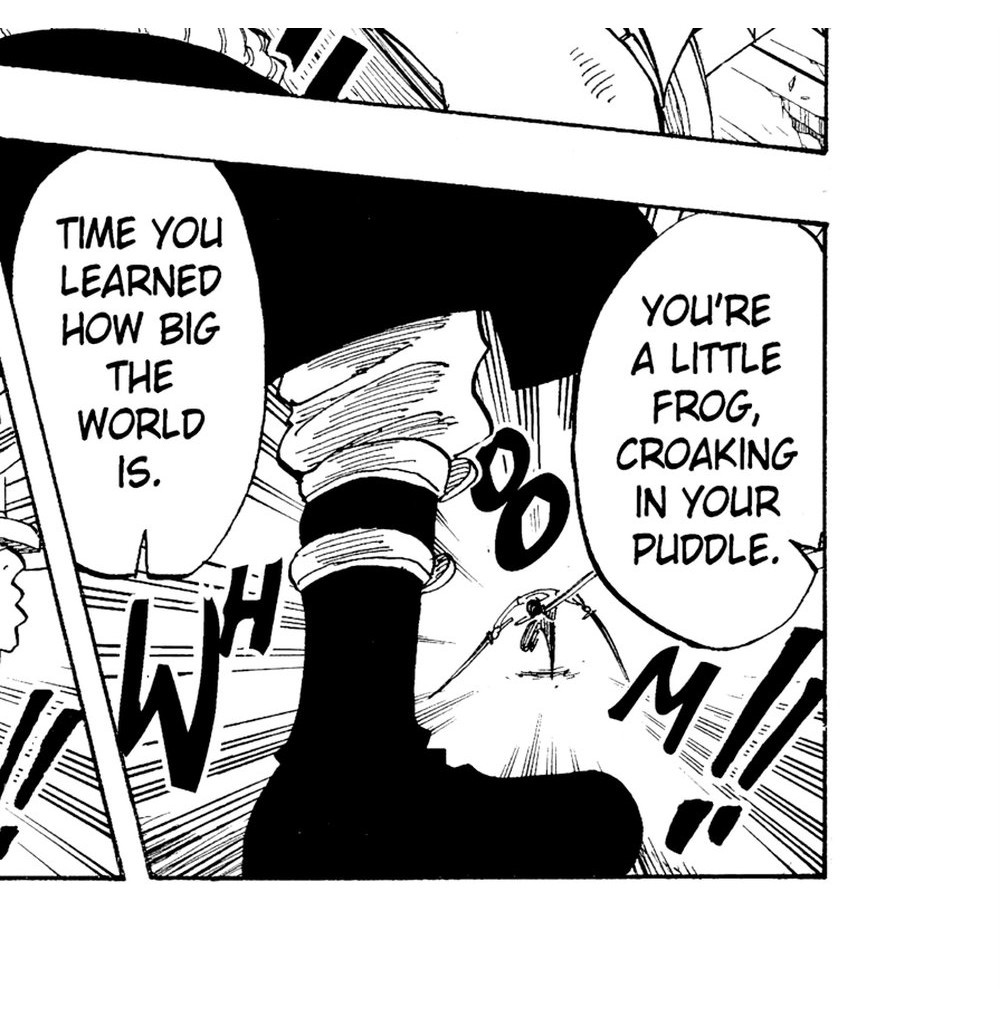
Mihawk answers — not with the knife, with a verdict, spoken across two speech bubbles in the same panel, read right to left the way the page is drawn:
「井の中の吠えし蛙よ 世の広さを知るがいい」
I no naka no hoeshi kawazu yo, yo no hirosa o shiru ga ii
VIZ's English edition prints: "YOU'RE A LITTLE FROG, CROAKING IN YOUR PUDDLE." paired with "TIME YOU LEARNED HOW BIG THE WORLD IS." (Vol. 6, p.129.)
Grant the rendering its due first: it's a good insult. "Little frog, croaking in your puddle" has real music — the hard consonants, the diminishing "little" — and it needs no footnote to land as condescension. Oda's own panel does half the translator's job before the reader even reaches the caption: he draws Mihawk's boot filling the entire frame, foreground and enormous, with Zoro shrunk to a speck on the open sea far below. Anyone, in any language, gets the scale joke on sight. But set the two lines side by side and one specific, load-bearing piece of the Japanese has gone missing in the English — not "frog." VIZ keeps the frog. It's the frog's house.
The Original
Take the line apart syllable by syllable, because every piece of it is doing work.
井 (i) is "well" — not a puddle, not a pond, a dug and walled shaft, the same 井 in 井戸 (ido, "water well"). の中 (no naka) is "the inside of." 吠えし (hoeshi) is where the line turns strange: 吠える (hoeru) means "to bark, to howl" — an animal-cry verb reserved for dogs, wolves, hounds treeing something. A frog's proper verb in Japanese is 鳴く (naku, "to cry, to call"). Mihawk has reached for the wrong animal on purpose, upgrading Zoro's death threat to the noise of a beast, then handing it to something smaller than a beast. And hoeshi, not hoeta — し here is the attributive form of き, the classical (文語) past auxiliary. Modern spoken Japanese would say 吠えた. Mihawk speaks like a text a century out of date.
Then 蛙, which any modern reader would sound out as kaeru. The furigana printed over it reads かわず (kawazu) — the old, poetic reading, the one that shows up in the Man'yōshū and classical waka, where the frog's call was thought beautiful enough to be a spring season-word. Mihawk dresses his insult in court-poetry vocabulary while using it to spit on a teenager. Finally よ, the vocative/exclamatory particle — direct address, "O frog," "you, frog" — turning what is normally an anonymous proverb about frogs-in-general into a verdict delivered to one specific face.
Because the proverb behind the line isn't Mihawk's invention. 井の中の蛙、大海を知らず — "the frog in the well does not know the great ocean" — is Japan's borrowing of a passage from Zhuangzi (荘子), the Warring States-era Daoist classic, in the chapter 秋水 ("Autumn Floods"). There, the spirit of the North Sea corrects the spirit of a river who had been feeling rather grand about his own size, until he reached the ocean and understood what "big" actually meant: 井蛙不可以語於海者、拘於虚也 — "you cannot discuss the sea with a well-frog, for it is confined by the space it lives in." The proverb about narrow horizons sits inside a story about a character discovering his own horizons were narrow. That framing detail rarely survives into the four-word insult, but it's worth knowing it's there.
One more piece of trivia worth flagging so it isn't mistaken for the classical original: many Japanese speakers know the line with a coda tacked on — 井の中の蛙大海を知らず、されど空の深さ(青さ)を知る, "...but it knows the depth (or blueness) of the sky." That half-line is not in Zhuangzi. Its actual author is disputed — candidates include the broadcaster Ei Rokusuke's "revised proverbs," the writer Hōjō Tamio's prison-sanatorium essays, and a piece of calligraphy by the potter Kawai Kanjirō — but it's a 20th-century Japanese addition, not a 2,300-year-old one. Mihawk, notably, does not use it. His frog gets no consolation prize.
As vocabulary, 井の中の蛙 is a standard kotowaza comfortably at home in JLPT N1 reading and idiom material. The archaic grammar wrapped around it in this line — 吠えし, かわず — sits outside the JLPT scale entirely, since the test covers contemporary spoken and written Japanese, not classical (文語) forms. That gap between "testable vocabulary" and "actual register" is the whole character voice: Mihawk's speech runs old-world and formal all through the Baratie arc (あいにく, 持ちあわせていないのだ), and this is the moment that mannered diction turns into a blade of its own.
VIZ's Choice
井の中の吠えし蛙 appears exactly once across the One Piece volumes in our corpus — one bubble, one translator, one decision, worth sitting with on its own rather than charted against alternatives.
VIZ chose "YOU'RE A LITTLE FROG, CROAKING IN YOUR PUDDLE." Two moves are stacked in that clause, and they deserve to be judged separately. The first — keeping the frog, and inventing "croaking," which is in fact the correct verb for a frog, where Mihawk's own 吠える was deliberately the wrong one — is a reasonable trade: English has no everyday equivalent for "using a dog's verb on a frog as an insult," so the joke gets rebuilt as a diminutive instead ("little frog") rather than a verb mismatch. Defensible.
The second move is the one worth stopping on: VIZ needed a container to replace 井 (well), and reached for "puddle." A puddle is vivid, one syllable, instantly legible, and it completes "croaking" with a tidy little rhyme of imagery — frogs belong in puddles, after all. But a puddle is a shallow, open pool with the whole sky already visible from inside it. A well is a deep, walled vertical shaft where the only sky you can see is a single coin far overhead — a container built for exactly one kind of ignorance: not knowing what you cannot see. The Zhuangzi proverb's entire argument depends on that specific geometry, measured against 大海, "the great ocean," a scale of water the frog cannot even conceive of, let alone see. "Puddle" replaces a psychologically precise metaphor with a generically small one. It wasn't laziness — "puddle" is the fastest one-word gesture at "you live somewhere tiny and wet," and in a fast-moving panel with limited lettering space, fast is a real virtue. But the swap converts a proverb about the limits of what you can perceive into a proverb about the limits of where you live, and those are not the same claim.
The Gap
A well is vertical and walled; a puddle is horizontal and open. This is the whole failure in miniature. Stand a frog in a well and it looks straight up at one small disc of light — it knows the sky exists, and has no way to learn its true size. Stand a frog in a puddle and it can see the entire sky already, unobstructed, from where it's sitting. The well's specific cruelty — knowledge of your own confinement without any way to measure what's outside it — is the mechanism the proverb runs on. The puddle just means "small." VIZ's frog isn't trapped; it's merely damp.
大海 disappears from the sentence chain entirely, in two separate steps. First Oda's own script trades it: the second bubble says 世の広さを知るがいい, "learn how big the world is," not the classical proverb's 大海 (the great ocean) — Oda paraphrases his own source material into a villain's voice, and that's a legitimate authorial choice, not a translation failure. But then VIZ's frog line compounds it: "puddle" doesn't gesture at any larger body of water at all, so the English reader never gets the well-versus-ocean math the Japanese sets up even secondhand. A puddle sits opposite "the world" as an odd mismatch of registers — wet versus abstract — where a well sitting opposite an ocean is at least a coherent unit of comparison: water measured against water, scale against scale.
The archaic voice and the deliberate wrong verb both vanish without a trace. 吠えし蛙 is doing two things at once in Japanese: an animal-cry verb borrowed from a bigger, fiercer creature, delivered in grammar a century out of fashion, with a poetic reading (かわず) lifted from court verse. It's an insult with three layers of costume on. "Croaking" is accurate, current, and entirely undressed — a correct verb where the original wanted a wrong one, in the plainest possible register. The insult survives; the performance of contempt inside the insult does not.
What If
No option is free. Here's the menu and what each choice costs.
- "YOU'RE A FROG AT THE BOTTOM OF A WELL." — restores the actual container; a reader can now picture the shaft, the walls, the single disc of sky. Cost: loses the snap and internal rhyme VIZ built with "little frog, croaking in your puddle," and runs a beat longer in the bubble.
- "STILL HOWLING DOWN YOUR WELL, ARE YOU?" — keeps 吠える's "howling" instead of the tamer "croaking," preserving the wrong-verb joke, and keeps the well. Cost: loses the vocative punch of よ, and "still" implies a history the line doesn't actually claim.
- "A WELL-FROG, HOWLING AT NOTHING." — compact, keeps both the container and the animal-verb mismatch. Cost: "well-frog" reads as a compound noun English doesn't actually have, so it lands slightly odd rather than instantly legible — exactly the trade VIZ's "puddle" was built to avoid.
- Keep VIZ's frog and puddle, but repair the second line: "TIME YOU LEARNED HOW VAST THE OCEAN IS." — cheapest fix, cost lowest. It doesn't rescue the well, but it restores the water-against-water math (puddle vs. ocean instead of puddle vs. "the world"), which at least keeps the proverb's shape intact even with the wrong container.
Notice what all four share: every option that restores the well loses some of the punch "puddle" bought, and every option that keeps the punch keeps the mismatch. That's not a translator being careless. That's a four-word insult trying to carry a philosophy passage, and English not being willing to spend the extra syllables.
Take-away
Mihawk's frog is a genuine partial success: VIZ kept the animal, kept the contempt, kept the punch — and quietly swapped the one detail the whole proverb is actually built on. A well and a puddle are both small bodies of water next to an ocean, but only one of them is a container that hides the sky's true size from something living inside it. That's the metaphor Zhuangzi wrote 2,300 years ago, and it's specific enough that "small" isn't really a synonym for it.
Three rules of thumb to carry off this page:
- When a metaphor names a specific container, ask what that container is shaped like before translating it as "somewhere small." A well, a puddle, a birdcage, and a jar are all "small," and none of them mean the same thing.
- Watch for a verb aimed at the wrong animal. 吠える on a frog is not an accident; deliberately mismatched verbs are one of Japanese's quieter ways of building contempt into a sentence, and they rarely survive translation as anything but "accurate."
- A kotowaza with a famous coda isn't always quoting the coda. 井の中の蛙 shows up constantly without されど空の深さを知る attached — check which half of a two-part proverb a given speaker is actually using before assuming the gentler ending is implied.
For another line where a Japanese proverb met VIZ's lettering constraints, see the sound-over-sense problem in 河童の川流れ — or browse the full One Piece translation notes index. One Piece isn't the only work hub where a borrowed proverb has made this trip: Naruto's own translation notes track Kakashi burying a stake twice over 出る杭は打たれる, and Temari tripping over a lighthouse in 灯台下暗し — different work, same old habit of folk wisdom losing its furniture at the border.
Every Japanese and English line quoted above is a byte-exact capture from the cited editions — ONE PIECE Vol. 6 (Japanese) and One Piece Vol. 6 (VIZ Media) at the corresponding panel — via our bilingual page database; see Sources below.