The Moment
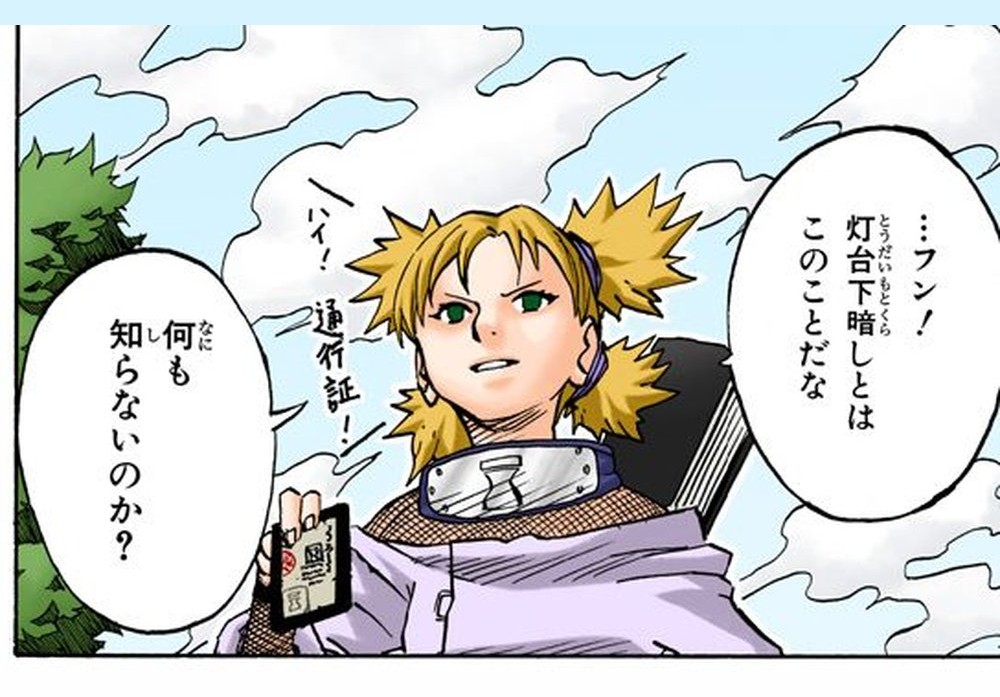
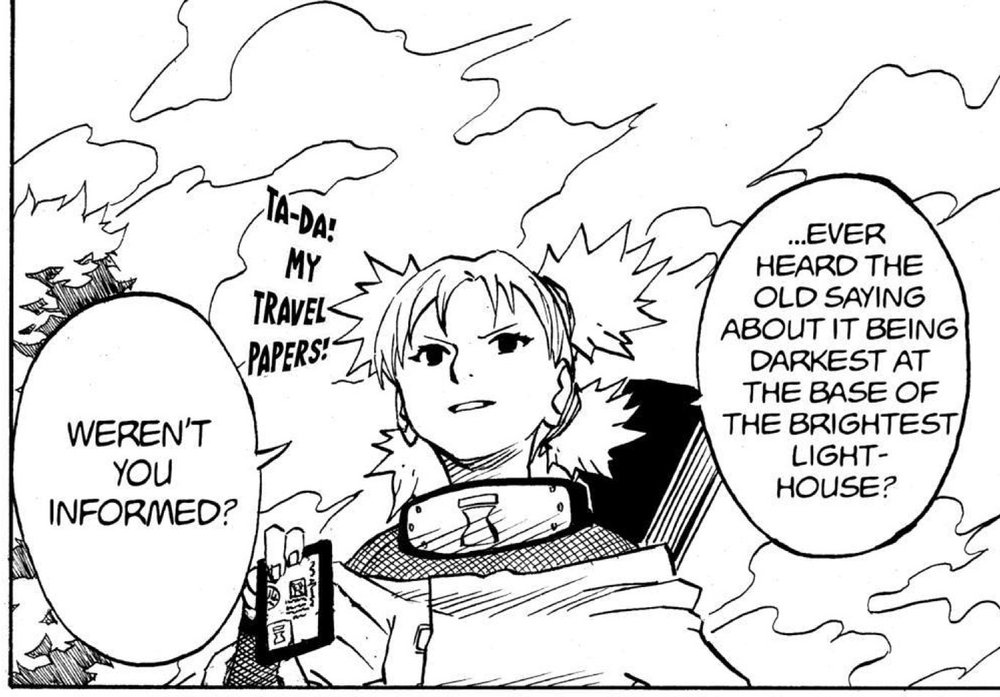
Volume 4, on a Konoha street, at the doorstep of the arc that will swallow the next ten volumes. Two shinobi with Sand headbands have just been caught loitering in the Leaf — someone has pointed out exactly what they are, and wants to know what Sand ninja are doing inside another village's walls. Temari doesn't apologize. She produces her travel pass with a flourish — the English edition hand-letters it "TA-DA! MY TRAVEL PAPERS!" — looks down at Konoha's own genin, and scoffs:
「…フン!灯台下暗しとはこのことだな」
…Fun! Tōdai moto kurashi to wa kono koto da na
VIZ's English edition prints: "...EVER HEARD THE OLD SAYING ABOUT IT BEING DARKEST AT THE BASE OF THE BRIGHTEST LIGHTHOUSE?" (Vol. 4, p.156).
Then the punchline the proverb was aimed at. 「何も知らないのか?」 — "WEREN'T YOU INFORMED?" 「お前のいうとおり私達は砂隠れの下忍…」 — "AS YOU GUESSED, WE'RE JUNIOR-LEVEL NINJA FROM THE HIDDEN SAND VILLAGE." They have come to take the Chunin Selection Exam — held here, in Konoha, the home village of the kids she's talking to. Naruto's response: 「中忍選抜試験…?」 — "WHAT'S THE CHÛNIN SELECTION EXAM?" The foreigners know. The locals don't. That is the joke, and Temari has just named it with a proverb.
Grant VIZ its due, because it earns real credit here. Faced with a Japanese proverb, most translations quietly swap in an English one, or pave over it with plain prose. VIZ did the rare, honest thing: it kept the proverb as a proverb — "EVER HEARD THE OLD SAYING" is a flag planted in the panel saying she is quoting something old — and translated the image inside it literally. That is a brave strategy and usually the most nourishing one for readers. There is just one catch, and it is sitting in the middle of the sentence with a lamp on its head.
The Original
Take 灯台下暗し apart — all four beats of it.
灯台 (tōdai) = 灯 "lamp, light" (the 灯 of 灯り, akari) + 台 "stand, platform" (the 台 of 舞台, "stage," and 台所, "kitchen"). A light-stand.
下 (moto) — read もと here, not した — "the space at the foot of," the same moto as 足下 (ashimoto), "at one's feet."
暗し (kurashi) — the classical predicative form of 暗い, "is dark." Proverbs are museums of old grammar: the 〜し ending is the classical 終止形 that modern Japanese abandoned, fossilized here exactly as in 良薬は口に苦し ("good medicine is bitter in the mouth"). You never conjugate it; you just recognize it, the way English speakers recognize "all that glitters is not gold" without parsing the word order.
Literally: "at the foot of the lamp stand, it is dark." And here is the whole point of this article: the 灯台 in this proverb is not a lighthouse. It is the 灯明台 (tōmyōdai) — the pre-modern Japanese household lamp: a wooden stand at about hand height, an oil dish on top, a wick burning in the oil. It lights the whole room — except that the dish itself shades the floor directly beneath the flame. In a room lit by one, the single dark patch is at the lamp's own foot. From that piece of household physics, the meaning: the things closest to you are the hardest to see. Your keys in your pocket. The exam in your own village.
Modern Japanese, of course, uses 灯台 almost exclusively for "lighthouse" — a sense that only became possible after Japan lit its first Western-style lighthouse in 1869, when this proverb was already old. The result is one of the Japanese language's favorite pieces of trivia: generations of native speakers picture the wrong lamp too. Quiz shows and dictionary columns correct the lighthouse reading the way they correct 情けは人のためならず ("kindness is never wasted," popularly misread as "kindness doesn't help people"). The misreading survives because it almost works — a lighthouse beam really does miss the rocks at its own base — but it swaps a domestic truth for a maritime one, and the proverb was born indoors.
One more part worth owning: the frame. 〜とはこのことだ — "this, right here, is what [the saying] means" — is the standard device for slapping a proverb onto a live situation: a textbook-case marker. Learn it once (it is solid N2 grammar) and every kotowaza you've memorized becomes something you can actually say. The proverb itself lives in N1-plus cultural-literacy territory — less a vocabulary item than a citizenship test.
VIZ's Choice
In the volumes we have on file, this is the proverb's only appearance in Naruto — no scatter to chart, just one decision to read closely.
A translator meeting 灯台下暗し has three doors. Domesticate: reach for English's native idiom — "right under your nose" — and lose the texture of a quoted saying. Foreignize: translate the Japanese image literally and flag it as a proverb, trusting the reader to enjoy the foreignness. Pave: "You don't even know what's happening in your own village?" — no idiom at all. VIZ picked the second door, the connoisseur's choice, and even added the flag explicitly: "THE OLD SAYING." An English reader walks away knowing Japanese has a proverb about darkness at the foot of a light. That is more than most panels teach.
But inside that good decision sits the homonym trap. 灯台 in a modern dictionary means "lighthouse"; 灯台 in this proverb means the oil-lamp stand. VIZ translated the modern word, not the old artifact — and then, feeling the image needed drama, upgraded it: not just a lighthouse but "THE BRIGHTEST LIGHTHOUSE," a superlative with no counterpart in the Japanese, which grades nothing and simply reports where the shadow falls. The eight-mora scoff tōdai moto kurashi to wa kono koto da na becomes a seventeen-word rhetorical question. In fairness, VIZ is in excellent company: it translated the proverb exactly the way most of modern Japan mis-pictures it. But "the error native speakers also make" is still the error — and a translation is the one place where someone was paid to look it up.
The Gap
The wrong lamp. The proverb's blind spot is domestic — the patch of floor at the foot of a lamp in your own room. VIZ's image is maritime — a tower on a coast, warning ships away from rocks where nobody lives. Both bases are dark; only one of them is where you keep your keys. The proverb is about the two feet around you, and the translation points it out to sea — an image the saying is older than.
An invented superlative. "BRIGHTEST" is the translator's poetry, not Kishimoto's. The Japanese doesn't set up a dazzling-light-versus-deep-shadow paradox; it states flat household physics. The superlative makes the proverb grander and more mystical than it is — a fortune-cookie aphorism where the original is a shrug at how lamps work.
A sneer becomes a quiz. フン!…とはこのことだな is a verdict: snort — textbook case. The frame points at the situation: this scene, right here, is the proverb happening. "...EVER HEARD THE OLD SAYING...?" is a question, and it points at the listeners: have you heard it? Temari stops sneering at the facts and starts examining the students — a small shift, but it recasts her from scornful to schoolteacherly, and the seventeen words sink the snap of an eight-mora jab.
The address of the irony. In the Japanese, the unspoken "lamp" maps neatly onto Konoha itself: the genin live at the foot of their own village and can't see what it's hosting. Aim the image at a lighthouse on some coastline and the metaphor no longer has their home in it — the darkness moves somewhere none of the characters are standing.
What If
The menu and its prices:
- "Hmph! Talk about not seeing what's right under your nose." — English's native idiom for precisely this blind spot, at scoff length. Cost: the proverb texture vanishes; Temari no longer quotes anything, she just sneers.
- "Hmph! 'It's darkest at the foot of the lamp' — and here's the proof." — keeps VIZ's translate-the-proverb instinct, restores the right lamp, and carries the this-is-that frame of とはこのことだ. Cost: an unfamiliar proverb slows readers down mid-panel.
- "Hmph! The darkest place is under the candlestick, as they say." — borrows the near-twin proverb recorded in older English proverb collections; domestic scale intact, quotation flagged. Cost: obscure enough that it reads as invented; "as they say" has to do all the flagging work.
- Keep the lighthouse, cut the sprawl: "HMPH! DARKEST AT THE FOOT OF THE LIGHTHOUSE, EH?" — Cost: still the wrong lamp, but the scoff gets its snap back and the invented "brightest" goes overboard where it belongs.
Notice the shape of the trade: the closer an option stays to the Japanese image, the more it asks of the reader; the more natural the English, the less of Japan survives in the bubble. VIZ chose to keep Japan in the bubble and paid the toll at the wrong tollbooth — the one word in the sentence whose meaning had moved since the proverb was coined.
Take-away
灯台下暗し is a gift of a pitfall because the trap isn't hiding: it's the first word, and it catches native speakers, translators, and dictionaries' least careful readers alike. The proverb about missing what's at your feet gets translated by reaching for the meaning farthest away — the saying demonstrating itself.
Three rules of thumb to carry off this page:
- In a proverb, date the words, not the characters. Old sayings carry old furniture: the 灯台 here predates lighthouses, just as 油を売る ("selling oil" = slacking off) preserves Edo-era oil peddlers. When a proverb's image seems oddly modern, suspect the word has moved and the saying hasn't.
- Own the frame 〜とはこのことだ. It is the socket every memorized kotowaza plugs into — "this is that, live, in front of us" — and it turns trivia into speech.
- Read 〜し as a fossil, not a typo. Classical 終止形 endings (暗し, 苦し, 難し) survive inside proverbs the way "glitters" survives inside Shakespeare — recognize them and move on; never try to conjugate the museum pieces.
For another expression whose built-in prop English readers never get to see — the patience-pouch whose cord snaps inside 堪忍袋 — read our piece on Tobi's kannin-bukuro; for another scene-stealing idiom from these same exams, there's the war-shiver Sasuke calls musha-burui — or browse the Naruto translation notes index.
Every Japanese and English line quoted above is a byte-exact capture from the cited editions — NARUTO―ナルト― Vol. 4 (Japanese) and Naruto Vol. 4 (VIZ Media) at the corresponding panels — via our bilingual page database; see Sources below.