The Moment
Volume 1, the tail end of the bell test — the survival exercise that decides whether Naruto, Sasuke, and Sakura become genin at all, or get sent back to the academy. Sasuke has just tried to do what the test is secretly designed to punish: go it alone. He lunges for one of Kakashi's two bells by himself, without waiting on his teammates, and Kakashi answers by grabbing his ankle and driving him straight into the earth.
「土遁 心中斬首の術…」
"EARTH STYLE! GROUNDHOG TECHNIQUE DECAPITATION!" (Vol. 1, p.180) — VIZ's own bit of wordplay for a jutsu name, and a fair one: Sasuke disappears into the ground like a groundhog going to den, and comes up only as far as his neck. Kakashi crouches over what's left of him and needles the wound a little further:
「…にしても お前は やっぱ 早くも頭角を現してきたか」
"...BUT AT LEAST, AS YOU PREDICTED, YOUR PERFORMANCE WAS HEAD AND SHOULDERS ABOVE THAT OF YOUR COMPANIONS." (Vol. 1, p.180) — a compliment with a hook in it: 頭角を現す literally means "to reveal one's horns," the image of a stag's antlers breaking the treeline before the rest of the animal is visible. Sasuke is impressive. Sasuke is also, right now, a head poking up out of a hole.
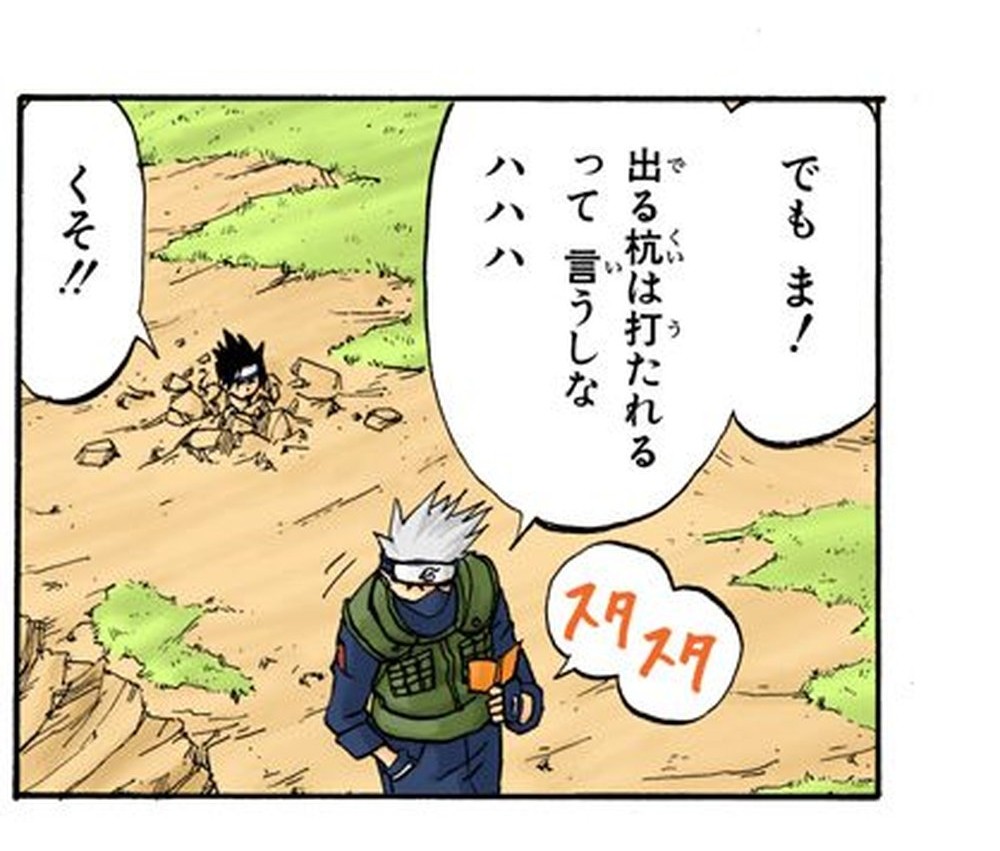
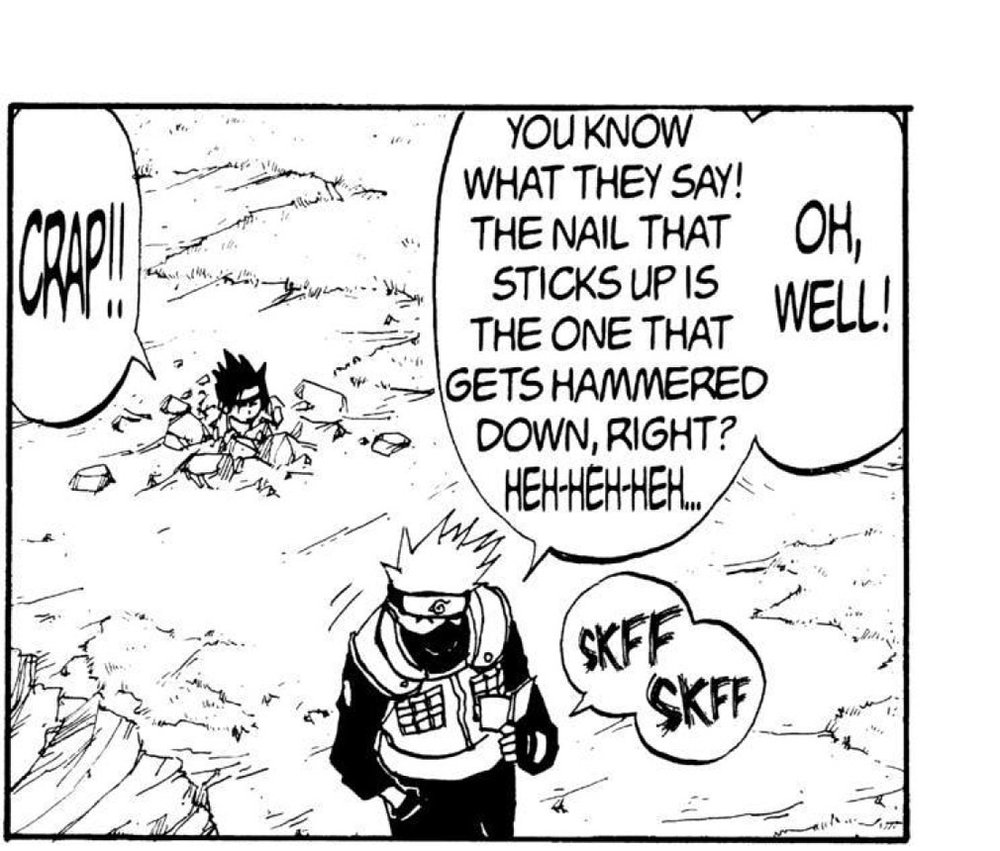
Then Kakashi turns and walks off, hands in his pockets, book back out, and delivers the line this article is about — half to Sasuke, half to nobody in particular:
「でもま!出る杭は打たれるって言うしなハハハ」
Demo ma! Deru kui wa utareru tte iu shi na. Hahaha.
VIZ's English edition prints: "YOU KNOW WHAT THEY SAY! THE NAIL THAT STICKS UP IS THE ONE THAT GETS HAMMERED DOWN, RIGHT? HEH-HEH-HEH..." (Vol. 1, p.181), while Sasuke, still buried, snarls 「くそ!!」 — "CRAP!!"
Grant this rendering its due immediately, because it earns something rare in this collection: VIZ translated the proverb. Not a swap, not a paraphrase, not a shrug into plain prose — an honest, word-order-preserving translation of a Japanese kotowaza into an English sentence that sounds exactly as proverbial as the original. That almost never happens cleanly. The reason it happens here, and the one small thing that still slips through even so, are both worth slowing down for.
The Original
Take 出る杭は打たれる apart piece by piece.
出る (deru) — "to emerge, to stick out, to come out." The same verb in 出口 (deguchi, "exit"), 出席 (shusseki, "attendance"), 出発 (shuppatsu, "departure"): something moving from inside/below to visible/outside.
杭 (kui) — a stake or pile. Not a nail. 杭 is what you drive into open ground: a fence post, a mooring piling at a dock, the test stake a construction crew drives to check the soil before building (杭打ち, kuiuchi, "pile driving"). It is bigger than a nail, driven with a mallet or a pile driver rather than tapped in with a hammer, and it belongs outdoors, in earth — which matters enormously for what Kakashi has just done to Sasuke's body two panels earlier.
打たれる (utareru) — the passive of 打つ (utsu), "to strike, hit, drive." Notice the loop: 打つ is the verb that drives a stake into the ground in the first place. The proverb's punishment — 打たれる, "gets driven/struck" — is administered with the exact motion that planted the thing being punished. The stake goes in by being struck; the stake that won't lie flat gets struck again.
って言う…しな — the quotative "they say that," plus a casual, listing-and-tagging しな ("you know," "and all"). This is citation, not accusation: Kakashi isn't calling Sasuke a nuisance in his own words, he's reciting folk law, the way an English speaker says "well, you know what they say" before landing a jab they'd rather not own outright.
Put together: "They say the stake that sticks out gets driven back down, you know." As vocabulary, 出る and 打つ are elementary; the fixed proverbial reading sits around N2–N1, and 出る杭 functioning as a standalone noun for a type of person — the show-off, the overachiever, the squeaky nail — is advanced cultural literacy, closer to knowing what "tall poppy" means than to knowing what any individual word in it means.
VIZ's Choice
Naruto's corpus gives this proverb exactly one appearance, so there's no scatter chart to build here — only one decision, made once, worth sitting with, because it's the opposite decision from the one this collection usually documents.
Compare it directly to a proverb from the very same volume, twelve chapter-title pages earlier: 油断大敵, the maxim stamped across Chapter 5's splash page. Facing that one, VIZ swapped in an entirely different, ready-made English proverb — "PRIDE GOETH BEFORE A FALL," borrowed wholesale from the Book of Proverbs — because Japanese carelessness-language and English pride-language don't actually overlap; there was no honest literal bridge to walk across. Facing 出る杭は打たれる, VIZ crossed the bridge directly. Why does one proverb tolerate translation and the other doesn't?
Because English, unusually, already owns something close to this exact image — not through independent folk evolution, but largely through import. "The nail that sticks up gets hammered down" circulates in English mostly as a cited Japanese saying: management books, op-eds about workplace conformity, and pop-sociology writing about Japanese group harmony (和, wa) have been quoting some version of this proverb, credited as Japanese, for decades. So when VIZ writes "YOU KNOW WHAT THEY SAY," it is — probably without meaning to — being more accurate than it looks: what "they" say in English is, to a real extent, a translation of what Kishimoto's characters say in Japanese, arrived earlier and by a different route. VIZ isn't finding a lucky coincidence. It's reconnecting the line to an English phrase that was always, quietly, borrowed from the same source.
The one place VIZ's hand shows is a single noun. The fixed English phrasing that circulates is "the nail that sticks up" — carpentry, not construction; a plank, not a field. Kishimoto printed 杭, with the furigana くい spelled out plainly over it in the panel, unmistakably "stake," not 釘 ("nail"). VIZ almost certainly reached for "nail" not out of carelessness but because that's the form the English saying already exists in — the fixed idiom people recognize uses "nail," and "the stake that sticks up gets hammered down" would have read, to most English readers, like an unfamiliar phrase invented for the occasion rather than the well-worn saying it's standing in for. A defensible trade. Just not a free one, on this particular page.
The Gap
The stake becomes a nail, and the panel loses its best rhyme. 杭 is earthbound: driven into soil, the shape of a fence post or a piling. 釘 is domestic: driven into wood, the shape of a nail in a plank. Two panels earlier, Kakashi didn't hammer Sasuke into a wall — he drove him into the ground, with an earth-style jutsu, leaving him planted like exactly the kind of object 杭 names. "Stake" would have closed that loop on the page itself; "nail" quietly opens it back up.
The noun disappears. In everyday Japanese, 出る杭 doesn't need the rest of the proverb to mean something — あいつは出る杭だから, "that guy's a stick-out-stake, so...," works as a complete character judgment, the way "he's a tall poppy" works in Australian English without anyone finishing the sentence. "The nail that sticks up" has no such independent life in English; say half of it and you've said nothing.
The page-turn callback goes quiet. 頭角を現す (page 180, "his horns are already showing") and 出る杭は打たれる (page 181, "the stake that sticks out gets hammered down") are two different idioms sharing one image — something pointed rising above a surface — deployed one page apart, timed to land exactly as Sasuke's head is the only part of him still visible. VIZ's "HEAD AND SHOULDERS ABOVE" and "THE NAIL THAT STICKS UP" don't share a word between them, so a reader without Japanese gets the same drawing, but not the same echo.
What If
The menu, and what each option costs:
- "YOU KNOW WHAT THEY SAY — THE STAKE THAT STICKS OUT GETS HAMMERED DOWN. HEH-HEH-HEH..." — restores 杭's earthbound image, matching what the jutsu just did to Sasuke's body. Cost: trades away the fixed English phrasing readers already half-recognize.
- "OH WELL. THAT'S WHAT THEY SAY ABOUT STICKING OUT, ISN'T IT? HEH-HEH-HEH..." — keeps the deflecting, quotative shrug of って言うしな intact. Cost: the stake/nail image vanishes outright, along with the visual pun.
- "HE'S QUITE THE DERU-KUI, ISN'T HE? HEH-HEH-HEH..." — preserves 出る杭's life as a standalone noun for a person. Cost: unreadable without a glossary note, which defeats the point of translating in-line at all.
- Keep VIZ's line, change one word: "...THE STAKE THAT STICKS UP IS THE ONE THAT GETS HAMMERED DOWN, RIGHT?..." — minimal surgery on an already-strong line. Cost: still doesn't reach back to fix 頭角 on the previous page; the two-panel echo needs two edits, not one.
Notice what's different about this menu compared to most entries in this collection: every option here is a refinement, not a rescue. VIZ's actual choice already clears the bar that matters most — it translated the proverb as a proverb, kept the logic, kept the laugh. The remaining costs are all downstream of one word.
Take-away
出る杭は打たれる is the proverb that makes the case for literal translation, precisely because English happens to have imported the same metaphor already — which is itself worth remembering the next time a Japanese saying "just happens" to have a near-perfect English match: check whether that match grew independently, or arrived as a citation of the very culture being translated.
Three rules of thumb to carry off this page:
- A proverb translates literally only when both languages already own the image. 出る杭 works in English because the metaphor was previously imported as cultural commentary; 油断大敵, two chapters earlier in this same volume, had no such head start and got swapped for an unrelated Bible verse instead. Check for prior import before trusting a literal rendering to land.
- 杭 and 釘 are not interchangeable, even when English collapses them. A stake is driven into ground; a nail is driven into wood. When the surrounding scene supplies one image on-panel, a translation that reaches for the other one is picking euphony over echo.
- Watch for idioms that rhyme across a page-turn. 頭角を現す and 出る杭は打たれる share one root picture a page apart; manga writers plant these pairs on purpose, and a translation that nails each line individually can still lose the rhyme between them.
For the proverb that took the opposite road in this very volume, see the chapter title VIZ swapped for scripture — 油断大敵; for another kotowaza VIZ tried to translate literally and caught the wrong noun anyway, see the lighthouse that keeps its own feet dark — 灯台下暗し; and for a third proverb whose Buddhist arithmetic got rounded off in translation, see the three strikes VIZ blurred into "eventually" — 仏の顔も三度. Or browse the full Naruto translation notes index.
Every Japanese and English line quoted above is a byte-exact capture from the cited editions — NARUTO―ナルト― Vol. 1 (Japanese, colored digital edition) and Naruto Vol. 1 (VIZ Media) at the corresponding panels — via our bilingual page database; see Sources below.