The Moment
Volume 32. Deidara has just dragged himself back to his Akatsuki partners from the mission that made his name — and it shows: both sleeves of the black cloak hang wrecked, and the man who sculpts bombs with his hands currently has no hands to sculpt with. Zetsu's flytrap looms out of the dark to ask what happened to the jinchūriki; Deidara, sweating, answers that his quota is filled. And then Tobi — the masked newcomer with the personality of a golden retriever — looks his maimed senior up and down and starts poking. First: 「アララ…ギリギリじゃないっすかデイダラさん」 — "A CLOSE ONE THOUGH, EH, DEIDARA?" Then, with surgical timing: 「大丈夫…」「じゃあないか…」 — "BUT AT LEAST YOU'RE ALL RIGHT..." "...OR PERHAPS NOT..."
Deidara gets up and walks toward him — slow, armless, dead-eyed:
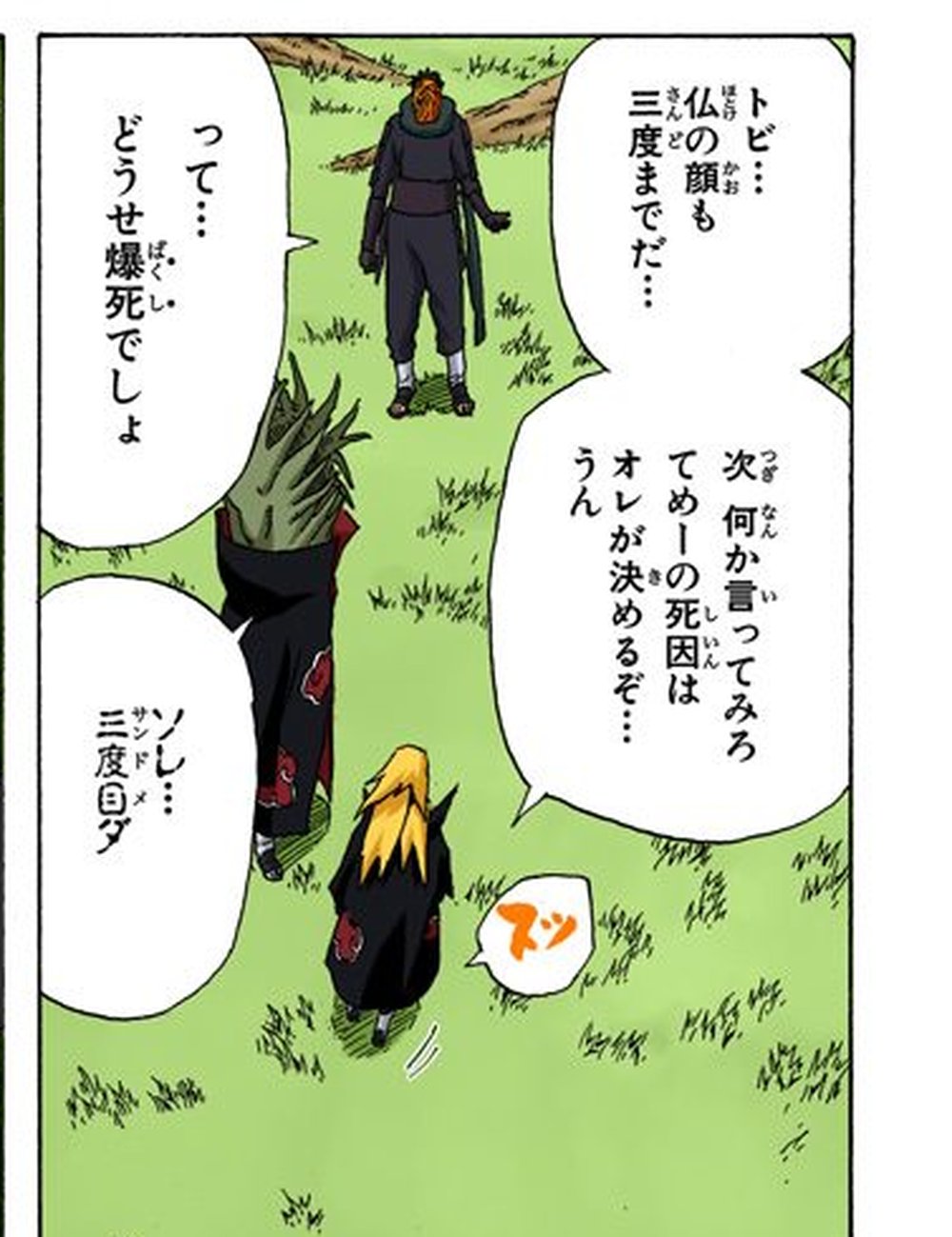
「トビ…仏の顔も三度までだ…」
Tobi… hotoke no kao mo sando made da…
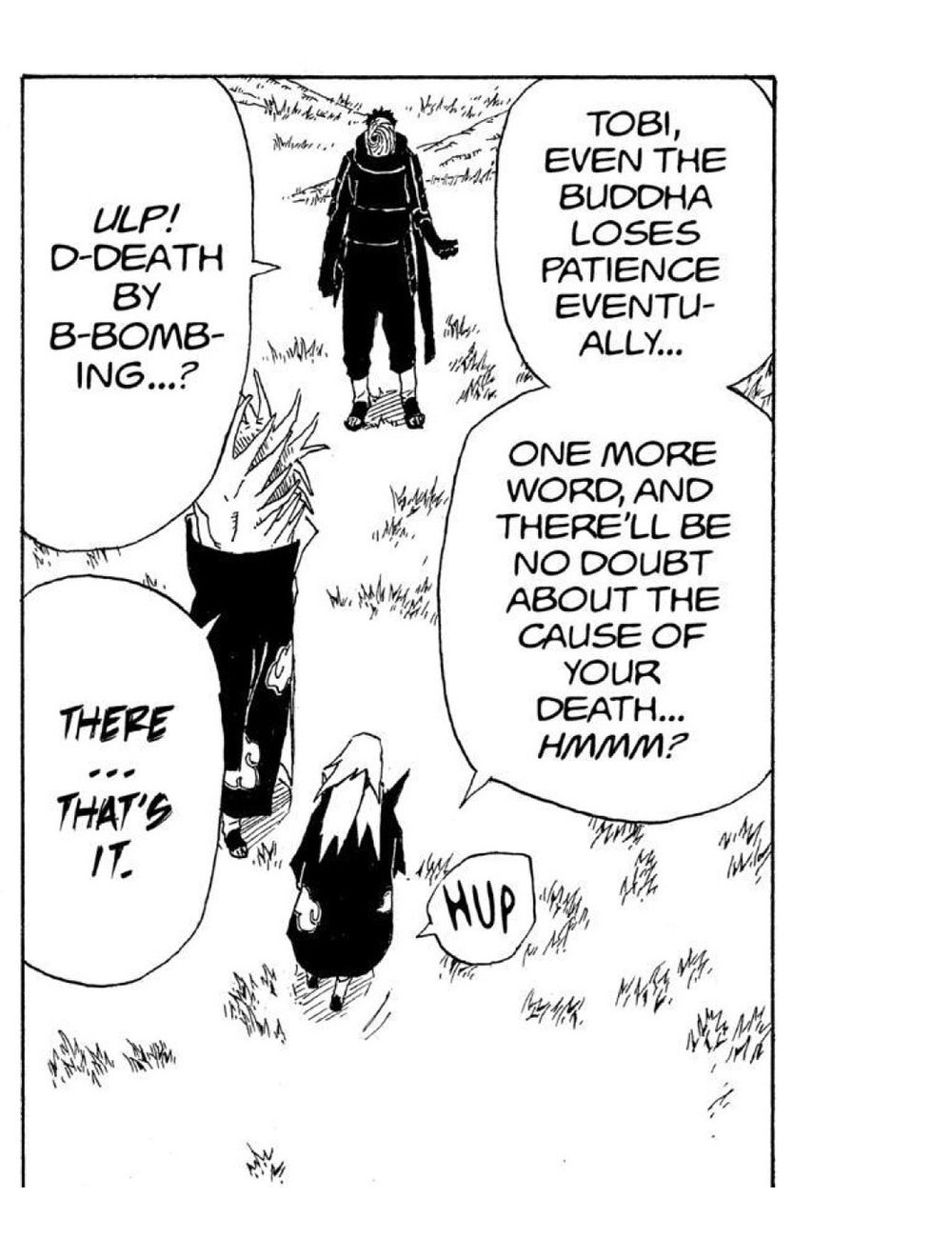
VIZ's English edition prints: "TOBI, EVEN THE BUDDHA LOSES PATIENCE EVENTUALLY..." (Vol. 32, p.23).
Grant the translator the first round, because there is real credit to hand out. The Buddha survived — rarer than you would think, in a publishing tradition that routinely files Buddhist vocabulary under "untranslatable, delete." The folk lesson is read correctly: the proverb is indeed about the limits of even perfect patience. The line even scans like a threat. One thing is missing, and it is small, and it is everything: the proverb Deidara actually quoted has a number in it — and on this very page, that number is a loaded weapon.
The Original
Take 仏の顔も三度(まで) apart:
- 仏 (hotoke) — the Buddha. A grade-school kanji with three everyday lives: the Buddha or his statue; a person of saintly gentleness (仏のような人, "a person like a Buddha"); and, in police-drama slang, the deceased (ホトケさん). Here it is the first sense, with the second shimmering behind it.
- 顔 (kao) — face. The face you stroke on a statue; the face a gentle person keeps composed.
- も — "even." The particle that concedes the extreme case.
- 三度 (sando) — "three times." 度 is the counter for occasions.
- まで — "up to — and no further." The limit marker.
Literally: even the Buddha's face, only up to three times. The sentence is clipped — proverbs usually are — from a longer recorded folk form: 仏の顔も三度撫ずれば腹が立つ (hotoke no kao mo sando nazureba hara ga tatsu), "stroke even the Buddha's face three times, and anger rises." Note the arithmetic in the full version: the anger arrives with the third stroke, not politely after it. Japanese speakers occasionally quibble over whether 三度まで grants three offenses or two; the parent proverb answers, and so — as we are about to see — does Deidara's bookkeeping.
Register: this is a household kotowaza, learned in childhood, listed in every proverb dictionary, and deployable mid-threat because it is common property. The grammar is N5-simple (も…まで…だ); as a set phrase it lives on N1 proverb lists. And the cultural slot it fills is precise: Japanese measures patience against the Buddha the way English measures it against Job or the saints — 知らぬが仏 ("not knowing is Buddha": ignorance is bliss), 地獄で仏 ("a Buddha in hell": an unexpected savior), 仏心 (a merciful heart). Cross that with Japan's folk fondness for three as the threshold number — 三度目の正直 ("the third time is the truth"), 二度あることは三度ある ("what happens twice happens thrice") — and you get this proverb: infinite mercy, metered at exactly three.
One more layer, because it is half the joke: look who is claiming the Buddha's seat. An S-rank terrorist who art-bombs villages, freshly de-armed, casting himself as the mildest face in the cosmos. The proverb's deadpan self-canonization is part of Deidara's comedy — and it only works if the line sounds like a quotation, not a mood.
VIZ's Choice
The proverb appears exactly once in our Naruto corpus — but the page it appears on is a seven-beat comedy routine, and the proverb is its mainspring. Here is the whole machine, Japanese against VIZ:
| Beat | Japanese | VIZ English |
|---|---|---|
| 1 — Tobi pokes | アララ…ギリギリじゃないっすかデイダラさん | A CLOSE ONE THOUGH, EH, DEIDARA? |
| 2 — Tobi pokes again | 大丈夫…/じゃあないか… | BUT AT LEAST YOU'RE ALL RIGHT... / ...OR PERHAPS NOT... |
| 3 — the proverb | トビ…仏の顔も三度までだ… | TOBI, EVEN THE BUDDHA LOSES PATIENCE EVENTUALLY... |
| 4 — the rule | 次何か言ってみろ てめーの死因はオレが決めるぞ…うん | ONE MORE WORD, AND THERE'LL BE NO DOUBT ABOUT THE CAUSE OF YOUR DEATH... HMMM? |
| 5 — strike three | って…どうせ爆死でしょ | ULP! D-DEATH BY B-BOMBING...? |
| 6 — the audit | ソレ…三度目ダ | THERE... THAT'S IT. |
| 7 — the verdict | 窒息死だ……うん | DEATH BY SUFFOCATION...! |
Read beat 3 alone and VIZ's line is perfectly respectable. Read the column down and the cost surfaces. In Japanese, beats 3 through 6 are one continuous piece of bookkeeping: the proverb posts the allowance (three), Tobi promptly spends the third, and Deidara calls the audit out loud — ソレ…三度目ダ, "that… makes three" — set in katakana with katakana ruby サンドメ over 三度目, typography doing deadpan, a robot voice reading a verdict. Then the leg closes around Tobi's throat.
VIZ, having rounded 三度 off to "EVENTUALLY," reaches beat 6 with no ledger to audit. "THERE... THAT'S IT." carries snapped patience just fine; what it cannot carry is the callback, because there is no "three" anywhere upstream to call back to.
Beats 4–7 deserve their own note, because the translator was visibly working. The Japanese rule is 次何か言ってみろ てめーの死因はオレが決めるぞ — "say one more word, and I decide your cause of death." Tobi's deadpan reply — どうせ爆死でしょ, "it'd be death-by-bombing anyway, right?" — calls the bluff by guessing the verdict; and Deidara wins the exchange with 窒息死, suffocation: the bomber, armless, denies his own signature and throttles Tobi with his legs. VIZ rebuilds the logic — "NO DOUBT ABOUT THE CAUSE OF YOUR DEATH" → a stammered guess of bombing → "DEATH BY SUFFOCATION...!" — and the surprise still lands. But two edges are filed off: the I decide of オレが決めるぞ, and Tobi's nerve, of which more below.
The Gap
The proverb's number is its mechanism — and "eventually" deletes it. 三度まで is a fuse of stated length, and Kishimoto burns it down on-panel: two cracks before the proverb, one after, then the audit line. The English reader sees cause and effect — annoyance, then violence — but not the contract: three, and no more. That is the difference between a man losing his temper and a man executing a stated policy, and Deidara, the self-styled artist with rules about everything, is precisely a stated-policy man.
A citation flattened into an observation. Quoting a proverb mid-threat borrows impersonal, communal authority — it says this is not me being touchy; it is the rule even the Buddha follows. "EVEN THE BUDDHA LOSES PATIENCE EVENTUALLY" is grammatical, clear, and sounds like something Deidara thought up on the walk over. English had proverb-shaped seats available — three strikes, even a worm will turn — but the translation sits in none of them, so the borrowed authority evaporates with the count.
Tobi flinches early — and the joke changes species. って…どうせ爆死でしょ is Tobi at his most Tobi: needling a maimed bomber about his own signature move, flat, unbothered, suicidally cheeky. That fearlessness is what makes it strike three — an offense freely committed. VIZ's "ULP! D-DEATH BY B-BOMBING...?" has him stammering in terror before Deidara even moves, so the pounce lands on a man already cowering. In Japanese the clamp is bookkeeping; in English it is bullying.
What If
The menu, with prices:
- "TOBI... EVEN THE BUDDHA FORGIVES ONLY THREE TIMES..." — keeps the Buddha, the count, and the citation cadence, and hands beat 6 — "AND THAT... WAS THREE." — over for free. Cost: not an established English proverb, so it reads imported. Which it is.
- "TOBI... THREE STRIKES AND YOU'RE OUT..." — a native idiom with a built-in counter; "THAT'S... STRIKE THREE." lands the audit perfectly. Cost: trades the temple for the ballpark, and Americana sits oddly on an Akatsuki cloak.
- "EVEN A SAINT'S PATIENCE RUNS OUT AT THE THIRD OFFENSE..." — proverb cadence plus the number. Cost: baptizes the Buddha into a saint — the quiet conversion English performs almost every time Buddhism surfaces in a translation.
- Keep VIZ's headline, repair downstream: render ソレ…三度目ダ as "AND THAT... MAKES THREE." — minimal surgery that restores the ledger. Cost: a count that was never announced; the reader does the arithmetic alone.
Notice the common denominator: any rendering that keeps a number in beat 3 gets beat 6 for free. The one thing a translator cannot afford here is roundness — "eventually," "sooner or later," "only so much" — because two panels later the script does the math out loud.
Take-away
Three rules of thumb to carry off this page:
- When a Japanese idiom contains a number, assume it is load-bearing. Proverbs like 仏の顔も三度 are fuses of stated length, and manga writers love to burn them down on-panel. If the number disappears in translation, look two panels ahead for the joke left unpaid.
- Learn the hotoke shelf. 仏の顔も三度, 知らぬが仏, 地獄で仏, 仏心 — Japanese measures patience and mercy against the Buddha the way English leans on Job and the saints. When a translation actually keeps "Buddha," as VIZ did here, give it credit — then check what it traded away instead.
- A quoted proverb is its own register. It carries impersonal, communal authority — case law, not opinion. When the English sounds like the character's personal aphorism, the words survived but the citation didn't; listen for that drop whenever a line feels suspiciously freshly minted.
This page is also the birth of the Akatsuki double act whose later, louder episode we cover in the patience-bag Tobi jokes should be a bag of bombs — 堪忍袋: Vol. 39, same duo, same fuse, bigger detonation. For another proverb VIZ paraphrased into plain prose, see the lighthouse that keeps its own feet dark — 灯台下暗し; for the Buddhist vocabulary that keeps slipping out of Naruto's English, start with the world outside the walls, 娑婆 — or browse the Naruto translation notes index.
Every Japanese and English line quoted above is a byte-exact capture from the cited editions — NARUTO―ナルト― Vol. 32 (Japanese) and Naruto Vol. 32 (VIZ Media) at the corresponding panels — via our bilingual page database; see Sources below. Where the database's OCR differs from the printed page (トピ for the printed トビ, the stray furigana ほらかお fused into the 仏の顔 line, サンドメ三度目グ for the printed 三度目ダ with its katakana ruby サンドメ, .. ellipses for the printed …, and "TOBI..." for VIZ's printed "TOBI,"), quotations above follow the printed page. On this page the database's machine alignment also shuffles several English bubbles between line-pairs (Tobi's stammer, Deidara's one-more-word rule, and the third-time call-out trade places, and the two halves of "ALL RIGHT... / OR PERHAPS NOT" are swapped); the English quotations above follow the printed VIZ page, and the raw captures in Sources preserve the database bytes.