The Moment
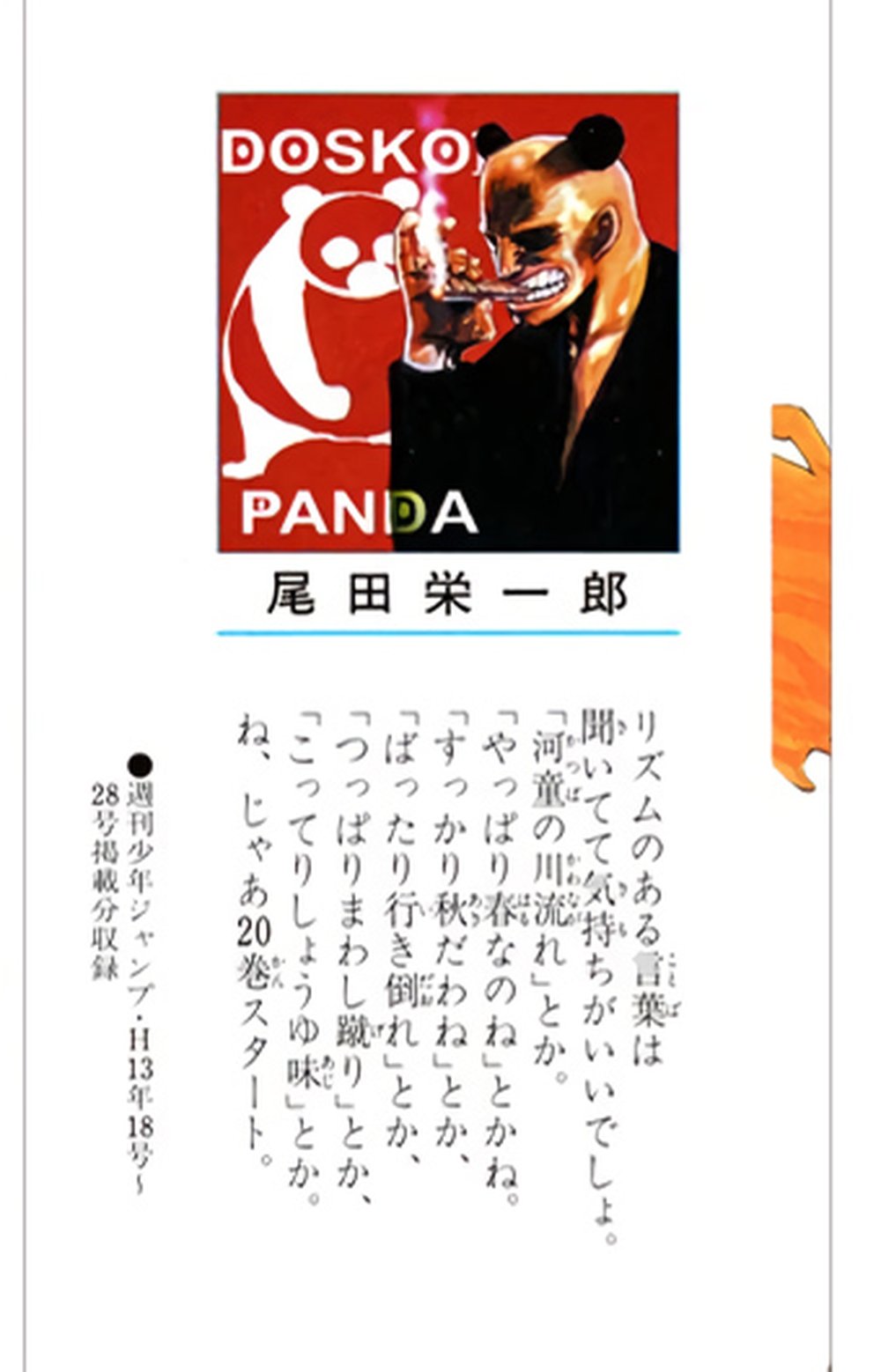
Not a battle, not a bubble — a cover flap. Every Japanese One Piece volume opens with a few sentences from Eiichiro Oda printed on the dust-jacket fold, next to his stand-in portrait (in Volume 20, the grinning tuxedoed mascot of DOSKOI PANDA, the story's in-world fashion label). These comments are a beloved institution precisely because Oda refuses to use them for anything useful. Volume 20 — the heart of the Alabasta arc — gets this:
リズムのある言葉は聞いてて気持ちがいいでしょ。「河童の川流れ」とか。「やっぱり春なのね」とかね。「すっかり秋だわね」とか、「ばったり行き倒れ」とか、「つっぱりまわし蹴り」とか、「こってりしょうゆ味」とか。ね、じゃあ20巻スタート。
Rizumu no aru kotoba wa kiitete kimochi ga ii desho. "Kappa no kawa-nagare" toka. "Yappari haru na no ne" toka ne. "Sukkari aki da wa ne" toka, "battari ikidaore" toka, "tsuppari mawashi-geri" toka, "kotteri shōyu-aji" toka. Ne, jā nijukkan sutāto.
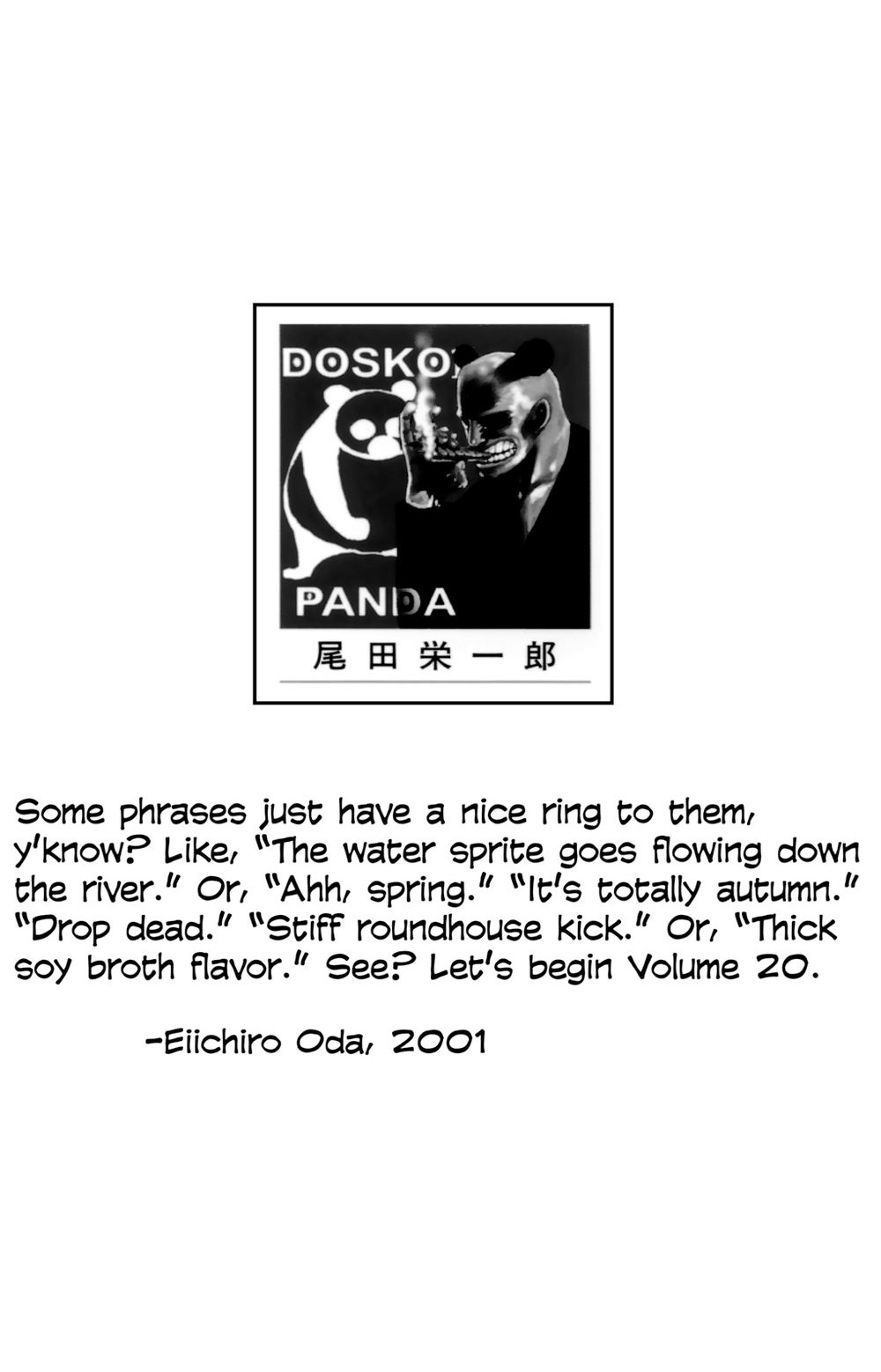
VIZ relocates author comments to the front matter, and its Volume 20 note reads: "Some phrases just have a nice ring to them, y'know? Like, 'The water sprite goes flowing down the river.' Or, 'Ahh, spring.' 'It's totally autumn.' 'Drop dead.' 'Stiff roundhouse kick.' Or, 'Thick soy broth flavor.' See? Let's begin Volume 20." — signed Eiichiro Oda, 2001.
Grant the rendering its due: VIZ translates these throwaway notes at all, which is a service; "y'know?" catches Oda's chatty でしょ perfectly; and "Drop dead." is genuinely funny. But this particular note is a trap with no exit, because it is a sentence about how Japanese sounds, followed by six pieces of evidence — and evidence doesn't survive paraphrase.
The Original
Start with the phrase Oda puts first, because it's the only one with papers. 河童の川流れ (kappa no kawa-nagare) breaks into:
- 河童 — 河 "river" + 童 "child": the kappa, the cucumber-loving river goblin of Japanese folklore, whose entire identity is being unbeatable in the water;
- 川流れ — 川 "river" + 流れ "flowing; being carried off": in older usage, a noun for drowning, being swept downstream.
Literally "a kappa, carried away by the river" — folklore's champion swimmer, drowned in his own element. It is a genuine, schoolroom-certified proverb meaning even the expert fails at their own specialty, filed in every kotowaza collection beside 猿も木から落ちる ("even monkeys fall from trees") and 弘法にも筆の誤り ("even Kōbō Daishi's brush slips"). Learners meet it in N1-grade idiom lists; Japanese children meet it on karuta cards.
But Oda isn't quoting it for wisdom. Listen to what the six phrases share:
- かっぱの・かわながれ — kappa-no (4 morae) + kawa-nagare (5)
- やっぱり・はるなのね — yappari (4) + haru na no ne (5)
- すっかり・あきだわね — sukkari (4) + aki da wa ne (5)
- ばったり・いきだおれ — battari (4) + ikidaore (5)
- つっぱり・まわしげり — tsuppari (4) + mawashi-geri (5)
- こってり・しょうゆあじ — kotteri (4) + shōyu-aji (5)
Six for six: a four-mora word with the little っ — the sokuon, the doubled consonant that gives casual Japanese its snap — followed by a five-mora tail. The 4+5 bounce is a baby cousin of the 5-7-5 instinct that runs through haiku, chants, and jingles; Japanese even has a word for this pleasure, 語呂 (goro), "how the syllables sit in the mouth." And the joke is the guest list. One venerable proverb; two sighing TV-melodrama lines (なのね, だわね — say them in a soap-opera housewife's voice); one grim news word (行き倒れ, collapsing dead by the roadside); one dōjō move with a sumo prefix (つっぱり is the open-palm thrust — note the DOSKOI PANDA portrait grinning above, どすこい being a sumo cry); and one line off a ramen menu. Semantically, chaos. Rhythmically, identical sextuplets. That is the sentence VIZ has to translate.
VIZ's Choice
This is the expression's only appearance in our corpus — but the one appearance contains six translation decisions. Here is the whole list, meter on the left, VIZ on the right:
| Japanese | Scans as | VIZ English |
|---|---|---|
| 河童の川流れ | kappa-no · kawa-nagare (4+5) | "The water sprite goes flowing down the river." |
| やっぱり春なのね | yappari · haru na no ne (4+5) | "Ahh, spring." |
| すっかり秋だわね | sukkari · aki da wa ne (4+5) | "It's totally autumn." |
| ばったり行き倒れ | battari · ikidaore (4+5) | "Drop dead." |
| つっぱりまわし蹴り | tsuppari · mawashi-geri (4+5) | "Stiff roundhouse kick." |
| こってりしょうゆ味 | kotteri · shōyu-aji (4+5) | "Thick soy broth flavor." |
Every row is a defensible sentence-level translation, and the column is a catastrophe. VIZ translated six meanings; Oda had written six drum hits. "The water sprite goes flowing down the river" — eleven words for nine morae — even domesticates the kappa into a generic "water sprite," so the one phrase with a pedigree arrives as whimsical nonsense. "Drop dead." is the most interesting row: 行き倒れ is a noun for keeling over in the street, not an insult, but VIZ clearly reached for something punchy — the one place the translation tries to have rhythm instead of meaning, and, tellingly, the one place it strays furthest from the Japanese. And then the flourish: Oda's ね、 — "right?" — becomes "See?", cheerfully asking the English reader to confirm a pattern that the preceding six phrases no longer contain.
The Gap
The music is deleted, and the music was the message. This note has no plot, no characters, no information — its entire content is "listen to these." Once yappari–sukkari–battari–tsuppari–kotteri becomes "Ahh / totally / Drop dead / Stiff / Thick," the six phrases share nothing, and the English reader meets a manga author free-associating nonsense instead of a craftsman demonstrating his materials.
The proverb stops being a proverb. A Japanese reader clocks 河童の川流れ instantly: a real idiom, the aquatic sibling of "even monkeys fall from trees." That's what makes the list funny — it opens with certified classical goods and slides, beat by identical beat, down to soy-broth ramen. "The water sprite goes flowing down the river" has no idiomatic existence in English, so the descent starts nowhere and lands nowhere; the list is uniformly random instead of comically deflating.
The voices inside the quotes go silent. なのね and だわね stage a melodrama heroine gazing at cherry blossoms; 行き倒れ is a coroner's word; つっぱり is the sumo ring. Oda's phrases are tiny costume changes on a fixed rhythm. "Ahh, spring." and "It's totally autumn." wear no costume at all — and "Drop dead." changes the corpse into an insult, swapping the register loss for a meaning swap.
What If
What could a translator actually do with a sentence whose content is its sound?
- "Even a kappa can drown in his own river." — restores the proverb as a proverb and keeps the yokai. Cost: no 4+5 beat, and "kappa" bills the reader for folklore knowledge.
- Rebuild the pattern, not the phrases: "Like, 'happy as a clam at high tide,' 'snug as a bug in a rug,' 'flat on his back in the gutter,' 'thick brown gravy on a biscuit'…" — invent an English list with one shared groove, so "See?" finally has something to point at. Cost: every original meaning dies, kappa first.
- Gloss and keep the sound: "'Kappa no kawa-nagare — even a kappa gets swept downstream'…" Romaji hands the reader the actual rhythm; the gloss carries the sense. Cost: six of these turn a flap note into a homework sheet.
- VIZ-plus-honesty: keep the renderings, add "…they all bounce along in Japanese, trust me." Cost: printing an admission of defeat — though on a flap this playful, a wink might be perfectly in voice.
Notice the shape of the menu: you can keep the meanings or keep the music, and the sentence's whole point is the music. This is the rare case where the "free" translation — option two — is arguably the faithful one.
Take-away
Oda's Volume 20 note is translation theory smuggled onto a dust jacket: a native speaker pointing at six phrases and saying feel that? — followed, in the English edition, by six phrases you can't feel anything through. Nobody blundered; VIZ simply chose meaning over meter at all six forks, and a sentence about meter has nothing left.
Three rules of thumb to carry off this page:
- When a Japanese sentence praises its own sound, read it aloud before you translate it. Count morae, find the っ. If the pattern is the point, translating the words is already a paraphrase.
- File 河童の川流れ with 猿も木から落ちる and 弘法にも筆の誤り — the experts-fail trio. Meeting any one of them in the wild, you now know the other two are standing behind it.
- Collect the っ-adverbs — やっぱり, すっかり, ばったり, こってり and their dozens of cousins. The doubled consonant is the drumbeat of casual Japanese, and it is precisely the beat English spelling has no way to write down.
One Piece keeps forcing this same choice between sound and sense: see how VIZ wrestled a four-way Buddhist pun into a "Pound Phoenix" it had to rebuild from scratch, how a liar's name got tangled in the dust–pride pun on 誇り, or how a stagey 茶番 became mere "nonsense" — or browse the One Piece translation notes index.
The Japanese author's comment above is a byte-exact capture from our bilingual page database — ONE PIECE Vol. 20 (Japanese edition), archived cover-flap page — with display punctuation confirmed against the printed flap. Because VIZ relocates author comments to the front matter, the database pairs this flap with a provisional machine rendering; every VIZ line quoted above was instead transcribed directly from the author's comment page of One Piece Vol. 20 (VIZ Media). See Sources below.