The Moment
Volume 20, deep in the Infinity Castle. Upper Rank One — Kokushibo, the six-eyed demon who was once the Sengoku-era swordsman Michikatsu Tsugikuni — is losing, and as he loses, his oldest memory surfaces: the night, sixty-some years after he traded his humanity for the blade, when he met his twin brother for the last time. Yoriichi Tsugikuni — the effortless genius he envied to the marrow — should be long dead; every swordsman who bears the Mark dies before twenty-five (皆死ぬはずだ二十五になる前に, p.95). Instead an old man past eighty stands in the moonlit pampas grass, and the brother who never once showed a flicker of feeling looks at what Michikatsu has become and weeps:
「お労しや…兄上」 — Oitawashi ya… anue — in VIZ's edition, "MY SYMPATHIES... ...MY BROTHER."
Pitied. By the withered creature that was once his little brother. Kokushibo's narration admits the unthinkable — 私は己の予期せぬ動揺に困惑した, "I was bewildered by my own unexpected agitation" — and then does what this man always does with a feeling he cannot cut: he reaches for a rule.
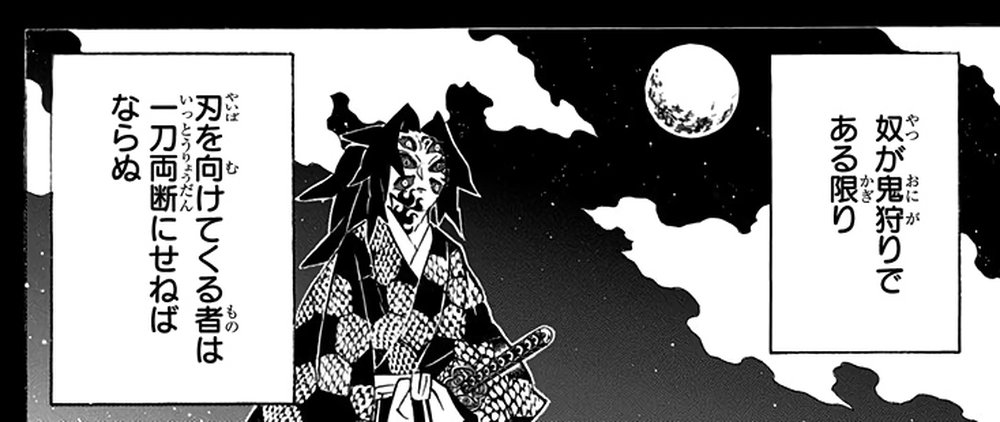
「奴が鬼狩りである限り/刃を向けてくる者は一刀両断にせねばならぬ」
Yatsu ga onikari de aru kagiri / yaiba o mukete kuru mono wa ittō-ryōdan ni seneba naranu
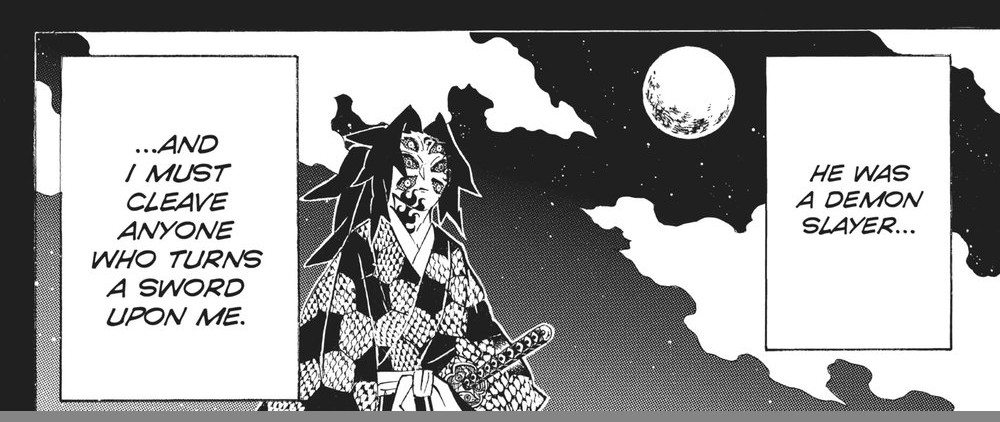
VIZ's English edition prints: "HE WAS A DEMON SLAYER... ...AND I MUST CLEAVE ANYONE WHO TURNS A SWORD UPON ME." (Vol. 20, p.98.)
Give the translator full credit before we take anything away, because this line earns it twice. First, the whole vow arrives as a matched pair in Japanese — 殺さねばならぬ… 一刀両断にせねばならぬ — and VIZ keeps the anaphora perfectly: "I MUST KILL... ...AND I MUST CLEAVE..." Second, cleave itself is a connoisseur's verb: Old English clēofan, the word English uses when something is split in two — a cleaver, a cloven hoof. Of all the single verbs on the shelf, it is the one that carries the bisection inside it, and its slightly archaic grain even gestures at Kokushibo's antique grammar. This is a good translation. What follows is an audit of the remainder.
The Original
一刀両断 (ittō-ryōdan) is a yojijukugo — one of the four-character idioms Japanese inherited from the Chinese chengyu tradition — and its four characters are a piece of arithmetic:
- 一 (ichi) "one" + 刀 (tō) "sword; stroke of the blade" → 一刀, a single stroke;
- 両 (ryō) "both" + 断 (dan) "to sever" → 両断, severed into both halves.
One stroke in, two pieces out. Notice that the two numbers count different things — 一 counts the act, 両 counts the result — which is why the idiom feels so economical: cause and effect, invoice and receipt, in four characters. The literal sense encodes a real ideal of Japanese swordsmanship: the cut so perfect it ends the matter by itself — the premise of iai, the quick-draw art, and of every samurai-film standoff where two men pass each other at speed and only one sheathes his blade.
And like most sword vocabulary in Japanese, the idiom long ago left the dojo. In everyday modern usage 一刀両断 is mostly figurative: to settle a question, demolish an excuse, or cut through a tangle decisively, at a stroke — 問題を一刀両断する, "to cut the problem clean in half." It is what a pundit does to a ministry's talking points on the evening news. The blade family is large: 単刀直入 ("single blade, straight in" — straight to the point), 快刀乱麻を断つ ("a keen blade severs the tangled hemp" — Japan's Gordian knot), 真剣 ("a real sword," now simply "serious"). Japanese spent centuries minting words out of swordsmanship, and this coin still circulates daily.
The grammar around the idiom is doing just as much characterization as the idiom itself. 〜にせねばならぬ is the classical ancestor of しなければならない — 為ねば with the archaic negative ぬ — and 〜である限り ("so long as he is…") frames a standing condition. Crucially, the sentence has no subject: it does not say I will cut anyone in two; it says one-who-turns-a-blade-here must be cut in two. This is the syntax of a law, not a mood — Sengoku-period speech from a man born in the Sengoku period, reciting his own code back to himself. Level check: yojijukugo sit outside the official JLPT lists, but the parts are N3–N2 and the idiom is comfortably N1-plus — newspaper and period-drama vocabulary, not textbook fare.
VIZ's Choice
一刀両断 appears exactly once in the twenty-three Demon Slayer volumes we have on file — this line — so instead of a scatter across volumes, here is the full vow it belongs to, bubble by bubble, against VIZ's rendering (JP Vol. 20 p.97; VIZ p.98):
| Japanese | VIZ English |
|---|---|
| 殺さねばならぬ | I MUST KILL... |
| 人であった頃の肉の片割れを | ...THIS PART OF ME FROM WHEN I WAS HUMAN... |
| 全盛期を過ぎ脆い肉体の老人を | THIS OLD MAN OF BRITTLE FLESH PAST HIS PRIME... |
| 奴が鬼狩りである限り | HE WAS A DEMON SLAYER... |
| 刃を向けてくる者は一刀両断にせねばならぬ | ...AND I MUST CLEAVE ANYONE WHO TURNS A SWORD UPON ME. |
Read the column as a whole and the translator's strategy is visible: keep the drumbeat (I must… I must…), keep the imagery (brittle flesh past his prime for 全盛期を過ぎ脆い肉体 is lovely), and spend one carefully chosen verb — cleave — on the four-character idiom. As a compression it is honest work: cleave keeps the two halves, and its King-James patina nods at せねばならぬ.
But two quiet reshapings ride along. 奴が鬼狩りである限り is a condition in force — "so long as he is a demon slayer" — and VIZ recasts it as narrated past: "HE WAS A DEMON SLAYER..." And the subjectless precept becomes first-person resolve: "I MUST CLEAVE." Small shifts, same direction: a standing law turns into one man's remembered feeling.
The Gap
The arithmetic vanishes. 一刀両断 counts, and the count is the boast: one stroke (一刀), both halves (両断). "Cleave" delivers the halves — that is exactly what the verb means — but the single stroke has no seat in the English sentence, and the single stroke is the swordsman's entire claim: not that he can kill you, but that it will take him one motion. The story audits the number immediately. Pages later, Kokushibo recalls his certainty — だが次の一撃で私の頚は落とされるという確信があった, "but I was certain the next stroke would take my head" — after Yoriichi's first draw opened his throat before his own hand reached the hilt. The idiom he recited was performed on him, by an eighty-year-old, one stroke, no reply. (次の一撃が放たれることは終ぞ無かった — the next stroke never came: Yoriichi died on his feet, mid-stance.) The English reader watches the same scene; they just never heard the number the scene is contradicting.
The verdict sense is gone. To a Japanese reader, 一刀両断 arrives pre-loaded with its everyday figurative life: cutting through excuses, tangles, hesitation — deciding. That matters here because of what the panel before showed: a demon confessing that his brother's tears bewildered him (己の予期せぬ動揺に困惑した). The vow is not tactical planning; it is a man using the decisive-verdict idiom on his own wavering — trying to 一刀両断 the one thing in six centuries he never managed to sever. "Cleave anyone who turns a sword upon me" is purely literal; the self-directed cut, the idiom's second blade, never crosses.
A law becomes a preference. せねばならぬ with no subject is the grammar of code — what must be done, by anyone, always — and 〜である限り keeps the code in force in the present. "I MUST CLEAVE" is personal; "HE WAS" is past. In Japanese, Kokushibo hides behind the impersonality: the rule kills Yoriichi, not the brother reciting it. In English the shelter is gone — the sentence owns the desire it was built to disown. It reads fine; it just absolves him of one less thing.
What If
The menu, with prices:
- "ANYONE WHO TURNS A BLADE ON ME MUST BE CUT IN TWO — WITH A SINGLE STROKE." — restores both numbers and the subjectless, law-like ring of せねばならぬ. Cost: long for a bubble, and the dash performs with punctuation what the Japanese does with vocabulary.
- "WHOEVER BARES A BLADE AT ME, I CUT DOWN IN ONE STROKE." — keeps the stroke count and reads at bubble speed. Cost: "cut down" fells the enemy but loses the bisection, and two pieces were half the idiom.
- "A SINGLE STROKE, CLEAN IN TWO — THAT IS THE ANSWER FOR ANY DRAWN SWORD." — foregrounds the arithmetic as a maxim, which is what a yojijukugo is. Cost: theatrical staging for something the Japanese delivers in four flat characters; it risks sounding like calligraphy on a dojo wall.
- Keep "CLEAVE," add the count: "...AND I MUST CLEAVE IN A SINGLE STROKE ANYONE WHO TURNS A SWORD UPON ME." — Cost: the sentence starts to buckle under its freight, and the idiom's verdict overtone still has nowhere to sit.
The shared price is instructive: 一刀両断 is a number sentence wearing an idiom's clothes, and English idioms of decisiveness ("cut to the chase," "cut the knot," "make short work of") all dropped their arithmetic centuries ago. You can buy back the numbers or the brevity — not both.
Take-away
VIZ's "cleave" is the right verb losing gracefully: it keeps the halves, drops the stroke, and converts a recited law into a personal vow. What disappears is not meaning but bookkeeping — and in a scene built on a swordsman's fatal precision, the bookkeeping was the poetry.
Three rules of thumb to carry off this page:
- Count the numbers inside a yojijukugo. 一刀両断, 単刀直入, 一石二鳥 — four-character idioms love arithmetic, and the numbers are usually the exact thing English paraphrase spends first. When you meet one, ask what 一, 両, 二 are counting before you accept a verb in trade.
- Treat archaic grammar as characterization. せねばならぬ, ならぬ, 〜である限り — when a manga character talks like a classical text, the grammar is telling you when they are from. Kokushibo's ぬ endings are as much a costume as his six eyes.
- Sword idioms live double lives. Nearly every blade word in Japanese cuts both literally and figuratively — 一刀両断 settles arguments, 単刀直入 opens meetings, 真剣 just means "serious." When a swordsman uses one literally, check whether the figurative edge is also in play. Here, it is the whole tragedy.
This is the first entry in the Demon Slayer translation-notes hub — more are on the way at the Demon Slayer index. For another four-character idiom that made VIZ choose between brevity and bookkeeping, see our One Piece note on 自業自得 at /japanese/jigou-jitoku/.
Every Japanese and English line quoted above is a byte-exact capture from the cited editions — 鬼滅の刃 Vol. 20 (Japanese) and Demon Slayer: Kimetsu no Yaiba Vol. 20 (VIZ Media) at the corresponding panels — via our bilingual page database, and every VIZ line was re-confirmed against the printed English page. One housekeeping note: in this stretch of Vol. 20 the English edition runs one page behind the Japanese (JP p.97 ↔ VIZ p.98), so the machine-aligned database pairs this line with "...HAD PITY FOR ME." — which is really VIZ's rendering of 憐れまれた, one JP page earlier. The renderings analyzed here are the ones VIZ actually printed.