The Moment
Volume 12, the Swordsmith Village. Tanjiro has just offered to help the young Mist Hashira find a missing craftsman — 「一緒に捜そうか?」 ("SHALL WE SEARCH TOGETHER?") — and Muichiro Tokito is genuinely baffled by him: 「なんでそんなに人を構うの?」「君には君のやるべきことがあるんじゃないの?」 — "WHY ARE YOU SO HELPFUL?" / "DON'T YOU HAVE YOUR OWN CONCERNS?" Tanjiro answers with a smile and, though he never names it, half of an old proverb:
「人のためにすることは結局 巡り巡って自分のためにもなっているものだし」
Hito no tame ni suru koto wa kekkyoku, meguri-megutte jibun no tame ni mo natte iru mono da shi
VIZ: "HELPING OTHERS... ...OFTEN ENDS UP HELPING YOURSELF." (Vol. 12, p.171).
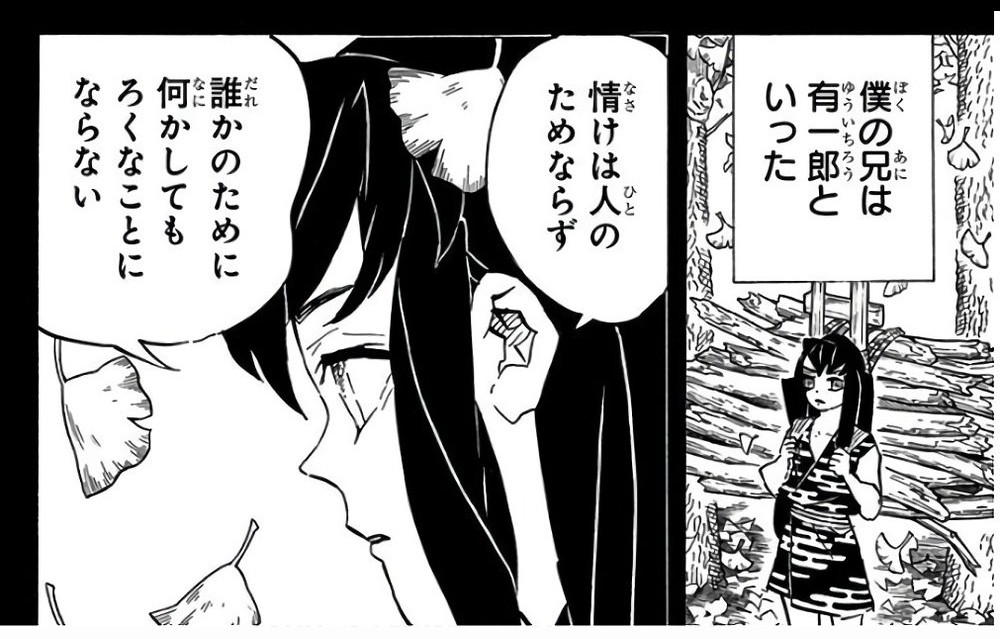
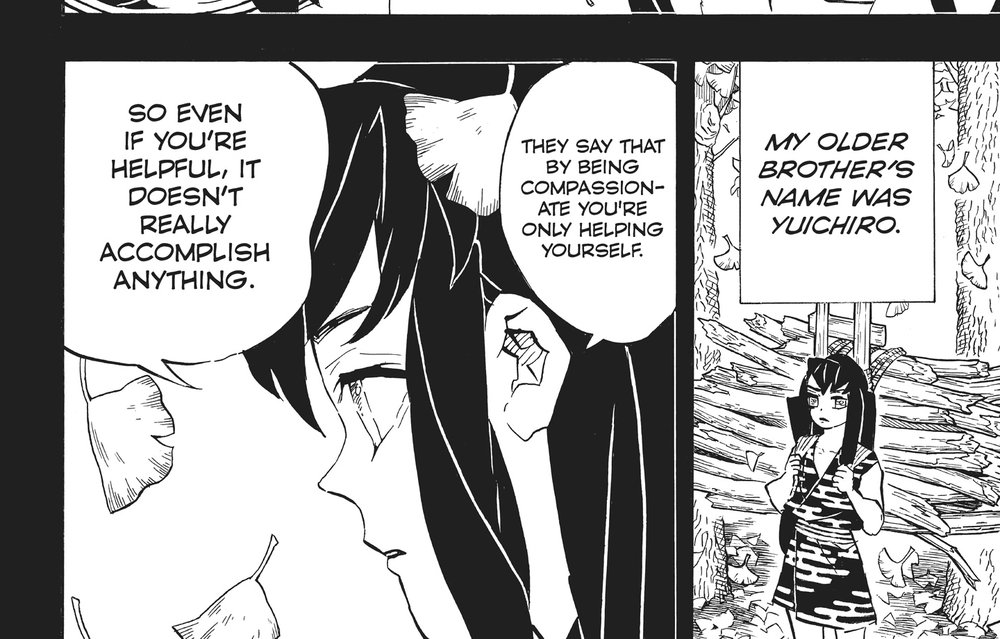
The sentence follows Muichiro around. It resurfaces mid-swordstroke in Volume 13 — printed in quotation marks, a remembered voice — and again in Volume 14 as he sinks, lungs filling, inside a demon's water prison, where the dream-version ends by calling him by his given name: Muichiro. And with that, memory opens: 「僕は双子だった」 — "I HAD A TWIN." 「僕の兄は有一郎といった」 — "MY OLDER BROTHER'S NAME WAS YUICHIRO."
Then the twin speaks: a boy with Muichiro's face and none of his patience, reciting — flat, unattributed, the way you quote something everyone already knows — an actual Japanese proverb:
「情けは人のためならず」
Nasake wa hito no tame narazu
— and, in the next bubble, his own verdict on it: 「誰かのために何かしてもろくなことにならない」 — doing things for people comes to no good.
VIZ's English edition prints: "THEY SAY THAT BY BEING COMPASSIONATE YOU'RE ONLY HELPING YOURSELF." — then — "SO EVEN IF YOU'RE HELPFUL, IT DOESN'T REALLY ACCOMPLISH ANYTHING." (Vol. 14, p.52).
Grant the translation its due, because this one earns more than most. "THEY SAY THAT..." plants a flag: what follows is a saying, not my sentence. And "BY BEING COMPASSIONATE YOU'RE ONLY HELPING YOURSELF" is a genuinely cunning line — read it warm and it states the proverb's true meaning (your kindness returns to you); read it cold and it drips Yuichiro's cynicism (charity is just self-interest). One sentence, straddling both. If a proverb must be replaced by its explanation, this is expert work.
But it has been replaced. What Japanese readers meet on this page is a fixed, classical, five-word saying they have known since childhood — and, famously, one that half of Japan gets wrong. That national misunderstanding is not background trivia here. It is the plot.
The Original
Take the proverb apart — five words, every one of them load-bearing.
情け (nasake) — warmth, compassion, human kindness. The 情 is the "feeling" kanji of 感情 (kanjō, emotion) and 愛情 (aijō, affection). Its negated adjective 情けない — "kindness-less" — has drifted into meaning "pathetic," which tells you how essential Japanese considers the stuff.
人 (hito) — "person," but here is the first trap: in proverbs and idioms, 人 routinely means other people, as in 人の目 ("other people's eyes") or 人のこと言えない ("you're one to talk"). The line is about others, not humanity in general.
の為 (no tame) — "for the sake of." So far: "kindness, for others' sake..."
ならず (narazu) — the second trap, and the famous one. This is classical Japanese: the copula なり ("to be") plus the literary negative ず. It means "is not." Kindness is not for others' sake — not, that is, for theirs alone. The saying is elliptical, and its unstated second half is supplied by the schoolroom couplet every Japanese student eventually meets: 情けは人の為ならず、巡り巡って己が為 — "kindness is not for others' sake; around it goes, and back for your own."
Now listen to the trap spring. Modern Japanese has an everyday set phrase 為になる (tame ni naru), "to do one good, to be beneficial." To a modern ear, ためならず sounds less like the classical "is not for the sake of" and more like ためにならない — "does them no good." Parse it that way and the proverb inverts: kindness does people no good — it spoils them, coddles them, accomplishes nothing. Same eleven syllables, opposite creed.
This is not a hypothetical confusion. In the Agency for Cultural Affairs' national survey on Japanese usage (fiscal 2010), 45.8% of respondents chose the true meaning — kindness comes back around to benefit you — and 45.7% chose the misreading. A statistical dead heat. 情けは人のためならず is the country's reigning example of a proverb that modern grammar has booby-trapped, a stock item in language columns, quiz shows, and JLPT N1 and kanken prep lists — precisely because the examiners know how many native speakers parse it wrong. (情け itself is roughly N3 vocabulary; the ず-negation is N1 grammar.)
Which is exactly the fault line Gotouge builds the twins on. Yuichiro recites the form and lives by the misreading — and for him it is armor, not ignorance: the twins' father went out into a storm to gather herbs for their dying mother and fell to his death. He died doing something for someone. 「人のために何かしようとして死んだ人間の言うことなんてあてにならない」 — "YOU CAN'T TRUST THE WORD OF A MAN WHO DIED TRYING TO DO SOMETHING FOR SOMEONE ELSE." (Vol. 14, p.53). Muichiro answers with the other parse, and with its source:
「違うよ」「人のためにすることは巡り巡って自分のためになるって意味だよ」「父さんが言ってた」
"YOU'RE WRONG." / "THAT EXPRESSION MEANS THAT DOING SOMETHING FOR OTHERS COMES BACK TO BENEFIT YOU TOO." / "THAT'S WHAT DAD SAID." (Vol. 14, p.53)
A dead father's reading against a grieving brother's misreading, with a real proverb as the battlefield. The scene is a Japanese classroom argument staged as a family wound.
VIZ's Choice
Here is the whole thread as it runs through the volumes we have on file — Tanjiro's version, its echoes, the proverb, and the correction:
| Vol. / p. | Who | Japanese | VIZ English |
|---|---|---|---|
| 12 / 171 | Tanjiro | 人のためにすることは結局 巡り巡って自分のためにもなっているものだし | HELPING OTHERS... ...OFTEN ENDS UP HELPING YOURSELF. |
| 13 / 24 | Tanjiro's words, remembered | 人のためにすることは 巡り巡って自分のために | "HELPING OTHERS..." "...OFTEN ENDS UP HELPING YOURSELF." |
| 14 / 44 | the words, returning as Muichiro drowns | 人のためにすることは 巡り巡って自分のためになる | HELPING OTHERS... ...OFTEN MEANS YOU END UP HELPING YOURSELF. |
| 14 / 52 | Yuichiro | 情けは人のためならず | THEY SAY THAT BY BEING COMPASSIONATE YOU'RE ONLY HELPING YOURSELF. |
| 14 / 53 | Muichiro | 人のためにすることは巡り巡って自分のためになるって意味だよ | THAT EXPRESSION MEANS THAT DOING SOMETHING FOR OTHERS COMES BACK TO BENEFIT YOU TOO. |
Read the right-hand column and give credit first: the refrain is disciplined. "HELPING OTHERS... HELPING YOURSELF" recurs across Volumes 12, 13, and 14 nearly verbatim — VIZ even adds quotation marks in Volume 13 to mark remembered speech — so the English reader does hear Tanjiro's sentence chasing Muichiro through three volumes. The echo, which is the emotional machinery, survives.
The pivot happens at the proverb. In Japanese, rows 1–3 and row 5 are all modern paraphrases orbiting row 4, the fixed classical star: 巡り巡って ("around and around it goes") is lifted straight from the proverb's schoolroom second half. Tanjiro has been unknowingly reciting the correct half of the exact saying Yuichiro misreads — that is the engineering of the whole arc. In English, row 4 is not a star but just another paraphrase: "THEY SAY THAT" gestures at sayinghood, but the sentence that follows is an explanation wearing the saying's clothes. And then row 5 must do the impossible. Muichiro says "THAT EXPRESSION" — what expression? The English reader was never shown an expression, only a summary — and he "corrects" his brother's "ONLY HELPING YOURSELF" with "COMES BACK TO BENEFIT YOU TOO," two paraphrases a hair's width apart. The entire quarrel now hangs on the difference between only and too.
The Gap
A proverb became its own footnote. 情けは人のためならず is a quotable, fixed, classical object — five words every Japanese reader recognizes on sight, no quotation marks needed. VIZ printed the meaning where the form should be, so English has nothing to recognize, nothing to memorize, nothing for later lines to point back at. When the story then talks about the saying (「〜って意味だよ」 / "THAT EXPRESSION MEANS..."), English readers watch a character explain a text they never saw.
The misreading — the actual subject of the scene — cannot cross. The Japanese quarrel is not about attitude; it is about parsing: classical ならず ("is not for") versus modern 為にならない ("does no good"), a garden-path ambiguity potent enough to split the Japanese public 45.8% to 45.7%. English grammar has no equivalent trapdoor, so the translation must pre-commit to one parse — and once it does, Yuichiro is no longer misreading a proverb; he is just quoting a bleak one. A whole layer — a boy bending a saying to fit his grief — flattens into mood.
"Only" relocates the cynicism from the boy into the saying. The proverb never claims kindness is merely self-interest; its true meaning is an encouragement — be kind, it comes back. Yuichiro's bitterness lives in his own next sentence (ろくなことにならない — "it comes to no good"). VIZ's "ONLY HELPING YOURSELF" pre-poisons the saying itself, so when the same words return in warm mouths — Tanjiro's, the father's — the English reader hears a different creed, instead of the same five words finally heard right.
What If
The menu, and its prices:
- "They say kindness is never just for others." — proverb-shaped, compact, true to the correct parse, and just leaves a sliver of room for a cynical ear. Cost: it quietly resolves the ambiguity; Yuichiro's "so it accomplishes nothing" follows a little less naturally.
- "Kindness is not for other people's sake — so the saying goes." — the literal rendering, ambiguity intact: an English ear can genuinely hear it serves you or it does them no good, which is the double reading the twins fight over. Cost: cryptic on first pass, long for a bubble, and it asks the reader to do the parsing the scene is about.
- "You know the proverb — charity does nobody any good." — prints Yuichiro's misreading as the saying, so his conclusion flows and Muichiro's correction lands with real teeth ("that's not what it means"). Cost: it forges an English proverb that doesn't exist and makes the true meaning sound like special pleading when it arrives.
- Keep the Japanese: "Nasake wa hito no tame narazu — kindness isn't for others' sake." — the saying stays a saying, the gloss stays a gloss, and the later 「って意味だよ」 line finally has a referent. Cost: two lines of lettering where the page gives you one, and weekly-shonen pacing rarely forgives it.
Every option pays somewhere, because the original is doing three jobs at once — being a fixed text, being misread, and being corrected — and English has to rebuild all three out of paraphrase.
Take-away
情けは人のためならず is the proverb Japan argues with itself about, and Demon Slayer turns that argument into two orphaned boys fighting over their father's last lesson. VIZ's gloss is about the best one-sentence solution available — and still a demonstration that a saying and its explanation are different genres, and that some scenes are about the difference.
Three rules of thumb to carry off this page:
- When a character says 〜って意味だよ ("that expression means..."), go hunting. An explanation in the dialogue almost always means a fixed form stood in the original — a proverb, a prayer, a pun — and the drama is usually in the form.
- ならず is "is not," not "does not become." Classical なり + ず survives inside dozens of set phrases; read 〜は〜のためならず as "X is not for Y('s sake)" — and remember that 人 in proverbs usually means other people.
- A proverb quoted flat, with no quotation marks, is still a quotation. Japanese marks sayinghood by form, not punctuation. If a line of dialogue suddenly sounds four hundred years old, it probably is.
Yuichiro is not done wounding with language, either: two pages after this line, in the same remembered clearing, he weaponizes his brother's own name — the 無 pun VIZ rebuilt as a cow joke — in Twins Named Being and Nothing: 無一郎の無. For another fixed Japanese formula English had to improvise around, see the prayer inside 成仏してください, or browse the Demon Slayer translation notes index. (Collectors of famously misread sayings: our Naruto notes take up another schoolroom favorite, 灯台下暗し — "darkest at the foot of the lantern.")
Every Japanese and English line quoted above is a byte-exact capture from the cited editions — 鬼滅の刃 Vol. 12–14 (Japanese) and Demon Slayer: Kimetsu no Yaiba (VIZ Media) at the corresponding panels — via our bilingual page database; see Sources below.