The Moment
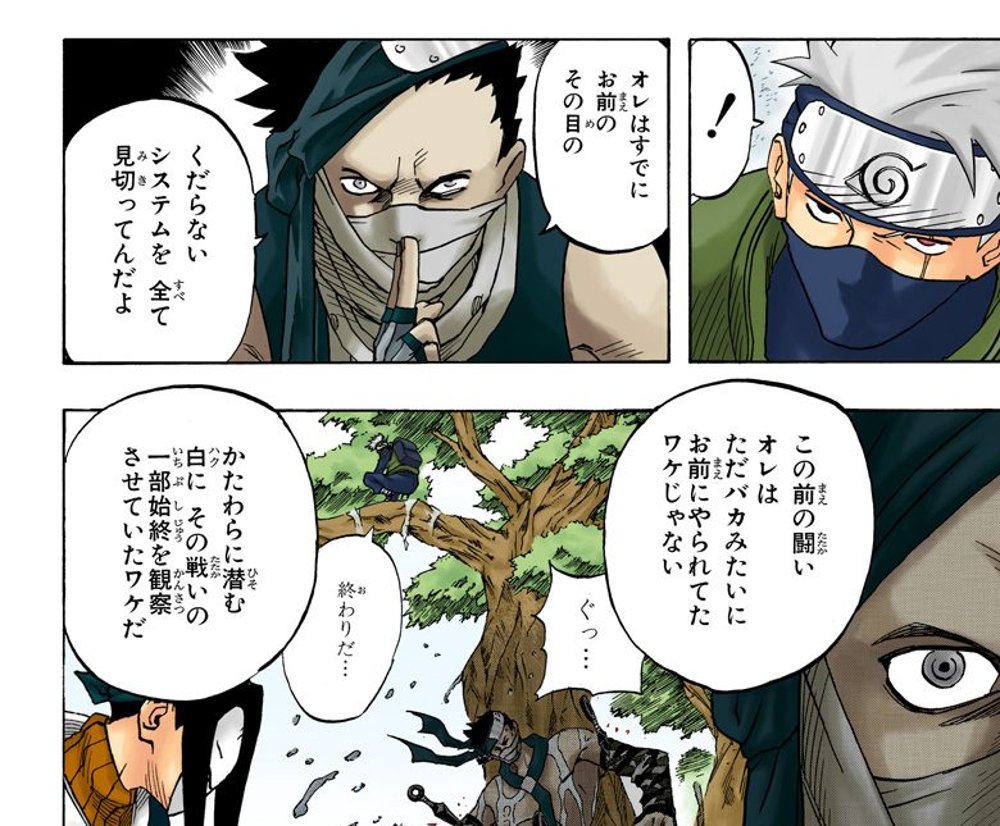
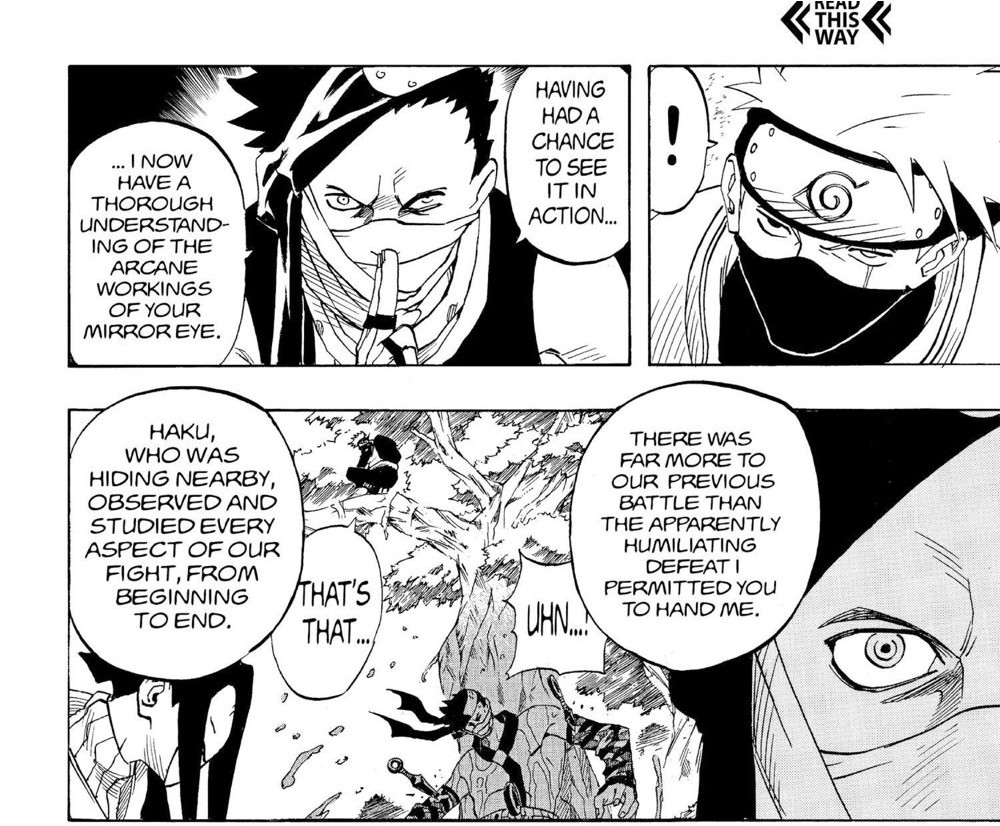
The Land of Waves, the half-built bridge, the rematch. Zabuza Momochi and Kakashi are fighting for the second time, and Zabuza opens with a boast: he has already seen through Kakashi's famous eye. 「オレはすでにお前のその目のくだらないシステムを全て見切ってんだよ」 — VIZ splits it across two bubbles, "HAVING HAD A CHANCE TO SEE IT IN ACTION... ...I NOW HAVE A THOROUGH UNDERSTANDING OF THE ARCANE WORKINGS OF YOUR MIRROR EYE." (this early VIZ printing still calls the Sharingan the "Mirror Eye" rather than the now-standard fan term). Then he goes further: 「この前の闘いオレはただバカみたいにお前にやられてたワケじゃない」 — "THERE WAS FAR MORE TO OUR PREVIOUS BATTLE THAN THE APPARENTLY HUMILIATING DEFEAT I PERMITTED YOU TO HAND ME." Kakashi's eye narrows into a single, wary panel. Then Zabuza explains exactly how much more:
「かたわらに潜む白にその戦いの一部始終を観察させていたワケだ」
Katawara ni hisomu Haku ni sono tatakai no ichibu-shijū o kansatsu sasete ita wake da.
VIZ's English edition prints: "HAKU, WHO WAS HIDING NEARBY, OBSERVED AND STUDIED EVERY ASPECT OF OUR FIGHT, FROM BEGINNING TO END." (Vol. 3, p.174).
Grant this one its due, because it earns it in a way this series of articles doesn't always get to say: VIZ actually unpacked the whole compound. 一部始終 is a single four-character noun, and the English spends two clauses doing it justice — "EVERY ASPECT OF OUR FIGHT" for 一部, "FROM BEGINNING TO END" for 始終. That's not a lucky paraphrase; that's a translator who correctly read both halves of a yojijukugo that most dictionaries gloss with a single blunt phrase like "full particulars." The next panel confirms why Zabuza is telling Kakashi this at all: 「白は頭も切れる…大抵の技なら一度見ればその分析力によって対抗策を繰り上げてしまう」 — "HAKU IS EXTREMELY INTELLIGENT. FOR HIM, TO SEE A TECHNIQUE IS TO ANALYZE AND UNDERSTAND IT. AND WITH THAT UNDERSTANDING, HE CAN DEVELOP EFFECTIVE COUNTER-MEASURES." — before Zabuza vanishes into 「霧隠れの術」, the Hidden Mist Jutsu, to press the advantage Haku's spying bought him.
So the translation is good. What's worth pulling apart is what "good" still had to leave behind.
The Original
Take 一部始終 apart, because the first half is a trap dressed as easy vocabulary.
一部 (ichi-bu) is a word every intermediate learner already "knows": in ordinary modern Japanese it means "one part; some of," the opposite of "all" — 一部の学生 is "some of the students," 一部変更 is "a partial change." Walk into 一部始終 assuming that meaning and the phrase should mean something like "part of the story, start to finish" — a fragment, not a whole. That reading is exactly backwards. Inside this yojijukugo, 部 is doing a different, older job: it's the counter for a bound document, a complete copy — the same 部 that survives today in 部数 (busū, "print run; number of copies") or 一部のコピーを取る, "make one copy [of an entire document]." Read through that lens, 一部 here doesn't mean "a portion" — it means "one whole volume."
始終 (shijū) is far more transparent: 始, "to begin" (the same 始 as 開始, kaishi, "commencement") plus 終, "to end" (the same 終 as 終了, shūryō, "conclusion, finish"). Beginning and end, welded into one word.
Put the halves back together and 一部始終 literally says: "one entire book, from its beginning to its end." It's a narrative image before it's an abstraction — as if a whole event could be bound, shelved, and read cover to cover — extended by long use into the everyday sense "every last detail of an affair, told in full." A learner who already knows modern 一部 as "some of" has exactly the vocabulary needed to get this exactly wrong, which is what makes VIZ's clean "EVERY ASPECT... FROM BEGINNING TO END" worth noticing: it lands on both halves correctly, false-friend and all.
One more thing worth clocking in the grammar around the phrase: 観察させていた is a causative, "had [him] observe; made [him] watch" — と the same construction behind 食べさせる ("make/let [someone] eat"). The subject of that verb is Zabuza, not Haku. And the whole sentence lands on ワケだ, a blunt, masculine sentence-final tag that means roughly "that's the reason; see, that's how it was" — the grammar of someone walking a listener through a realization, not just reporting a fact. As vocabulary, 一部始終 sits around JLPT N1, despite both of its parts being far more ordinary on their own — the usual fate of a yojijukugo, tested as a fixed unit no matter how plain its ingredients.
VIZ's Choice
Only one panel in the corpus we searched carries this exact four-character phrase in Naruto, so there's no scatter table to build within this manga alone — but the same four kanji surface once more in One Piece, in a completely different scene, and the contrast is worth the detour.
Arlong Park, Vol. 11: a Marine officer watches Luffy's crew defeat a squad of Fish-Man pirates and grins that it might be his lucky day. 「いやごくろう戦いの一部始終を見せてもらった」, he says — "well done; you let me watch the ichibu-shijū of the fight." VIZ prints: "I SAW THE WHOLE THING. WELL DONE."
Set the two side by side:
| Work / Vol. / p. | Japanese | VIZ English |
|---|---|---|
| Naruto 3 / 174 | その戦いの一部始終を観察させていたワケだ | HAKU... OBSERVED AND STUDIED EVERY ASPECT OF OUR FIGHT, FROM BEGINNING TO END. |
| One Piece 11 / 74 | 戦いの一部始終を見せてもらった | I SAW THE WHOLE THING. WELL DONE. |
Same four characters, same basic grammar (一部始終 as the object of a seeing/watching verb), and two opposite translation instincts. Naruto's line spends the extra words to keep both halves alive — the "every part" and the "start to finish." One Piece's line reaches for the shortest possible English idiom and gets a real one, "the whole thing," but that idiom has no beginning and no end built into it; it's a mass noun, not a span. Ask an English speaker what "I saw the whole thing" specifically claims about time, and the honest answer is: nothing. Ask the same of 一部始終, and the answer is everything — it's a book you can point to and say this much, cover to cover. One four-character phrase, two English fates: unpacked, or dissolved into a phrase that could just as easily describe watching thirty seconds as thirty minutes.
The Gap
The engineer disappears from his own sentence. 観察させていた makes Zabuza the agent and Haku the instrument — Zabuza had Haku watch; the surveillance was ordered, not volunteered. VIZ's "HAKU... OBSERVED AND STUDIED" quietly promotes Haku to the sentence's own subject, as if the watching were his initiative. It's a small grammatical move with an outsized cost: this exact relationship — Zabuza directing Haku like an instrument rather than treating him as a partner — is the arc's central tragedy, and it pays off one volume later when Haku steps in front of Kakashi's Chidori and dies calling himself, in his own words, nothing more than a tool.
The reveal loses its "aha." ワケだ isn't decoration; it's the grammar of a taunt landing in real time, Zabuza watching the realization cross Kakashi's face as he speaks. VIZ's flat declarative sentence, closed on a period, states the fact without performing the reveal — accurate content, missing choreography.
The false-friend trap catches everyone who isn't paying attention — including, elsewhere, VIZ's own sister franchise. As the One Piece comparison above shows, the default translator's instinct for 一部始終 is to reach for a vague, un-timed idiom like "the whole thing," which happens to align with 一部's common modern meaning ("some/all of it," loosely) while dropping 始終's specific start-to-finish architecture entirely. Naruto's translator avoided that trap here; the fact that the trap exists, and usually gets sprung, is precisely what makes this one clean rendering worth studying rather than skipping past.
What If
The menu, and what each option costs:
- "I HAD HAKU HIDE NEARBY AND WATCH OUR ENTIRE FIGHT, START TO FINISH." — restores Zabuza as the causative agent and keeps 始終's temporal span explicit. Cost: longer, and it loses VIZ's tighter two-bubble rhythm on the page.
- "THAT'S RIGHT — I HAD HAKU WATCHING THE WHOLE TIME. HE SAW IT ALL." — keeps ワケだ's reveal as a beat ("that's right") landing before the content does. Cost: splits one Japanese breath into two English sentences.
- "HAKU WAS MY EYES ON THAT FIGHT — EVERY LAST MOMENT OF IT." — swaps the causative grammar for an image, Haku as instrument ("my eyes"), that keeps the tool-relationship without literal causative syntax. Cost: "eyes" is an invented metaphor absent from the Japanese.
- Keep VIZ's line nearly as printed, but restore the agent: "I HAD HAKU HIDE NEARBY AND OBSERVE EVERY ASPECT OF OUR FIGHT, FROM BEGINNING TO END." Cost: minimal on the page, but even this small swap — "Haku observed" to "I had Haku observe" — changes whose sentence this secretly is.
Every option that restores the causative spends length or rhythm to do it; every option that keeps VIZ's clean cadence has to let Haku's agency stand in for Zabuza's. English apparently gets to keep two of the sentence's three moving parts — the false-friend trap dodged, the temporal span kept — but not all three.
Take-away
一部始終 looks, on paper, like the easiest kind of yojijukugo to misread: half its characters are words a first-year learner already "knows." That's exactly the danger — 一部 means "a part" everywhere except here, where it means "a whole volume," and only 始終's plain beginning-and-end vocabulary keeps the phrase honest. VIZ's Naruto translator read it correctly. Their One Piece counterpart, on a different page entirely, reached for the shortcut instead — proof the trap is real even when one crossing of it goes clean.
Three rules of thumb to carry off this page:
- Don't trust 一部 on sight. In 一部の, 一部変更, it means "some, partial." In 一部始終, the surrounding 部数-family sense — "one whole document" — takes over completely. Context, not the character itself, decides which 一部 you're reading.
- させる in a boast is a confession of design. Whenever a causative verb shows up inside a villain's explanation of a plan, the causative is the plan — someone was made to do something, not left to choose it.
- ワケだ marks a reveal, not just a fact. When a sentence lands on ワケだ, read it as "and that's why," the speaker walking the listener through a realization — not a neutral period.
For the same speaker's very last words on this same bridge, and a different Buddhist word Naruto's translators mostly declined to translate at all, see the eight-tiered hell packed into 地獄. For more of this hub's yojijukugo cluster, see 問答無用 and the verdict VIZ cut to one word, 油断大敵 and the proverb VIZ swapped in for a chapter title, and 大義名分 and the Confucian doctrine flattened into "justify" — or browse the full Naruto translation notes index.
Every Japanese and English line quoted above is a byte-exact capture from the cited editions — NARUTO―ナルト― Vol. 3 (Japanese) and Naruto Vol. 3 (VIZ Media), plus the comparison panel from ONE PIECE Vol. 11 (Japanese) and One Piece Vol. 11 (VIZ Media) — at the corresponding panels, via our bilingual page database; see Sources below.