The Moment
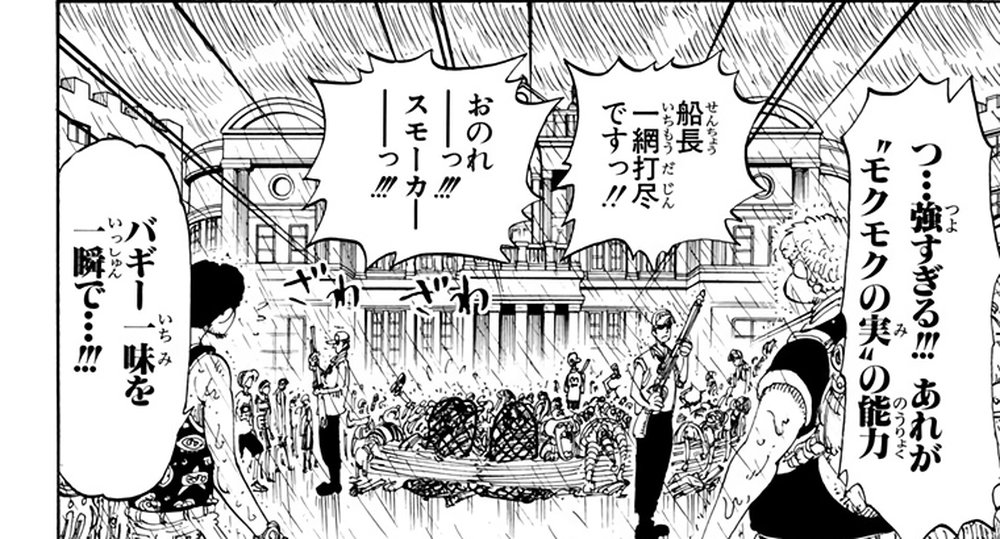
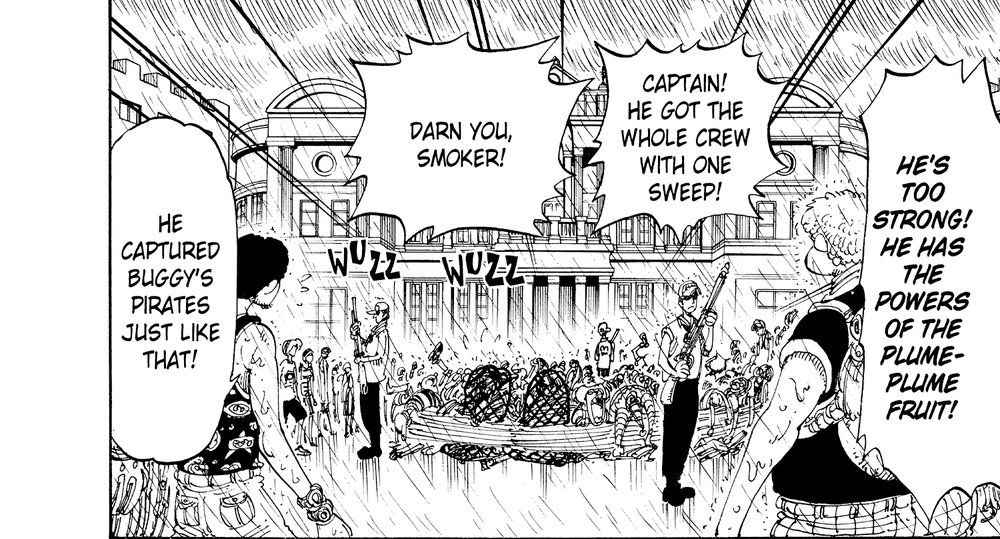
Loguetown, the town where the Pirate King was born and executed, and where the rain never seems to let up. Buggy the Clown and his crew have just learned what happens when a Marine captain with a smoke-logia Devil Fruit decides a fight isn't worth having: he simply engulfs everyone. 「つ...強すぎる!!あれが〝モクモクの実〟の能力」 — "HE'S TOO STRONG! HE HAS THE POWERS OF THE PLUME-PLUME FRUIT!" — a bystander gasps, watching Smoker's smoke roll over the entire crowd of pirates like weather. When it clears, Buggy's whole crew is lying bound in the street, and one of them — caught alongside his own captain — shouts up through the downpour:
「船長一網打尽ですっ!!」
Senchō ichimō-dajin desu'!!
VIZ's English edition prints: "CAPTAIN! HE GOT THE WHOLE CREW WITH ONE SWEEP!" (Vol. 12, p.14).
Grant the rendering its due: it is fast, it is clear, and "with one sweep" correctly tells the English reader that this was total — nobody got away. That is not a small thing to get right under a deadline. But look at what image did the telling. The Japanese says a net went out once and the entire crew came up in it. The English says a sweep went across and the entire crew got caught in it. One is water closing over fish; the other is dust pushed into a pile. Both end with everyone captured. They do not end with the same picture in your head.
Oda, as it happens, was not done with the net. Two panels later, one of the same bound pirates complains: 「このうっとうしい鉄の網は何だい妙なピストル撃ちやがって」 — "WHAT IS THIS LOUSY STEEL NET, ANYWAY? AND WHAT WAS THAT WEIRD WEAPON HE USED?" Smoker's Marines have fired an actual steel-mesh prison bullet at the fleeing crew — a literal net, sitting two beats after the idiom's metaphorical one. Whether or not Oda planned the echo, the page makes the idiom's buried picture impossible to miss: this is a scene about nets, twice.
The Original
一網打尽 (ichimō-dajin) is a 四字熟語 — a four-character idiom — and like most of them, it comes apart into two matched halves.
一網 (ichimō) — 一 "one" + 網 (mō, also read ami), the net. This is the same 網 in 投網 (toami), the cast-net a fisherman throws by hand, and in 網棚 (amidana), the mesh luggage rack over a train seat. 網 is always a mesh: something with holes small enough to catch, arranged so there is no gap for the catch to escape through.
打尽 (dajin) — 打 (da) here is not simply "to hit"; in compounds it works as an intensifying prefix roughly meaning "to carry out the act of," the same 打 that turns 開く ("to open") into 打開 ("to break through, to force open"). 尽 (jin, also read tsuku-su) means "to exhaust, to use up, to leave nothing remaining" — the same 尽 in 尽力 ("to exhaust one's effort") and 理不尽 ("beyond reason, unreasonable" — literally "reason exhausted").
Put the two halves back together and you get a complete scene, not just a phrase: cast the net a single time, and empty the water of every last fish. The idiom keeps only the metaphor in modern use — the catch is now a gang, a faction, a fugitive's whole crew — but underneath every use is still that one throw, that one haul, nothing left swimming.
The idiom has a documented birthday, and it isn't Japanese. Song-dynasty scholar Wei Tai's miscellany 東軒筆錄 (Dongxuan Biji) records a real political purge from 1044–45: the censor Wang Gongchen impeached the poet-official Su Shunqin over a minor financial irregularity (Su had sold the Memorial Bureau's wastepaper to pay for a banquet) and used the case to sweep up an entire circle of reform-minded scholars aligned with statesman Fan Zhongyan. Reporting his success to the chancellor, Wang is recorded boasting 「聊為相公一網打尽」 — "I've bagged them all for you, my lord, in one net." The fishing image crossed into Japanese along with the rest of the classical-Chinese vocabulary that built the yojijukugo canon, and a thousand years later it is still the word Japanese newspapers reach for over a mass arrest, and the word a rain-soaked pirate reaches for watching his whole crew go down at once.
Worth filing beside it: this is not the only four-character idiom on this site built from a picture English can't hold onto whole. 自業自得 — "one's own deeds, one's own harvest" — sits on the same shelf: a different image (karma's ledger, not a fisherman's net) but the same closed, citation-shaped form, quoted rather than merely spoken, that keeps coming apart when it crosses into English.
VIZ's Choice
Both appearances of the idiom in the volumes we have on file, side by side with the official English:
| Vol. / p. | Japanese | VIZ English |
|---|---|---|
| 12 / 14 | 船長一網打尽ですっ!! | CAPTAIN! HE GOT THE WHOLE CREW WITH ONE SWEEP! |
| 34 / 164 | 一味全員一網打尽だ!! | ...AND ROUND UP THE REST OF THE CREW! |
Twenty-two volumes apart, two completely different scenes, and the translator reaches for two different verb phrases — "with one sweep" and "round up" — that share exactly one thing: neither one is a net.
In Vol. 34, on Water 7, a Franky Family officer lays out an ambush against Luffy's crew: 「そして船内で待ち伏せて一味全員一網打尽だ!!」 — "THEN WE'LL HIDE OUT ON BOARD... AND ROUND UP THE REST OF THE CREW!" This is the idiom used exactly the way Wang Gongchen used it nine centuries earlier: a plan, spoken with satisfaction in advance, to catch an entire group in a single coordinated action. "Round up" is not wrong — it is standard English for a mass capture, the same phrase a news anchor uses for a drug bust. But notice what happened to the idiom's shape: 一網打尽 is a single four-character citation, the kind of fixed phrase a speaker reaches for because it already exists, fully formed, for exactly this situation. "Round up the rest of the crew" is built fresh, word by word, for this sentence alone. The content survives. The fact that the speaker was quoting something does not.
The two translations don't even agree with each other on a house style for the idiom — which is itself the finding. English has no fixed one-shot equivalent for 一網打尽, so every appearance gets solved locally, the way 因縁 does elsewhere on this site: not from carelessness, but because there is no slot in English vocabulary built to receive it.
The Gap
The vehicle flips from enclosure to erasure. A net is a three-dimensional trap: once it closes, there is no direction left to swim. A sweep is a broom's pass across a flat surface — directional, quick, and, crucially, capable of missing a spot. 一網打尽 promises that there was nowhere to go. "With one sweep" and "round up" promise only that, this time, the job got finished. The difference sounds small until you remember why the idiom exists at all: it is the word for the version of a raid where escape was never on the table.
The citation snaps off. 一網打尽 is not an ordinary phrase built for its sentence; it is a fixed four-character unit, quoted the way English quotes "caught red-handed" or "the whole nine yards." Both VIZ renderings replace the quotation with fresh description. The speaker stops sounding like someone reaching for a known idiom and starts sounding like someone simply narrating what happened — a small loss of voice that repeats a pattern this site keeps finding in yojijukugo: the meaning crosses, the fact of it being a saying does not.
The borrowed weight disappears. 一網打尽 carries the faint literary lift of classical Chinese underneath it — the same lift that makes a mass-arrest headline sound authoritative rather than casual. "Sweep" and "round up" are contemporary, procedural, and carry no historical baggage at all. The idiom sounds like it's citing precedent; the English sounds like it's just describing Tuesday.
What If
No rendering is free; here is the menu and its prices.
- "CAPTAIN! HE NETTED THE WHOLE CREW IN ONE THROW!!" — restores the net and the single-cast image explicitly. Cost: without the art alongside it, "throw" risks reading as a physical toss rather than a fisherman's cast.
- "CAPTAIN! ONE NET, AND THAT'S THE WHOLE CREW!!" — keeps both the net and the totality, tight enough for a bubble. Cost: clipped and telegraphic; the exclamatory rush of ですっ doesn't survive.
- "CAPTAIN! HE'S HAULED IN THE ENTIRE CREW — NET AND ALL!!" — vivid, still fishing-flavored, reads as natural spoken alarm. Cost: "net and all" turns the net into an accessory to the haul rather than the mechanism of it.
- Keep VIZ's "sweep," but rescue the enclosure sense: "CAPTAIN! HE'S BAGGED THE WHOLE CREW IN ONE GO!!" — "bagged" at least implies something closing around its catch. Cost: swaps fishing for hunting — same silhouette, different sport, and the wrong one for a net.
Take-away
一網打尽 is not hard because the words are rare — 網 and 尽 are both ordinary kanji on their own. It's hard because the idiom is a whole scene folded into four characters: one net, one throw, nothing left in the water. English has plenty of ways to say "caught everyone," and none of them are a net.
Three rules of thumb to carry off this page:
- Split every 四字熟語 2 + 2 before reaching for a dictionary gloss. 一網打尽 → 一網 ("one net") + 打尽 ("exhaust completely"). The halves usually hand you the whole scene, not just the meaning.
- When a yojijukugo shows up in dialogue, ask whether it's being quoted or merely meant. A fixed idiom carries the extra fact of being a known phrase — a citation, not a description — and that fact is as translatable-or-not as the meaning underneath it.
- Watch for kanji that keep their picture across centuries. 網 has meant "net" since long before this idiom existed and still means it in 網羅する and 網を張る today; when a translation drops the picture, check whether the picture was still doing work.
For the karmic idiom on the same shelf — "your own deeds, your own harvest," and the priest who quotes it instead of casting anything — see 自業自得. For more lines where the words survive translation and the fingerprint doesn't, browse the One Piece translation notes index.
Every Japanese and English line quoted above is a byte-exact capture from the cited editions — ONE PIECE Vol. 12 & Vol. 34 (Japanese) and One Piece (VIZ Media) at the corresponding panels — via our bilingual page database; see Sources below.