The Moment
Arlong Park has just fallen. Two chapters of buildup — Nami's hidden past, Arlong's tyranny over Cocoyasi Village, the map-room reveal — have collapsed into one punch. On the beach, Luffy is laughing with his crew, carefree: 「ししし!!」 — "HEE HEE HEE!!" — while behind him, villagers throw their arms in the air. The party lasts exactly one panel.
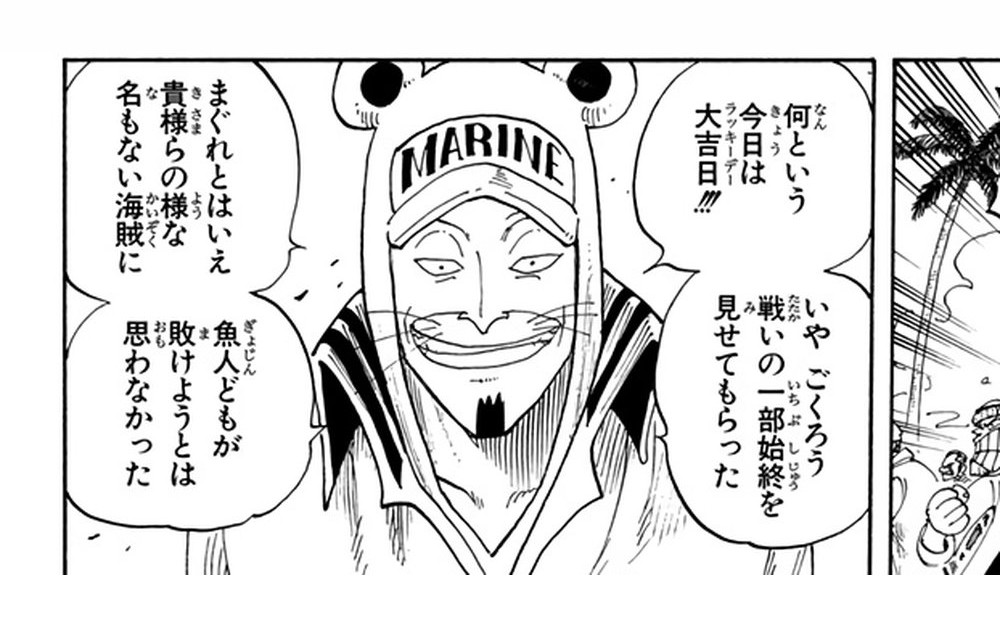
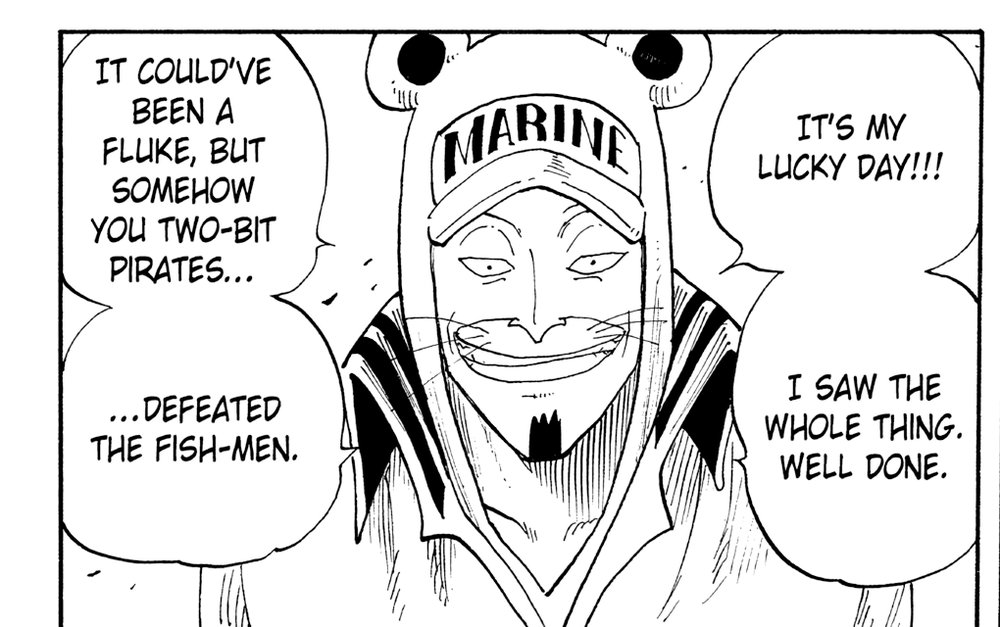
A shadow slams down between them — sound effect ダ・ドーン, "DA-DOOM!!!" — and a voice cuts the celebration off: 「そこまでだ貴様らァ!!!」, "HOLD EVERY-THING!!!" A Marine officer has arrived: MARINE cap pulled low over a grinning, whiskered face. His first words are backhanded: 「まぐれとはいえ貴様らの様な名もない海賊に魚人どもが敗けようとは思わなかった」 — "IT COULD'VE BEEN A FLUKE, BUT SOMEHOW YOU TWO-BIT PIRATES... DEFEATED THE FISH-MEN." Then, to himself: 「何という今日は大吉日!!!」 — "IT'S MY LUCKY DAY!!!" And then the line this article is about — his real reason for grinning:
「いやごくろう戦いの一部始終を見せてもらった」
Iya, gokurō. Tatakai no ichibu-shijū o misete moratta.
VIZ's English edition prints: "I SAW THE WHOLE THING. WELL DONE." (Vol. 11, p.74.)
Grant the rendering its due first: it's punchy, it fits the bubble, and "well done" lands with exactly the right oiliness for a man about to reveal he did nothing to earn the compliment he's handing out. The problem is what got folded into those five words. 一部始終 (ichibu-shijū) isn't just an intensifier meaning "totally" — it's a four-character compound with its own anatomy, its own false-friend trap, and its own claim about time, none of which survive the trip into "the whole thing."
The Original
一部始終 splits into two two-character words, and the first one is a trap. 一部 (ichi-bu) is vocabulary every intermediate learner already "knows": in ordinary modern Japanese it means "a part; some of" — 一部の意見 is "some opinions," 一部変更 is "a partial change," essentially the opposite of "all." Walk into 一部始終 assuming that sense and the phrase should mean something like "a fragment of the story, start to finish" — a piece, not a whole. That reading runs exactly backwards. Inside this yojijukugo, 部 is doing an older, narrower job: it's the counter for a bound document, a complete copy — the same 部 that survives today in 部数 (busū, "print run; number of copies") or 全部 (zenbu, "the whole lot"). Read through that lens, 一部 here doesn't mean "a portion" — it means "one whole volume."
始終 (shijū) is far more transparent: 始, "to begin" (the same 始 as 開始, kaishi, "commencement"), plus 終, "to end" (the same 終 as 終了, shūryō, "conclusion, finish"). Beginning and end, welded into one word.
Put the halves back together and 一部始終 literally says: "one entire book, from its beginning to its end." It's a narrative image before it's an abstraction — as if a whole event could be bound, shelved, and read cover to cover — extended by long use into the everyday sense "every last detail of an affair, told in full." A learner who already knows modern 一部 as "some of" has exactly the vocabulary needed to get this exactly wrong.
One more piece of grammar worth clocking: 見せてもらった. もらう is the humble "to receive [a favor from someone]" verb — the same もらう behind 手伝ってもらう, "to have someone help you [as a favor]." Grammatically, Nezumi is framing Luffy's crew as having done him the courtesy of letting him watch. He wasn't invited. He was hiding. The politeness is a blade. As vocabulary, 一部始終 sits around JLPT N1, despite both of its halves being far more ordinary on their own — the usual fate of a yojijukugo, tested as a fixed unit no matter how plain its ingredients.
VIZ's Choice
Only one occurrence of 一部始終 turns up in the One Piece volumes on file, so there's no in-series scatter table to build — just one translator's single call under deadline. "I SAW THE WHOLE THING" does something specific: it treats 一部始終 as pure intensifier and folds both halves into a single, idiomatic mass-noun phrase. Locally this works — a native English reader gets "he watched everything," which is the right takeaway. But the move is a flattening, not a compression. Nothing marks that 一部 nearly means the opposite of what it's doing here, and nothing marks that 始終 specified a span — a start and a finish you could point to — rather than a quantity.
The same four characters get a different fate one manga over. In Naruto Vol. 3, the missing-nin Zabuza reveals he had his subordinate Haku secretly study an entire earlier battle: 「その戦いの一部始終を観察させていたワケだ」. VIZ's Naruto translator rendered it as "OBSERVED AND STUDIED EVERY ASPECT OF OUR FIGHT, FROM BEGINNING TO END" — spending two clauses to keep both halves of the compound alive: "every aspect" for 一部, "from beginning to end" for 始終.
| Work / Vol. / p. | Japanese | VIZ English |
|---|---|---|
| One Piece 11 / 74 | 戦いの一部始終を見せてもらった | I SAW THE WHOLE THING. WELL DONE. |
| Naruto 3 / 174 | その戦いの一部始終を観察させていたワケだ | OBSERVED AND STUDIED EVERY ASPECT OF OUR FIGHT, FROM BEGINNING TO END. |
Same four kanji, same basic grammar — 一部始終 as the object of a watching verb — and two opposite translation instincts. One spends the extra words; one reaches for the shortest idiom on the shelf. Neither is "wrong" in isolation. But set side by side, they show exactly what a learner loses whenever a yojijukugo gets treated as disposable filler instead of a compound worth unpacking: the difference between a phrase that specifies its own shape and a phrase that just gestures at "a lot."
The Gap
一部's false-friend trap goes unmarked. "I SAW THE WHOLE THING" happens to land close to the right meaning, but only because English "whole thing" is itself vague enough to cover it — not because the translation shows any awareness that 一部 usually means the opposite of what it means here. A reader trying to learn from the kanji gets no help; the trap that catches most translators of this phrase (a trap this One Piece line falls straight into) stays invisible.
The clock disappears. 始終 isn't a synonym for "totally" — it names a span, a beginning and an end you could narrate scene by scene. "The whole thing" is a mass noun with no timeline: it could describe watching for thirty seconds or half an hour. Nezumi's boast is specifically that he watched from the opening move to the last punch — that temporal completeness is the entire point of his gloating, and it's the first thing to go.
The false gratitude goes flat. 見せてもらった borrows the grammar of being done a favor — as if Luffy's crew had generously let him watch. It's a sneer wearing a bow. VIZ's declarative "I SAW" states the fact without the courtesy-that-isn't, so the line reads as an honest compliment where the Japanese reads as a threat dressed as one.
What If
The menu, and what each option costs:
- "Well, much obliged — I got to watch that fight of yours, start to finish." — keeps もらった's sarcastic false-gratitude and 始終's timeline. Cost: longer, and "much obliged" risks reading as sincere rather than mocking without careful voice acting on the page.
- "I watched your whole little fight — beginning to end." — restores the temporal span explicitly. Cost: loses the backhanded politeness of もらった entirely; "little" has to do all the condescension by itself.
- "Nicely done. I caught the entire performance, curtain to curtain." — trades 一部始終's book-image for a theater-image, keeping both the totality and a start/end frame. Cost: "performance" invents a metaphor absent from the Japanese, though it does suit a character who's about to reveal his own performance of authority is a scam.
- Keep VIZ's line, restore the clock: "I SAW THE WHOLE THING, START TO FINISH. WELL DONE." — Cost: minimal change to the page, but even three added words recover the span the compound was built to specify.
Every option that restores 始終's timeline spends length to do it; every option that keeps VIZ's tight two-sentence rhythm has to let the span go unstated and trust the reader to infer it from context.
Take-away
一部始終 looks, on paper, like an easy compound: half its characters are words a first-year learner already "knows." That's exactly the danger. 一部 means "a part" everywhere except here, where the old counter-sense for a bound volume takes over completely, and 始終's plain beginning-and-end vocabulary is the only thing keeping the phrase honest about what it's actually claiming: not quantity, but span.
Three rules of thumb to carry off this page:
- Don't trust 一部 on sight. In 一部の, 一部変更, it means "some, partial." In 一部始終, the 部数-family sense — "one whole document" — takes over completely. Context, not the character itself, decides which 一部 you're reading.
- 始終 asks "from when to when," not "how much." Whenever a translation swaps this word for a vague quantifier like "everything" or "the whole thing," check whether the original was making a claim about a timeline that just went missing.
- もらう in a threat is a blade wearing a bow. The humble "receive a favor" verb, aimed at someone who did you no favor, is one of Japanese's cheapest and most effective ways to make politeness sound like a warning.
For more of this hub's yojijukugo cluster, see 自業自得 and the Buddhist verdict English turns into battle advice, 一網打尽 and the net English swaps for a broom's sweep, and 言語道断 and the Buddhist silence VIZ turns into an ellipsis — or browse the full One Piece translation notes index. For the fuller, more careful translation of these same four characters — spoken by a very different kind of villain, on a bridge in the Land of Waves — see the sister analysis of 一部始終 published on the Naruto hub.
Every Japanese and English line quoted above is a byte-exact capture from the cited editions — ONE PIECE Vol. 11 (Japanese) and One Piece Vol. 11 (VIZ Media), plus the comparison panel from NARUTO―ナルト― Vol. 3 (Japanese) and Naruto Vol. 3 (VIZ Media) — at the corresponding panels, via our bilingual page database; see Sources below.