The Moment
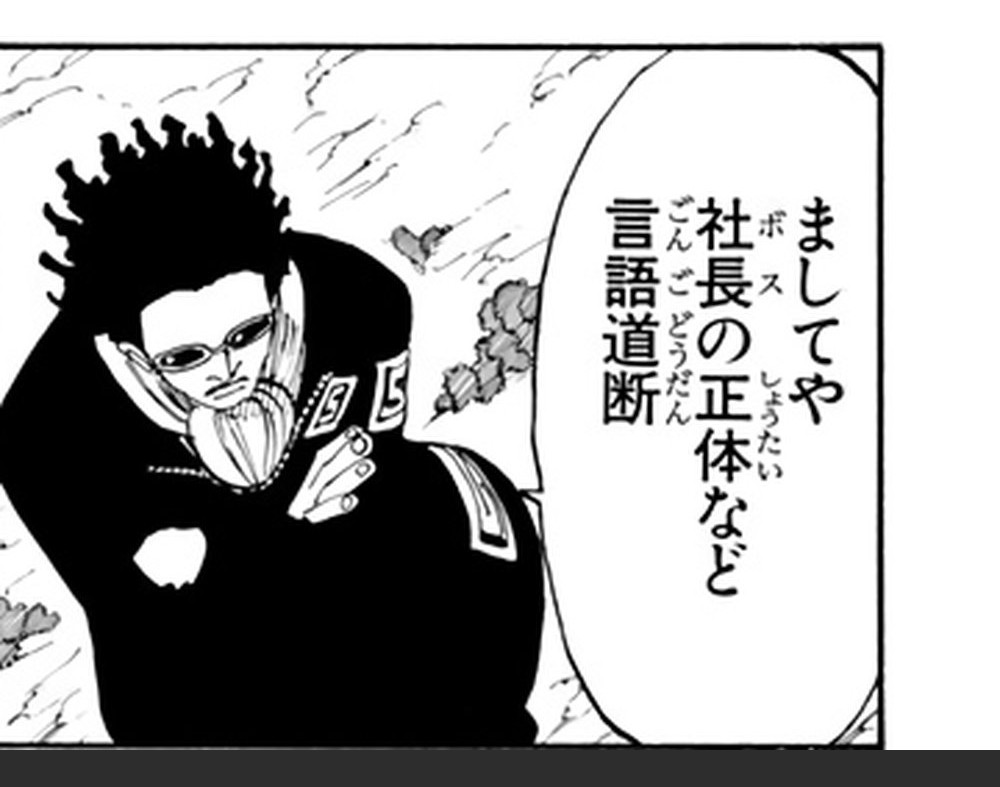
Whiskey Peak, a desert town that turns out to be a nest of Baroque Works agents posing as friendly bounty hunters. A dreadlocked enforcer in sunglasses and a leather jacket stamped with a big "5" — Mr. 5, freshly arrived with his partner Miss Valentine — is briefing the local agents on how the organization actually runs. His first line sets the rule:
「我が社の社訓は〝謎〟...社内の誰の素性であろうとも決して詮索してはならない」
Waga sha no shakun wa "nazo"… shanai no dare no sujō de arō to mo kesshite sensaku shite wa naranai
VIZ: "OUR ORGANIZATION'S MOTTO IS 'MYSTERY.' WE NEVER REVEAL THE IDENTITY OF ANY OF OUR PEOPLE."
Then he takes the rule one step further, and this is our line:
「ましてや社長の正体など言語道断」
Mashiteya bosu no shōtai nado gongo-dōdan
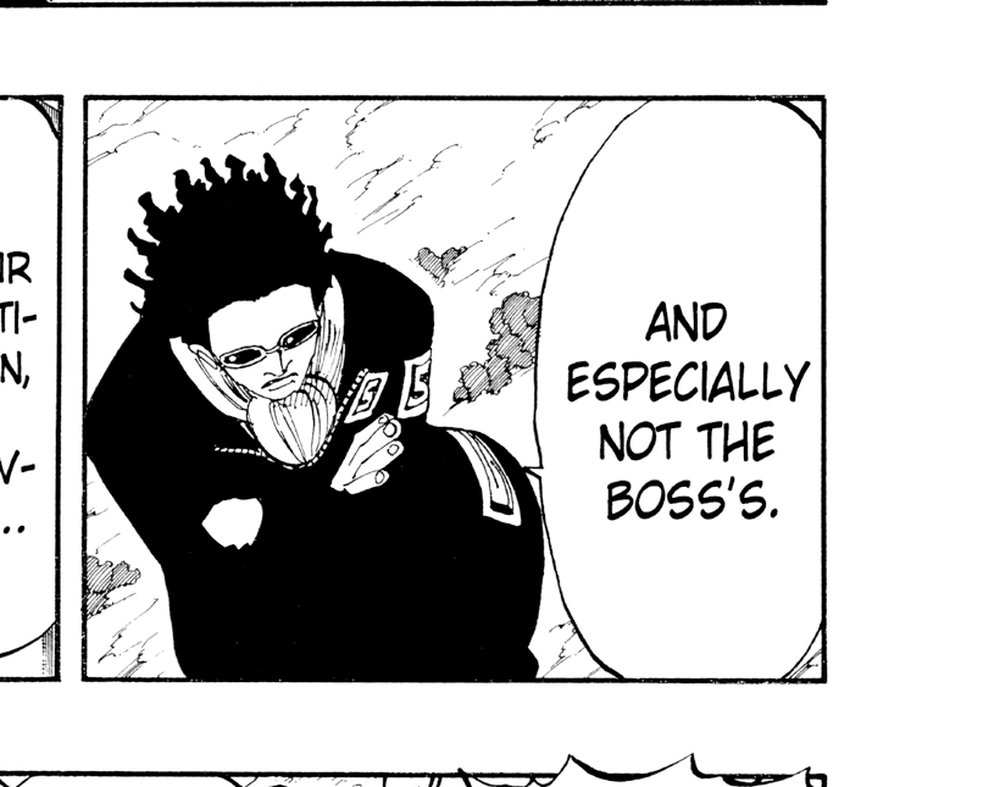
VIZ's English edition prints: "AND ESPECIALLY NOT THE BOSS'S." (Vol. 13, p.37.)
Grant the rendering its due first: as the back half of a two-sentence policy statement, "and especially not the boss's" reads clean and natural, and the emphasis is exactly right — the boss's identity is the most forbidden of all forbidden things. But notice what disappeared. The Japanese doesn't just add emphasis; it adds an entirely new word, one with its own charge and its own history: 言語道断 (gongo-dōdan). English compresses two ideas — "forbidden" and "a taboo so extreme that words fail in front of it" — into one adverb, "especially." Two panels later, the stakes of breaking that rule turn immediate: the target of Mr. 5's mission is unmasked, and someone screams "DIE!! IGARAP-PAPPA!!!" — the company motto was never a joke.
The Original
Split 言語道断 down the middle. 言語 is "words, language": 言 "to say" plus 語 "word," the same 語 you know from 単語 (tango, "vocabulary word"). Note the reading here is gongo, not the more familiar gengo — an older, Buddhist-flavored reading of 言 that survives almost nowhere else in modern Japanese, a small fossil of how old this compound is. 道断 is 道 "path, road, way" — the same 道 that turns a skill into a lifelong Way in 剣道 (kendō) or 茶道 (sadō) — plus 断 "cut off, severed," the same 断 in 断る (kotowaru, "to refuse") and 断食 (danjiki, "fasting," literally "cutting off food"). Read straight through: 言語の道が断たれる — "the road of language is severed."
That is not casual hyperbole; it is Buddhist doctrine. The phrase comes from scripture — most famously the formula 言語道断・心行処滅, from commentaries in the Tendai tradition and echoed throughout later Zen writing, meaning "the path of words is cut off; the place where the mind's workings operate is extinguished." It describes ultimate reality (実相) as something no sentence, no concept, no road built out of language can ever fully reach — the same intuition behind two doctrinal siblings: 不立文字 (furyū-monji, "not established in words or letters," the teaching that enlightenment can't be handed down through text) and 以心伝心 (ishin-denshin, "heart transmits to heart," mind-to-mind transmission without speech). All three describe the same edge: a place words cannot walk to.
And then, like so much Buddhist vocabulary in Japanese, the phrase left the temple. Centuries of secular use wore the sublime claim down into something much blunter — not "too vast for words" but "too outrageous for words." By the time it reaches a modern newspaper headline (増税は言語道断だ, "the tax hike is outrageous") or a modern manga panel, 言語道断 has all but lost its scriptural sense; it now reads as a stiff, formal way of saying unconscionable, out of the question, inexcusable — words fail the speaker not out of awe, but out of disgust. It isn't on standard JLPT vocabulary lists (yojijukugo of this kind mostly aren't tested directly), but functionally it sits at an advanced N1-and-above literary register — newspaper-editorial Japanese, not small talk.
VIZ's Choice
Only one occurrence of 言語道断 turns up across the volumes on file, so there is no scatter table to build — just one translator's single decision under deadline, worth sitting with on its own. VIZ's "AND ESPECIALLY NOT THE BOSS'S" does something specific: it treats 言語道断 as pure intensifier and folds it entirely into the adverb "especially," attached to the previous sentence's rule about not revealing identities. Locally, this works — the reader understands the boss's identity is the most closely guarded secret of all. But the move is a deletion, not a compression. Nothing in the English marks that a second, independent concept — a taboo so extreme it is described as literally unspeakable — was ever invoked. The rule got stronger; the vocabulary describing why it's stronger vanished outright.
That this happens to a Buddhist word inside a gag about corporate secrecy is almost too fitting. Baroque Works, a crime syndicate, briefs its footsoldiers with a "company motto" (社訓) and calls its crime boss 社長 — "company president" — glossed in furigana as ボス ("boss"), so the reader sees corporate kanji and hears gangster English simultaneously. Dropping a stiff, scripture-derived yojijukugo into that same breath is Oda's punchline: a phrase built for describing the ineffable nature of ultimate truth is being used to describe an HR policy. English keeps the joke's shape (a tough guy talking like a memo) but loses the specific word doing the most work inside it.
The Gap
The word is deleted, not translated. "Especially" is emphasis; 言語道断 is a noun-phrase naming an entire category — the unspeakable. A reader who only has the English never learns that Japanese marked this moment with a second, separate word, distinct from the general secrecy rule stated one line earlier.
The etymology has no landing strip. 言語道断 is built from a physical image — a road, severed. Every workable English rendering ("unspeakable," "outrageous," "out of the question") is a dead metaphor with no route back to a road, a path, or the temple the phrase came from. The image is not hard to translate; it's untranslatable into anything that still functions as natural English dialogue.
The word's own history disappears. 言語道断 is unusual in that it has lived two lives — sublime (truth beyond words) and censorious (outrage beyond words) — both powered by the identical "words fail here" mechanism, just aimed at opposite emotional targets. English has separate words for each life ("ineffable" for the first, "unspeakable" for the second) but nothing that quietly is both, the way 言語道断 still faintly is for a reader who knows where it came from.
What If
- "AND THE BOSS'S IDENTITY? THAT'S UNSPEAKABLE." — keeps a visible "words fail" marker where VIZ leaves none. Cost: "unspeakable" now defaults to horror ("unspeakable crime") in English, tilting the line toward atrocity rather than forbidden secrecy.
- "MUCH LESS THE BOSS'S IDENTITY — THAT'S OUT OF THE QUESTION." — a tight transplant of the modern colloquial sense, and it keeps the ましてや ("much less") escalation structure intact. Cost: "out of the question" is a completely dead metaphor; no trace of road, word, or severance survives.
- "AND AS FOR THE BOSS'S IDENTITY — THAT ROAD DOESN'T EVEN EXIST." — reaches directly for the buried 道 ("road") imagery. Cost: sounds like a riddle, not a gangster's briefing; too literary for the panel's pace.
- "AND THE BOSS'S IDENTITY? DON'T EVEN GO THERE." — colloquial, tough, and "go there" accidentally keeps a faint road-shape. Cost: modern American slang clashes badly with a phrase this formal and this old, undercutting the very stiffness that makes Mr. 5's line funny.
Every option trades the same two things against each other: keep the word's weight (formality, scripture) and lose its naturalness in English dialogue, or keep the naturalness and lose the weight. That tension is 言語道断's whole modern life in miniature — a temple word doing gang business.
Take-away
言語道断 asks English to hold two things it usually keeps in separate boxes: a word can go quiet because a truth is too sublime for language, or because an offense is too outrageous for language — and this one phrase, across its long life, has meant both. When Mr. 5 uses it to describe a company secret, the joke depends on readers hearing both registers at once: something almost sacred, guarding something merely corporate.
Three rules of thumb to carry off this page:
- When a word for "unspeakable" shows up, ask which direction it's pointing — toward awe (too sublime for words) or toward outrage (too extreme for words). 言語道断 has walked both roads; most single English words have only ever walked one.
- 道 (dō, "the Way") keeps showing up as a physical metaphor for language and discipline alike — 言語道断's severed road, 剣道's sword-path, 茶道's tea-path. Watch for it; it's one kanji doing a lot of quiet philosophical work across the language.
- Corporate-sounding kanji glossed with un-corporate furigana (社長 read ボス) is Oda signaling a joke. When the reading fights the kanji, the translation is telling you where the comedy lives — worth checking even when, as here, the joke mostly survives translation on its own.
言語道断 is one of several Buddhist compounds hiding in plain sight across this series. For another four-character Buddhist verdict English quietly turns into something more mundane, read the karmic sentence hiding inside 自業自得; for a sister case where a single Buddhist compound gets scattered five different ways across the whole series rather than deleted once, read the karmic tie hiding inside 因縁. Or browse the full One Piece translation notes index.
Every Japanese and English line quoted above is a byte-exact capture from the cited editions — ONE PIECE Vol. 13 (Japanese) and One Piece Vol. 13 (VIZ Media) at the corresponding panels — via our bilingual page database; see Sources below.