The Moment
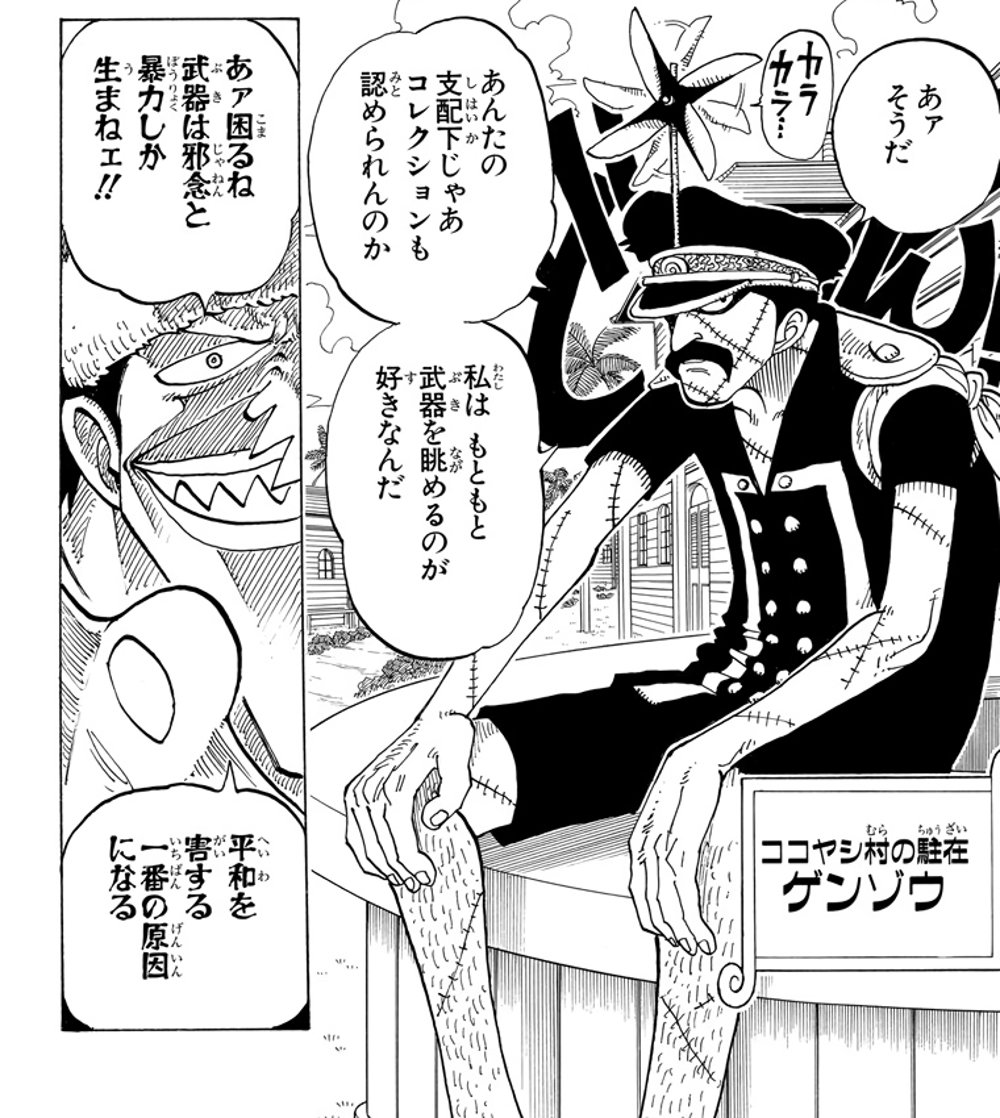
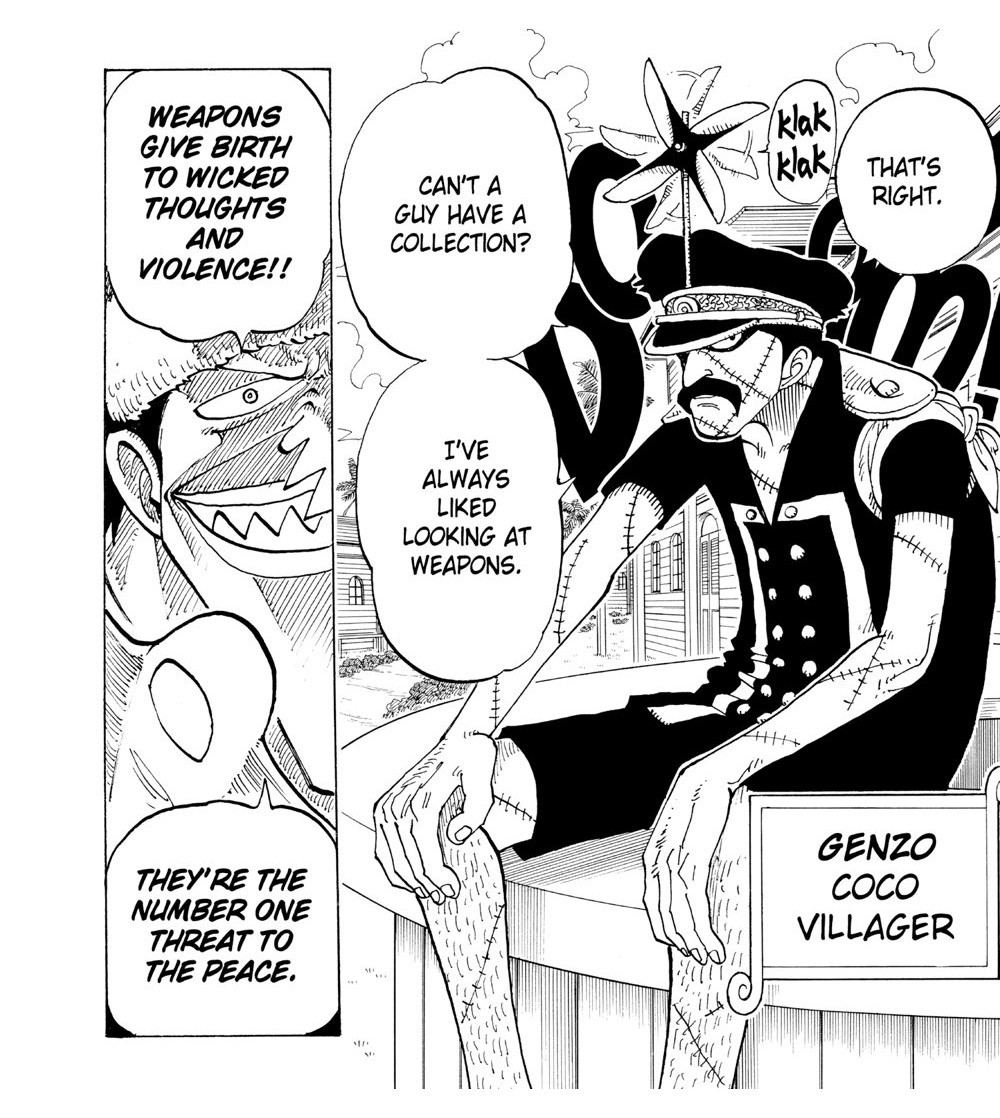
Cocoyasi Village, under Arlong's boot. Genzo — the village's policeman, and secretly the man organizing what little resistance the villagers have left — has hauled in a Fish-Man from Arlong's crew over a sword found in his possession three days earlier. The Fish-Man protests: 「あんたの支配下じゃあ武器のコレクションも認められんのか」 — "CAN'T A GUY HAVE A COLLECTION?" — and Genzo answers with something closer to a sermon than a citation:
「あァ困るねー武器は邪念と暴力しか生まねェ!!」
Ā, komaru ne. Buki wa janen to bōryoku shika umanē!!
VIZ's English edition prints: "WEAPONS GIVE BIRTH TO WICKED THOUGHTS AND VIOLENCE!!" (Vol. 8, p.184).
Grant the rendering its due first: it's punchy, it scans as a proverb, and "wicked thoughts" is not a bad guess at 邪念 in isolation. But look at what's sitting inside that one compound. 念 is doing real philosophical work in Japanese — it isn't a throwaway word for "an idea," it's the technical name Buddhist psychology gives to a unit of mental attention. Genzo isn't just calling weapons "bad influences." He's saying they produce a specific, namable kind of mental event — attention that has gone off its rails — and English collapses the claim into a generic adjective before it ever gets to make its case.
The Original
Take 邪念 apart, because both halves carry weight most readers skate past.
念 (nen) is written 今 ("now") sitting on top of 心 ("heart-mind") — attention pinned to the present moment. In Buddhist vocabulary that pictograph is not decorative: 念 is the standard Sino-Japanese rendering of smṛti, "mindfulness," the seventh fold of the Eightfold Path (八正道). 正念 (shōnen), "right mindfulness," is the disciplined, correctly-aimed version — the one a meditator is supposed to be cultivating, moment by moment. (If you've read our companion site's Naruto piece on 正念場 (shōnenba), "the scene that tests what you are," you've already met this same 念 doing duty in a kabuki term for the make-or-break scene of a performance.) 念 also survives in 一念 (ichinen), "a single thought-moment," and in everyday words like 記念 (kinen, "commemoration," a thought kept) and 残念 (zannen, "regret," a thought left over).
邪 (ja) is the disqualifier: "evil, wicked, crooked, heterodox — off the true way." It's the same 邪 in 邪道 (jadō), "the heterodox path" (see our companion piece on Zoro's favorite insult, 外道/gedo, a near-synonym built the same way), and in the extremely common 邪魔 (jama), "a hindrance" — literally an evil spirit blocking the road, now just the word you say when you squeeze past someone on a train.
Put 邪 in front of 念 and you don't get "a bad thought" the way English means the phrase — a stray, unremarkable idea that happens to be unkind. You get a technical failure mode: a moment of attention that has left the 正 (right) track for the 邪 (crooked) one. The doctrine assumes thought is gradable, on a path or off it. 邪念 names the "off" case.
Grammatically the headline line is nothing exotic — [X は Y しか生まない], "X produces nothing but Y" — but 邪念 itself sits nowhere on the standard JLPT vocabulary lists. Both kanji are individually common (邪 is taught by lower-secondary school, 念 by elementary school), yet the compound's Buddhist technical sense pushes real command of the word past N1, into native-reader territory — vocabulary you feel the weight of before you can define it.
VIZ's Choice
Every appearance of 邪念 in the volumes on file, side by side with VIZ's English:
| Vol. / p. | Japanese | VIZ English |
|---|---|---|
| 8 / 184 | あァ困るねー武器は邪念と暴力しか生まねェ!! | WEAPONS GIVE BIRTH TO WICKED THOUGHTS AND VIOLENCE!! |
| 9 / 14 | かけらでも邪念を抱いた奴がどうなるか | EVEN A HINT OF SEDITION IS ENOUGH TO SEAL YOUR DOOM! |
| 27 / 146 (EN p.144) | 黙れ!!!こんなものがあるから戦闘に邪念を生む!!! | SILENCE! IT'S DISTRACTIONS LIKE THIS THAT WILL COST US A VICTORY!! |
(The Vol. 27 pair crosses a two-page offset between editions — the Japanese line sits on tankobon p.146, its VIZ counterpart on English p.144, an artifact of the volumes' different lettering pagination. Both panels were checked directly against the page art to confirm the pairing is genuine and not an alignment error.)
Three appearances, three unrelated English words, and the scatter tells three different stories about how a translator solves an untranslatable technical term under deadline.
In Volume 9, Arlong — having just conquered Cocoyasi Village and cowed its people into paying tribute — turns to the crowd and delivers a warning before making an example of Genzo: 「よく見ておけ人間どもっ!!!かけらでも邪念を抱いた奴がどうなるか」, "Watch carefully, you humans!!! [See] what happens to anyone who harbors even a splinter of janen." VIZ: "WATCH CAREFULLY, YOU HUMANS!!! EVEN A HINT OF SEDITION IS ENOUGH TO SEAL YOUR DOOM!" "Sedition" is a sharp, purposeful choice — it keeps the threat's political shape (Arlong is punishing disloyalty to his rule) and it's a real, chillable word. But it swaps Buddhist mind-training vocabulary for courtroom vocabulary. Arlong's Japanese threatens people for a private mental event; VIZ's English threatens them for something closer to treason.
In Volume 27, deep in the Shandia's assault on Skypiea's Upper Yard, the warrior Wyper scolds the young girl Aisa for stopping mid-battle to protect a keepsake — a friend, Kamakiri, has just been wounded shielding her: 「黙れ!!!こんなものがあるから戦闘に邪念を生む!!!」, "Silence!!! It's because of things like this that battle breeds janen!!!" VIZ: "SILENCE! IT'S DISTRACTIONS LIKE THIS THAT WILL COST US A VICTORY!!" Here the concept doesn't get relabeled — it disappears. "Distractions… will cost us a victory" is tactical language, about outcomes on a battlefield, with no trace of the idea that a tainted motive is itself the danger, not just its side effect.
Three renderings — "wicked," "seditious," "distracting" — for one word that means none of those things exactly, and all of them approximately.
The Gap
念 disappears as a concept every time. "Wicked thoughts," "sedition," and "distractions" each name an outcome or a category, not the specific mental phenomenon 邪念 describes — a thought-moment that has left the path. English has no everyday noun for a graded, gradable unit of attention, so the translator never gets a chance to carry one across; each solution reaches for the nearest adjacent English concept instead.
Arlong's line loses its real chill. かけらでも邪念を抱いた奴が — "anyone who harbors even a splinter of janen" — threatens people for what they privately think, not for what they do or say. That's a colder, more totalitarian threat than ordinary tyranny: punishment for an inner state nobody else can even verify. "EVEN A HINT OF SEDITION" reframes the danger as disloyal action or speech — a lesser, more familiar kind of menace.
Wyper's line drops the moral register entirely. 邪念を生む literally "gives birth to janen" — the Japanese treats a corrupted motive as a battlefield hazard as real and as physical as an injury. "Distractions… will cost us a victory" is pure tactics: the idea that an impure motive is itself a kind of enemy, present in the room the way an armed opponent is, has been quietly edited out.
What If
For the headline line, the menu and its prices:
- "Ah, that's the trouble. Weapons breed nothing but impure thoughts and violence!!" — keeps "thoughts" and reaches for "impure," closer to 邪's religious-adjacent flavor. Cost: "impure" leans more overtly devotional than a blunt village cop's speech.
- "Weapons poison the mind — nothing comes of them but violence!!" — "poison the mind" dramatizes 邪念 as corruption entering a person, close to the underlying doctrine. Cost: adds a metaphor (poison) the Japanese doesn't literally use.
- "All a weapon ever does is breed wrong-minded thinking and bloodshed!!" — "wrong-minded" keeps 邪's off-path sense attached to "thinking." Cost: reads more like a political or clinical judgment than a moral one.
- Keep VIZ's "wicked thoughts," restore the dropped preamble: "Ah, that's the trouble — weapons give birth to nothing but wicked thoughts and violence!!" — Cost: still doesn't reach for 念's mindfulness sense, but restores the bit of Genzo's character voice ("that's the trouble") VIZ's version cuts.
Notice the shared limitation: every option can chase either the "evil" half (邪) or the "mental-event" half (念) of the compound, never a single English word that is both at once — because English simply doesn't grade thoughts the way this vocabulary assumes.
Take-away
邪念 isn't hard because it's obscure — it's hard because it assumes something English vocabulary doesn't: that thought comes in a specific, namable unit (念), and that unit can be judged as being on the right path or off it (正 vs 邪). Ask a village cop, a warlord, and a battle-hardened warrior to use the word, and each one reaches for a different face of it — and English, lacking the concept's home turf, reaches for a different translation every time in return.
Three rules of thumb to carry off this page:
- 念 is a unit, not a synonym for "thought." Whenever you meet a 念 compound — 正念, 一念, 邪念, 念仏 — ask what's being measured: attention, fixed on something, graded as right or wrong, present or absent. English's closest cousin is "mindfulness," and even that undersells how technical the term is.
- 邪 marks a path, not just a quality. It isn't simply "bad" — it's "the wrong road," the same metaphor riding underneath 邪道 and 邪魔. Watch for the path-metaphor whenever 邪 shows up; English tends to flatten it into a flat moral adjective and lose the geography.
- Convergence and scatter are both diagnostic. One Japanese word landing as three unrelated English words (as here) means the same thing three unrelated English words landing as one Japanese word does elsewhere: the concept doesn't have a fixed home on one side of the language pair.
For the same 邪 marking a wrong path in a different shape, see the companion piece on Zoro's insult of choice, 外道 and the Buddhist heretic English turns into "stinking," "brute," and "fiend". For another Buddhist word that scatters across VIZ's choices the way 邪念 does, see 因縁 and the karmic tie English splits five ways. The same word even jumps continuity: in Naruto Vol. 33, watching Naruto's chakra curdle toward the Nine-Tails' shape, an onlooker notes 「何より邪念が強い...」 — VIZ's "FAR MORE MALEVOLENT" keeps the 邪 (evil) half and drops the 念 (mental-event) half completely, the same trade Arlong's "sedition" makes in the opposite direction. Browse more of these swapped concepts at the One Piece translation notes index.
Every Japanese and English line quoted above is a byte-exact capture from the cited editions — ONE PIECE Vol. 8, 9 & 27 (Japanese) and One Piece (VIZ Media) at the corresponding panels, plus one NARUTO Vol. 33 line for cross-work comparison — via our bilingual page database; see Sources below.