The Moment
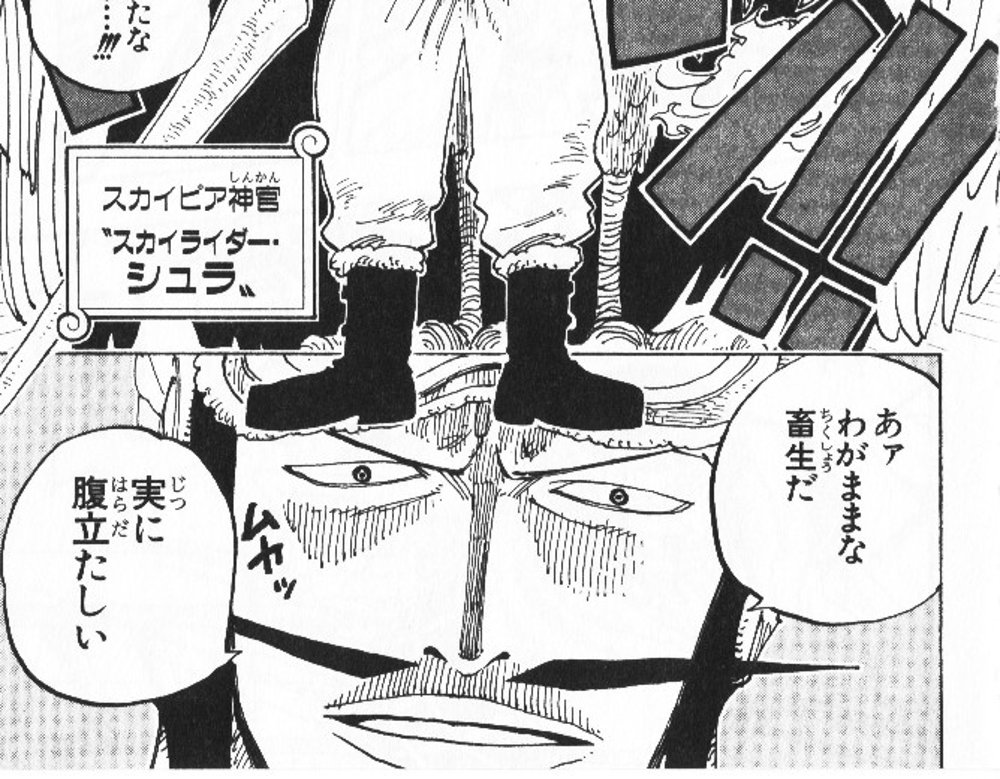
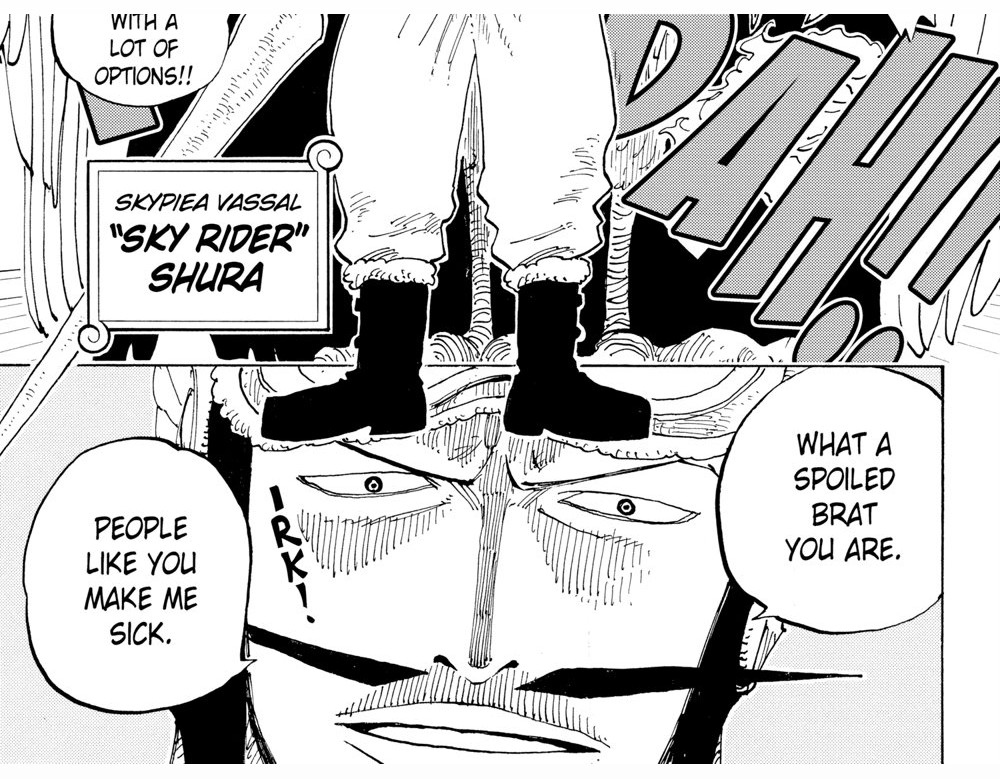
Skypiea, high above the world's oceans on a sea of clouds. The white-robed vassal "Sky Rider" Shura rides into battle on a colossal bird — but the animal won't cooperate. Two bubbles set up the standoff just before our line: 「仲間は襲うなと言う..船は傷つけるなと言う..己は死にたくねェと言う..困ったな...!!!」 ("You don't want me to attack your comrades... you don't want me to destroy your ship... and you don't want to die. You don't leave me with a lot of options!!"). Glaring down at his own mount, Shura spits:
「あァわがままな畜生だ」
Aa, wagamama na chikushō da.
VIZ's English edition prints: "WHAT A SPOILED BRAT YOU ARE." (Vol. 27, p.39 JP / p.37 EN.)
Give the rendering its due: for once, the insult and its target actually line up. Shura is talking to an animal — a giant bird — and calling it 畜生, "a beast," lands as a plain literal description before it lands as an insult. VIZ's "BRAT" keeps the scolding, parent-to-disobedient-pet tone, and "PEOPLE LIKE YOU MAKE ME SICK" (実に腹立たしい, the line right after) carries real contempt. But "brat" is a word about age and bad manners. 畜生 is a word about which of six possible next lives a soul is unlucky enough to have earned — and Shura is not being clever or cute here. He is handing his own bird a verdict.
The Original
畜生 (chikushō) splits into 畜 (chiku), "livestock, a domesticated animal" — the same 畜 as 家畜 (kachiku, "livestock") — and 生 (shō), "to live, to be born." Literally: born as livestock. Put together, the compound names 畜生道 (chikushō-dō), the Animal Realm — one of the 六道 (rokudō), the Six Realms of rebirth that Buddhist cosmology says every soul cycles through according to karma: 天 (heaven), 人 (human), 修羅 (asura, endless warfare), 畜生 (animal), 餓鬼 (hungry ghost), 地獄 (hell). A soul lands in the Animal Realm specifically through 愚痴 (guchi) — foolishness, an inability to reason or tell right from wrong — and lives there by pure instinct: eating, being eaten, unable to accumulate the merit that might climb it back toward a human rebirth. That is real doctrine, preached for over a millennium.
And, like every Buddhist word loud enough to leave the temple, 畜生 split into two separate everyday jobs. As a bare interjection, shouted alone with no grammar attached — often spelled 畜生ォ, 畜生っ, ちくしょう to catch the growl — it is simply "damn it!": the reflex curse of anyone who has stubbed a toe or lost a fight, no animals implied, often no one even listening. As a noun insult, slotted into [ADJECTIVE + 畜生 + だ], the frame Shura uses here, it calls its target a beast on purpose — coarser and older than "brute," closer to spitting "animal" at someone's face.
Register-wise, 畜生 is rough, low, entirely spoken — you will not find it in a business email. Some dictionaries file 畜生-as-vocabulary near the old 1級/N1 tier, but the truth is simpler: nobody learns this word in a classroom. Every reader of this manga has heard both faces of it — the wordless curse and the pointed insult — dozens of times before anyone explains that they're the same word, and that the word has an afterlife attached.
VIZ's Choice
畜生 turns up roughly 55 times across the volumes we have on file — far too many to table in full. Below is a representative sample of six, image-verified against both editions, spanning the bare curse and the pointed insult:
| Vol. / p. (JP → EN) | Japanese | VIZ English |
|---|---|---|
| 1 / 136 → 136 | 畜生ォ...!!! | DARN! |
| 1 / 43 → 43 | ..!!...畜生お!!! | &%$!!!! !!! |
| 6 / 117 → 117 | 畜生ォ てめェ!!何の恨みがあっておれ達を狙うんだ!!! | YOU MONSTER!! WHY DO YOU KEEP PICKING ON US!? |
| 11 / 133 → 133 | 営業妨害で訴えるぞ畜生がっ!!! | WHY, YOU... I'LL SUE YOU FOR DAMAGING MY BUSINESS!!! |
| 27 / 39 → 37 | あァわがままな畜生だ | WHAT A SPOILED BRAT YOU ARE. |
| 30 / 149 → 147 | 畜生おれ達がフガイねェからさらわれたんだ!!! | DAMN IT!! SHE WAS TAKEN BECAUSE WE WERE SO USELESS!!! |
Read down the column and a pattern falls out immediately: every bare-curse use gets a different noise. Young Zoro, having just lost his 2001st duel to Kuina, clenches a fist and gets "DARN!" — polite enough for a children's cartoon. A voice inside the same Party's Bar brawl that opens Volume 1 gets the full typographical grawlix, "&%$!!!!" — VIZ reaching for the oldest trick in the profanity playbook, symbols standing in for a word its own editors won't print. Sanji, watching his crew realize they've lost Robin, gets "DAMN IT!!" — the strongest of the three, because the scene is the strongest. Three curses, three intensities, and English never writes the same word twice, because for English there isn't one word to write; it's reaching for tone, panel by panel, the way a sound designer picks a sting.
The insult uses split just as hard. Shura's 畜生 — aimed, appropriately, at an actual animal — becomes "BRAT," at least in the right emotional family. But the Loguetown sword-shop owner's 畜生 in Volume 11 — snapped at a human customer who's just cost him a sale, 営業妨害で訴えるぞ畜生がっ!!!, "I'll sue you for hurting my business, you 畜生!!" — disappears completely; VIZ's "WHY, YOU... I'LL SUE YOU FOR DAMAGING MY BUSINESS!!!" keeps the threat and drops the insult it was riding on. And a terrified sailor's 畜生ォ てめェ at Dracule Mihawk, moments after Mihawk slices their captain's flagship in half with one stroke, gets "YOU MONSTER!!" — close by accident: Mihawk is, structurally, being called something less than human, but English arrives at "monster" from fear of his power, not from any theory of which realm a monster belongs to.
The Gap
One curse word, unlimited English intensities. 畜生 as an interjection carries no built-in volume — it is exactly as loud as the panel around it, which is why VIZ can honestly render it as "DARN!," "&%$!!!!," and "DAMN IT!!" within the same handful of volumes and be right every time. The cost is that the word itself disappears as a throughline. A reader of the Japanese meets 畜生 dozens of times and, whether they consciously register it or not, is hearing the same beast-curse every time a character loses a fight, a bet, a friend. A reader of the English meets a different curse each time and never learns there was a rhyme to find.
The insult can vanish with nothing to replace it. In Volume 11, dropping 畜生がっ costs the line its entire second half — the shop owner isn't just threatening a lawsuit, he's calling the customer a beast while he does it, and English keeps only the threat. This is the cleanest kind of loss: not a wrong word, but no word.
Accidental hits teach the wrong lesson. "YOU MONSTER!!" and even "BRAT" both land close to their targets — but for reasons that have nothing to do with 畜生's actual content. "Monster" works because Mihawk is terrifying in that panel, not because English understands that calling someone a beast is a specific, gradable insult with a cosmology behind it. A learner could study these "successful" renderings and still never learn that six realms exist, or that 畜生 names the second-worst of them.
What If
- "DAMN YOU, BEAST!!" for the pointed insult uses — keeps an explicit animal word in play so a reader tracking repeats could start to notice the pattern. Cost: sounds like Victorian melodrama in a modern speech bubble, and it's too strong for the many bare "damn it!" uses where no one is being called an animal at all.
- "YOU ANIMAL!!" for Volume 11's dropped insult — natural spoken English, keeps the beast-word, keeps the aggression. Cost: still loses the specifically Buddhist "which realm did your soul earn" resonance; an English reader hears generic mockery, not karma.
- A consistent curse-word policy — reserve one recognizable tag, some form of "beast" or "brute," every time 畜生 is doing insult-work, the way "rest in peace" stays fixed across our companion piece on 往生しろ・成仏してください. Cost: no single translator working chapter by chapter over twenty-five years can realistically maintain that cross-volume consistency, and it would occasionally force an unnatural line to preserve a pattern almost no reader would consciously notice.
- "WHAT A SPOILED CREATURE!!" for Shura's line specifically — trades "brat" for a word that still names an animal. Cost: "creature" is stiffer and less punchy than "brat" in a one-line insult aimed at a bird that can't understand English or Japanese anyway.
Take-away
畜生 is proof that a curse word can carry a whole cosmology and still sound, to a native ear, like nothing more than "damn it." Six realms of rebirth collapse into a syllable spat after a stubbed toe or a lost duel — and the same syllable, aimed at a person instead of the air, calls them an animal on purpose.
Three rules of thumb to carry off this page:
- Split 畜生 into curse and insult before you translate it. Alone, mid-sentence, with no grammar attached, it's "damn it" — pure noise. Slotted as [ADJECTIVE + 畜生 + だ], it's aimed at someone, and the aim is the point.
- 畜 is the "domesticated animal" kanji — spot it in 家畜 (kachiku, livestock) and you'll recognize 畜生's literal claim: not just "beast," but specifically "born and kept like livestock," the lowest rung a soul can be assigned.
- Watch for its cousins on the same wheel. 畜生道に堕ちる ("to fall into the Animal Realm") and 畜生にも劣る ("lower than an animal") both cash the same karmic check outside a curse — and the Hungry-Ghost Realm has its own everyday face too: our companion piece on the Demon Slayer hub tracks 餓鬼 (gaki), the six-realms word that wore down into "brat" instead of "beast."
For more One Piece Buddhist vocabulary hiding in plain sight, see 因縁 and the karmic tie English splits five ways, 自業自得 and the karmic verdict English turns into tactics, 悪運 and the devil English hired to explain it, and 冥土の土産, the souvenir VIZ wrote into Buggy's threat — or browse the full One Piece translation notes index.
Every Japanese and English line quoted above is a byte-exact capture from the cited editions — ONE PIECE Vol. 1, 6, 11, 27, 30 (Japanese) and One Piece (VIZ Media) at the corresponding panels — via our bilingual page database; see Sources below.