The Moment
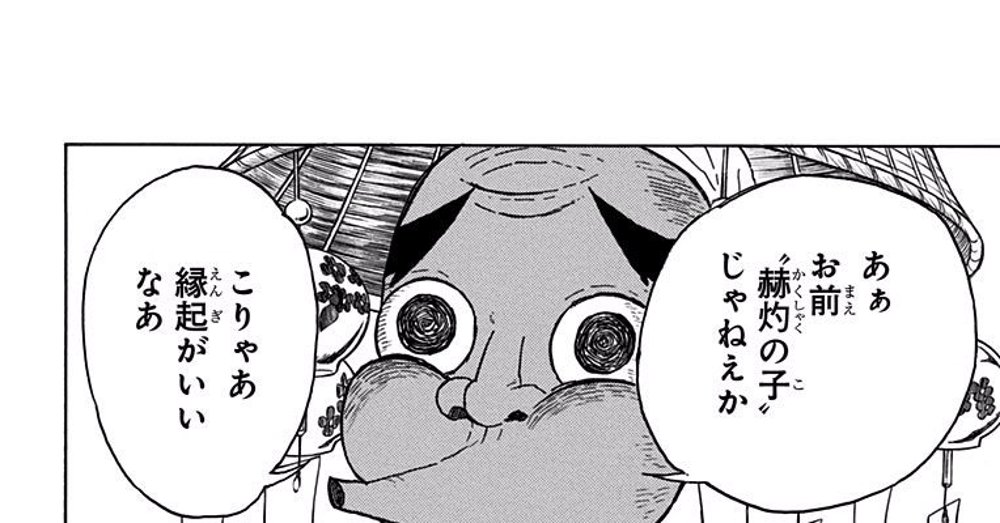
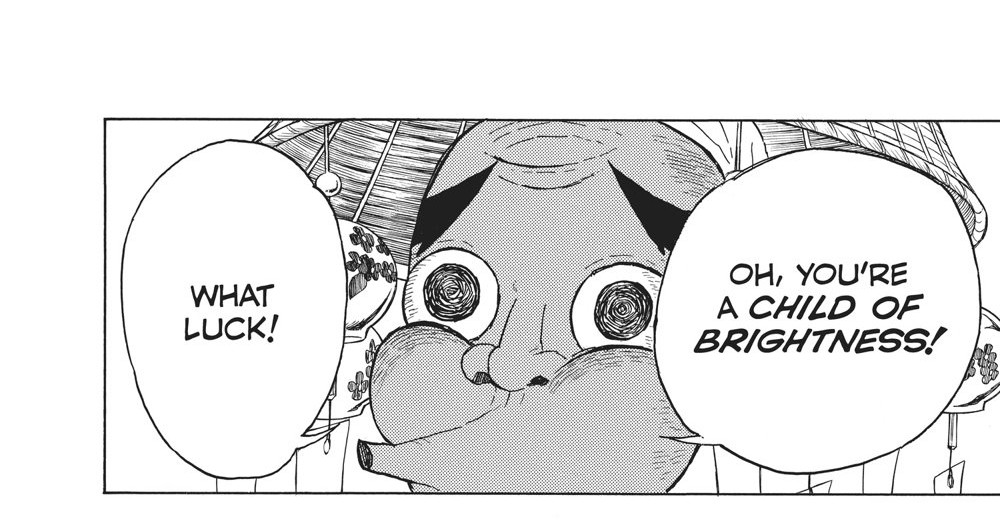
Tanjiro hasn't even reached Final Selection yet. He's just been led, blindfolded by circumstance more than by choice, into the workshop of the swordsmith who will forge his Nichirin blade — a man (every swordsmith in this story, we later learn, hides his face for his own safety) whose expression is a fixed, wide-eyed grin under a straw hat hung with charms. He leans in, studies Tanjiro's hair and eyes, and says:
「あぁお前『赫灼の子』じゃねえか こりゃあ縁起がいいなあ」
Ā omae 'kakushaku no ko' janē ka. Koryā engi ga ii nā.
VIZ's English edition prints: "OH, YOU'RE A CHILD OF BRIGHTNESS! WHAT LUCK!" (Vol. 2, p.40).
Grant the rendering its due first: "WHAT LUCK!" is exactly the exclamation an English-speaking craftsman would make, short and punchy in a small bubble, and it isn't wrong that engi-ga-ii means something good is afoot. But sit with the word underneath it a moment. 縁起 (engi) is not a coin-flip word. It is Japanese Buddhism's term for pratītyasamutpāda — dependent origination, the doctrine that nothing in the universe arises by itself. The swordsmith isn't telling Tanjiro he rolled well. He's reading a causal chain off the boy's face.
The Original
Take the compound apart. 縁 (en) is "connecting condition" — the same 縁 that sits inside 因縁 (innen, a karmic tie between two people) and the everyday ご縁 (go-en, a fateful human connection, as in またご縁がありましたら, "if fate brings us together again"). 起 (ki) is "to arise, to rise up" — the same 起 in 起きる (okiru, "to get up / to occur") and 起こる (okoru, "to happen").
Put the two together and 縁起 says, quite literally, "arising via conditions." This is not folk etymology; it is the standard Japanese calque for the doctrine the historical Buddha is traditionally said to have realized under the bodhi tree: nothing possesses an independent self (無我, muga) — everything you can point to is a temporary knot tied where causes met conditions. The formal doctrine survives whole in compounds like 十二縁起 (jūni engi, "the twelve links of dependent origination") and 縁起の法 (engi no hō, "the law of dependent origination") — this is textbook Buddhist philosophy, taught in exactly those terms.
And then, as Buddhist vocabulary tends to do once it moves into ordinary Japanese, the doctrine wore down into a predicate: 縁起がいい, "[the omen] is good." Grammatically it is almost nothing — [NOUN] が いい, "X is good" — but the noun it's attached to used to mean the entire machinery of causation. As vocabulary, 縁起 in this everyday sense is roughly JLPT N2 — common enough to appear in a textbook's "superstitions" unit — while the doctrinal 十二縁起 sense belongs to specialist religious vocabulary well past N1. Same two syllables, two very different shelves.
VIZ's Choice
Here are all three appearances of 縁起 we can verify in the volumes on file, VIZ's English beside each:
| Vol. / p. | Japanese | VIZ English |
|---|---|---|
| 2 / 40 | こりゃあ縁起がいいなあ | WHAT LUCK! |
| 2 / 40 | 縁起がいいって喜ぶんだぜぇ | BE HAPPY FOR YOUR GOOD FORTUNE. |
| 12 / 58 | 縁起の悪いこと言うんじゃないわよ | DON'T SAY UNLUCKY THINGS! |
Three appearances, three different English adjectives doing the work — "luck," "fortune," "unlucky" — and every single one is a fluent, idiomatic, locally correct choice. That's what makes the scatter worth noticing: this isn't a case of a translator struggling for footing the way 因縁 forces five different guesses across One Piece. Here English actually has a whole ready-made family of near-synonyms — luck, fortune, omen — and reaches for a different one each time purely for variety and flow. The doctrine doesn't get lost because English ran out of words. It gets lost because English's words for engi never carried the doctrine to begin with; there was nothing to lose in translation because "luck" arrived already hollow.
Notice too what happens on the same page, twice: the swordsmith says 縁起がいい (line 1), explains the lineage of fire-workers whose children have reddish coloring (lines 3–5), and only then repeats 縁起がいい (line 7) — "be happy for your good fortune." The explanation sits between the two invocations of the word, doing exactly the work 縁起 itself should be doing: naming the causal chain. English needs the whole middle paragraph to carry what Japanese front-loads into one adjective.
The Gap
"Luck" names an absence of cause; 縁起 names a visible node inside one. A coin-flip is lucky because nothing determined it. Tanjiro's hair is 縁起がいい because something absolutely determined it — a bloodline of fire-workers, a chain of cause and condition stretching back generations, which the swordsmith is reading like a genealogist reading a birthmark. "WHAT LUCK!" is fluent and charming, and it also quietly says the opposite of what the Japanese word means: that this is chance rather than lineage.
縁起でもない treats speech as a cause, not just a jinx. Ten volumes later, watching over the unconscious Tanjiro at the Butterfly Mansion, Aoi Kanzaki blurts "あー!!またコイツ昏睡した!!" ("Oh no! He's unconscious again!!") and immediately catches herself: 「縁起の悪いこと言うんじゃないわよ」 — "DON'T SAY UNLUCKY THINGS!" In English, "don't jinx it" is folk magic about inviting a curse by naming it. In the logic 縁起 carries, her own words are a 縁 — a condition — one more input that could help a bad outcome arise. She isn't warding off luck; she's refusing to supply a cause.
The word's two lives split into two unrelated English vocabularies. In Japanese, 縁起 covers the Buddha's philosophy of universal co-arising and the good-luck charm on a shrine gift-shop shelf — 縁起物 (engimono) — with the shared root sitting in plain view. English keeps "dependent origination" in the philosophy seminar and "lucky charm" in the gift shop, and nothing about the two phrases suggests one grew out of the other, even though in Japanese they visibly did.
What If
For the headline line, the options and their prices:
- "Now that's a sign!" — keeps the sense of reading an omen off a visible fact, closer to 縁起's causal logic than "luck." Cost: "sign" can land neutral in English; it doesn't guarantee the reader hears it as unambiguously good news.
- "That bodes well, now!" — "bodes" at least gestures at a forward chain of consequence rather than pure chance. Cost: archaic phrasing, better suited to a British countryman than this gruffly rustic Japanese craftsman.
- "That's a good omen, that is!" — "omen" is English's best surviving word for a visible sign pointing at an unseen cause. Cost: "omen" defaults to ominous in modern English, so "good" has to work hard to flip the valence.
- Keep "WHAT LUCK!" but trust the surrounding dialogue — the lines about fire-working families and reddish children — to carry the lineage argument the word itself no longer signals. Cost: asks the English reader to do the etymology's work themselves, paragraph by paragraph, instead of hearing it in one syllable.
Take-away
縁起 is deceptively small: two kanji, an N2 word, the kind of vocabulary a first-year learner meets in a unit on superstition. But underneath 縁起がいい sits the same claim the Buddha is said to have made under the bodhi tree — that nothing arises alone, that every visible thing is a temporary knot of causes and conditions. English's "luck" describes the opposite idea, an absence of cause, and the two words meet only by convention, not by meaning.
Three rules of thumb to carry off this page:
- When you meet 縁起がいい/悪い, listen for whether the speaker is naming a coincidence or reading a cause. In this manga it's almost always the latter — omens here are diagnostic, not random.
- Collect 縁 (en) wherever it surfaces — 縁起, 因縁, ご縁, 縁を切る ("to sever ties") — it is Buddhist vocabulary for connection wearing a dozen different everyday outfits.
- English isn't innocent here either: "fortune" descends from Fortuna, the Roman goddess whose devotees drew lots at her temple to divine the future, and "lot" itself once meant a cast object used to learn a god's will before it settled into meaning nothing more than "a bunch of stuff" or "chance." English's own luck-words buried a divination doctrine the same way 縁起 buried the Buddha's.
縁起 is also a live candidate across the wider corpus — the same word turns up doing comparable work in both One Piece and Naruto, worth its own cross-work note some day. For the sibling term that splits a karmic tie five ways in translation, see our companion piece on 因縁 in One Piece. For more Buddhist vocabulary hiding in plain sight across this series, see 地獄 and the eight Buddhist underworlds, 成仏してください and the epitaph that points the wrong way, 餓鬼 and the hungry-ghost hell behind every "brat", 天罰 and the impersonal heaven English keeps personifying, 極楽 and the footnote VIZ used when the kanji wouldn't move, and 南無三 and the one prayer VIZ chose to translate — or browse the full Demon Slayer translation notes index.
Every Japanese and English line quoted above is a byte-exact capture from the cited editions — Demon Slayer: Kimetsu no Yaiba Vol. 2 & Vol. 12 (Japanese) and Demon Slayer: Kimetsu no Yaiba (VIZ Media) at the corresponding panels — via our bilingual page database; see Sources below.