The Moment
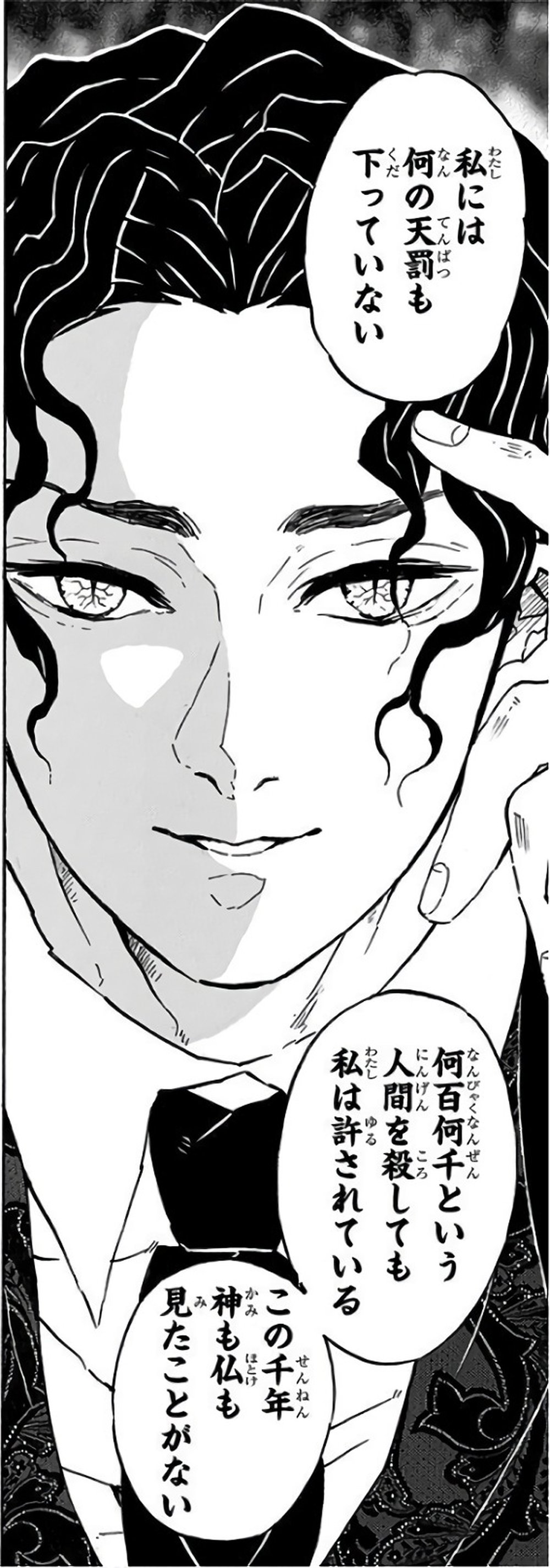
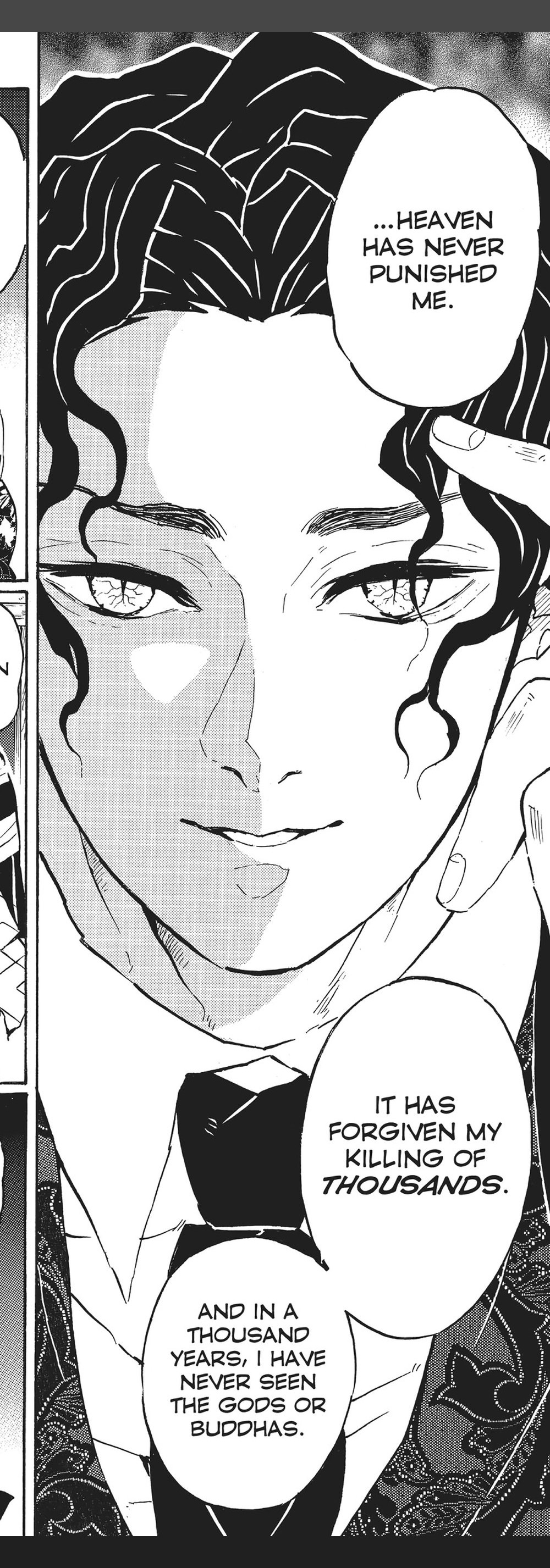
Volume 16, a private audience with no urgency to it. Muzan Kibutsuji — a thousand years old, disguised in a human shape that never quite looks alive — sits across from Kagaya Ubuyashiki, the blind head of the Demon Slayer Corps, wrapped in the bandages of the illness that shortens every Ubuyashiki life, his wife Amane at his side. It is one of their periodic, almost courteous meetings. Kagaya has just heard Muzan's worldview and murmured 「君は…そのようにものを考えるんだね…」 — "IS THAT HOW YOU VIEW IT?" Muzan's answer fills the page as a single unbroken close-up of his own face:
「私には何の天罰も下っていない」
Watashi ni wa nan no tenbatsu mo kudatte inai
「何百何千という人間を殺しても私は許されている」「この千年神も仏も見たことがない」
VIZ's English edition prints: "...HEAVEN HAS NEVER PUNISHED ME." followed by "IT HAS FORGIVEN MY KILLING OF THOUSANDS." and "AND IN A THOUSAND YEARS, I HAVE NEVER SEEN THE GODS OR BUDDHAS." (Vol. 16, p.74).
Grant the line its due first: "Heaven has never punished me" is clean, quotable, and menacing in exactly the register a thousand-year-old monster's confession should have. It reads, cold and satisfied, like a man presenting an audit. The trouble is what English's "Heaven" quietly does to that audit. In the small panels beside Muzan's face, Kagaya keeps talking through the monologue — 「だが私には私の…考え方がある…」 ("WELL, I SEE IT DIFFERENTLY."), then 「無惨…」, then, astonishingly, a genuine question to his eternal enemy: 「君の夢は何だい?」 ("...WHAT IS YOUR DREAM?"). Muzan never answers it. He answers with more evidence for the acquittal instead — and closes the page in silence, Kagaya's own final panel just a trailing 「……」
The Original
Take 天罰 apart, because both halves carry more weight than "heavenly punishment" suggests.
天 (ten) is "heaven" or "sky" — but not the address of a personal god. It is the Japanese inheritor of the Chinese philosophical concept Tian: the impersonal moral order of the cosmos itself, the same 天 behind 天命 (tenmei, "the Mandate of Heaven"), the Confucian doctrine that grants or strips a ruler's legitimacy without any deity ever handing down a scroll. 天 doesn't watch you and decide. 天 is closer to what a modern English speaker might mean by "the universe" or "the moral order of things" — vast, structural, and utterly without a face.
罰 (batsu) is the ordinary word for punishment or penalty — the same 罰 in 罰金 (bakkin, "a fine") and 体罰 (taibatsu, "corporal punishment"). Nothing exotic here; the strangeness is entirely in what it's attached to.
Together, 天罰 names what happens when the moral order of the universe corrects itself: wrongdoing that eventually 下る (kudaru), "comes down," as consequence. That verb is doing real work. 下る describes arrival, descent, something settling into place — not a verdict pronounced by a judge, but weather rolling in. The idiom 天罰が下る ("heavenly punishment falls") makes 天罰 the subject of an intransitive verb of arrival, never the object of somebody's decision to strike. Muzan's line negates precisely that arrival — 下っていない, "has not come down" — present-negative of the same verb. He isn't saying "I was never judged and found innocent." He's saying the weather never broke.
As vocabulary, 天罰 sits at roughly JLPT N2: its parts (天, N5; 罰, N3) are elementary, but the fused abstract-noun sense — a whole cosmology folded into two kanji — is not conversational Japanese. It shows up in scolding, in news commentary on disasters, in exactly the kind of monologue Muzan is giving here: solemn, load-bearing vocabulary for a claim about the shape of the universe.
VIZ's Choice
天罰 surfaces twice in the volumes we have on file — once from Muzan, once, three volumes later, from Upper Rank Two Doma, talking to Shinobu Kocho about why humans invent religion. Here both occurrences, with a complication attached to the second:
| Vol. / p. (JP) | Japanese | VIZ English (as actually printed) |
|---|---|---|
| 16 / 74 | 私には何の天罰も下っていない | ...HEAVEN HAS NEVER PUNISHED ME. |
| 19 / 8* | 天罰はくだらないだからせめて悪人は死後地獄に行くって | THE IDEA OF DIVINE PUNISHMENT IS A JOKE... WICKED PEOPLE GOING TO HELL AFTER DEATH? |
*A flag on that second row, because it very nearly derailed this article. Kimetsu no Yaiba Vol. 19 is one of the volumes where VIZ's pagination runs one page behind the Japanese tankōbon — a chapter-title splash page inserted in the English edition (absent from the JP page count) shifts every following page number by exactly one. Our bilingual corpus auto-aligns JP page 8 with EN page 8 anyway, and hands back a fluent-sounding but wrong line: "DIVINE PUNISHMENT NEVER COMES. SO AT THE VERY LEAST..." That English sentence is real VIZ text — it just belongs to a different Japanese line entirely, one page earlier in the story, about wild boars and made-up afterlives, not to 天罰はくだらない. Opening the actual EN page 9 recovers the real rendering: "THE IDEA OF DIVINE PUNISHMENT IS A JOKE." / "WICKED PEOPLE GOING TO HELL AFTER DEATH?" — the version quoted in the table above, and the one this whole article is built on.
Once the true text is on the table, the real finding appears: VIZ's two solutions for 天罰 don't agree with each other. Muzan's line hands 天 a grammatical role — subject of "has never punished" — and gets a personal, if failed, Heaven. Doma's line makes tenbatsu the idea being mocked, no subject doing any punishing at all, which is structurally much closer to the Japanese's facelessness. The better translation is the one that was almost invisible — sitting one page away from where the automated tools said to look.
The Gap
English personifies where Japanese only reports an absence. "...HEAVEN HAS NEVER PUNISHED ME" makes Heaven the grammatical subject of a transitive verb — an agent who tried and came up empty. 私には何の天罰も下っていない has no such subject: 天罰 is a thing that either arrives or doesn't, and here it simply hasn't. The Japanese describes an empty ledger. The English describes a disinterested, or defeated, judge.
The two VIZ solutions quietly disagree, and the better one is the harder one to find. Vol. 16 anthropomorphizes tenbatsu into "Heaven"; Vol. 19 turns it into an abstract "idea" of "divine punishment," which sidesteps personification — but the accurate quote only exists because a one-page pagination slip was tracked down by hand. Two demons say functionally the same thing about the same word, three volumes apart, and a reader relying on the corpus's automatic alignment would come away thinking English gave them two different, contradicting theologies for no reason at all.
"Heaven" is already carrying a second job nearby. Two pages before Doma dismisses 天罰, he tells Shinobu 「この世界には天国も地獄も存在しない」 — VIZ: "HEAVEN AND HELL DO NOT EXIST IN THIS WORLD." That's 天国 (tengoku), a specific afterlife destination, not 天 the cosmic order. One is a place you might go after death; the other is the moral structure judging you here, now, in this life. A reader working only from English's word "Heaven" has no way to keep a place and a principle apart — even though, in this particular pair of scenes, VIZ's own choices ("Heaven" for tenbatsu in one volume, "Heaven" for tengoku in the other) happen to reinforce exactly that collapse.
What If
No rendering is free; here is the menu and its prices.
- "THE SKY HAS NEVER SENT DOWN A PUNISHMENT ON ME." — keeps 下る's descending image and avoids making Heaven an agent. Cost: "the sky" reads as weather, not morality, to an English ear.
- "NO COSMIC JUSTICE HAS EVER TOUCHED ME." — makes 天's impersonal-order sense explicit for readers who already know "karma" as a loanword. Cost: "cosmic justice" is a modern, almost sci-fi register that undercuts Muzan's antique menace.
- "I HAVE NEVER ANSWERED TO ANY HIGHER LAW." — reframes tenbatsu as an absent authority-relationship, preserving Muzan's defiance. Cost: "higher law" still implies a lawgiver, which is exactly the personification 天 refuses.
- For Doma: "PUNISHMENT FROM ON HIGH IS A FANTASY." — "on high" nods at 天's verticality (下る, "coming down") without capitalizing a Western Heaven. Cost: "on high" carries its own King James echo — no English shelf for cosmic justice comes entirely free of religious residue.
The deeper problem for a translator: English's entire vocabulary for cosmic consequence assumes somebody is home — a Heaven that wills, a God who judges, a Maker who's met. The moment a language's moral order has no face at all, the translator is building a doorway with no house behind it.
Take-away
When Demon Slayer's villains talk about why they've gotten away with it, they reach for 天罰 — not a god's verdict, but the impersonal moral order of the universe simply failing to arrive. English's only real shelf for cosmic consequence is stocked by Christianity, so "Heaven" and "divine" keep getting reached for, and each time, a listener creeps in where the Japanese insisted there wasn't one.
Three rules of thumb to carry off this page:
- 天 alone is not 天国. One is the cosmic order judging conduct; the other is a specific afterlife address. English's "Heaven" covers both, so watch for a translation quietly picking a lane the original never had to.
- 下る tells you the verb is arrival, not verdict. 天罰が下る is weather rolling in, not a judge banging a gavel. Any translation that inserts an agent — someone deciding, someone striking — has added something the grammar didn't ask for.
- A subject with no fixed vote can still be tracked across a whole cast. Muzan and Doma reach for the identical word to describe the identical absence — the corpus alignment just tried to hide that fact behind a one-page printing quirk. When a word recurs, check whether the translations recur with it.
For the fake paradise Doma was selling while he said all this, see the banners hanging in his own chambers; for the word that tells a demon to move on instead of lingering, see 成仏してください. One Piece runs the same karmic machinery under a different name — 自業自得 (jigou-jitoku), "your own actions, your own consequences," analyzed on the One Piece hub — proof that manga across two different worlds keep needing a word for justice with nobody behind the bench. Browse more of these on the Demon Slayer translation notes index.
Every Japanese and English line quoted above is a byte-exact capture from the cited editions — Demon Slayer: Kimetsu no Yaiba Vol. 16 & 19 (Japanese) and Demon Slayer: Kimetsu no Yaiba (VIZ Media) at the corresponding panels — via our bilingual page database; see Sources below. Where the corpus's automatic page-alignment diverged from the real printed VIZ page (Vol. 19, a one-page pagination offset), the discrepancy is disclosed above in VIZ's Choice, and the article's analysis follows the line VIZ actually printed.