The Moment
Team Kakashi is underground, inside Orochimaru's own hideout near the Tenchi Bridge, on a mission that started as a search for Sasuke and is turning into something else. Naruto is still raw from Gaara's death — the loss that first cracked his chakra open a few volumes back — and he has just answered Orochimaru with a blast that guts a crater clean through solid stone. Even Orochimaru, watching from a careful distance, allows himself something close to a compliment:
「さすがにアレだけ高密度のチャクラを食らったら...死ぬわね」
VIZ: "CONTACT WITH CHAKRA SO DENSE... ...COULD KILL EVEN ME!" (Vol. 33, p.100.)
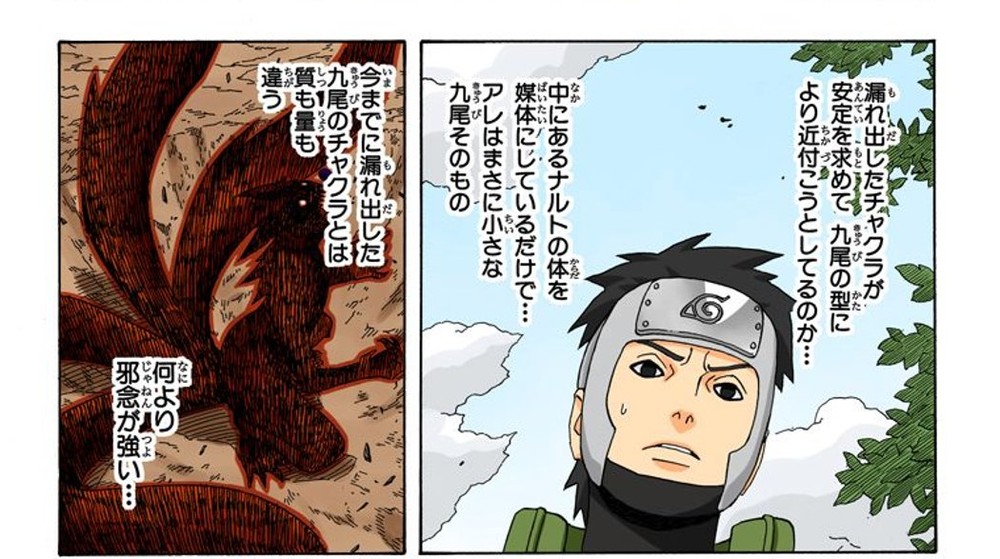
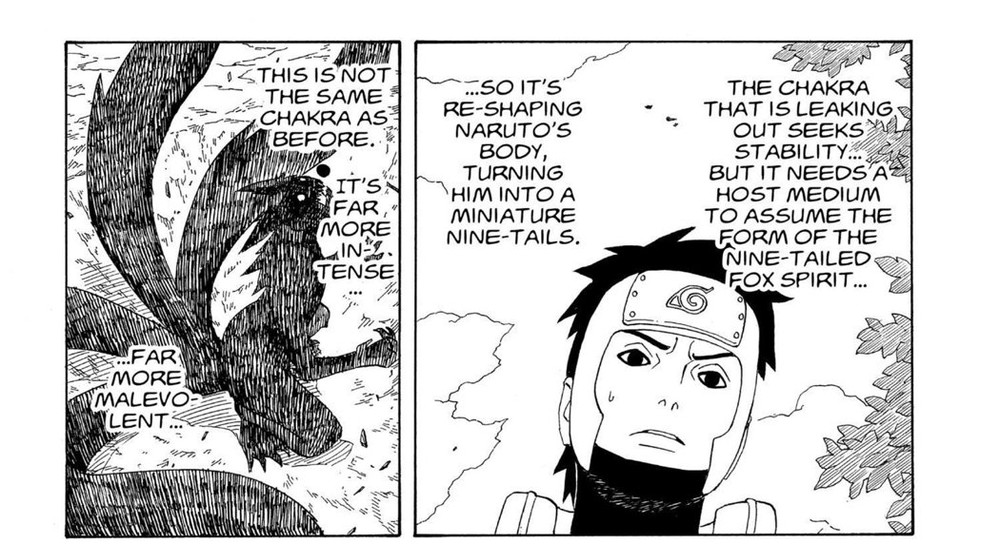
Then the panel cuts to Yamato — the wood-style ANBU specialist folded into the reconstituted Team Kakashi for one specific job: read Naruto's Nine-Tails chakra, and suppress it if it goes too far. He watches the fox-shaped shroud billow and reshape around Naruto's back, and reports what he sees the way a sensor calls out readings, not the way a bystander reacts to a monster:
「中にあるナルトの体を媒体にしているだけで...アレはまさに小さな九尾そのもの」 「今までに漏れ出した九尾のチャクラとは質も量も違う 何より邪念が強い...」
Naka ni aru Naruto no karada o baitai ni shiteiru dake de... are wa masa ni chiisana kyūbi sono mono. Ima made ni more-deta kyūbi no chakura to wa shitsu mo ryō mo chigau. Nani yori janen ga tsuyoi...
VIZ's English edition prints, across the same two panels: "SO IT'S RE-SHAPING NARUTO'S BODY, TURNING HIM INTO A MINIATURE NINE-TAILS." / "THIS IS NOT THE SAME CHAKRA AS BEFORE. IT'S FAR MORE INTENSE..." / and then, closing the beat: "...FAR MORE MALEVOLENT..."
Grant the rendering its due first. "Malevolent" is a real, natural word for a translator to reach for under a hard deadline, it fits the vertical bubble, and it keeps the escalating dread of Yamato's list intact — quality, quantity, and now this. Nothing about the line reads as wrong. But listen to what Yamato is actually doing across those three short sentences: he isn't flinching, he's cataloguing. And the noun anchoring his last item, 邪念 (janen), is doing far more specific work than "evil" ever could.
The Original
Take 邪念 apart, because both halves are carrying real technical weight.
念 (nen) is written 今 ("now") sitting directly on top of 心 ("heart-mind") — attention pinned to the present moment. This is not a loose, poetic etymology; 念 is genuine Buddhist psychological vocabulary, the standard Sino-Japanese rendering of a discrete unit of mindful attention. It is the same 念 inside 正念 (shōnen), "right mindfulness," the seventh fold of the Eightfold Path (八正道) — and the same 念 inside 正念場 (shōnenba), the kabuki term for the scene that forces an actor to reveal the true core of the role (if you've read our companion Naruto piece on that word, you already own this kanji). 念 also survives in everyday words like 残念 (zannen, "regret" — attention left over) and 念のため (nen no tame, "just to be sure" — attention held in reserve).
邪 (ja) is the disqualifier: "evil, wicked, crooked, heterodox — off the true way." It's the same 邪 in 邪道 (jadō), "the heterodox path," and in 邪気 (jaki), "a malevolent aura" — the atmospheric word manga sensors reach for when something feels wrong before anyone can name why.
Put them together and 邪念 does not mean "a bad thought" the way English hears that phrase — one unpleasant idea, morally colored but otherwise unremarkable. It names a specific mental event that has left the wholesome track for a crooked one: a 念 gone 邪. The doctrine underneath assumes thought is gradable, sortable into on-path and off-path — and 邪念 is the technical name for the off-path case.
Grammatically, Yamato's headline clause is nothing exotic: 何より ("above all, more than anything") + 邪念が強い ("the janen is strong"). But the noun doing the work sits nowhere on the standard JLPT vocabulary lists — 邪 is taught by lower-secondary school and 念 by elementary school individually, yet the compound's Buddhist-technical sense pushes real command of the word past N1, into native-reader territory. It is exactly the kind of word a reader feels the weight of before being able to define it — which is a problem for a translator working against a deadline and a speech-bubble word count.
VIZ's Choice
邪念 appears exactly once in the Naruto volumes we have on file, so there's no multi-panel scatter table to chart the way there is for a word like 邪念's own One Piece appearances. Instead, here is the full readout Yamato delivers, Japanese against the true printed English lettering:
| Speaker | Japanese | VIZ English (as printed) |
|---|---|---|
| Orochimaru | さすがにアレだけ高密度のチャクラを食らったら...死ぬわね | CONTACT WITH CHAKRA SO DENSE... ...COULD KILL EVEN ME! |
| Yamato | 中にあるナルトの体を媒体にしているだけで...アレはまさに小さな九尾そのもの | SO IT'S RE-SHAPING NARUTO'S BODY, TURNING HIM INTO A MINIATURE NINE-TAILS. |
| Yamato | 今までに漏れ出した九尾のチャクラとは質も量も違う | THIS IS NOT THE SAME CHAKRA AS BEFORE. IT'S FAR MORE INTENSE... |
| Yamato | 何より邪念が強い... | ...FAR MORE MALEVOLENT... |
A citation note, in the interest of the same rigor this site asks of every VIZ line: our bilingual page database extracts the third row's English as the single sentence "IT'S FAR MORE IN TENSE." — the opening sentence visible on the printed page, "THIS IS NOT THE SAME CHAKRA AS BEFORE.", is missing from that extraction entirely, not merely re-punctuated. The fourth row is extracted as "FAR MORE MALEVOLENT." (no ellipses), where the printed bubble actually reads "...FAR MORE MALEVOLENT..." on both sides. Both gaps were confirmed directly against the page art (see the panel crops below) before writing this article; rawCapture/rawCaptureEn in this article's sources and references preserve the corpus bytes exactly, per this project's citation rule, while the table above and the analysis that follows describe the real printed lettering.
Zoom out, and 邪念 is not actually a stranger to translation scatter — it's just that the scatter happens across a different work. Cocoyasi Village's policeman Genzo warns a Fish-Man that weapons breed nothing but 邪念 and violence (VIZ: "WICKED THOUGHTS"); the warlord Arlong threatens villagers who harbor "even a splinter" of it (VIZ: "SEDITION"); the Shandia warrior Wyper snaps that treasure-hunting mid-battle breeds it too (VIZ: "DISTRACTIONS") — see 邪念 and the Buddhist mindfulness English splits into "wicked," "sedition," and "distraction". "Malevolent" is arguably the closest of these four English solutions to the 邪 half of the word — it's a real synonym for "evil" or "wicked" — but like the other three, it drops 念 without a trace. Four scenes, four unrelated speakers, four different English words, and not one of them treats 念 as anything but disposable.
The Gap
念 disappears as a named phenomenon. "Malevolent" is a quality, a degree of badness. 邪念 is a graded, countable thing — a unit of mental attention that can be present in greater or lesser amounts, exactly the way Yamato is measuring it. English has an adjective for how evil something feels; it doesn't have an everyday noun for a specific unit of corrupted attention, so the noun that gave Yamato's sentence its technical edge is quietly demoted to a mood.
The clinical cadence reads as pure menace. Yamato's line is the third item on a checklist — quality, quantity, janen — delivered by a specialist assigned to this exact chakra for this exact reason. "...FAR MORE MALEVOLENT..." standing alone reads like a shudder, not the third reading on an instrument. The Japanese never stops being a report; the English can't help becoming an exclamation.
The path metaphor, and the story's own long argument with itself, go missing. 邪 doesn't just mean "bad" — it means "off the correct road," the same geography sitting under 邪道 and 邪気. And Naruto's relationship with the Nine-Tails is, across the volumes that follow this one, a slow argument between exactly those two poles: chakra that is forced, borrowed, and 邪 giving way, eventually, to chakra that is offered and shared, closer to 正. "Malevolent" is a dead end — an adjective has nowhere further to go. A path does.
What If
No rendering is free; here is the menu and its prices.
- "...ITS INTENT HAS TURNED FAR MORE MALEVOLENT..." — restores 念 as a named, measurable thing ("intent") instead of folding it into a bare adjective. Cost: adds a noun the tight three-word Japanese doesn't spell out, and softens the checklist rhythm of Yamato's three clauses.
- "...FAR MORE TAINTED WITH MALICE..." — "tainted" keeps chakra readable as a substance that can be corrupted, closer to 邪's off-path metaphor than a plain mood word. Cost: "malice" still names an emotion rather than a mental unit, so 念's technical weight only partly survives.
- "...THE THOUGHT INSIDE IT HAS GONE FAR MORE CORRUPT..." — keeps "thought" as a countable thing gradable on- or off-path, which is exactly what 念 claims. Cost: a stranger image in English than a chakra simply being evil, and it trades away VIZ's terse punch.
- Keep "malevolent," restore the readout frame: "...AND THE READING ON ITS INTENT IS FAR MORE MALEVOLENT..." — Cost: considerably longer, trading the clipped field-report cadence for an explanation of what that cadence implied.
Notice the shared limitation: every option can chase the evil half of the compound (邪) or the measured-thing half (念), but rarely both at once in three words — because English simply doesn't keep a stock noun for a gradable unit of corrupted attention the way this vocabulary assumes.
Take-away
邪念 looks like a throwaway insult and turns out to be a diagnosis. In Yamato's mouth it's the third reading on a chakra assessment, not a shudder; in Naruto's own magic system, where chakra is explicitly built from a physical half and a spiritual half, "more janen" is a literal claim about which half has spiked, not a figure of speech. VIZ's "...FAR MORE MALEVOLENT..." is a fine adjective for a scary fox-shaped chakra shroud. It just isn't the noun Yamato actually said.
Three rules of thumb to carry off this page:
- When you meet 念, look for a measurement, not a mood. The kanji is 今 over 心 — attention pinned to now — and Buddhist vocabulary treats it as a countable unit, gradable and gradeable, not a synonym for "thought" in general.
- 邪 marks a road, not just a rating. It isn't simply "bad"; it's "the wrong direction," the same metaphor underneath 邪道 and 邪気. Watch for it whenever a translation reaches for a flat moral adjective instead of a path.
- A single kanji can carry a whole series' argument. The same 念 that lets Yamato measure Naruto's corrupted chakra here is the 念 the story spends years trying to move from 邪 to 正 — off the path, back onto it.
For more Buddhist vocabulary Naruto's translators have had to reckon with, see our companion pieces on 正念場, the exam-arc scene that tests what you are, 精進, the discipline VIZ reduces to "practice hard", 娑婆, the sutra word for the world outside a cell, and 修羅場, the asura's battlefield — or browse the full Naruto translation notes index. For the same word in a different continuity entirely, where it scatters across three unrelated English solutions instead of converging on one, see 邪念 and the Buddhist mindfulness English splits into "wicked," "sedition," and "distraction" on our One Piece site.
Every Japanese line quoted above is a byte-exact capture from the cited edition — NARUTO―ナルト― Vol. 33 (Japanese) — via our bilingual page database, cross-checked directly against the page art; the English lettering follows the printed VIZ edition, Naruto Vol. 33, at the corresponding panels; see Sources below.