The Moment
Team 7 has existed for all of half a page. Iruka has just read out the rosters — Sasuke top of the class, Naruto dead last, deliberately paired together so "the team's strength balances out" — and while the three of them wait outdoors for whoever their new sensei turns out to be, Sasuke does something almost polite: he actually asks Sakura a question.
「サクラ お前に一つ聞いときたいことがある」 「ナルト...どう思う?」
Sakura, omae ni hitotsu kiitokitai koto ga aru… Naruto… dō omou?
VIZ: "SAKURA, I HAVE TO KNOW... WHAT DO YOU THINK OF... NARUTO?"
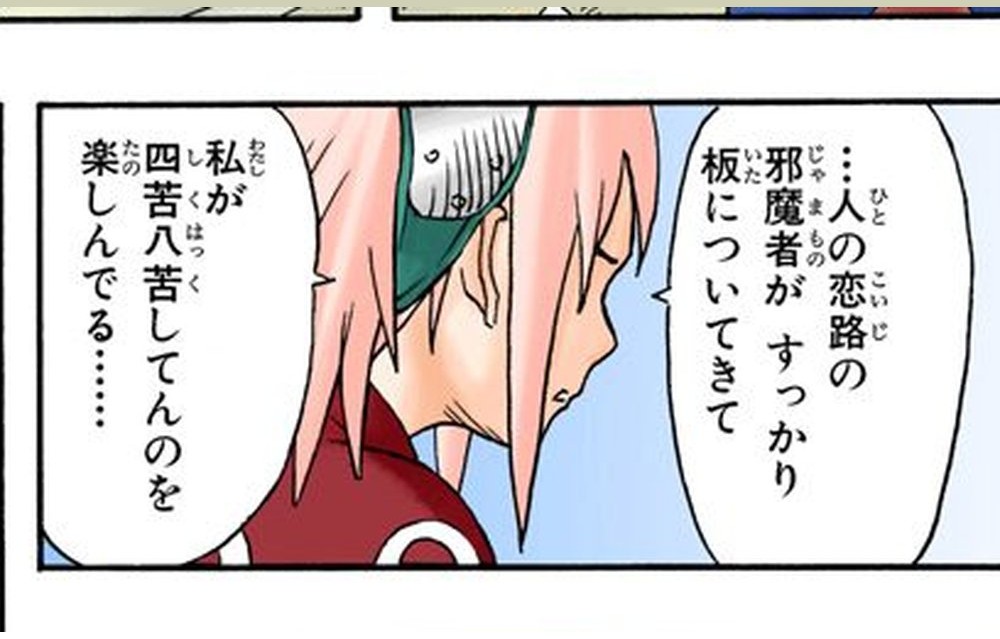
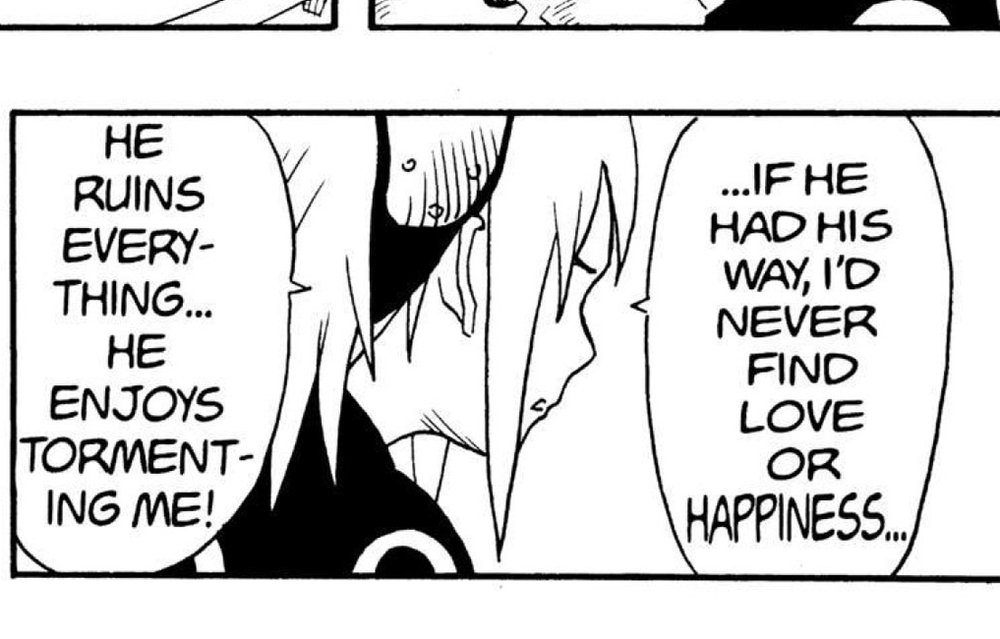
Sakura's mouth manages one dazed syllable — 「え?」, "YES?" — because thirty seconds earlier she was still floating through a daydream where fantasy-Sasuke told her she had a "charming forehead" and leaned in for a kiss, while Inner Sakura threw a triumphant punch and screamed ゲット!!! ("GOT IT!!!"). Naruto flopping down onto a nearby stump snapped her out of it. Now the real Sasuke is asking about the real Naruto, and the manga cuts straight past whatever Sakura manages to say out loud to what she's actually thinking, in a single unbroken thought spanning two speech-clouds:
「...人の恋路の邪魔者がすっかり板についてきて/私が四苦八苦してんのを楽しんでる......」
…Hito no koiji no jamamono ga sukkari ita ni tsuite kite / Watashi ga shiku-hakku shiten no o tanoshinderu……
VIZ's English edition prints: "...IF HE HAD HIS WAY, I'D NEVER FIND LOVE OR HAPPINESS... HE RUINS EVERYTHING... HE ENJOYS TORMENTING ME!" (Vol. 1, p.100).
Grant the rendering its due: it's a clean, punchy teenage outburst, and "HE ENJOYS TORMENTING ME!" lands with exactly the exasperated heat the panel wants — a girl fed up with the boy wrecking her fantasy love life. VIZ even keeps the two-cloud structure of Sakura's thought, splitting it across the same two panels the Japanese uses, mirrored left-to-right for this early volume's Western-reading-order printing — Sakura's bowed, pink-haired head sits dead center of the panel in both editions, the one fixed point the mirror can't move. Worth flagging before moving on: the two English clouds don't map clause-for-clause onto the two Japanese ones. 邪魔者がすっかり板についてきて ("[he]'s really gotten good at obstructing people's love lives") surfaces in VIZ's right-hand cloud as "...IF HE HAD HIS WAY, I'D NEVER FIND LOVE OR HAPPINESS...", while "HE RUINS EVERYTHING..." — which has no direct counterpart in either Japanese cloud — gets folded into the left-hand cloud alongside "HE ENJOYS TORMENTING ME!," VIZ's rendering of 四苦八苦してんのを楽しんでる. The overall complaint survives the reshuffle intact. The specific word doing the real work in it does not.
That word is 四苦八苦 (shiku-hakku). VIZ's "torment" is a feeling. 四苦八苦 is a number.
The Original
Take 四苦八苦 (shiku-hakku) apart, because it's two numbered sufferings stacked on each other, and both numbers are load-bearing.
四 is "four." 八 is "eight." 苦 (ku) — the same 苦 as 苦しい (kurushii, "painful") and 苦労 (kurō, "hardship") — means "suffering, bitterness, pain." So far, nothing hidden: it's a four-and-an-eight bracketing a suffering.
四苦, the Four Sufferings, are the four things no living being escapes:
- 生 (shō) — birth
- 老 (rō) — aging
- 病 (byō) — sickness
- 死 (shi) — death
Simply being born, growing old, falling ill, and dying. Not moral failures, not bad luck — the baseline terms of having a body at all.
八苦, the Eight Sufferings, is not a different list. It's the same four, plus four more, and the second four are about desire and relationship rather than biology:
- 愛別離苦 (aibetsuriku) — the suffering of being separated from those you love
- 怨憎会苦 (onzōeku) — the suffering of being forced to stay near those you hate
- 求不得苦 (gufutokuku) — the suffering of wanting what you cannot have
- 五蘊盛苦 (goun-jōku) — the suffering built into merely having a body and mind at all — the five skandhas (aggregates: form, sensation, perception, mental formations, consciousness) that make up a person, and that a person is stuck carrying around
Four original sufferings, plus four relational ones, make eight — and 四苦八苦 names the whole set in one breath: not "four or eight," but "four, and then eight on top of that." This isn't folk wisdom dressed up in kanji. It is the itemized content of 苦諦 (kutai), "the truth of suffering," the first of Buddhism's 四諦 (shitai), the Four Noble Truths — the founding claim, running back to the Buddha's first sermon at the Deer Park in Sarnath, that existence itself is dukkha. Where English philosophy might spend a chapter arguing that life contains suffering, the doctrine behind 四苦八苦 arrived with an itemized inventory already attached.
Centuries of daily use wore the compound down the way daily use wears everything down. In modern speech, 四苦八苦する is a common, almost throwaway verb for "to struggle desperately, to have an awful time (with something)" — 数学に四苦八苦する, "to struggle with math"; 資金繰りに四苦八苦する, "to struggle to make ends meet." Nobody counting on their fingers when they say it. The doctrine still rides along inside the number, the way "cross to bear" still rides along inside a complaint about a difficult coworker — present, mostly unnoticed, available the moment someone stops to look.
Grammatically the headline line is almost aggressively casual: 四苦八苦してんの is 四苦八苦している の, with the い of している dropped (a standard colloquial contraction) and の nominalizing the whole clause — "the thing of my being in shiku-hakku" — which を then marks as the object of 楽しんでる, "[he] enjoys." No JLPT list carries 四苦八苦 officially, the way none carries 悪戦苦闘 or 一切皆苦; but every yojijukugo frequency guide that ranks them places it at N1 — a word learners meet in a dictionary long before a textbook dialogue would ever use it, and then discover, once they start reading real manga, gets tossed around by furious twelve-year-olds without a second thought.
VIZ's Choice
Only one hit for 四苦八苦 surfaces across the volumes we have on file — this is a single-occurrence case, not a scatter — so the question isn't "how did the choice vary," it's "what did this one choice buy, and what did it cost."
VIZ had a shelf of options for a sentence built on "suffer": struggle, have a hard time, suffer, torment. It picked the most aggressive, most agentive word on the shelf. That's worth sitting with, because "torment" carries its own buried history — it comes from Latin tormentum, originally an engine of torture, a device for twisting rope under tension to launch a projectile, before it settled into "to inflict great suffering" and then, worn down the same way 四苦八苦 was worn down, "to be a nuisance to." Put the two words side by side and there's an odd, unplanned symmetry: one started as Roman military hardware and softened into "he's being annoying"; the other started as a precise Buddhist body-count and softened into "having an awful time." Both words lost their original engine on the way to a manga panel. Neither translator — Kishimoto writing 四苦八苦, VIZ writing "torment" — was reaching for etymology; both were reaching for the word that felt right in the moment, and by coincidence both of those words used to mean something far more specific than "annoyed."
The difference is that Kishimoto's choice keeps its specificity legible to any Japanese reader who stops to look — the kanji themselves spell out "four" and "eight" — where "torment"'s torture-engine has been dead for centuries and carries no charge at all. VIZ's choice is the right register (a furious teenager, not a philosophy student) and the wrong shape (an intensity, where the Japanese offers a count). Given a single panel and a single beat to land the joke — Sasuke's innocent question detonating into Sakura's private fury — "torment" is a perfectly reasonable one-word solution. It just isn't the same one-word solution Japanese reached for.
The Gap
The arithmetic vanishes. 四(4)+八(8) is not decorative dressing on a complaint; it is a specific, countable doctrine, the same eight items every time: birth, aging, sickness, death, then separation, aversion, want, and selfhood. "TORMENTING ME" has no numbers in it at all — it's a magnitude, not a manifest. English has no everyday idiom that keeps a headcount running inside a complaint the way 四苦八苦 does; the closest structural cousins ("a thousand and one troubles," "every trial under the sun") are exaggerations, not tallies.
The temple disappears with the count. A Japanese reader who has sat through a funeral, or heard a priest's New Year address, carries a faint echo of 生老病死 into this line whether they notice it or not — the same low hum an English reader gets from "cross to bear" without consciously picturing Calvary. VIZ's "torment" opens onto nothing behind it: no religion, no doctrine, just a generic verb for making someone miserable that could describe a sibling, a boss, or a mosquito equally well.
The grammar reassigns the blame. The Japanese verb is 楽しんでる (tanoshinderu, "enjoys, relishes, takes pleasure in") — Naruto's crime, as the sentence is actually built, is watching and delighting, an emotional state parked on top of Sakura's suffering, not necessarily an action he's engineering. "HE ENJOYS TORMENTING ME" turns "tormenting" into something Naruto actively does to her — inflicted cruelty, where the Japanese gives only witnessed pleasure. It's a small shift, and it happens to suit Naruto's pestering personality fine within the scene. But strictly read, the Japanese sentence indicts Naruto's reaction to Sakura's frustration, not a campaign of torment he's running against her.
What If
For Sakura's line, the menu and its cost:
- "He loves watching me suffer through my Four Sufferings and my Eight..." — keeps the Buddhist count audible, even in translation. Cost: baffling to a reader with zero context; "Four Sufferings and Eight" reads like nonsense without a footnote explaining the doctrine.
- "He enjoys watching me struggle through every kind of misery there is..." — "every kind" at least gestures at 四苦八苦's totalizing, catalogued quality — this isn't one problem, it's the whole set. Cost: still no number, and "every kind of misery" is actually vaguer than the Japanese, which is oddly precise about which miseries.
- "He enjoys my four-and-eight kinds of suffering..." — literal, compact, keeps both numbers visible on the page. Cost: unreadable as idiomatic English; nothing signals that "four-and-eight" names a fixed doctrine rather than an invented tally a character just made up.
- Keep VIZ's "torment," restore the enjoyment: "He just loves that I'm suffering..." — Cost: still zero doctrine, but it corrects the agency problem — Naruto delights in her suffering rather than manufacturing it, closer to what 楽しんでる actually claims, without pretending English owns a word for the count underneath it.
Every option pays the same tax the innen and 精進 articles on this hub keep finding: English can buy the feeling of a Japanese Buddhist compound, or it can buy the doctrine underneath it, but rarely both in a single word a twelve-year-old would actually think to herself.
Take-away
四苦八苦 is what happens when a religion's complete inventory of suffering — four inescapable facts of having a body, four more about wanting and losing — gets worn smooth enough by daily use that a furious genin can fling it at a boy who won't leave her alone. English hears the fury. It never gets to count.
Three rules of thumb to carry off this page:
- When a Japanese idiom is built on two numbers, ask what each number is actually counting before you translate the feeling alone. 四苦八苦 isn't intensified suffering; it's itemized suffering — four, then eight — and the itemization is the point.
- Watch for doctrine hiding in throwaway speech. 四苦八苦, like 精進 and 正念場 elsewhere on this hub, spent centuries in temples before it spent centuries in living rooms; the sutra doesn't announce itself in casual dialogue, but it's still the reason the word exists.
- Check who the verb accuses. "Enjoys watching X suffer" and "torments X" are not the same sentence, even when they describe the same jerk. Japanese grammar is often more precise than English gives it credit for about who is doing what to whom.
Naruto keeps letting its cast complain in borrowed Buddhist vocabulary elsewhere on this hub: the Third Hokage grants a month of training in the language of the six perfections in 精進 — the discipline that purifies, reduced to "practice hard"; Kabuto invokes the Eightfold Path's seventh limb as a death threat in 正念場 — the scene VIZ turned into fun; a four-character verdict shuts down an argument before it starts in 問答無用 — the dialogue VIZ ruled useless; and a doubled compliment survives the trip intact, for once, in 正々堂々 — the rare case where "fair and square" really fits. For the rest of what gets lost in translation across Konoha, browse the Naruto translation notes index.
Every Japanese and English line quoted above is a byte-exact capture from the cited editions — NARUTO―ナルト― Vol. 1 (Japanese, colorized digital edition) and Naruto Vol. 1 (VIZ Media) at the corresponding panels — via our bilingual page database; see Sources below.