The Moment
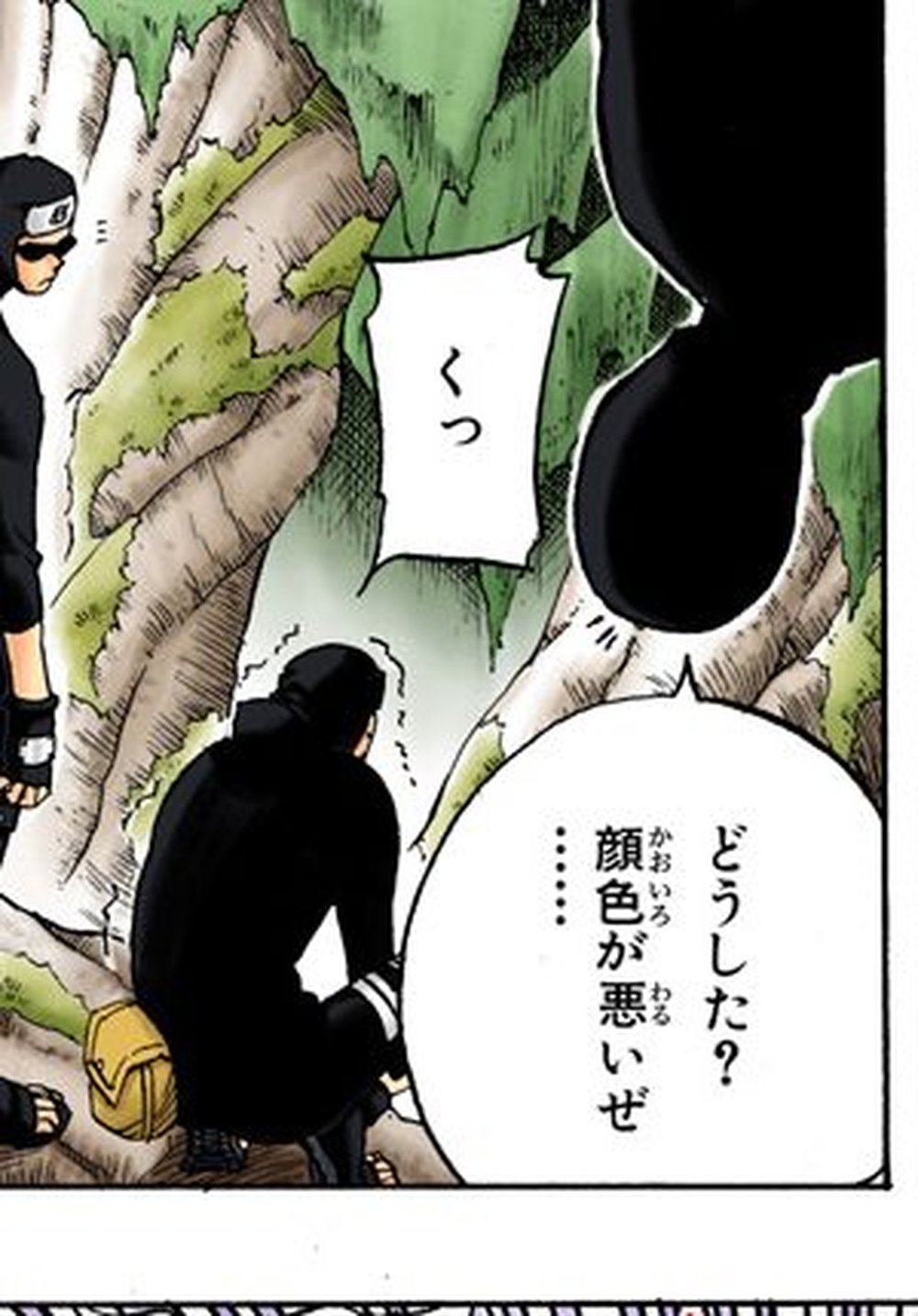
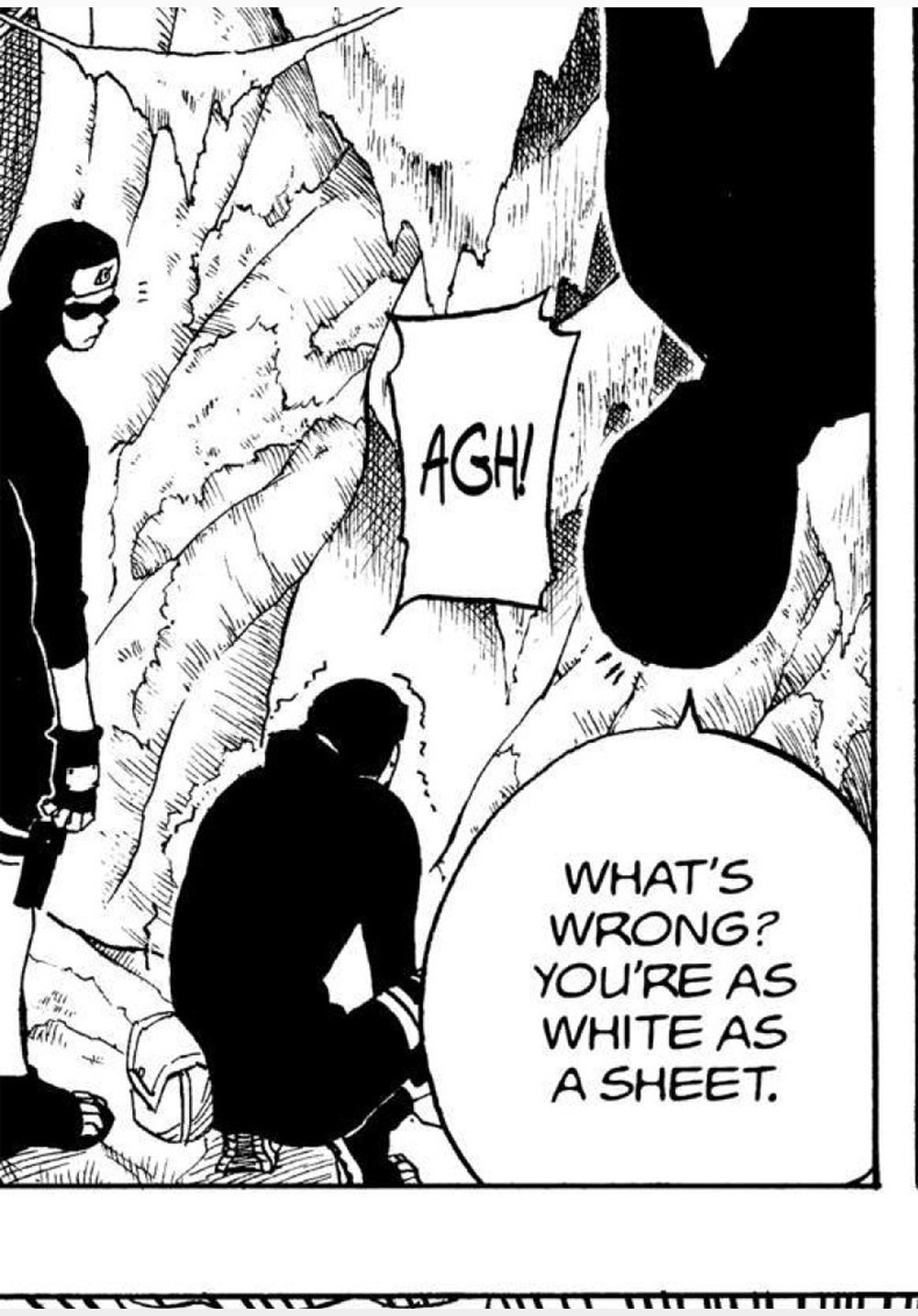
The Forest of Death, the Chunin Exam's brutal second stage. A page earlier, two unnamed Leaf genin have staked out territory near the tower every team is ultimately headed for — 「とりあえず全員塔を目標にしてるワケだろ...だったら出来るだけ塔付近に罠を張るのが利口だな」, "everyone's ultimately headed to the tower... so it's smart to set traps as close to there as possible" — and settled in to ambush whoever passes. One of them, hooded and crouched in the underbrush, lets out a small grunt: 「くっ」. His partner, standing over him, notices something before the reader does:
「どうした?ああ顔色が悪いぜ...」
Dō shita? Ā kaoiro ga warui ze…
VIZ's English edition prints: "WHAT'S WRONG? YOU'RE AS WHITE AS A SHEET." (Vol. 6, p.9.)
Grant the rendering its due: it's a natural, idiomatic thing for one English speaker to say to another, and the concern lands exactly where the panel wants it. It also happens to be correct in outline — this is a colorized digital edition, and the crouching genin's face genuinely has gone pale on the page. But look at what the Japanese sentence actually commits to. どうした? is "what's wrong?" — nothing new there. ああ is a small interjected "oh" of noticing. And 顔色が悪いぜ says, literally, "[your] face-color is bad." Not white. Not pale. Not any hue at all — just a verdict, 悪い, "bad," stapled onto the word for color without ever specifying which color is meant. One panel later, something is revealed to have latched onto the crouching genin under his cloak; the pallor his partner clocked was the first visible symptom of it. The Japanese line is doing exactly what a diagnosis does: naming that something is wrong with the readout, not describing the readout itself.
The Original
顔色 (kaoiro) is built from two of the first kanji any learner owns. 顔 (kao) is "face" — N5, the same 顔 in 顔文字 ("face character," an emoticon) and 洗顔 (face-washing). 色 (iro) is "color" — also N5, the 色 in 色鉛筆 (colored pencil) and the proverb 十人十色, "ten people, ten colors": to each their own. Compounded, 顔色 names the color of the face as a single readable surface — and the word carries two separate lives depending on how it's voiced.
Read かおいろ (kaoiro), the everyday kun-reading behind all three lines in this article, it's the plain spoken word for "complexion, coloring" — the thing a friend glances at and comments on without a second thought. Read がんしょく (ganshoku), the on-reading, it stiffens into set phrases with a harder social edge: 顔色を窺う (ganshoku o ukagau, "to watch someone's face-color") is what a nervous subordinate does before saying anything to a superior, reading the room off one surface. 顔色なし (ganshoku nashi), literally "no face-color at all," means to be so thoroughly outclassed by a comparison that you've figuratively lost your color — put to shame.
The grammar in all three of this article's occurrences is the same bare diagnostic frame: [X の/は 顔色 が 悪い/良い] — "X's face-color is bad/good." A verdict (良い or 悪い) bolts directly onto the color-word, and the sentence stops there. It commits to a judgment. It never commits to a hue. That's the whole gap this article is about, sitting in plain sight inside two N5 kanji.
VIZ's Choice
Every occurrence of 顔色 on file across the volumes we have, speaker included:
| Vol. / p. | Speaker | Japanese | VIZ English |
|---|---|---|---|
| 6 / 9 | An unnamed Leaf genin, to his partner lying in ambush | どうした?ああ顔色が悪いぜ... | WHAT'S WRONG? YOU'RE AS WHITE AS A SHEET. |
| 9 / 160 | Sakura Haruno, over the beaten, bleeding Hinata | やばいわよ...この顔色...! | SHE DOESN'T LOOK GOOD. HER FACE IS SO PALE...! |
| 18 / 43 | Tsunade, internal diagnosis while examining Orochimaru's ravaged arms | 心拍が荒い!顔色からしてかなりの発熱:疲労状態が続いている!それにあの腕は... | HIS HEART RATE'S ERRATIC... FROM HIS COMPLEXION, HE HAS A HIGH FEVER AND HE'S BEEN IN A STATE OF EXHAUSTION FOR A WHILE... AND HIS ARMS... |
Read down the right-hand column and a spectrum appears, not a scatter. "White as a sheet" is the most committed rendering — a full, specific English idiom standing in for a Japanese word that named nothing. "So pale" (for Sakura, watching Hinata carried off after Neji's assault in the Chunin Exam preliminaries) is the middle case: a real color-adjective, but a generic one, no more specific than the Japanese it replaces. And "complexion" — inside Tsunade's own clinical internal narration, cataloguing a patient's erratic heartbeat, fever, and exhaustion alongside his condition — is the outlier that matters most: it's the one English word on this list that is, itself, exactly as evasive as 顔色. "Complexion" doesn't say what color either. English has the right word sitting on its own shelf; VIZ reaches for it only when the Japanese register is at its most clinical, and reaches past it for something more vivid everywhere else.
The Gap
English cannot leave the hue blank the way Japanese does. 顔色が悪い commits only to a verdict; "YOU'RE AS WHITE AS A SHEET" commits to a specific, vivid simile the Japanese sentence never reached for. The translation isn't inaccurate — the art on the page really does show pale skin — but it is more decisive than its original, filling in a blank the Japanese grammar was built to leave open.
The two languages don't even point at the same color for fear. When Japanese does specify the hue behind a bad 顔色, it reaches for blue-green: 青ざめる ("to turn blue/pale"), 顔面蒼白 ("face deathly blue-white"). English's fear-color reflex — "white as a sheet," "white as a ghost," "the color drained from his face" — sits at the opposite end of the visible spectrum. "White as a sheet" isn't a translation of a Japanese color; it's a full substitution of English's own palette for a sentence that specified none.
The register drifts where the Japanese phrase doesn't. A blunt shinobi's masculine ぜ becomes a folksy American simile; Sakura's panicked やばい becomes a flat declarative sentence; Tsunade's genuinely clinical narration becomes the one rendering — "complexion" — that actually shares 顔色's own reticence. One recurring two-kanji diagnostic word; three unrelated English textures answering it.
In a colorized edition, the translation sometimes doubles up on information the original economized on. The art already shows the reader the color. 顔色が悪い doesn't need to name it a second time — that's precisely why the Japanese can stay abstract. "White as a sheet" tells the English reader something the Japanese panel was already showing them, which is generous, but it is not the same move the author made.
What If
For the headline line, the menu and its cost:
- "What's wrong? You've gone pale." — keeps the abstraction close to 顔色が悪い's own vagueness, a change of state rather than a named color. Cost: loses VIZ's punchy simile and some of the line's casual bite.
- "What's wrong? Something's off with your color." — keeps 色 visible as "color" in the English too, the closest literal echo available. Cost: sounds clinical, slightly odd for two shinobi trading banter mid-ambush.
- "What's wrong? You've gone blue." — imports Japan's actual fear-color mapping (青ざめる) instead of English's own. Cost: reads as bizarre or medically alarming to an English reader, since "gone blue" suggests oxygen deprivation, not fright.
- Keep "white as a sheet," but understand what kind of choice it is — not a translation of a Japanese color, but a full substitution of English's fear-color idiom for a Japanese sentence that named no color at all. Cost: changes nothing on the page, only what a careful reader should know to expect from a "faithful" translation.
Take-away
顔色が悪い is built to withhold exactly the information English idiom insists on supplying: which color. Japanese hands the reader a verdict and, in a colorized volume like this one, a drawing; English hands the reader a specific, borrowed hue — and because English's own fear-color instinct (white) doesn't match Japanese's (blue-green), every rendering is quietly translating between two different color-emotion systems, not just two vocabularies.
Three rules of thumb to carry off this page:
- When 顔色 shows up, ask whether the sentence names a color at all. Almost always it doesn't — 良い/悪い is a verdict on the reading, not a description of it. Any English color-word a translator adds is a choice, not a requirement.
- Track Japanese's own fear-color family separately from English's. 青ざめる, 顔面蒼白, 青くなる all read fright as blue-green; reach for "ashen" or "blue about the gills" before "white as a sheet" if you want to keep the original palette.
- "Complexion" is English's genuine cognate for 顔色's evasiveness — save it for when the Japanese register is genuinely clinical, the way this corpus's own translator did for Tsunade, and reach for vivid simile only where the Japanese register does too.
This sits beside two other Naruto body-idiom pieces on this hub: Gaara's 腰抜け locates failed nerve in the hips where English locates it in the spine, and Sakura's own 足手まとい — spoken, elsewhere in this same Forest of Death arc, about herself — pictures failure as rope wound around hands and feet where English just says "burden." All three chase the same pattern: Japanese keeps its emotional vocabulary anchored to a specific body part or a specific readable surface, and English keeps reaching for an abstraction, or for a completely different color, instead. For the rest of what Naruto's translators quietly relocate, browse the Naruto translation notes index.
Every Japanese and English line quoted above is a byte-exact capture from the cited editions — NARUTO―ナルト― Vol. 6, 9 & 18 and Kimetsu no Yaiba Vol. 2 (Japanese) and their VIZ Media English editions at the corresponding panels — via our bilingual page database; see Sources below.