The Moment
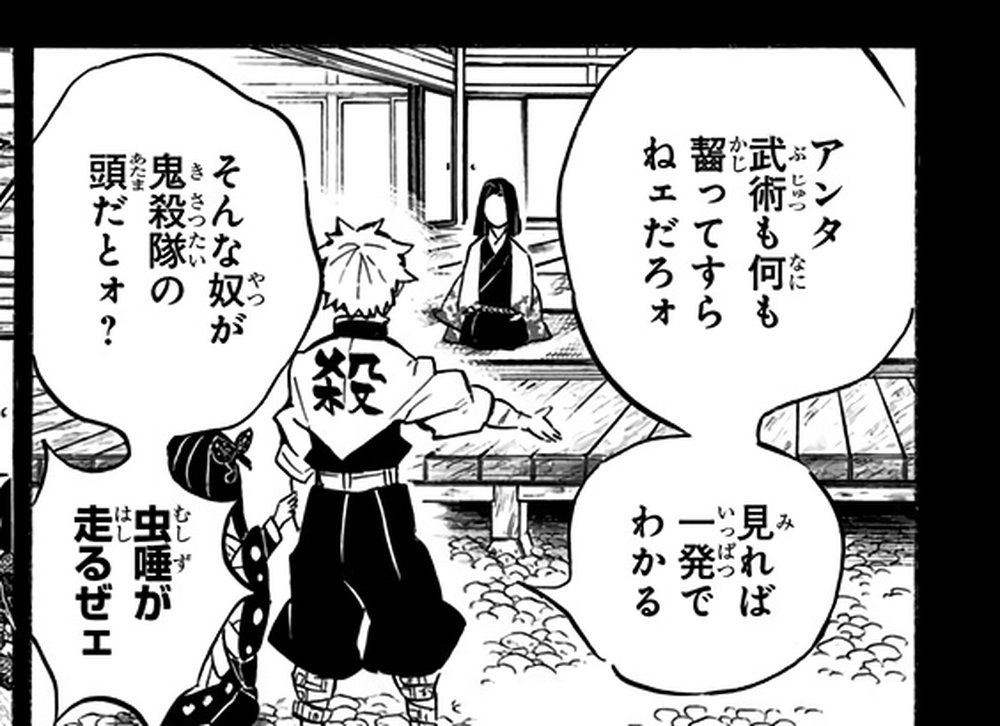
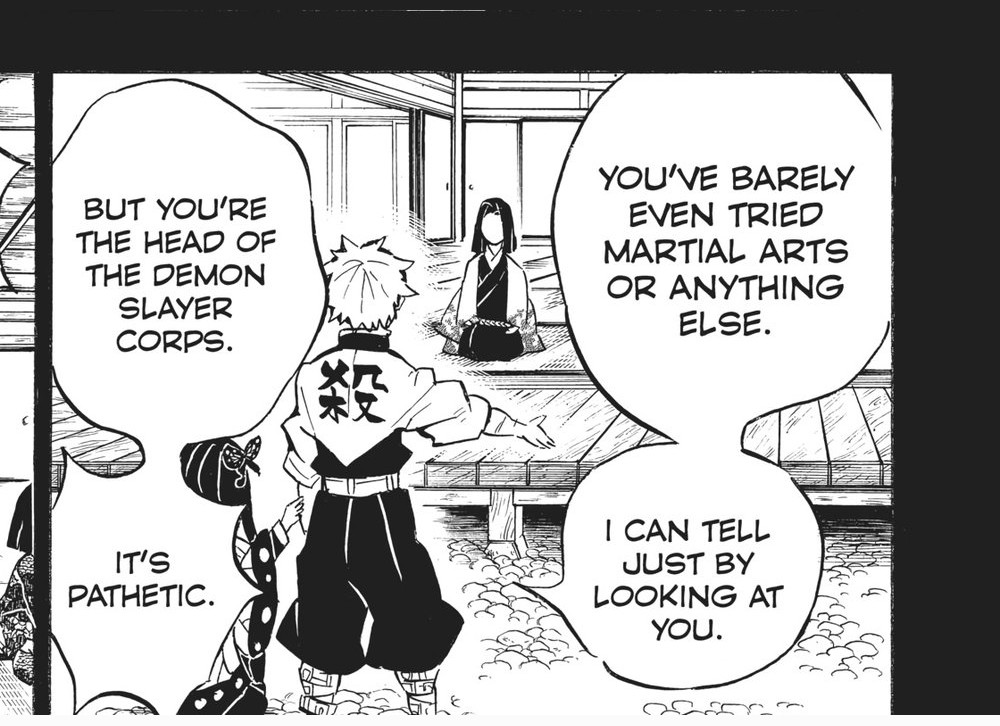
Volume 19, the Hashira Meeting. Sanemi Shinazugawa — the Wind Hashira, scarred, permanently furious — has been given the floor in front of Corps leader Ubuyashiki Kagaya, and he is using it to say the thing every other Hashira is too disciplined to say out loud. You only think of Corps members as pawns to be used and tossed aside, he tells Ubuyashiki. You've barely even tried martial arts or anything else — I can tell just by looking at you. Gyomei tries to shut it down: 「不死川...口の利き方というものが わからないようだな...」 ("Shinazugawa… it appears you do not understand how to speak properly.") Kanae starts to object — "But, Master—" — and Ubuyashiki stops her instead of Sanemi: "I do not mind. Let him speak." So Sanemi keeps going, past the accusation that Ubuyashiki has never risked his own life, past the verdict that a man like that leading the Demon Slayer Corps is unbelievable, and lands on:
「虫唾が走るぜェ」
Mushizu ga hashiru zē.
VIZ's English edition prints, in the same panel: "IT'S PATHETIC." (Vol. 19, p.161.)
A bibliographic note before anything else, because it matters for anyone trying to look this line up: the bilingual database this project draws from ships this exact pair with a blank English field. That's not VIZ dropping the line — it's an alignment artifact. For a short stretch of pages around this scene, the Japanese and English tankōbon fall out of sync by exactly one page (an insert, a differently-paginated splash, something upstream of this project), so the automated pairing that usually lines up JP page 160 with EN page 160 has nothing to attach to on this page. We opened both editions directly, panel by panel, to find where the true line landed: Vol. 19, p.161 of the English edition, in the same panel position — Sanemi's back, the 「殺」 character on his haori, Ubuyashiki kneeling in the middle distance — as page 160 of the Japanese. Once you line the panels up rather than the page numbers, the match is unambiguous.
Grant the translation its due: "IT'S PATHETIC." lands with real venom. It's short, it's blunt, it's exactly the kind of two-word gut-punch a rough-spoken Hashira would throw at the end of a tirade, and English readers get every bit of Sanemi's contempt. What they don't get is the idiom underneath it — because 虫唾が走る isn't contempt stated as an opinion. It's contempt reported as a symptom.
The Original
虫唾が走る breaks into three pieces. 虫 (mushi) is "bug" or "insect" — but in Japanese folk anatomy it's also the name for a resident inside the body, something with its own will that produces states the conscious self doesn't choose. 唾 is written here with the irregular reading ず (its ordinary readings are つば, "spit," kun-yomi, or ダ on-yomi) standing in for "saliva." And 走る is "to run" — not walk, not appear, run, the same verb you'd use for a sprinter or a rumor, a sensation crossing the body under its own power.
The more transparent spelling, and arguably the historically prior one, is 虫酸(むしず)が走る, where the second kanji is 酸 (su, rendaku-shifted to zu) — "sour, acid." That version names the thing actually said to run: not spit but the sour stomach reflux that climbs into your throat when disgust turns physical, the same acid a doctor would ask about if you complained of heartburn. 虫唾 is a folk re-spelling of the same word, quietly trading "acid" for the more familiar, more visceral "spit" while keeping the identical reading — both forms are standard in modern print, and Sanemi's line in Volume 19 happens to use the 唾 spelling, while all three other occurrences in this article use 酸. Same word, same idea, two accepted kanji.
That idea belongs to a whole family. 疳の虫 (kan no mushi, "the tantrum-bug") was the traditional explanation for a screaming, inconsolable baby — a diagnosis that came with its own folk remedy, 虫封じ (mushi-fuji), a shrine ritual to seal the bug away. 腹の虫 (hara no mushi, "the belly-bug") growls when you're hungry (腹の虫が鳴る) and refuses to settle when you're too angry to let something go (腹の虫が治まらない). 虫の居所が悪い (mushi no idokoro ga warui, literally "the bug's whereabouts are bad," 居所 being a real bureaucratic word for current address) is simply a foul mood, filed as the bug having relocated somewhere unpleasant. None of this is dead metaphor to a Japanese speaker any more than "gut feeling" is dead metaphor in English — it's just the inherited vocabulary for a reaction that comes from below conscious control. 虫唾が走る is the disgust-specific branch: the bug's own sour secretion, in motion.
Keep one more idiom in view for later, because English is about to reach for it by accident: 鳥肌が立つ (tori-hada ga tatsu, "bird-skin stands up") is Japanese's actual goosebumps idiom — the chill of fear, cold, or a different flavor of revulsion, filed under skin rather than gut. Japanese keeps the two reactions, and the two organs, apart.
Grammatically, the headline line is almost nothing: bare noun, が, intransitive verb — 虫唾が走る, "the bug-acid runs." No object, no stated target; the disgust is just happening, weather inside a body. What turns dictionary vocabulary (one corpus annotation grades it N2) into an insult aimed at a specific man is the ぜェ Sanemi tacks on — ぜ, the blunt masculine sentence-ender of turf disputes and back rooms, stretched into a snarl by the small-katakana ェ that manga uses to spell contempt out loud.
VIZ's Choice
Four appearances of 虫唾/虫酸が走る turn up in the volumes on file — two from the demon Akaza, applying the phrase to weakness itself, one from Sanemi aimed at Ubuyashiki, and one from a dying Muzan aimed at Tanjiro:
| Vol. / p. | Speaker | Japanese | VIZ English |
|---|---|---|---|
| 8 / 33 | Akaza | 弱者を見ると虫酸が走る | WHEN I SEE WEAKNESS, MY SKIN CRAWLS. |
| 17 / 126 | Akaza | 弱者には虫酸が走る反吐が出る | WEAKLINGS MAKE ME SICK. |
| 19 / 161* | Sanemi Shinazugawa | 虫唾が走るぜェ | IT'S PATHETIC. |
| 22 / 86 | Muzan | ......虫酸が走る | …TANJIRO KAMADO. |
(English page; see the alignment note above — the Japanese original is on p.160.)
Read down that right-hand column and no two solutions match. That's diagnostic on its own — a phrase with no fixed seat in English — but the Akaza rows are the more interesting pair, because they're the same character voicing the same worldview twice. On the Mugen Train, meeting Rengoku for the first time, Akaza states his creed as fact: "WHEN I SEE WEAKNESS, MY SKIN CRAWLS." Nine volumes later, in the flashback that finally explains where that creed came from, young Akaza states it again almost verbatim — 弱者には虫酸が走る反吐が出る, "weaklings make my acid run, make me retch" — and his teacher spends the rest of the page refuting it, panel by panel: everyone starts as a helpless baby; you did too, Akaza. VIZ renders the second instance as the plainer "WEAKLINGS MAKE ME SICK." — accurate to the emotion, silent on the organ, and not obviously the same line as "MY SKIN CRAWLS" nine volumes earlier. A reader tracking Akaza's philosophy across the story loses the fact that he says the identical idiom both times.
"MY SKIN CRAWLS" deserves a closer look on its own terms, because it's the one rendering here that keeps a body in the sentence at all — it's simply the wrong body part for this idiom, on loan from 鳥肌が立つ instead. And the Muzan line is its own case study in restructuring rather than mistranslation: VIZ folds three Japanese bubbles (どちらが鬼か/わからないな竈門炭治郎/......虫酸が走る — roughly "Which one's the demon? I can't tell anymore, Tanjiro Kamado…") into one flowing English sentence spread across three bubbles ("YOU LOOK… POSITIVELY AWFUL… TANJIRO KAMADO."). The philosophical question — which of us is the monster now — disappears in favor of a comment on appearance, and 虫酸が走る's own bubble is reduced to the bare vocative, its disgust folded backward into "positively awful" two bubbles earlier.
The Gap
The headline line drops the body entirely. "IT'S PATHETIC." is Sanemi handing down a verdict about Ubuyashiki from the outside. 虫唾が走る is a report from the inside — acid rising in Sanemi's own throat, whether he wills it or not. Trading a symptom for an opinion changes what kind of sentence this is: not this disgusts me, physically, involuntarily, but this is bad, a judgment he's chosen to make.
Where the body does survive, it's the wrong organ. "MY SKIN CRAWLS" is vivid, physical, and still misses: it's the language of 鳥肌が立つ, Japanese's own goosebumps idiom, filed under skin and chills rather than gut and acid. English collapses two idioms that Japanese keeps carefully separate into one borrowed image.
The 虫 disappears every time. "Skin crawls," "make me sick," "pathetic," "positively awful" — not one of the four renderings is wormy, insectile, or otherwise hints that a bug is involved. A reader who meets 腹の虫 or 虫の居所が悪い elsewhere in translation has no way to recognize 虫唾が走る as a relative; the whole folk-physiological system that makes these four idioms make sense together is invisible from the English side.
One character, one repeated line, two unrelated translations. Akaza's twin uses of the idiom — one on the Mugen Train, one in his own flashback — are VIZ's best chance to let a translation choice recur and rhyme. Instead "MY SKIN CRAWLS" and "WEAKLINGS MAKE ME SICK" read as two different thoughts, and the small motif of a fixed idiom for a fixed obsession quietly dissolves.
What If
No option here is free; here's the register and the price of each.
- "It turns my stomach." — keeps the organ of disgust in the gut, physical rather than judgmental. Cost: loses 走る's sense of a reaction arriving, in motion; "turns" sits still where the Japanese verb runs.
- "It makes my gorge rise." — the closest image-for-image match English owns: "gorge" is old-fashioned English for the throat, and the whole idiom is built on the identical rising-reflux picture as 虫唾が走る. Cost: "gorge" is a museum word in a modern speech bubble; most readers would need a gloss.
- "Just looking at him makes me want to retch." — explicit, visceral, aimed squarely at Ubuyashiki the way Sanemi's line is. Cost: retching is a stronger, more graphic image than casual Japanese usage of the idiom typically carries — it tips contempt into spectacle.
- Keep VIZ's contempt, restore an organ: "Just looking at him turns my stomach." — Cost: still not the throat-acid picture specifically, but it puts the reaction back inside Sanemi's body instead of exporting it entirely to a bare moral verdict.
Take-away
虫唾が走る is small, N2, and utterly unremarkable to a Japanese reader — right up until you notice that English has no organ standing by to receive it, and every VIZ rendering on file solves that problem a different way: by dropping the body, by borrowing the wrong body part, or by folding the disgust into a nearby line and moving on.
Three rules of thumb to carry off this page:
- When a Japanese idiom names a 虫, look for its relatives before you translate it in isolation. 虫唾が走る, 腹の虫, 疳の虫, and 虫の居所が悪い are one folk-physiological system, not four unrelated phrases — and English usually has to break that system apart to render any single piece of it.
- A vivid English body image isn't proof of an accurate translation. "My skin crawls" is real, physical, disgusted language — and still the wrong idiom's organ, borrowed from 鳥肌が立つ rather than 虫唾が走る.
- Watch for a single character's fixed phrases losing their fixedness in translation. When Akaza repeats himself across nine volumes, that repetition is characterization; if the English renderings don't repeat too, the throughline is only visible to readers of the original.
For two more Demon Slayer idioms that put an internal organ in charge of an emotion English hands off to a plain adjective, see 肝が据わる・腰を抜かす and the anatomy English flattens to adjectives and 鼻が利く and the object English demands; for the idiom that reads a face rather than a stomach, see 顔色 and the complexion English stops reading. Outside this work, the same 虫 that powers 虫唾が走る shows up renamed and relocated in 虫の居所が悪い, over on the One Piece hub — and in 腹の虫, the belly-bug that growls and refuses to settle, in the Naruto volumes. Browse more of these on the Demon Slayer translation notes index.
Every Japanese line quoted above is a byte-exact capture from the cited Japanese editions — Demon Slayer: Kimetsu no Yaiba Vol. 8, 17, 19 & 22 — via our bilingual page database. The VIZ English lines for the headline occurrence (Vol. 19, p.161) and the Muzan occurrence (Vol. 22, p.86) were confirmed directly against VIZ's printed page images rather than the database's automated pairing, for the reasons explained above; see Sources and References below.