The Moment
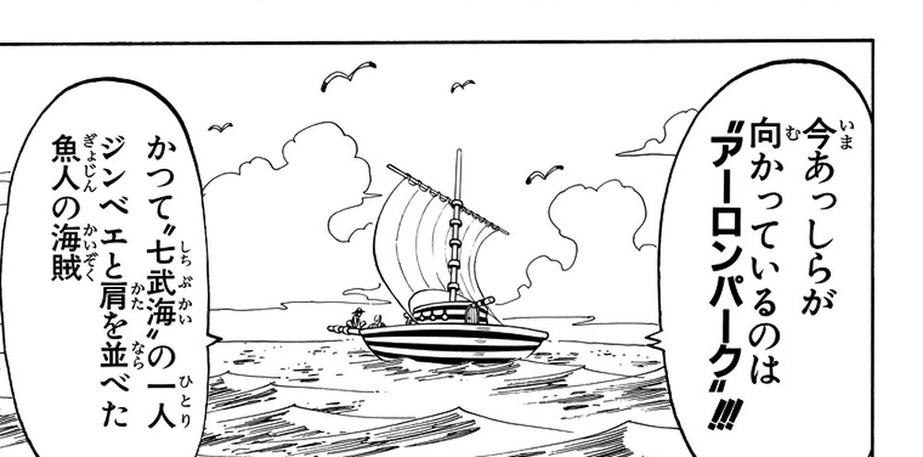
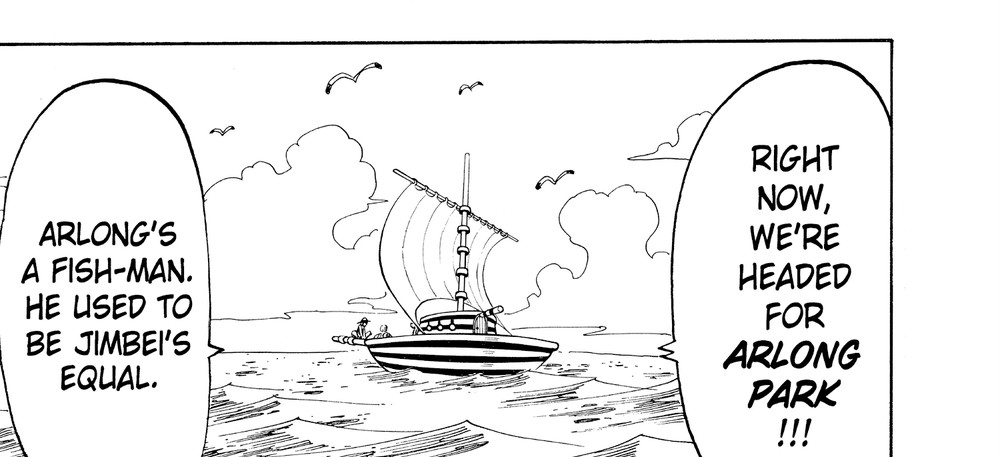
Nami has just told Luffy's crew what a Warlord of the Sea is — and named Jinbei, leader of the Fish-Man Pirates, as one of the seven. Two pages later, on the same slow sail toward Arlong Park, she finishes the résumé for the fish-man they are actually about to meet: 「魚人海賊団の頭"ジンベエ!!」, "JIMBEI, THE LEADER OF THE FISH-MAN PIRATES!!" Then, over a wide, wordless panel of the little sailboat crossing open water — no faces, just gulls and cloud and a bare hull — her voice-over lands the threat assessment:
「かつて“七武海”の一人ジンベエと肩を並べた魚人の海賊」
Katsute “Shichibukai” no hitori Jinbei to kata o narabeta gyojin no kaizoku.
VIZ's English edition prints: "ARLONG'S A FISH-MAN. HE USED TO BE JIMBEI'S EQUAL." (Vol. 8, p.133.)
Grant the rendering its due first: it's brisk, it reads like something a crewmate would actually say aloud while briefing her captain, and "equal" gets the load-bearing fact exactly right — Arlong once stood on the same level as one of the strongest pirates sailing under government sanction. VIZ even earns a small compression credit: by page 133 the reader already knows Jinbei is a Warlord, since Nami said so two pages earlier, so dropping “七武海”の一人 here isn't laziness, it's economy.
But look at the verb Japanese actually reached for. Not 対等だった ("was his equal"), not 匹敵した ("rivalled him") — 肩を並べた, "lined up shoulders with him." The sentence pictures two bodies standing at the same height, side by side, close enough to compare. English has an idiom built from the identical picture — "stood shoulder to shoulder" — sitting right there, unused. "EQUAL" reports the outcome of the comparison and skips the comparison itself.
The Original
肩を並べる (kata o naraberu) is two ordinary words doing an extraordinary job together.
肩 (kata) is simply "shoulder" — the same 肩 in 肩こり (kata-kori, stiff shoulders, the national office ailment), 肩身 (kata-mi, one's standing or face, literally "shoulder-body"), and dozens of idioms that use the shoulder as a stand-in for a person's bearing in the world.
並べる (naraberu) is "to line up, to arrange side by side" — the transitive partner of the intransitive 並ぶ (narabu), "to stand in a row." You 並べる books on a shelf, chairs in a room, dishes on a table: things placed level, in a series, for comparison or display.
Put the two together and 肩を並べる pictures exactly what it says: two people standing close, shoulders at matching height, nobody's higher than the other's. From that literal tableau the idiom generalizes into pure metaphor — to be equal to, to rival, to hold a position on par with someone — in ability, rank, achievement, reputation. A rookie company 大手と肩を並べる, "ranks with the industry giants"; an athlete 世界の強豪と肩を並べる, "stands level with the world's best." Arlong once did this with Jinbei — stood, figuratively, close enough that no one's shoulder sat higher.
Grammar-wise the line offers nothing exotic: [PERSON と] 肩を並べる[た], "lined up shoulders with [person]" — a plain transitive verb taking と for the comparison partner, the same pattern as 戦う ("to fight with") or 話す ("to talk with"). What makes the idiom worth an article isn't its difficulty — most JLPT wordlists place it comfortably at N2, solidly intermediate — it's that English owns a phrase built from the exact same image, and, as the next section shows, almost never reaches for it at the moment that would matter most.
VIZ's Choice
肩を並べる surfaces exactly once in the One Piece volumes on file, in Nami's line above — no second data point inside this series to chart against it. But the idiom is common enough that Demon Slayer's corpus, volumes later, gives VIZ's translators two more chances at the same image, and neither answer matches the other, let alone Nami's.
The first is Giyu Tomioka's self-indictment, deep into Volume 15. Tanjiro has spent days pressing the reluctant Water Hashira to explain why he refuses the title, and Giyu finally lays out the arithmetic in full: 「俺は水柱になっていい人間じゃない」 — "I'M NOT WORTHY OF BECOMING THE WATER HASHIRA." — because he survived Final Selection only by being saved, not by killing a single demon himself. Then the verdict: 「そもそも柱たちと対等に肩を並べていい人間ですらない」 — VIZ: "I CAN'T EVEN STAND SHOULDER TO SHOULDER WITH THE HASHIRA." Here, finally, is the idiom English also owns, deployed for the idiom Japanese used. And it is a genuinely strong rendering — "shoulder to shoulder" carries real force in Giyu's mouth, a man auditing his own right to stand among his peers.
The second data point complicates the first. Two volumes on, mid-duel between Zenitsu Agatsuma and his former fellow disciple Kaigaku — now a demon, and losing — Zenitsu lands the technique he has invented in the heat of the fight itself, and as he does, tells the man he is about to defeat: 「お前にだけ教えて俺に教えなかった」「やっぱりあの爺贔屓しやがったな!!」, Kaigaku's own rage moments earlier — "HE ONLY TAUGHT YOU! HE DIDN'T TEACH ME!" — has already set up the wound between them. Zenitsu's answer, mid-strike: 「いつかアンタと肩を並べて戦いたかった…」 — literally, "I wanted, someday, to fight alongside you, as equals…" VIZ: "...I WANTED TO FIGHT YOU AS AN EQUAL!" "Alongside" — the one word carrying the entire idea of standing together rather than standing opposite — is the word that goes missing.
Three occurrences, three unrelated English solutions: a bare adjective ("equal"), a kept idiom ("shoulder to shoulder"), and a phrase that quietly reverses the image's direction ("fight you" instead of "fight alongside you"). No pattern connects them, because for the translators handling each line, there wasn't one to preserve — 肩を並べる doesn't read as a fixed, recognizable unit needing a fixed, recognizable English answer. It reads as a sentence to be solved locally, and gets solved three different ways.
The Gap
English had the matching idiom sitting right there, and the translator reached past it. Arlong's introduction is the one occurrence in this corpus where 肩を並べる and "shoulder to shoulder" line up perfectly — same body part, same posture, same comparison. VIZ's "EQUAL" isn't wrong, but it trades a manga's favorite trick — making rank and strength almost physically legible — for a flat adjective, in the one sentence built specifically to avoid being a flat adjective.
When the idiom does survive, it imports a connotation Japanese never asked for. "Shoulder to shoulder" in English defaults to solidarity — soldiers in close formation, allies backing each other up, the phrase's own military ancestry showing through. 肩を並べる, especially fenced by 対等に ("as equals," Giyu's own qualifier), is pure rank-comparison — a measurement, not an alliance. Giyu isn't saying he can't fight beside the Hashira; he's saying he doesn't belong on their scoreboard. "STAND SHOULDER TO SHOULDER WITH" is an excellent English sentence that quietly answers a slightly different question than the one Giyu is asking himself.
One dropped word flips the image's direction entirely. 肩を並べて戦う ("to fight side by side, as comrades") is the one construction where Japanese and English genuinely mean the same thing — both languages picture allies, not rivals. Zenitsu's 「いつかアンタと肩を並べて戦いたかった」 is exactly that: a wish for comradeship with the boy who once trained beside him. VIZ's "I WANTED TO FIGHT YOU AS AN EQUAL!" drops "alongside" and, without changing a single fact on the page, turns a mourning for lost partnership into something that reads like a wish for a duel — which, cruelly, is precisely what the two of them are doing as the line is spoken. The English sentence is true to the scene (they are fighting) and false to the wish (he wanted the opposite of this).
Across all three, the idiom never once reads as a fixed unit in English. A Japanese reader meets 肩を並べる in a narrator's exposition, a Hashira's confession, and a demon-duel's dying regret, and recognizes, each time, the same idiom doing the same rank-comparison work. An English reader meets "equal," "shoulder to shoulder," and "fight you as an equal," with no way to know a single Japanese phrase produced all three — the pattern that would let a reader feel two different authors reaching for the same image stays invisible on the English side.
What If
For Nami's headline line specifically, the menu and its prices:
- "Arlong's a fish-man — a pirate who once stood shoulder to shoulder with Jinbei." — recovers English's own matching idiom and keeps the physical image intact. Cost: "shoulder to shoulder" nudges an English reader toward reading Arlong and Jinbei as allies or comrades, which they never were — the Japanese claims parity of rank, not partnership.
- "He used to rank with Jinbei, one of the Seven Warlords." — "rank with" is a plain, under-used English collocation that states pure parity with no physical image at all, closer to the idiom's actual job in this sentence. Cost: "rank with" reads a shade formal and dated next to Nami's brisk crew-briefing voice.
- "Arlong's a fish-man who once held his own against Jinbei." — keeps a competitive, embodied flavor and sounds natural in English. Cost: "held his own against" implies an actual contest or fight between them, an adversarial note the Japanese doesn't supply — 肩を並べる measures standing, not combat.
- Keep VIZ's plain "EQUAL," restore the image with one word: "HE USED TO STAND AS JIMBEI'S EQUAL." — Cost: "stand as" gestures faintly at the physical posture the idiom depends on, but the shoulder itself, and the felt sense of two bodies measured side by side, is still gone.
Take-away
肩を並べる isn't hard to translate — "equal," "on par with," "rival" all get the fact across, every time. What's hard to translate is the decision buried inside the word: Japanese chose to say "equal" through a body, and English, even when it owns the identical body-idiom, keeps reaching past it.
Three rules of thumb to carry off this page:
- When you meet 肩を並べる, resist collapsing it straight to "equal" in your head — picture the two shoulders first. The idiom is doing image-work, not just stating a rank, and English's own "shoulder to shoulder" is available precisely when the sentence wants that image kept.
- Watch what "shoulder to shoulder" adds in English before you reach for it: solidarity, alliance, a shared fight. If the Japanese sentence is measuring rank rather than describing partnership — especially under 対等に — a plainer "on par with" or "rank with" may track the original more closely than the flashier idiom does.
- When 肩を並べる is paired with 戦う ("to fight"), don't lose "alongside" in translation — 肩を並べて戦う means fighting with, never fighting against, and the one word standing between comradeship and combat is exactly the word most likely to get dropped under a bubble's word count.
肩 turns up across this hub wherever Japanese measures a person by their bearing — see the liver English relocates to the gut in 肝っ玉, the missing hand-and-foot idiom in 手も足も出ない, and the heartbeat VIZ turns into a shrug in 胸が高鳴る — three more body parts doing quiet metaphorical work English answers with plain description. For more of them, browse the One Piece translation notes index.
Every Japanese and English line quoted above is a byte-exact capture from the cited editions — ONE PIECE Vol. 8 (Japanese) and One Piece (VIZ Media) at the corresponding panels, plus 鬼滅の刃 Vol. 15 & 17 for the Demon Slayer comparison — via our bilingual page database; see Sources below.