The Moment
Team 7's disaster in the Forest of Death has reached its floor. Sasuke, bitten by Orochimaru and carrying a cursed seal he doesn't understand yet, has just gone berserk against one of the Sound Genin and collapsed. Naruto is out cold beside him. Rock Lee, who tried to help, has been beaten down too. Two Sound-village enemies are circling what's left of the team, and Sakura — the only one left on her feet — can't make her body obey her:
「体の力が入らない...」
Karada no chikara ga hairanai…
VIZ: "CAN'T SUMMON ANY STRENGTH..." (Vol. 6, p.161).
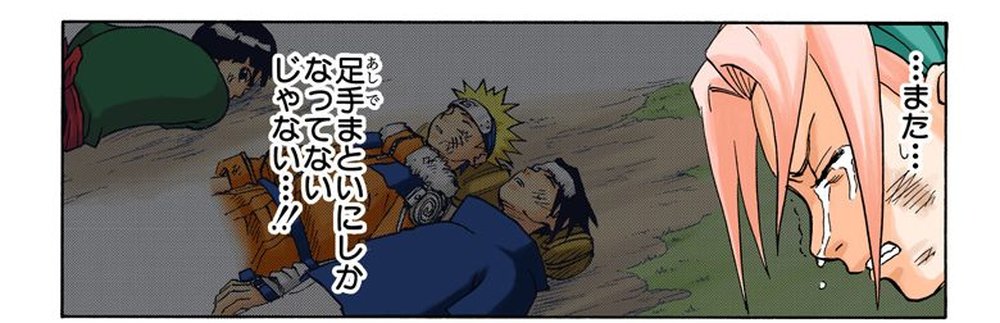
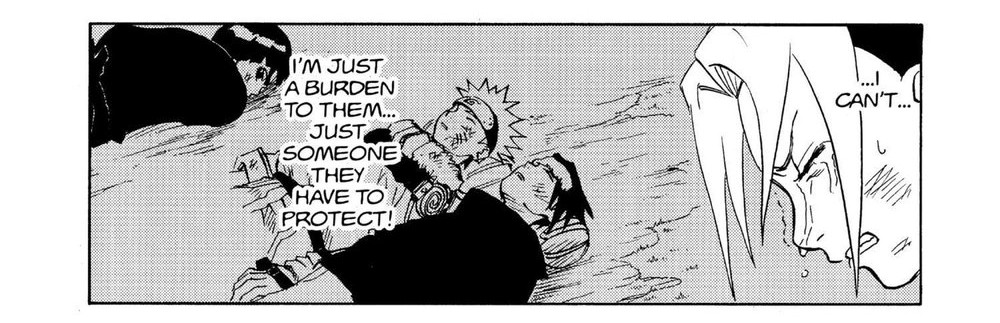
One of the Sound Genin threatens to have her partner finish Sasuke off — right in front of Sakura, right now, as entertainment. Sakura does the one thing she still can: she grabs a kunai and cuts off her own hair rather than let an enemy grab it and use it against her. It costs her something she's vain about and nothing she can't afford to lose, and it works. The panel that follows shows the aftermath — Naruto and Sasuke still unconscious on the ground behind her, cut hair scattered in the dirt, Sakura kneeling with tears on her face:
「...また...」
…Mata…
VIZ: "...I CAN'T..."
And then, in the same breath, the line this article is about:
「足手まといにしかなってないじゃない...!」
Ashidematoi ni shika natte nai janai…!
VIZ's English edition prints: "I'M JUST A BURDEN TO THEM... JUST SOMEONE THEY HAVE TO PROTECT!" (Vol. 6, p.162.)
Give this rendering its due, because it earns it. "Burden" is accurate. "Someone they have to protect" isn't padding — it correctly unpacks what Sakura means, foreshadowing the resolve she finds three panels later, when she agrees to fight anyway. An English reader understands exactly what Sakura feels and exactly why. What that reader can't see is what she actually said. 足手まとい isn't an abstraction meaning "burden." It's a picture — rope wound around hands and feet — and the picture never makes it across.
The Original
Take 足手まとい (ashidematoi) apart, because it's built from parts a first-year student already owns.
足手 (ashide) is 足 (ashi, "foot, leg") plus 手 (te, "hand, arm"), fused into one compound noun for "the limbs" — te voices to de by rendaku, the same sound-shift Japanese compounding does constantly (逆手, 縄手, and dozens more). Both kanji are first-year vocabulary; nothing exotic yet.
まとい is the noun form of 纏う (matou), "to wind [something] around, to wrap, to drape" — the verb behind 身に纏う (mi ni matou, "to have draped over the body," said of clothes or an aura) and 纏わりつく (matowaritsuku, "to cling to, to coil around," said of vines, smoke, or a clingy little sibling).
Put the two pieces back together and 足手まとい pictures exactly what it says: something wound around your hands and feet. Not a weight on your back, not baggage in your arms — a tangle at the exact four points a body uses to move. A person who is 足手まとい isn't just heavy to carry; they're rope on the ankles, the reason the whole group's stride breaks.
One orthographic note worth keeping: 纏 sits outside the Jōyō kanji list Japan teaches through high school. Fluent adults can read it, but the word is almost never printed 足手纏い — it shows up as 足手 in kanji and まとい in hiragana, which is exactly how all nine hits in this article's corpus print it (our search specifically included the kanji form 足手纏 to catch any exception; there wasn't one). The related verb 纏める (matomeru, "to gather together, to bring to a conclusion") comes from the same root image — many strands, bound into one — which is a useful way to think about 纏う: it's the verb for binding things together, and 足手まとい is what happens when the thing it binds is your own limbs.
Grammatically the word sits as a noun: 〜を足手まといだと決めつける ("to write someone off as a burden"), 足手まといになる ("to become a burden"), 足手まといにしかならない ("to be nothing but a burden"). No JLPT list carries it officially; call it N2-territory vocabulary assembled from two N5 kanji wrapped around a word most learners never see spelled with its own kanji.
VIZ's Choice
Every appearance of 足手まとい on file across the volumes we have, speaker included:
| Vol. / p. | Speaker | Japanese | VIZ English |
|---|---|---|---|
| 1 / 20 | Iruka, to Mizuki | しかしナルトの場合はたった一人...しかも足手まといを増やしているだけです | NARUTO ONLY PRODUCED ONE, AND HE DID IT VERY BADLY. |
| 2 / 13 | Kakashi, of Sasuke | サスケ!お前は2人を足手まといだと決めつけ | AND SASUKE HAD ALREADY DECIDED THAT THE OTHER TWO JUST GOT IN HIS WAY... |
| 2 / 19 | Sasuke, to Naruto | 足手まといになられちゃこっちが困るからな | YOU'RE NO GOOD TO ME IF YOU'RE JUST GOING TO BE A LIABILITY. |
| 3 / 197 | Sasuke, to Naruto | ...まったく...お前は...いつまでたっても...足手まといだぜ... | SHEESH... NO MATTER HOW MANY TIMES I WARN YOU, NARUTO, YOU STILL KEEP GETTING IN MY WAY... |
| 6 / 75 | Sakura, of Naruto | 足手まといかもしんないけど | AND SOMETIMES HE'S A BIG NUISANCE, BUT AT LEAST HE'S GOT GUTS! |
| 6 / 162 | Sakura, of herself | 足手まといにしかなってないじゃない...! | I'M JUST A BURDEN TO THEM... JUST SOMEONE THEY HAVE TO PROTECT! |
| 13 / 178 | Orochimaru, to the Third Hokage | アナタにとっては足手まといに入ってこられる方がやりにくいでしょう | BESIDES, YOU WOULDN'T WANT ANYONE TO INTERFERE AND GET IN THE WAY, WOULD YOU?! |
| 20 / 72 | Naruto, of himself | 足手まといじゃねーぜ | ...SLOWING EVERYBODY DOWN. |
| 24 / 156 | Rock Lee, of himself | まだ...体が...これじゃかえって足手まといだ... | MY BODY'S STILL... I'LL ONLY GET IN THE WAY... |
(One alignment note: Vol. 6 p.75's English line runs inside a single continuous speech balloon that also carries the preceding "HE'S CLUMSY, AND HE HOLDS US BACK..." and the following "NARUTO'S NO COWARD!" — VIZ merged several Japanese bubbles into one flowing English sentence there, so the row above reflects the corpus's own pairing, not a clean one-to-one bubble match. The panel itself is confirmed: Sakura, mid-cry, defending Naruto to Sasuke during his cursed-seal rampage.)
Nine appearances, eight different English strings. Read down the column and a pattern surfaces immediately: four of the nine — Vol. 2 p.13, Vol. 3 p.197, Vol. 13 p.178, Vol. 24 p.156 — land on some version of "in the way." That's VIZ's real default for 足手まとい, more common than "burden" itself. But "in the way" is a generic phrase for obstruction, not a translation of this specific idiom — it's what a translator reaches for when no single English word fits, and it works precisely because it's vague enough to cover almost anything.
Notice, too, what the table can't show on the page but the story remembers: the same character says this word twice, to the same person, in opposite circumstances. In Vol. 2, Sasuke ties Naruto to a stake and tells him flatly he'll be a liability. In Vol. 3, three volumes and one near-death experience later, Sasuke says almost the identical sentence — 足手まといだぜ, "you're still getting in my way" — while standing over Naruto's unconscious body with a leg full of senbon needles he took meant for him. The word hasn't changed. Everything around it has. English's "liability" and "getting in my way" happen to land far enough apart that an attentive reader might not register these as the same idiom recurring — which quietly erases one of the manga's better character beats: Sasuke's insults are load-bearing affection, and 足手まとい is the specific insult he keeps recycling to say it.
The Gap
The limbs disappear. 足手まとい pictures rope wound around hands and feet; "burden," "liability," "nuisance," and "in the way" are pure abstractions, a verdict with no body attached. Every one of the nine renderings is defensible sentence by sentence. None of them shows a single hand or foot.
Convergence erases the callback. Four separate scenes collapse toward "in the way," a phrase generic enough to fit a dropped grocery bag as easily as a life-or-death teammate. That vagueness is exactly why it's useful to a translator working panel by panel — and exactly why it can't preserve the fact that this is one word doing one specific job, again and again, across arcs and speakers who never talk to each other.
Register drops out with the particles. Sasuke's だぜ and Naruto's じゃねーぜ are rough, masculine bravado — the verbal swagger of someone who'd rather insult you than admit he's worried. Sakura's にしかなってないじゃない…! is the grammar of a private accusation turned on herself, じゃない here working as a rhetorical tag rather than a negation. English collapses both into plain declarative sentences and exclamation points; the swagger and the self-accusation end up reading in almost the same voice.
The word can vanish outright. In Vol. 1, しかも足手まといを増やしているだけです — "and what's more, he's just increasing the number of ashidematoi" (the clone Naruto managed barely counts; it's practically a liability rather than a completed jutsu) — compresses to "AND HE DID IT VERY BADLY." True, but it deletes the specific, almost comic image of a failed ninjutsu literally manufacturing more burdens instead of the doppelgängers it was supposed to.
What If
For Sakura's line, the menu and its cost:
- "Aren't I just a rope around their ankles…!" — keeps the tangled-limb picture audible and explicit. Cost: no English precedent for this metaphor; the reader has to build the image from scratch mid-panel, which risks confusion in a scene that needs to land fast.
- "I'm nothing but dead weight tied to them…!" — "tied" at least gestures at binding. Cost: "dead weight" means inert mass in English, not limbs that trip a group's stride — the tangle becomes a lump.
- "All I ever do is hold them back…!" — plain, idiomatic, and consistent with how VIZ renders the same word elsewhere in this corpus. Cost: no trace of the body survives at all.
- Keep VIZ's "burden," cut the added clause: "I'm just a burden to them…!" — Cost: tighter to the Japanese's one-clause self-accusation, but the limbs are still gone; this preserves the register, not the picture.
Take-away
足手まとい is what Japanese says instead of "burden" when it wants you to feel the rope, not just carry the weight. Nine times on file, the word gets aimed by a teacher's verdict, a rival's put-down, a snake-eyed enemy's needling, and — increasingly, as the manga goes on — a character's own fear about themselves. English gets every meaning and none of the rope.
Three rules of thumb to carry off this page:
- When Japanese names hands and feet before naming a verdict, expect the verdict to survive translation and the body not to. 足手まとい here, 手も足も出ない in One Piece, 歯が立たない elsewhere on this hub — Japanese keeps reaching for anatomy that English keeps quietly amputating.
- Track 纏う's family (纏う, 纏める, 足手まとい) as one idea: binding many strands into one — sometimes tidy (纏める), sometimes literally hobbling (足手まとい). Same root, opposite feelings, depending on whether the thing being bound wants to be.
- When a word recurs across a manga's cast, read the recurrence as characterization, not repetition. Sasuke didn't run out of insults for Naruto; he kept the same one on purpose, and what changed between Vol. 2 and Vol. 3 is everything except the word.
Naruto keeps failing its characters through the body elsewhere on this hub: Rock Lee's own teeth give out in 歯が立たない, Jiraiya's hands can't hold what's in front of him in 手に負えない, Kabuto's mouth won't crack under torture in 口を割る, and somebody's bones are one twist from snapping — literally, not idiomatically — in 骨が折れる. One Piece runs the identical 手足 image through its own idiom, 手も足も出ない ("not even hands or feet come out") — same limbs, same helplessness, aimed inward instead of at a teammate. For the rest of what gets lost in translation across Konoha, browse the Naruto translation notes index.
Every Japanese and English line quoted above is a byte-exact capture from the cited editions — NARUTO―ナルト― Vol. 1, 2, 3, 6, 13, 20 & 24 (Japanese) and Naruto (VIZ Media) at the corresponding panels — via our bilingual page database; see Sources below.