The Moment
Loguetown — the town where Gold Roger was born and executed, the last stop before the Grand Line swallows every ship that enters it. The Straw Hats have spent the chapter running errands before the real trouble starts; a few pages earlier in this same volume, a blacksmith gave Zoro a sword for free, moved by a boy's insistence on chasing an impossible dream. Now, with a disturbance breaking out in the town square, a Navy officer is late to report for duty.
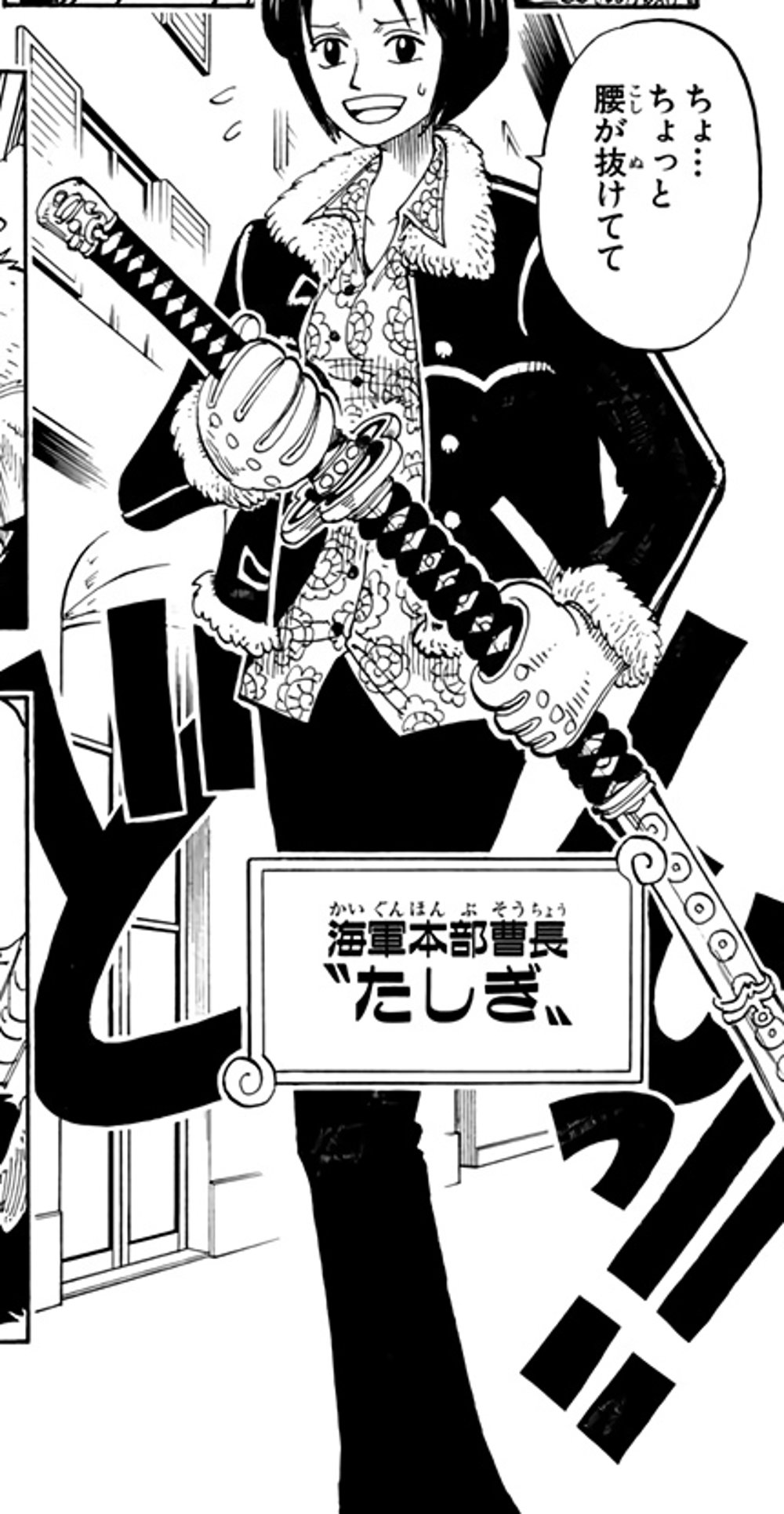
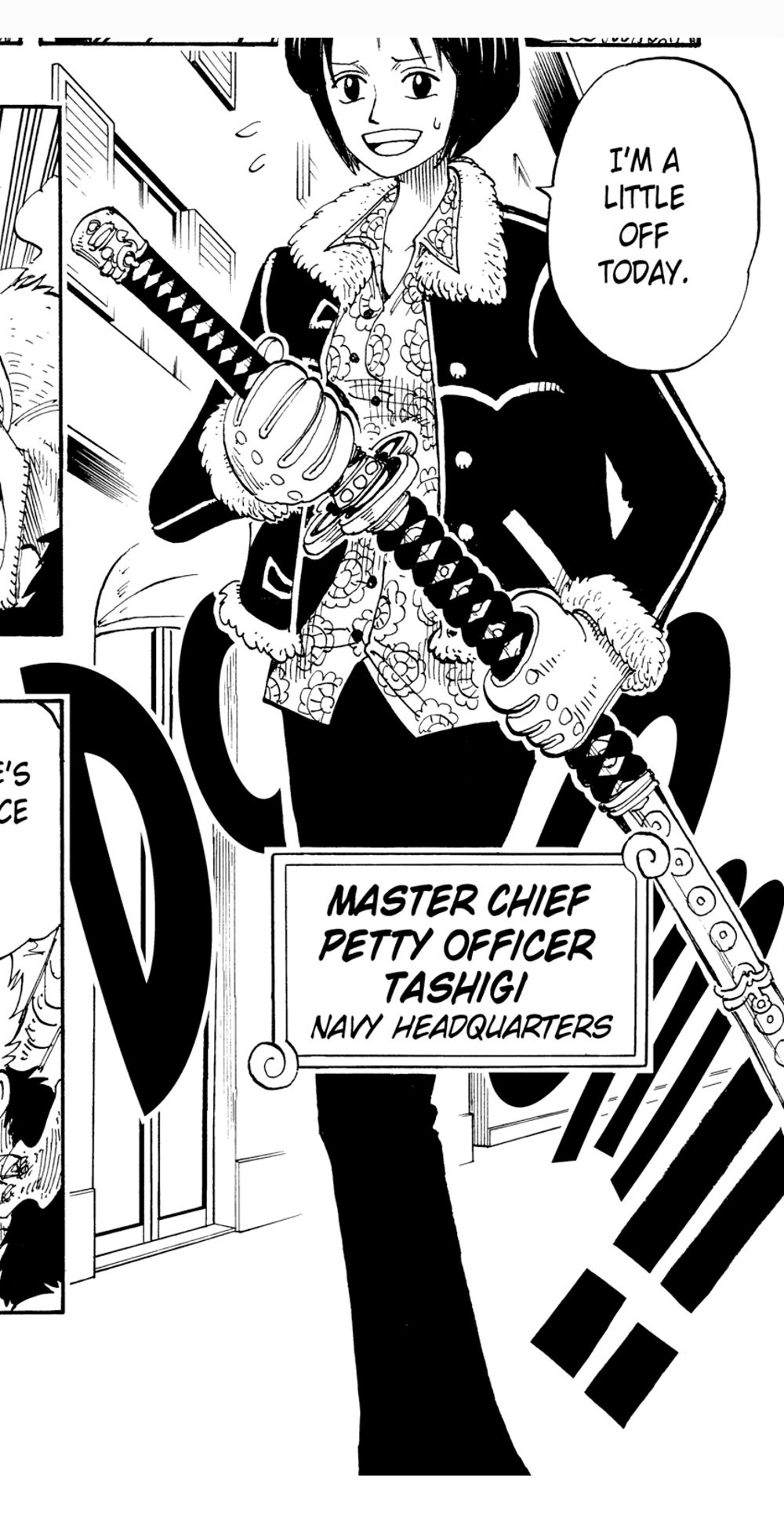
Master Chief Petty Officer Tashigi — the blade-obsessed young officer who spends most of her page time chasing Zoro over sword etiquette — comes sprinting into frame, breathless. 「たしぎィ!!!?てめェトロトロと何やってた!!!」 barks Captain Smoker — "TASHIGI!!!! WHERE HAVE YOU BEEN!!?" 「ご...ごめんなさいっ!!すぐ支度を」 she manages — "I'M SORRY!! I'LL GET READY RIGHT AWAY!" — before a colleague hands back her jacket and she offers a stammered excuse for whatever just knocked her off her feet:
「ちょ...ちょっと腰が抜けてて」
Cho… chotto koshi ga nuketete
VIZ's English edition prints: "I'M A LITTLE OFF TODAY." (Vol. 11, p.161).
Grant the rendering its due: it's a clean, idiomatic deflection, exactly the kind of vague non-answer an embarrassed subordinate gives a demanding captain. And Smoker's comeback lands hard either way:
「ヌケてんのは気合いだけじゃ足らねェのかっ!!!」
VIZ: "YOU MEAN MORE SO THAN USUAL!!?"
Good banter — but listen to the Japanese underneath it. Smoker doesn't just tease her; he reaches back and grabs her own verb. ヌケてんの (nuketen no) is 抜けている, the same 抜ける that just failed her hips, now aimed at her 気合い (spirit, focus): is it not just your concentration that's slipped loose, but your whole body too? The joke is a pun, built entirely on one verb doing two jobs in two consecutive lines. English keeps the joke's shape and loses its engine.
The Original
Take 腰が抜ける apart the way you'd take apart any two-part verb phrase, because both halves carry weight on their own.
腰 (koshi) is "hips, lower back" — not a niche body part but the pivot Japanese physical vocabulary never stops returning to: 腰を入れる ("put your hips into it," commit fully to a stance or a swing), 腰高 (a beginner's unstable, hips-too-high stance in judo or kendo), 腰の入った (a strike with real weight behind it). If Japanese has a physical seat of readiness, this is it.
抜ける (nukeru) is intransitive: "to slip out, come loose, fall away, go missing" — the same verb behind 気が抜ける ("the tension slips out": to let your guard down) and 力が抜ける ("the strength slips out": to go limp). Nothing breaks or tears; something that was properly seated simply stops being seated. Tashigi's exact form, 腰が抜けて(い)て — trimmed in speech to けてて — is the -te form plus an implicit いる: not a single snap but an ongoing state, "is in the condition of having slipped."
抜ける also has a transitive twin: 抜かす (nukasu), "to let something slip out." 腰を抜かす — the transitive, causative-flavored version, "to lose the use of one's hips" — is the more common everyday idiom for the full-body collapse of shock: what happens to old men who see ghosts and grandmothers who win the lottery. (It's the same phrase running through Demon Slayer's own hip-and-liver sentence about Mitsuri Kanroji's mother.) Whether the grammar leans intransitive (腰が抜ける, it just happens to you) or transitive (腰を抜かす, something knocks it out of you), the destination is identical: legs that stop being legs.
Freeze either version into a noun and you get 腰抜け (koshinuke), "the de-hipped" — no longer a one-time event but a standing verdict on someone's character. Three of this article's five occurrences use exactly that frozen noun, thrown as a bare insult with none of Tashigi's grammar left in it at all. None of this is exotic grammar — 抜ける is N4 vocabulary, 腰 is N5 — but the idiom's working frequency across shonen manga puts real fluency with it closer to N2.
VIZ's Choice
All five appearances of the verb phrase or its frozen noun in the volumes on file, in story order:
| Vol. / p. | Speaker | Japanese | VIZ English |
|---|---|---|---|
| 11 / 161 | Tashigi, reporting late to Captain Smoker (Loguetown) | ちょ...ちょっと腰が抜けてて | I'M A LITTLE OFF TODAY. |
| 11 / 142 | an unnamed swordsmith's wife, scolded mid-sentence (Loguetown) | 腰抜けて立てないや... | I- I CAN'T GET UP. |
| 16 / 32 | Zoro, cornering a fleeing enemy (Little Garden) | フン!!無駄だ腰抜けめっ!!! | HMPH!! RUNNING WON'T SAVE YOU, COWARD !!! |
| 20 / 191 | a Baroque Works agent, taunting Usopp over a false report of Luffy's death (Alabasta) | 船長も貧弱なら船員も腰抜けってわけかい...!! | HOW FITTING THAT A FEEBLE CAPTAIN LIKE YOURS WOULD HAVE A COWARDLY CREW!! |
| 25 / 114 | Sarquiss, mocking Luffy's wanted poster (Mock Town, Jaya) | てめェみてェな腰抜けに何ができる!!! | WHAT CAN A COWARD LIKE YOU DO TO ME?! |
Read the first two rows first, because they're the real find here: the same idiom, in the same verb form, in the same volume, nineteen pages apart — and VIZ hands it two completely unrelated English sentences. Tashigi's stammered 腰が抜けてて becomes a vague, deflecting "I'm a little off today." The swordsmith's wife's near-identical 腰抜けて立てないや — same verb, same event, played as a bigger pratfall right after being told to mind her own business — gets the literal, almost clinical "I- I CAN'T GET UP." Both are good English sentences. Neither tells the reader that a book they're nineteen pages into has already used this exact idiom once before.
The remaining three rows are the noun, 腰抜け, doing its other job as a flat insult — and here VIZ is admirably consistent on the word itself: "coward"/"cowardly" every time, with none of the drift into synonyms that Naruto's translation shows for the identical Japanese noun ("coward," "losers," and the archaic "milksop" — see the cross-work note below). What varies instead is the sentence built around it: Zoro's taunt gets restructured into two clauses ("running won't save you" absorbing 無駄だ, "coward" left standing alone for 腰抜けめ); the Baroque Works agent's line inverts the sentence order entirely ("a feeble captain... a cowardly crew," reversing the Japanese's captain-then-crew sequence for English rhythm); Sarquiss's line stays closest to a direct transplant. Three different sentence shapes wrapped around one steady word — the mirror image of the verb-phrase rows above: the noun survives as "coward" but loses its hips, while the verb phrase keeps no trace of "coward" at all, so an English reader would never guess the two are built from the same word.
The Gap
The pun deletes itself before it can cross. Smoker's jab only lands as a joke in Japanese because it reuses Tashigi's exact verb — 抜ける covering both "your hips gave out" and "your focus slipped" in the same breath. "I'M A LITTLE OFF TODAY" / "YOU MEAN MORE SO THAN USUAL!!?" keeps the teasing rhythm perfectly and loses the machinery underneath it; there is no way for an English reader to notice the two lines share a root word, because in English they don't.
Fear and clumsiness share one Japanese phrase, and English needs a different image for each. The corpus catches 腰が抜ける describing two unrelated kinds of collapse — a comic pratfall after a scolding (Vol. 11, p.142) and Tashigi's own klutzy stumble (Vol. 11, p.161) — with nothing in the grammar to signal which one you're getting; context alone decides. English has to pick a specific image every time ("can't get up," "a little off"), so two scenes that read as the same idiom in Japanese share no vocabulary at all in translation.
The frozen insult sheds its body. 腰抜け → "coward," repeated for Zoro, for a Baroque Works agent, and for Sarquiss, is accurate and consistent — but it's an abstract Latinate noun standing in for a compound that names one specific, physical joint failure. "Spineless" or "gutless" were sitting on English's own shelf of body-based cowardice vocabulary, unused all three times.
Same volume, same word, no visible thread. A reader moving through Volume 11 in Japanese meets 腰が抜ける twice in nineteen pages — first played for a stranger's slapstick, then for the heroine's own embarrassment — and clocks it as an idiom the book likes returning to. The English reader meets "I CAN'T GET UP" on page 142 and "I'M A LITTLE OFF TODAY" on page 161 and has no way to know they just read the same four Japanese characters twice.
What If
For Tashigi's line, the menu and its prices:
- "M- my legs just gave out..." — keeps the stammer and the physical collapse. Cost: reads more dramatic than a simple case of Tashigi's usual clumsiness deserves.
- "My hips just... gave out on me." — literal enough that a translator could build Smoker's reply around the same word. Cost: longer, and "hips" sounds like an odd thing to blame out loud in English.
- "I'm having one of those days..." — a natural English deflection, matching the vague-excuse register. Cost: no body left in the sentence at all — further from the Japanese than VIZ's own line.
- Keep VIZ's "I'M A LITTLE OFF TODAY," but let Smoker's reply carry the pun instead: "MORE THAN JUST YOUR AIM, HUH?" — Cost: still abandons 腰 entirely, but at least restores an echo between the two lines that the current pairing doesn't have.
Notice the shared problem: every fix that keeps the body ("legs," "hips") loses the joke's other half — the fact that Smoker's line is supposed to rhyme with hers. English has "off" and "more so than usual" doing perfectly good comic work on their own; the trouble is they were never going to rhyme with each other, because nothing in English ties losing your composure to losing your hips the way 抜ける does.
Take-away
腰が抜ける and its frozen cousin 腰抜け are easy vocabulary hiding a real fault line between the languages: Japanese keeps one verb for "your body gave out" and "your nerve gave out," and lets a single pun run on that overlap; English keeps its courage vocabulary in a different organ altogether (spine, gut, backbone) and its clumsiness vocabulary in no organ at all ("off," "out of it"), so the wordplay has nowhere to land.
Three rules of thumb to carry off this page:
- When 抜ける shows up attached to a body part, check whether it's describing an event or a verdict. 腰が抜ける (verb phrase) is something that just happened; 腰抜け (frozen noun) is a character judgment built from the same collapse. English usually needs different vocabulary for each, even though Japanese uses one root for both.
- A shared verb is often the whole joke. Smoker's tease only works because he recycles Tashigi's own 抜ける. Whenever a Japanese comeback seems to repeat a word from the line before it, assume the repetition is doing work a synonym-hunting translation will quietly undo.
- Track a word across a whole volume, not just a page. 腰が抜ける appears twice in this book, nineteen pages apart, describing two different kinds of scene. Reading in Japanese, that recurrence is free; reading in English, it takes a reference table like the one above just to see it at all.
This is the third work in a hip-and-liver idiom cluster running across the hub: Naruto's own 腰抜け — thrown by Gaara, Naruto, and Shikamaru at various targets — hits the identical joint and scatters into "coward," "losers," and the archaic "milksop"; Demon Slayer runs the transitive cousin 腰を抜かす against the liver-idiom 肝が据わる in a single sentence about Mitsuri Kanroji's mother, one organ that stayed seated against hips that didn't. Three manga, three translators, one anatomical vocabulary that never once survives the crossing intact.
For more of what English relocates out of the body in this series, see the hands and feet that won't come out in 手も足も出ない and the digestive act of understanding in 腑に落ちない — or browse the full One Piece translation notes index.
Every Japanese and English line quoted above is a byte-exact capture from the cited editions — ONE PIECE Vol. 11, 16, 20 & 25 (Japanese) and One Piece (VIZ Media) at the corresponding panels — via our bilingual page database; see Sources below.