The Moment
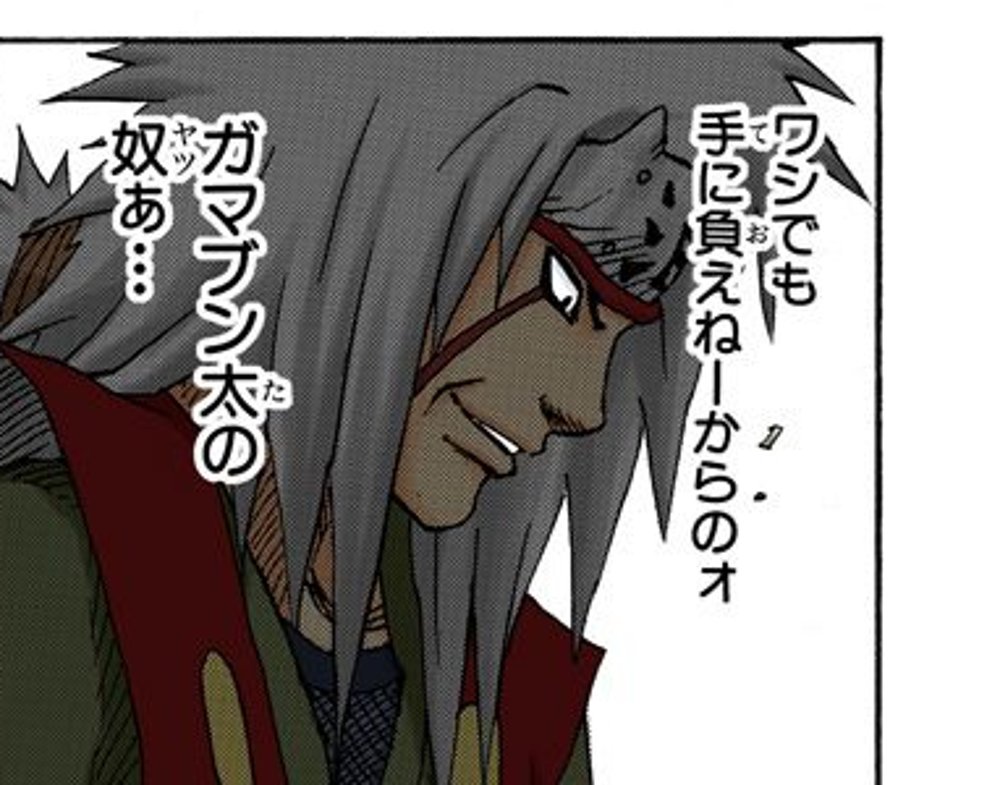
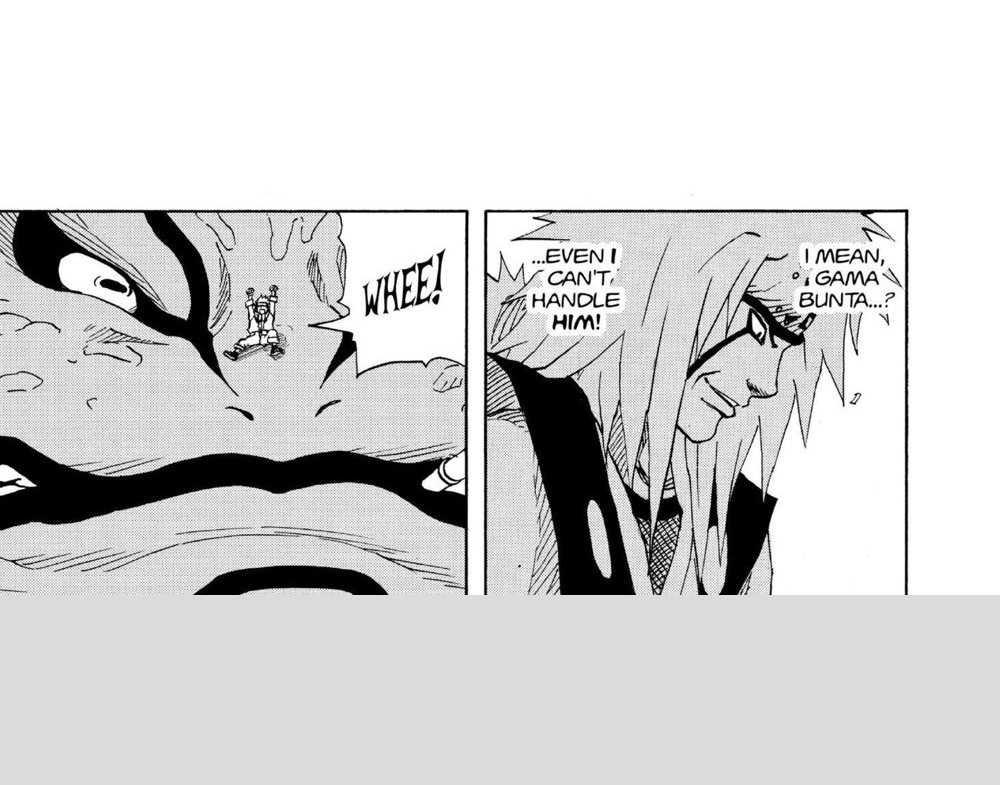
Naruto has been drilling the summoning jutsu (口寄せの術) with Jiraiya, trying to reliably call the toad boss Gamabunta the way he'll need to in the Chunin Exam finals. This attempt is real progress — for the first time, he's drawn on the Nine-Tails' chakra through his own will instead of it leaking out on its own — but Jiraiya isn't celebrating yet: 「まだまだ、安定してるとは言えねーのォ...」 ("...HIS CONTROL OF IT IS STILL FAR FROM STABLE.") Naruto calls up too much chakra, and the jutsu answers with something huge — genuinely huge, big enough that Naruto is a speck bouncing across its back, delighted (「やったぁ」 — "WHEE!"). Watching from below, unimpressed, Jiraiya narrates what just happened:
「よりによってアイツを呼び出しちまうとは..」
Yori ni yotte aitsu o yobidashichimau to wa…
VIZ: "TO HAVE SUMMONED HIM, OF ALL THINGS...!"
Then, watching the creature carry his student off across its own back:
「ワシでも手に負えねーからのォ」
Washi demo te ni oenē kara nō…
VIZ's English edition prints: "...EVEN I CAN'T HANDLE HIM!" (Vol. 11, p.109) — followed, in the same breath, by Jiraiya second-guessing himself: "I MEAN, GAMA BUNTA...?"
Grant the rendering its due: "EVEN I CAN'T HANDLE HIM" is exactly the right size for the panel, keeps the exasperation, and keeps the comedy of a legendary Sannin admitting he's out of his depth. Nothing about the plot is lost. But 手に負えない isn't just "I can't handle him" — it's my hands cannot carry him, a very specific, very physical admission from a man whose entire relationship to toads runs through his own two hands (the seals, the scroll, the summoning itself). The joke isn't only that the toad is unmanageable; it's that Jiraiya, of all people, is the one whose hands have run out of grip.
The Original
手 (te) — "hand." Beginner-level kanji, learned in the first weeks alongside 目 and 口.
負える — the potential form of 負う (ou), "to carry on the back; to bear, shoulder, sustain." This is a workhorse verb with a consistent physical logic underneath every use: 背負う (seou, "to carry on one's back," as a parent carries a child), 傷を負う ("to sustain/bear a wound" — literally, to have a wound placed on you), 責任を負う ("to bear responsibility" — a duty placed on you like a pack). Japanese doesn't draw a hard line between a literal load and a figurative one; 負う treats both the same way. Something is set onto your body, and the question is always whether you can carry it.
負えない negates the potential — "cannot be borne." Put the pieces together and 手に負えない reads, almost woodenly, "it cannot be carried in the hands": too heavy, too wild, too dangerous for two human hands to manage. The grammar is a bare existence frame — [X は/が 手に負えない], "X exceeds what the hands can carry" — and it very often skips naming whose hands at all, which becomes the whole story two sections from now.
As vocabulary, 負う usually shelves around N2, and 手に負えない tracks at roughly the same level — though, like most idioms, most learners absorb it whole rather than by parsing 負う first. Its two closest relatives are 手に余る (te ni amaru, "to overflow the hands," nearly interchangeable) and 始末に負えない (shimatsu ni oenai, "impossible to deal with," swapping 手 for 始末, "the handling/disposal of a matter") — proof that 負えない keeps recombining with different nouns to describe the same basic shape: something too big for the container meant to hold it.
VIZ's Choice
Every appearance of 手に負えない (or its contracted cousin 手に負えん) in the Naruto volumes on file:
| Vol. / p. | Speaker | Japanese | VIZ English |
|---|---|---|---|
| 11 / 109 | Jiraiya | ワシでも手に負えねーからのォ | ...EVEN I CAN'T HANDLE HIM! |
| 14 / 127 | an unnamed Leaf shinobi | くっ...手に負えん!! | GRRR... THIS IS OUT OF CONTROL !! |
| 14 / 148 | Kankuro | アレは私じゃあ手に負えない... | I CAN'T HANDLE IT BY MYSELF... |
Three appearances, three different English formulas, and — unlike a word like 因縁 that scatters across five loosely related meanings — every one of these renderings is correct. That's what makes the pattern worth studying: the scatter here isn't about meaning drifting off target, it's about which piece of the sentence English decides to hang the meaning on.
Look at where the grammatical subject lands in each line. Jiraiya's line keeps "I" as the one who can't manage: even I can't handle him. Kankuro's line does the same: I can't handle it by myself. But the Leaf shinobi's 手に負えん!! — barked out mid-panic, no subject named at all in the Japanese — becomes "THIS IS OUT OF CONTROL!!", where the grammatical subject flips from a person to the situation itself. Japanese left it open who, exactly, has run out of hands; English had to pick someone, or something, and this time it picked the chaos rather than the speaker. Three sentences built on one recurring Japanese construction end up looking, in English, like three unrelated idioms.
The Gap
The hands disappear. "Handle" and "control" are Latinate verbs worn smooth by centuries of idiom — neither one still calls up an actual hand failing to close around something. 手に負えない never lets go of the hand; all three English lines quietly set it down.
負う's duty-bearing echo goes untranslated. Because 負う also means "to shoulder a responsibility" or "to sustain an injury," 手に負えない carries a faint suggestion that the speaker tried to take this on as their charge and came up short — not merely that things are chaotic, but that a duty has exceeded what one set of hands could responsibly carry. "OUT OF CONTROL" describes a fact about the world; 手に負えん describes a failure of the body.
The grammatical subject wanders. Japanese 手に負えない is frequently agentless, naming no one at all — the sentence just states that no hands anywhere could manage this. English can't leave a sentence subjectless the same way, so a subject gets assigned each time: "I" for Jiraiya, "THIS" for the panicked shinobi, "I" again for Kankuro. Three faithful, sentence-by-sentence solutions still add up to a family resemblance no English reader can see.
What If
- "MY HANDS CAN'T HOLD HIM!" — keeps the two-hands image and the physical concreteness. Cost: sounds oddly literal for a toad sage's exasperated mutter, and "hold" undersells the danger of a giant toad on the loose.
- "HE'S MORE THAN I CAN CARRY!" — keeps 負う's carrying metaphor, close kin to "shoulder a burden." Cost: "carry" risks misreading as a literal offer to lift him rather than a statement of being overwhelmed.
- "HE'S TOO MUCH FOR MY TWO HANDS!" — keeps the body count concrete and countable. Cost: colloquial in a way that risks landing as comic relief rather than genuine exasperation.
- Keep VIZ's "CAN'T HANDLE," restore the hands: "MY HANDS CAN'T EVEN HANDLE HIM!" — Cost: sounds redundant in English, but the redundancy is exactly the point — Japanese needed both the hand and the verb; English usually only wants one or the other.
Take-away
手に負えない doesn't just report that something is unmanageable — it pictures a specific failure: two hands trying to take hold of a load and coming up short. Jiraiya's toad, the invasion's rampaging summon, and the demon asleep inside Gaara are three very different sizes of trouble, and Japanese describes all three the exact same physical way.
Three rules of thumb to carry off this page:
- Whenever you meet 負う, look for a load being set onto a body — 背負う, 傷を負う, 責任を負う, 手に負えない — the verb never fully lets go of its literal, physical sense, even in its most abstract uses.
- 手に負えない often names no subject at all. When the Japanese is agentless, ask "beyond whose hands?" from the scene, not the sentence — English will force an answer where Japanese didn't need one.
- Track 負えない's family — 手に負える spilling into 手に余る (overflowing) and 始末に負えない (incorrigible) — one shape, "too big for the container," recombined with different nouns.
Naruto keeps this same body-first reflex elsewhere: see the sister article on 歯が立たない, where Rock Lee's teeth fail to bite before he'll admit defeat out loud. One Piece runs the identical pattern through different limbs in 手も足も出ない — "not even hands or feet come out" — the same insistence that the body try, and fail, before the verdict arrives. For more of what Naruto's translators quietly set down, browse the full Naruto translation notes index.
Every Japanese and English line quoted above is a byte-exact capture from the cited editions — NARUTO―ナルト― Vol. 11 & 14 (Japanese) and Naruto (VIZ Media) at the corresponding panels — via our bilingual page database; see Sources below.