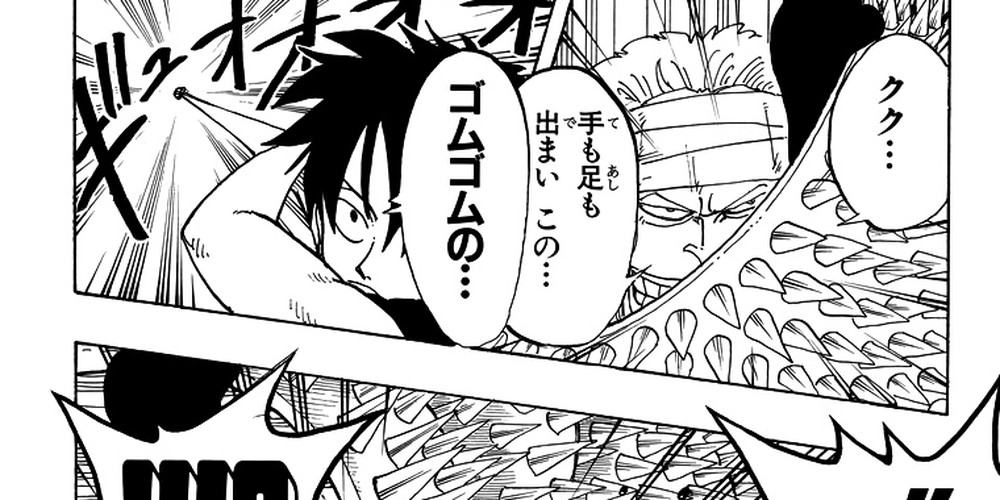
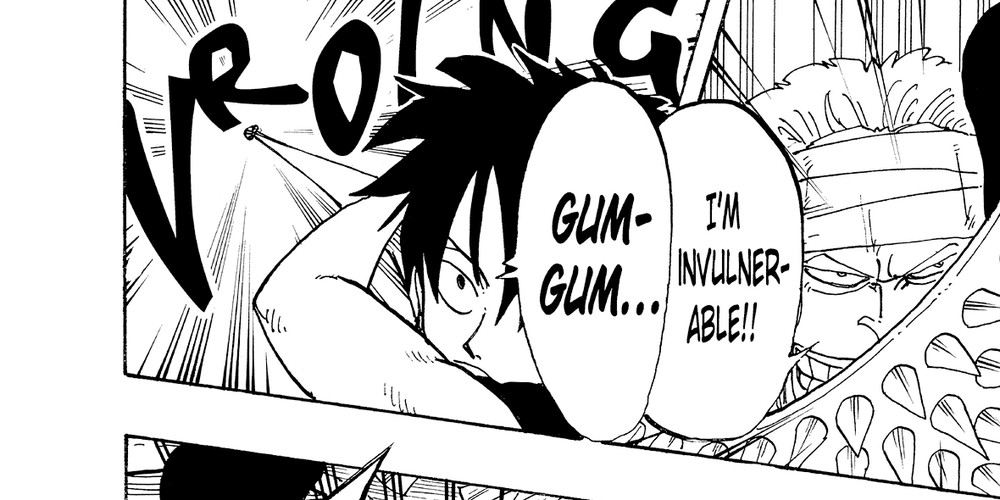
The Moment
A huge enemy looms over the crew, certain nothing they do can reach him, and spits:
「手も足も出まいこの...」
Te mo ashi mo demai kono…
VIZ: "I'M INVULNERABLE!!" (Vol. 8, p.18).
It's a clean, punchy bubble. It also quietly swaps who the sentence is about. The Japanese is aimed at you — "you won't be able to get hand or foot out [against me]." The English is aimed at me — "I am invulnerable." Same outcome on the page; opposite grammatical subject. And that little swap is a doorway into one of the most common idioms in Japanese, and one the official translation never settles on a single English word for.
The Original
手も足も出ない — te mo ashi mo denai
Build it from parts, because the parts are all beginner vocabulary and the sum is worth memorising:
- 手 (te) = hand. 足 (ashi) = foot / leg.
- 〜も〜も + [negative] = "neither ~ nor ~." (手も足も…ない = "neither hands nor feet … not.")
- 出る (deru) = intransitive "to come out, to emerge."
So, literally: "neither hands nor feet will come out." Picture someone so pinned, so overpowered, that they can't get a single limb free to do anything about it. That is the feeling: not just "losing," but no move available — utterly outmatched, frozen out of the fight.
One grammar upgrade in the headline line. Oda doesn't write the plain 出ない; he writes 出まい. The suffix 〜まい is the literary, old-fashioned negative of conjecture or volition — "surely won't ~," "shall not ~." It's the difference between "you can't" and "thou shalt not": it makes the boast sound archaic and lordly, which is exactly the flavour a swaggering villain wants. If you're studying, file 〜まい as an N1 tell — when you see it, someone is being formal, literary, or grand.
One more moving part. Japanese distinguishes 出る (deru, intransitive, "come out") from 出す (dasu, transitive, "put out"), and the idiom lives in both:
- 手も足も出ない — "hands and feet won't come out" — camera on the situation.
- 手も足も出せない — "can't put hands and feet out" — camera on the person who can't act.
Same helplessness, slightly different angle. One Piece uses both, and English blurs the distinction every time.
VIZ's Choice
Here is the idiom across the volumes we have on file, next to the official English:
| Vol. / p. | Japanese | VIZ English |
|---|---|---|
| 6 / 149 | “海賊狩りのゾロ”が手も足も出せねェ | EVEN THE PIRATE HUNTER ZOLO IS NO MATCH FOR HIM!!! |
| 8 / 18 | 手も足も出まいこの… | I'M INVULNERABLE!! |
| 14 / 29 | 恐竜相手じゃ手も足も出ねェ | I CAN'T DO ANYTHING AGAINST DINOSAURS!!! |
| 21 / 16 | 手も足も出せなくなった男 | …COULDN'T BRING HIMSELF TO HARM A FRIEND!! |
| 33 / 176 | 手も足も出ない | STRAW HAT LUFFY WAS HELPLESS!! |
Five appearances: no match, invulnerable, can't do anything, couldn't bring himself to harm, helpless. Not one word is shared between them. As with 往生際が悪い elsewhere on this site, that scatter is the diagnosis — when a phrase gets re-solved from scratch every single time, it has no fixed seat in English. The translator isn't being careless; there simply isn't a ready idiom to drop in, so each panel gets a bespoke paraphrase.
The Gap
The body picture evaporates. 手も足も出ない shows you a person who can't get a hand or foot free. "No match," "helpless," and "can't do anything" report the result but throw away the image. The odd thing is that English has perfectly good limb-idioms for this — can't lay a finger on him, couldn't lift a hand — and VIZ mostly walks past them. The vividness that makes the Japanese fun to hear is exactly what the abstractions sand off.
The subject flips. The idiom is, structurally, always about the powerless party — it describes the person whose limbs won't come out. So 手も足も出まいこの… means "[you] won't be able to do a thing." VIZ's "I'M INVULNERABLE!!" says the same situation from the winner's side. It reads great, but note what changed: the Japanese keeps its eye on the victim's helplessness; the English recenters on the boaster's invincibility. A translator who wanted both the meaning and the body-image had "You can't lay a finger on me!!" right there.
And once, it's simply wrong. In Vol. 21 a Baroque Works agent recalls: 「“友情”によってあちしに手も足も出せなくなった男」 — "a man who, because of friendship, became unable to act against me." He was paralysed — he couldn't bring his hands or feet out to fight her. VIZ renders it "a foe who COULDN'T BRING HIMSELF TO HARM A FRIEND," which swaps couldn't (was unable) for wouldn't (chose not to): incapacity becomes moral reluctance. It's an easy slip, because in English "couldn't bring himself to" is idiomatic — but it changes the cause from being overpowered to having scruples. The idiom is about ability, not conscience.
What If
Priced by what each keeps:
- 手も足も出まいこの… → "You can't lay a finger on me!!" — keeps the villain's meaning and an English body-idiom, and restores the victim-focused subject the Japanese uses. The closest single fix.
- 手も足も出ない (Luffy under the barrage) → "couldn't do a thing to stop it" — plain, but the eye stays on the helpless party, where the idiom puts it.
- 手も足も出せなくなった男 → "a man who could no longer raise a hand against me" — preserves paralysis (couldn't act), not VIZ's reluctance (wouldn't act), and even keeps the hand.
- When space is tight → "totally outmatched" / "couldn't touch him" — faithful to the sense, and "touch" at least nods at the body.
The throughline: English can honour the image (the finger/hand options) or the brevity ("outmatched") but tends to grab an abstract result-word under panel-space pressure, and the little picture — hands and feet that won't come out — is the first thing to go.
Take-away
手も足も出ない is beginner-friendly to build and worth owning: 手 hand + 足 foot + a double も + a negative = "I can't get a single limb out" = completely outmatched, no move left. When you meet it, look for two things the English usually drops: the body image (someone literally unable to move against a foe) and the subject (it's about the one who's helpless, not the one who's strong). And watch the verb — 出ない (can't come out) versus 出せない (can't put out) — because that transitive flip quietly changes whether the sentence is about the situation or the person stuck in it.
For another line where English keeps the meaning and loses the picture, see the One Piece translation notes index.
Every Japanese and English line quoted above is a byte-exact capture from the cited editions — ONE PIECE Vol. 6–33 (Japanese) and One Piece (VIZ Media) at the corresponding panels — via our bilingual page database; see Sources below.