The Moment
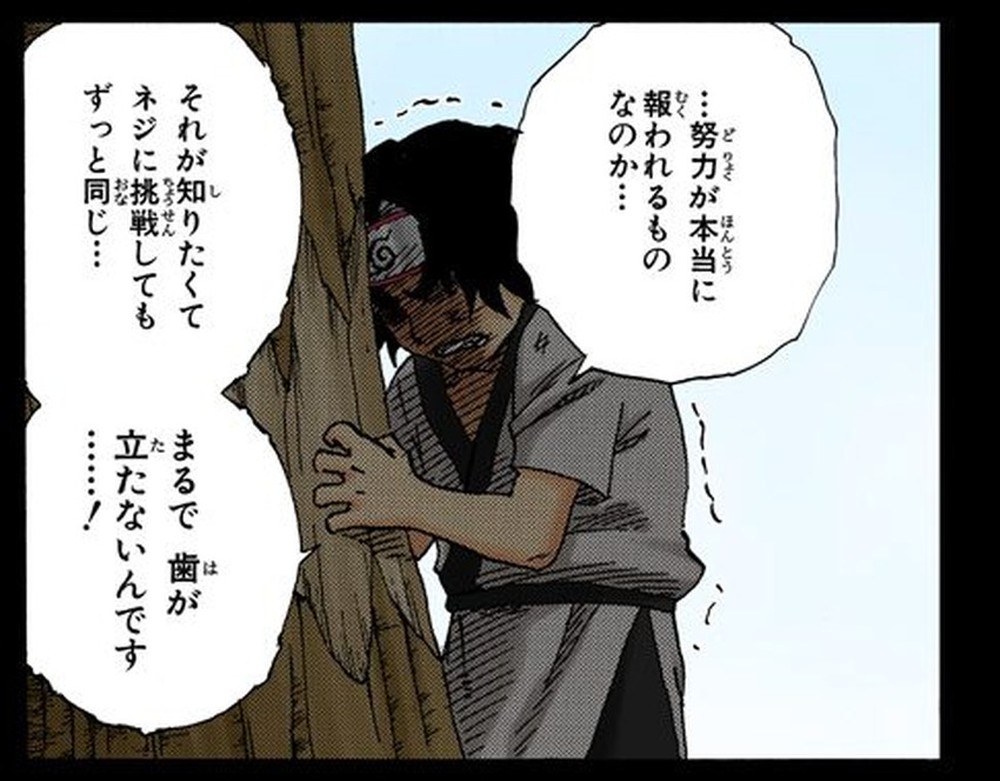
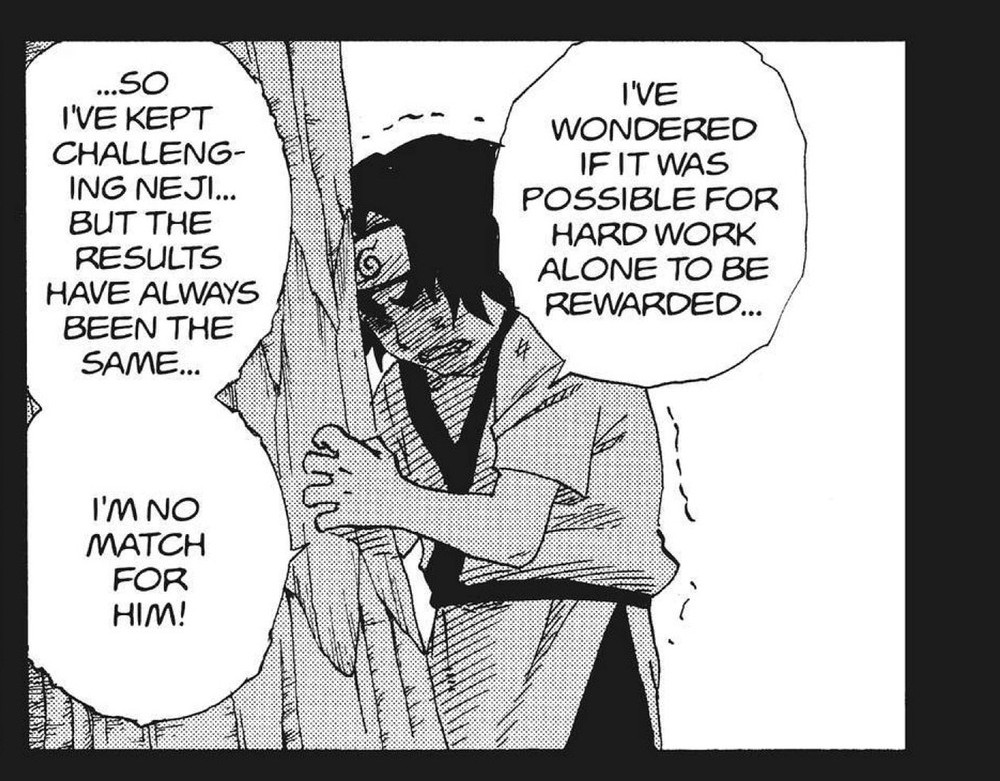
Rock Lee has just failed a mission, and his sensei, Might Guy, has cornered him at a training tree to say something Lee doesn't want to hear: that although he's no ninjutsu genius, no genjutsu genius, and not even a taijutsu prodigy like his rival, he has a hidden genius of another kind. Lee refuses the comfort — kicking the tree rather than accept it — and Guy holds his ground. It's here, hands finally still, forehead pressed to the bark, that Lee lets the real confession out. He admits he trained two or three times as hard as Neji Hyuga, telling himself it would be enough:
「それが知りたくてネジに挑戦しても..ずっと同じ..」
Sore ga shiritakute Neji ni chōsen shitemo…… zutto onaji……
VIZ: "...SO I'VE KEPT CHALLENGING NEJI... BUT THE RESULTS HAVE ALWAYS BEEN THE SAME..."
Then, hair fallen over his eyes, both hands locked white-knuckled on the trunk in front of him:
「まるで歯が立たないんです……!」
Marude ha ga tatanai n desu……!
VIZ's English edition prints: "I'M NO MATCH FOR HIM!" (Vol. 10, p.59).
Grant the rendering its due: it's the correct verdict, and the bare exclamation point does real work — a clean, exhausted admission dropped into a page already thick with tears and tree bark. An English reader loses nothing about what happened. But look at what's sitting behind まるで ("just plain," "as if") and 歯が立たない ("the teeth won't stand"): Lee isn't reporting a scoreline. He's narrating a failed physical act — teeth trying to close on something and sliding off it, uselessly, again — in the very panel where his own hands are failing to find purchase on the bark. The words and the picture are doing the same thing at the same moment. English keeps the score and drops the mouth.
The Original
Break 歯が立たない into its two moving parts.
歯 (ha) — "tooth, teeth." Beginner vocabulary, the kind of kanji that shows up in the first weeks of study next to 目 (eye) and 口 (mouth).
立たない — the negative of 立つ (tatsu), "to stand; to be set up; to take hold, to take an edge." 立つ has a wider range than English "stand" ever does: 腹が立つ, "the stomach stands" — to get angry; 予定が立つ, "a plan stands" — a plan comes together; and, closest to our idiom, 刃が立つ, said of a blade, "to take an edge" — to be sharp enough to actually cut something.
歯が立たない borrows that last, cutting-edge sense of 立つ and moves it into the mouth: teeth that try to "take" — to grip, to find purchase — and simply can't. Dictionaries trace the image to food, and it isn't hard to picture: a rock-hard senbei, an unripe persimmon, a bone too tough to crack. Your teeth close on it and slide right off without ever biting in. From the dinner table the idiom walked into every corner of the language: [X に] 歯が立たない — "X is too much for me" — said just as easily about a math problem, a boxer, a boss-level demon, or, here, a rival genin whose talent is simply a different order of thing.
Grammar-wise the frame is nothing exotic: [target に] + 歯が立たない. What makes the line worth teaching isn't the structure, it's the picture bolted onto it — one a learner has to be shown once and then owns for good. 歯 alone is N5; the set idiom 歯が立たない usually shows up around N3 vocabulary lists, though idioms rarely sort neatly by kanji difficulty. You either know the bite, or you reach straight for "outmatched" and never notice the teeth were there.
VIZ's Choice
Across every volume of Naruto in our bilingual corpus, 歯が立たない — or its close cousin 歯も立たない — surfaces exactly once: this line, on this page. That scarcity is itself worth a beat of attention. Unlike 因縁 or 手も足も出ない, which recur often enough that a translator has to solve them again and again, this idiom gets one shot, and it lands on one of the most emotionally loaded pages in early Naruto — Lee's private confession to his sensei, the scene that seeds the series' entire "hard work vs. genius" argument. There's no scatter to chart here, no pattern of five different English guesses across volumes. There's a single translator decision, made once, and it's a defensible one: "I'M NO MATCH FOR HIM!" is short, punchy, fits the bubble, and states exactly what's true. The cost isn't inconsistency — there's nothing to be inconsistent with — it's that the one chance to carry the bite across the language barrier doesn't take it.
The Gap
The mouth disappears. 歯が立たない doesn't just report a result; it makes the speaker narrate a failed physical action — teeth closing on something and finding no grip. VIZ's "I'M NO MATCH FOR HIM!" states the conclusion the Japanese sentence is walking toward, but the walk itself — the actual sensation of trying and sliding off — never makes it into English.
A visual rhyme gets cut. In the panel, Lee's hands are gripping the tree trunk, unable to do anything with it but hold on. His words, in Japanese, describe the same failure to grip happening in his mouth. Body and language are performing the identical motion at the identical moment — a small but real piece of manga craft, where art and text echo each other. English's "no match" doesn't touch anything, so the rhyme goes silent.
まるで's disbelief becomes a shout. まるで isn't filler; it's the word for measuring the gap between what should be true (train harder, get stronger) and what keeps happening anyway (nothing changes) — someone who still can't quite believe their own results. The bare "!" after "HIM" supplies energy, but it's the energy of a declaration, not the exhausted, private disbelief of まるで.
What If
- "IT'S LIKE MY TEETH CAN'T EVEN GET A GRIP ON HIM!" — keeps both the bite image and まるで's "it's as if." Cost: an unfamiliar body metaphor that risks landing as confusing rather than vivid for a reader who doesn't already own the Japanese idiom.
- "I CAN'T EVEN SINK MY TEETH INTO HIM!" — "sink one's teeth into" is existing English, so the bite survives without sounding invented. Cost: in English that phrase usually signals eager appetite for a challenge, not failure to meet one — a small drift in connotation.
- "HE'S TOO MUCH FOR ME TO EVEN GET A BITE IN!" — keeps the food-fight physicality and a hint of Lee's self-deprecating honesty. Cost: colloquial in a way that can read as glib for a confession this raw.
- Keep VIZ's verdict, restore the disbelief: "IT'S LIKE I'M JUST NO MATCH FOR HIM AT ALL!" — Cost: still no bite, but at least まるで's exhausted "it's as if" survives the sentence around it.
Take-away
歯が立たない is what Japanese reaches for when losing isn't the point — trying and failing to even engage is. Lee doesn't tell Might Guy that Neji is stronger. He tells him his own teeth won't take hold, the same way his hands won't stop failing to grip the bark in front of him. English's "no match" is true and entirely toothless.
Three rules of thumb to carry off this page:
- When a Japanese sentence names a body part before it names a verdict, slow down. 歯が立たない, 手も足も出ない, 腰が引ける ("the hips pull back," to lose one's nerve) — Japanese routes "I can't" through the body far more than English does, and translation almost always arrives at the verdict a beat early, having quietly amputated the body on the way.
- Track 立つ's family wherever it shows up. 腹が立つ (anger), 予定が立つ (plans coming together), 刃が立つ (a blade taking its edge), 歯が立たない (teeth failing to grip) — one verb, one idea of "taking hold," running through kitchen, swordsmith, and battlefield alike.
- まるで is a disbelief switch, not an intensifier. Whenever it sits in front of a negative, the speaker isn't just emphasizing — they're marking the gap between effort and result.
Naruto isn't the only work on this network where a body part fails before a character admits defeat: One Piece runs the identical pattern through different limbs in 手も足も出ない — "not even hands or feet come out" — the same reflex of routing "I can't win" through the body before the verdict ever arrives. For more of what Guy and Lee's training scenes hide from English, see the "engrave it on your liver" order VIZ rerouted to the muscles, or browse the full Naruto translation notes index.
Every Japanese and English line quoted above is a byte-exact capture from the cited editions — NARUTO―ナルト― Vol. 10 (Japanese) and Naruto (VIZ Media) at the corresponding panel — via our bilingual page database; see Sources below.