The Moment
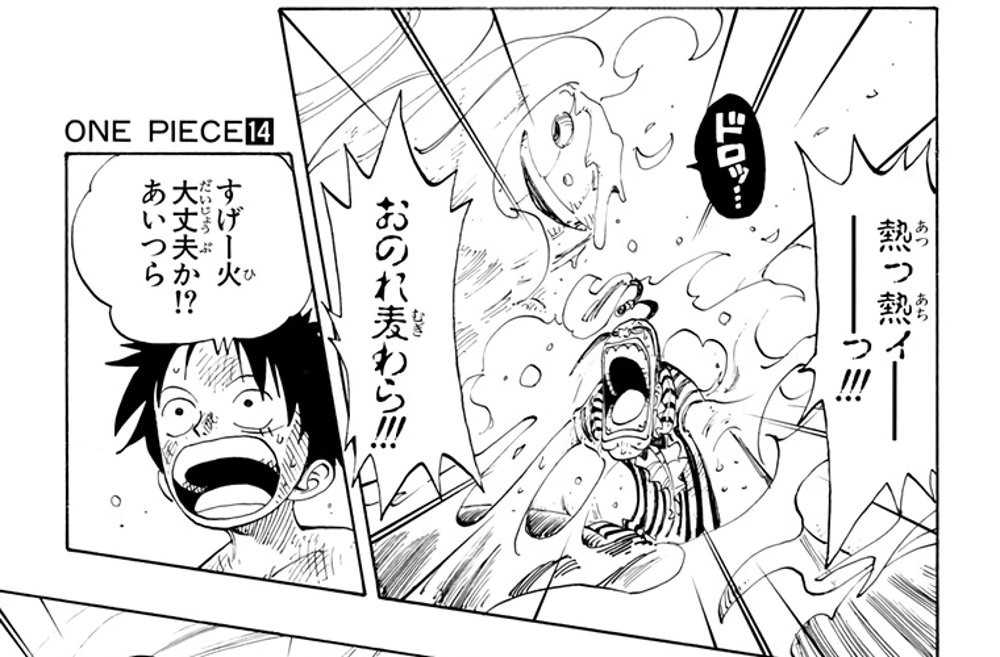
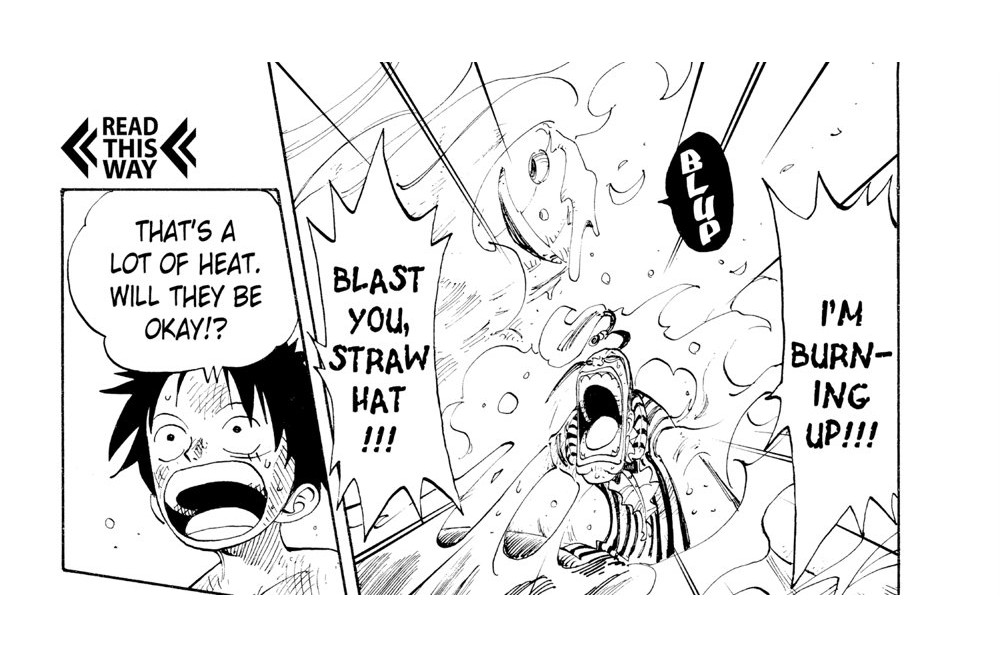
Little Garden — the prehistoric island where One Piece first plays a fight completely straight-faced despite giant beasts and a hundred-year duel roaring in the background. Mr. 3, a small-time bounty hunter with the Doru Doru no Mi (wax-wax fruit), has just sealed part of Luffy's group inside a construct of his own hardened wax, the "Candle Jacket." Luffy's answer is fire. The wax melts. Mr. 3 is caught inside his own creation, dripping and screaming — 「熱っ熱イ...っ!!!」, "I'M BURN-ING UP!!!" — while Luffy, watching from a small inset panel, worries aloud: 「すげー火大丈夫か!?あいつら」, "THAT'S A LOT OF HEAT. WILL THEY BE OKAY!?" And then, out of the melting wax, mid-explosion, comes the line this article is about:
「おのれ麦わら!!!」
Onore Mugiwara!!!
VIZ's English edition prints: "BLAST YOU, STRAW HAT!!!" (Vol. 14, p.169).
Grant the rendering its due: "blast you" is punchy, period-appropriate for an American action comic, and lands the aggression exactly where it needs to land, on a single beat, mid-panel, while the villain is on fire. But listen to what the Japanese is actually doing. おのれ is not a stock insult manufactured for this scene — it is one of Japanese's oldest, strangest words, a pronoun that has spent centuries refusing to settle on a single grammatical person. Mr. 3 didn't reach for "you scum"; he reached for a word whose most basic meaning is "self" and pointed it, weaponized, at somebody else.
The Original
Start with the kanji, even though this particular panel prints おのれ in kana (typical for manga, where the interjection needs to read fast). The character is 己, the same 己 inside 自己 (jiko, "self"), 利己的 (rikoteki, "selfish"), and 克己 (kokki, "self-mastery" — the word on a thousand dojo walls). 己 belongs to a small, famously confusable trio with 已 ("already") and 巳 ("snake"), distinguished only by how far the top stroke closes; traditionally it's explained as an early phonetic loan character, a shape borrowed for its sound to write the abstract idea "self" once no picture would do the job directly.
The kun'yomi おのれ shares its おの- root with 己が (onoga, classical "one's own") and おのずから (onozukara, "of itself, naturally"). Etymologically, おのれ is something like "one's very own self" — and critically, it names no particular grammatical person. That looseness is the whole story. A reflexive word always refers back to whoever is salient in the sentence around it, and over a very long history おのれ has been salient as:
- an archaic, humble first person — "I," in older and regional Japanese;
- the plain reflexive — "oneself, one's own," as in Mihawk's line to Zoro: 「このおれに刃をつき立てる勇気はおのれの心力か...」, "Does the courage to point your blade at me come from your own confidence…" (Vol. 6, p.122) — grammatically "one's own mental strength," pragmatically "your own," because the sentence is aimed straight at Zoro;
- a hostile, spat-out second person — "you," when hurled at an addressee, as in 「待たんかおのれらァ!!!」, "Would you not wait, you two!!!" — VIZ's "QUIET, BOTH OF YOU!!!" (Vol. 18, p.161);
- and, with nobody named at all, a bare exclamation of fury — closer to "damn it" than to any pronoun.
The headline line catches the word mid-transition between the last two categories: おのれ alone would already read as a curse; bolting on 麦わら (Mugiwara, "Straw Hat," Luffy's own nickname) turns the interjection into direct address without changing a syllable of おのれ itself. As grammar, this is almost nothing — a pronoun plus a name, no verb, no particle. As register, おのれ sits off the JLPT ladder entirely: the kanji 己 shows up around N3 in words like 自己, but おのれ as a pronoun-curse is pure literary and period-drama vocabulary, the word a wronged swordsman spits in a jidaigeki right before drawing steel.
VIZ's Choice
Six occurrences, spanning the reflexive, the hostile "you," and the bare curse, sampled and image-verified across the volumes we have on file:
| Vol. / p. | Speaker → Target | Japanese | VIZ English | Sense |
|---|---|---|---|---|
| 6 / 122 | Mihawk → Zoro | このおれに刃をつき立てる勇気はおのれの心力か... | DOES THE COURAGE TO POINT YOUR BLADE AT ME COME FROM CONFIDENCE... | reflexive ("your own") |
| 14 / 73 | Mr. 3 → Luffy | おのれ... | YOU LITTLE SWINE... | curse |
| 14 / 169 | Mr. 3 → Luffy | おのれ麦わら!!! | BLAST YOU, STRAW HAT!!! | curse + name |
| 18 / 161 | Chaka → two brawling kids | 待たんかおのれらァ!!! | QUIET, BOTH OF YOU !!! | hostile "you" (plural) |
| 22 / 11 | Chaka → Mr. 4 | おのれ貴様ァ!!! | YOU FIEND !!! | curse + 貴様 (doubled hostile pronoun) |
| 30 / 185 | Skypiean crewman → saboteur | おのれ... | HOW DARE YOU! (see note below) | curse |
Read down the middle-right column: "confidence," "you little swine," "blast you," "quiet, both of you," "you fiend," "how dare you" — six scenes, one Japanese word, effectively zero shared vocabulary in English. Even the doubled line at Vol. 22 — おのれ貴様ァ!!!, stacking two archaic hostile pronouns back to back — collapses into a single flat "YOU FIEND!!!", the repetition (and the irony that both words etymologically mean something gentler than they now sound) simply gone.
A note on Vol. 30, p.185 — the alignment sanity check this article exists partly to demonstrate. The bilingual source archive pairs this panel's おのれ... with EN page 183's "CURSE YOU...", carrying an automated page offset of −2. But the printed VIZ book tells a different story: cross-checking the actual page images shows the matching panel — same giant-mechanism artwork, same gritted teeth, same 「やってくれる...」/「おのれ...」 two-bubble beat — sits on EN page 184, not 183, where the line reads "HOW DARE YOU!", not "CURSE YOU...". The true offset at that point in the volume is −1, not −2 — a one-page drift the automated aligner didn't catch. "CURSE YOU..." isn't fabricated (it's a real VIZ phrase from elsewhere), but attaching it to this exact panel would have been wrong. This is exactly the trap the source brief warns about: exclamatory, near-identical single-word lines (おのれ..., 何...!, ぐわァ!!) are the easiest pairs for a machine aligner to place one panel off, because the words themselves give the aligner no distinguishing signal to anchor on.
The Gap
Three unrelated English words for one Japanese reflex. "Confidence" (the pronoun dissolved into a noun), a wardrobe of hostile "you"s (swine, fiend, both-of-you), and curses (blast/curse/how-dare-you) share no lexical DNA in English. A reader moving through these six scenes in translation has no way to feel the single thread — literally the word "self," bent outward — running from Mihawk's ice-cold formality through Chaka's righteous fury to Mr. 3's tantrum.
The standalone curse loses its missing object. おのれ…! with nobody named is grammatically complete in Japanese — pure exclamation, arguably not even addressed to a person. Every natural English gloss ("curse you," "damn you," "blast you") quietly reinserts a "you" the Japanese sentence never committed to. English cannot curse into a void the way おのれ can; it always needs a target to grab onto.
The archaic-samurai register evaporates. おのれ is the word a period-drama swordsman reaches for; "you little swine" and "you fiend" are aggressive, but they read as ordinary shōnen-villain bluster, not antique diction. Part of the joke of Mr. 3 — a con artist, not a warrior — reaching for おのれ is that he's borrowing a much older, more dignified fighter's vocabulary to sound like more than he is. English's fight-scene shelf has no equivalent "borrowed antiquity" effect built in.
What If
For the headline line specifically, the menu and its prices:
- "Damn you, Straw Hat!!!" — keeps the curse-plus-name shape and reads naturally. Cost: "damn" is generic modern profanity; the antique flavor is gone.
- "You wretch, Straw Hat!!!" — "wretch" at least sounds a little dated. Cost: it's the wrong kind of old — Victorian-gothic rather than samurai-drama.
- "How dare you, Straw Hat!!!" — captures おのれ's wounded-honor undertone, a duelist's outrage rather than a street insult. Cost: can read as prim next to a villain who is, at this exact moment, on fire.
- Keep VIZ's punch but add the honor beat: "CURSE YOU, STRAW HAT — YOU DARE!!!" — Cost: wordier than a single manga beat usually allows, but it recovers both halves — the curse and the affronted, old-fashioned register — in one line.
Every option still has to choose a lane English keeps separate — self, you, or oath — because that is the one thing おのれ was built not to do.
Take-away
おのれ is a word that never decided what grammatical person it belonged to, and every scene in this article is a snapshot of it mid-drift: reflexive in Mihawk's mouth, plural-hostile in Chaka's, a pure curse fused to a nickname in Mr. 3's. English's "myself," "you," and "damn it" are permanently different words; おのれ is permanently the same one.
Three rules of thumb to carry off this page:
- When a Japanese pronoun can stand completely alone as a sentence (おのれ! 貴様! てめェ!), expect English to need extra scaffolding — an implied "you," a target, punctuation — to do the same job the bare word does by itself.
- Reflexives drift toward whoever the sentence points at. Meet おのれ, 己が, or even modern 自分 used confrontationally, and ask first: whose self is this actually about? The answer is grammar, not vocabulary.
- An archaic word chosen by a modern or low-status speaker is characterization, not decoration. Mr. 3 reaching for おのれ tells you he wants to sound more dangerous than he is — the same trick 貴様 and てめェ play elsewhere in this corpus.
For the register cluster this word belongs to, see 貴様 and the honorific that curdled into an insult and てめェ, the humble "I" that turned around to insult you. And for more places where a single Japanese word carries more grammatical information than English can hold, browse the One Piece translation notes index.
Every Japanese and English line quoted above is a byte-exact capture from the cited editions — ONE PIECE Vol. 6–30 (Japanese) and One Piece (VIZ Media) at the corresponding panels — via our bilingual page database; see Sources below. The one exception is noted in the article itself: the Vol. 30, p.185 line is quoted as archived (paired with EN p.183's "CURSE YOU..."), while the analysis above it is based on the confirmed true panel at EN p.184 ("HOW DARE YOU!").