The Moment
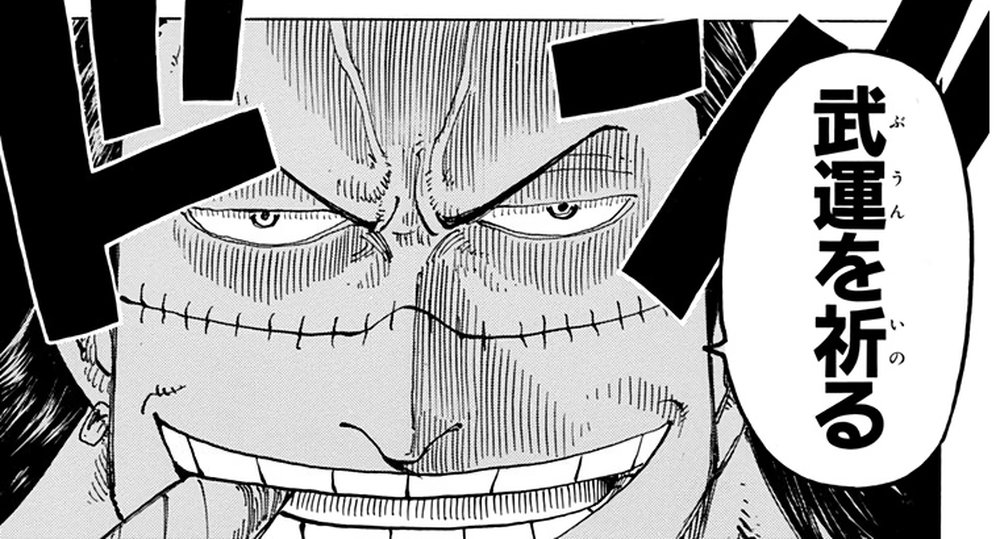
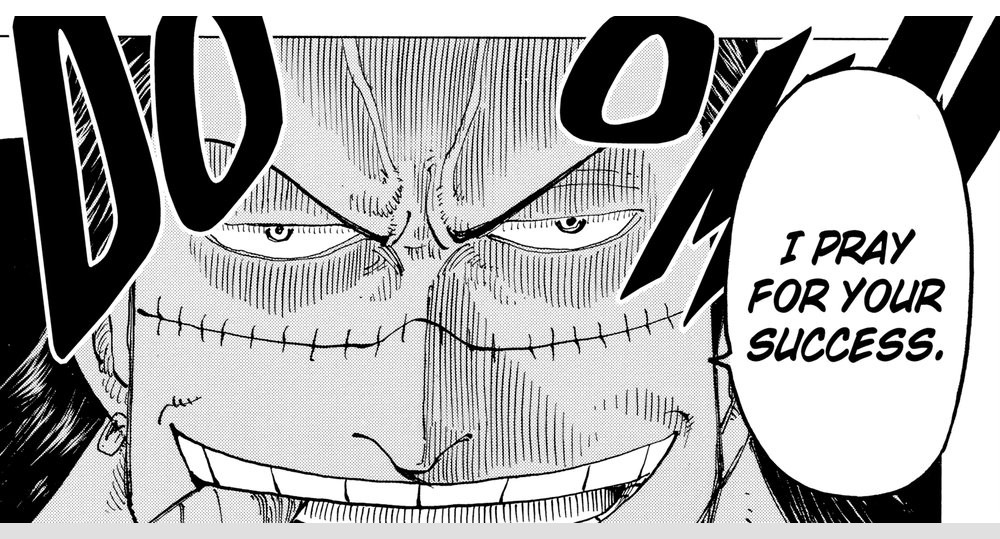
Volume 18, the heart of the Alabasta arc. The numbered elite of Baroque Works — the Officer Agents, summoned from every corner of the kingdom — sit around a long banquet table in their boss's stronghold in Rainbase, candelabra burning, wind howling outside. The man at the head of the table lays it out: 「これがB・W社最後にして最大の『ユートピア作戦』」 — "THIS IS BAROQUE WORKS' ULTIMATE PLAN-- OPERATION UTOPIA." Zero hour: 「決行は明朝7時!!!」 — "WE BEGIN AT SEVEN O'CLOCK TOMORROW MORNING!!!" And one condition: 「失敗は許されん」 — "FAILURE IS NOT AN OPTION." The agents answer with a single syllable of soldier-speak — 「了解」, "RIGHT." — and then the page ends on an extreme close-up: the stitched scar, the cigar, the grin, and one vertical bubble.
「武運を祈る」
Buun o inoru
VIZ's English edition prints: "I PRAY FOR YOUR SUCCESS." (Vol. 18, p.201).
Grant the rendering its due. The prayer verb survives — VIZ did not flatten this to "good luck, everyone." The cadence is formal, superior-to-subordinates. And "success" wears the corporate uniform Baroque Works itself insists on: this is a crime syndicate that calls itself a company (B・W社, "the B.W. Company"), numbers its employees, and gives its coup d'état a project name. A president praying for the success of Operation Utopia is, on paper, perfectly in-house.
But 武運を祈る is not office language. It is the send-off of warlords — and the joke of the panel is that for exactly one bubble, the company president stops pretending to be a businessman.
The Original
Two kanji, both worth owning.
武 (bu) is "martial; arms" — the 武 of 武士 (bushi, warrior), 武器 (buki, weapon), 武道 (budō, the martial ways). Wherever this character appears, someone is armed.
運 (un) is "luck; fortune" — the 運 of 運命 (unmei, fate), 幸運 (kōun, good luck), and 悪運 (akuun), the wrongdoer's uncanny luck we've covered that one too. Its root meaning is "to carry, to move" — luck as the thing that carries you, not the thing you steer.
Together: 武運 (buun), "the fortune of arms" — a warrior's luck in battle. And note precisely what that covers: the two outcomes no amount of training controls. Whether you win. And whether you come home.
The grammar of the line is almost embarrassingly simple — [武運]を[祈る], "(I) pray (for your) war-luck," no subject, no "your," no politeness — because this is not free composition. It is a fossilized send-off, recited whole, the fixed formula a commander speaks over troops before an engagement. The plain 祈る (rather than polite 祈ります) is itself information: this is rank speaking downward, a blessing bestowed, not a well-wish exchanged. The family includes the honorific ご武運を (go-buun o) — verb left respectfully unsaid, the version subordinates and well-wishers use upward — and the four-character ceremonial form 武運長久 (buun chōkyū), "lasting fortune in war."
That last form carries the heaviest history. Samurai prayed to Hachiman, the god of war, for 武運 before campaigns; in the Pacific War, 武運長久 was THE send-off for departing conscripts — brushed on the signed rising-sun flags they carried, stitched into senninbari, the thousand-stitch belts. And the same word writes the other ending: 武運つたなく (buun tsutanaku), "his war-luck failing…," is the classical euphemism for being defeated — for dying — in battle. The blessing and the obituary share a noun. To pray for someone's 武運 is to admit, inside the prayer itself, that they may not come back.
Register: parade-ground archaism. Today the phrase lives in period dramas and in deliberate, smiling theater — colleagues say ご武運を before someone's dreaded presentation, and everyone hears the costume rustle. JLPT-wise, 祈る is roughly N3; 武運 sits beyond the lists entirely (N1-plus, period-drama shelf). Learn the formula whole; nobody assembles it from parts.
VIZ's Choice
武運を祈る appears exactly twice in the One Piece volumes we have on file — and the two renderings are worth staring at side by side:
| Vol. / p. | Scene | Japanese | VIZ English |
|---|---|---|---|
| 13 / 183 | Bonus page: Oda signs off the rules of a pencil-and-paper battle game | 武運を祈る。 | May you be victorious in Battle. |
| 18 / 201 | Crocodile closes the Operation Utopia briefing | 武運を祈る | I PRAY FOR YOUR SUCCESS. |
Look at the inversion. In Vol. 13, the phrase closes a joke — game rules for a pencil die and graph-paper battleship, where the mock-solemn martial blessing over a schoolyard game IS the gag — and VIZ goes full ceremony: the optative "May you…," the archaic cadence, even a capital-B "Battle." It's a lovely rendering. In Vol. 18, the phrase closes a war council — a Warlord dispatching agents to topple a kingdom — and VIZ reaches for the office: "I PRAY FOR YOUR SUCCESS." The toy gets the war. The war gets the memo.
And neither rendering keeps the luck. "Victorious" and "success" are outcome words; 武運 is a chance word. Both times, English promises what Japanese only prays for.
For the record, VIZ's Demon Slayer team met the same fossil — the wisteria-house landlady's verbless ご武運を… over three departing demon slayers — and answered differently again: "I WISH YOU GOOD FORTUNE IN WAR!", fortune and war both intact, everything else (the hush, the ellipsis, the unsaid verb) traded away; our companion piece on the Demon Slayer hub takes that line apart. Three scenes, three teams, three unrelated solutions to one four-morpheme formula. That scatter is the signature of a fossil English never fossilized.
The Gap
The luck is gone. 運 is the entire theology of the phrase: battle is decided by chance as much as skill, so what you offer departing soldiers is not confidence but prayer. "SUCCESS" is a deliverable; "victorious" is a scoreboard. The Japanese line — through the same noun that writes 武運つたなく on memorial scrolls — quietly concedes that some of the people at that table may not survive the week. Delivered through Crocodile's grin, that concession is characterization: the boss blesses his employees like soldiers because he is perfectly willing to spend them like soldiers. English's polite executive concedes nothing.
The warlord is demoted to a manager. The whole Baroque Works aesthetic is corporate cosplay — 社 (company), numbered staff, project codenames — and the Japanese line is the one beat in the briefing where the mask slips and the president speaks in daimyo. That register spike is the panel's payload; it's why the bubble gets its own extreme close-up. "I PRAY FOR YOUR SUCCESS." sands the spike flat: same boardroom voice as the rest of the page, and the close-up is left grinning at nothing in particular.
A formula stops being a formula. A Japanese reader who meets 武運を祈る over a pencil game, from a Warlord, and (in another series entirely) from a bowing landlady hears the same recited object every time — one fossil, three costumes. The English reader meets "victorious in Battle," "YOUR SUCCESS," and "GOOD FORTUNE IN WAR," and has no way to know these are one phrase. The fossil dissolves into sentences; the shelf of Japanese send-offs loses one of its most recognizable items.
What If
The menu for Crocodile's bubble, with prices:
- "I pray for your fortune in battle." — the near-calque: prayer, luck, and war all survive, cadence ceremonial. Cost: a little stiff, and "fortune" flickers toward "riches" until "battle" corrects it.
- "May the fortunes of war be with you." — English genuinely owns "the fortunes of war," the nearest native seat for 武運. Cost: long for one vertical bubble, and the English idiom is fatalistic-neutral — the fortunes of war cut both ways — where the Japanese is a blessing aimed upward.
- "I pray your luck holds." — short, keeps prayer and luck, and suits the grin. Cost: the war evaporates, and with it the daimyo costume; this could close a poker night.
- Keep VIZ's frame, re-arm it: "I PRAY FOR YOUR VICTORY IN BATTLE." — Cost: still trades luck for outcome, but at least the man sounds like he is dispatching soldiers rather than sales reps.
Every option pays somewhere, because the original is doing four things in five morphemes: praying, conceding chance, declaring war, and quoting a thousand years of send-offs. English can cover any three.
Take-away
Three rules of thumb to carry off this page:
- Meet 運 (un) as a family, not a word: 幸運 (good luck), 悪運 (a scoundrel's luck), 武運 (a soldier's luck), 運命 (fate). English "luck" fragments the family; Japanese keeps one character running through all of them — luck as the thing that carries you. Our 悪運 piece walks the darkest branch.
- When a Japanese send-off prays (祈る) rather than wishes, it is conceding the outcome to powers beyond effort. Keep the fatalism in translation — it is usually the point.
- Treat fixed send-offs — 武運を祈る, ご武運を, 健闘を祈る — as register machines: each one dresses the speaker in a costume (general, retainer, coach) before it says a word. Identify the costume first; translate second.
And when you next see a blessing lose its nerve in English, compare notes across series: the Demon Slayer volumes hand the very same fossil to a bowing landlady, and VIZ's team there kept the war and lost the hush — a mirror image of Crocodile's memo. For more lines where the register is the meaning, try the flattery machine of 口車 — or browse the One Piece translation notes index.
Every Japanese and English line quoted above is a byte-exact capture from the cited editions — ONE PIECE Vol. 13 and 18 (Japanese) and One Piece (VIZ Media) at the corresponding panels, plus 鬼滅の刃 Vol. 4 for the Demon Slayer comparison — via our bilingual page database; see Sources below.