The Moment
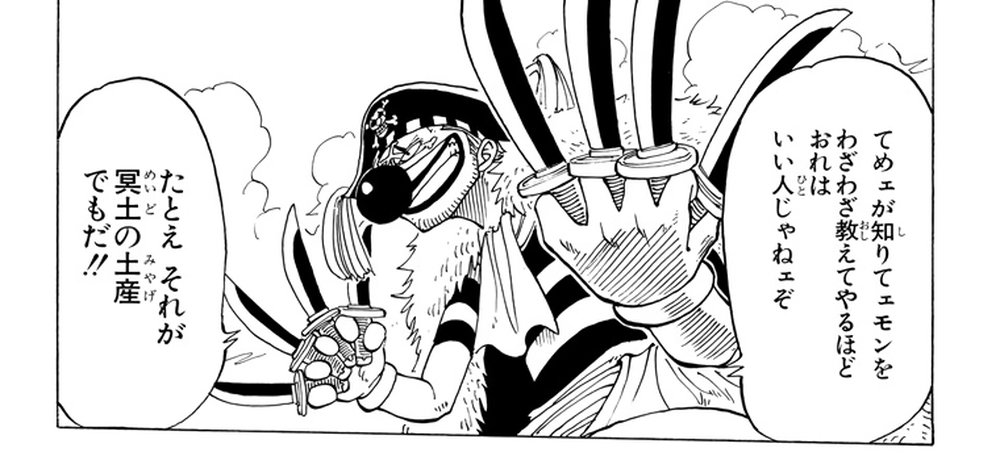
Orange Town, still smoking with wreckage. Luffy and Buggy the Clown have been circling one name. Luffy overheard "Red Hair" and lit up — 「赤髪って…!?」("RED HAIR!?") — then demanded, 「シャンクスの事か!?知ってんのかお前!!」("YOU TALKIN' ABOUT SHANKS? YOU KNOW SHANKS!?"). Buggy admits it, coolly: 「知ってるがどうした..」("YES, I KNOW HIM. WHAT'S IT TO YOU?") Then he dangles the one thing Luffy actually wants — 今どこにいる?("WHERE IS HE NOW?") — only to snatch it back a beat later: 知らんと言やあ全く知らん...!!("THEN AGAIN, MAYBE I DON'T.") Luffy calls him an idiot; Buggy, genuinely offended, escalates. Claws raised, he lays out the terms:
「てめェが知りてェモンをわざわざ教えてやるほどおれはいい人じゃねェぞ、たとえそれが冥土の土産でもだ!!」
Temē ga shiritē mon o wazawaza oshiete yaru hodo ore wa ii hito ja nē zo, tatoe sore ga meido no miyage demo da!!
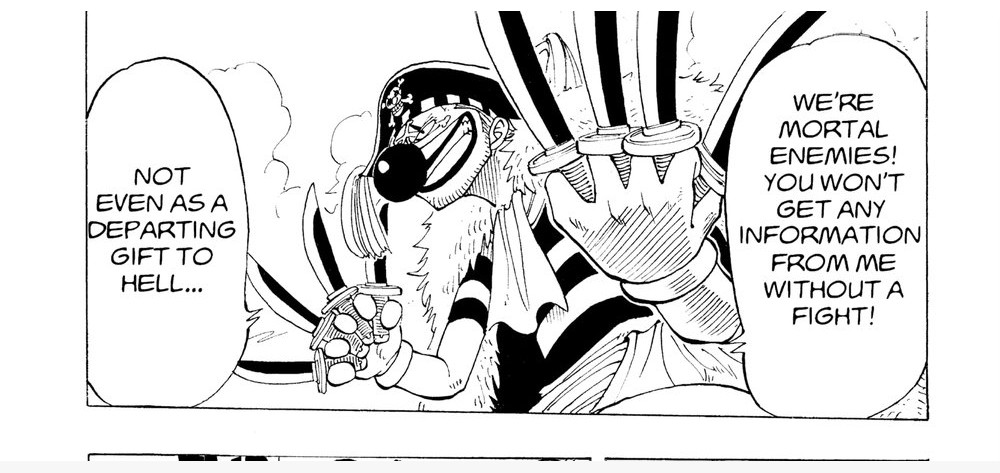
VIZ's English edition splits the line across two bubbles in the same panel: "WE'RE MORTAL ENEMIES! YOU WON'T GET ANY INFORMATION FROM ME WITHOUT A FIGHT!" and, beside it, "NOT EVEN AS A DEPARTING GIFT TO HELL..." (Vol. 3, p.10).
It's a good bubble on its own terms. "Departing gift" keeps the shape of a gift being withheld, the rhythm lands, and "to hell" reads as pure menace — exactly what a clown with knives strapped to his fingers should sound like threatening a fourteen-year-old. Grant it that much. But the Japanese isn't threatening Luffy with hell. It's citing — and then refusing — a specific, recognizable custom.
The Original
Two words, and both deserve their own paragraph before they get welded together.
冥土 (meido) — 冥 (mei) is "dark, hidden, the unseen"; you meet the same 冥 in 冥王星 (Meiōsei, literally "the dark king star," Japan's name for Pluto) and in 冥界 (meikai, "the nether realm"). 土 (do) is simply "earth, ground, land." 冥土 is, transparently, "the dark land" — the shadow country every soul crosses into after death, in the shared Buddhist-and-folk cosmology of premodern Japan. Crucially, 冥土 sits one whole tier away from 地獄 (jigoku), the actual word for hell — the specific Buddhist realm of fire, judgment, and punishment reserved for the wicked. 冥土 has no such judgment built in. It is simply the destination. Everyone goes, murderer and monk alike.
土産 (miyage) — a different, everyday 土 ("of the land, local") plus 産 (san), "product, something produced." Literally, "a local product [from where you visited]" — but in practice it means exactly one thing to any speaker of Japanese: the souvenir, almost always edible, that you are all but socially obligated to bring home from any trip for family, neighbors, and coworkers. お土産文化 (omiyage culture) is close to a national institution; skipping it is a minor faux pas.
Weld them and you get 冥土の土産: a keepsake for the trip to the other world. The phrase's dark comedy is built into its own grammar — it describes the ultimate one-way journey using the vocabulary of a work trip to Osaka.
Idiomatically, 冥土の土産に(も) is a small, recognizable ritual gesture: the one last thing granted to someone who is dying or about to die — a final sight, a final answer, a final fight — offered "as a gift for the road." An elderly character might say 一目見たい、冥土の土産に ("I want to see it once, as a keepsake for my trip to the other world"); a killer might offer 冥土の土産に教えてやる ("I'll tell you, as a parting gift"). Buggy's line does the opposite: たとえそれが冥土の土産でもだ!! names the customary kindness only to deny it. The たとえ〜でも ("even if…") construction marks it explicitly as a concession being refused, not an image invented on the spot.
As vocabulary, 冥土 lives beyond any standard JLPT list — it survives almost entirely in fiction, period drama, and funerary contexts, not daily conversation. 土産 alone, by total contrast, is everyday N5 vocabulary that every first-year learner meets. The phrase's difficulty isn't grammar; it's knowing the formula exists at all.
VIZ's Choice
冥土の土産 appears exactly once across the One Piece volumes in our corpus, so there's no scatter table to read here — only one translator, one bubble, one decision, worth sitting with on its own.
VIZ chose "NOT EVEN AS A DEPARTING GIFT TO HELL..." Two moves are stacked in that single clause. The first is a keeper: "gift" preserves the shape of 土産 well enough that a reader still feels something being offered and refused. The second is the one worth stopping on: VIZ needed a destination noun to replace 冥土, and reached for "hell" — vivid, one syllable, instantly legible to an English-speaking teenager. It is also a specific theological claim the Japanese never makes. 冥土 doesn't send Luffy anywhere fiery. It just says: the other side.
This wasn't laziness. "Hell" is the fastest one-word gesture at "you're about to die and go somewhere bad," and in a fast-moving action bubble, fast is a real virtue. But the swap quietly converts Buggy's threat from Buddhist folk vocabulary into Christian-flavored slang — the same kind of conversion this site has tracked before, in 往生しろよ becoming "NOW REST IN PIECES!!" a few volumes later. English's whole death-threat shelf just happens to be furnished that way, and the translator reached for what was on it.
The Gap
冥土 is not hell, and Buggy isn't threatening damnation. "HELL" imports fire, sin, and judgment onto a word that names a place with none of those attached — the ordinary, morally neutral land of the dead that a Buddhist cosmology assumes every soul eventually reaches. Buggy isn't promising Luffy eternal punishment. He's using the plain word for "over there," the way an English speaker might say "the other side" or "the great beyond" — and then weaponizing it by dangling and withdrawing a customary kindness.
The tourist joke vanishes. 冥土の土産 works because it borrows the vocabulary of a very specific, very mundane Japanese social ritual — the souvenir shopping every traveler does before coming home — and grafts it onto the one trip nobody returns from. "Departing gift" keeps "gift"; it loses "souvenir you bring back," and with it the small, dark laugh built into the phrase. An English reader gets menace. A Japanese reader gets menace plus the flicker of absurdity that comes from picturing Buggy stocking a gift shop for the underworld.
The formula reads as invention, not citation. In Japanese, 冥土の土産に is recognizable enough that saying it — and refusing it — carries its own small shock: Buggy is citing an actual custom, the way a real villain in real fiction might, and then pointedly withholding it. "Not even as a departing gift to hell" reads to an English audience as one clown's improvised turn of phrase, not as him invoking, and denying, a shared cultural script.
What If
- "Not even as a keepsake for your trip to the other side..." — swaps "hell" for a genuinely neutral English destination phrase, closer to what 冥土 actually claims. Cost: "the other side" is vaguer and softer than "hell," and the line loses some of the punch a fast action bubble wants.
- "Not even as a souvenir for the road to the afterlife..." — the most literal option, keeping 土産's specific "travel souvenir" sense intact. Cost: longer, and "souvenir" reads faintly whimsical in English, risking comedy where menace is the point — even though that whimsy-menace mix is exactly what the Japanese is doing on purpose.
- "I won't even throw you a bone on your way to the grave..." — reaches for an English idiom of grudging last mercy, keeping the "small kindness withheld" shape. Cost: the Buddhist afterlife geography and the tourist-souvenir irony both disappear; "the grave" is a much smaller image than "the other world."
- Keep VIZ's structure, fix the destination: "NOT EVEN AS A PARTING GIFT FOR THE OTHER WORLD..." — minimal surgery, same bubble length, same menace. Cost: "the other world" doesn't land with the same one-syllable force "hell" does on first read.
Every option pays a price, because English simply doesn't keep a neutral, one-word afterlife on the shelf the way Japanese keeps 冥土 next to 地獄. Reach for "the beyond" or "the other side" and you buy vagueness; reach for "hell" and you buy a theology nobody asked for.
Take-away
冥土の土産 is a small, mean joke wearing a Buddhist robe: it describes the ultimate one-way trip using the vocabulary of a business trip's souvenir shopping, and it survives in modern Japanese mostly as the customary "one last thing" granted to somebody about to die. Buggy doesn't grant it. He names the custom and slams the door on it — which only works if the reader recognizes there was a custom to slam.
Two rules of thumb to carry off this page:
- 冥土 ≠ 地獄. When Japanese wants actual hell — fire, sin, judgment — it has a specific word for that: 地獄. 冥土 (and its plainer cousin あの世, "that world") just means the place the dead go, no verdict attached. Watch for English translations collapsing that distinction into one all-purpose "hell."
- 〜の土産に is a formula, not a metaphor. Whenever 土産 shows up attached to something other than an actual trip — 冥土の土産, 話の土産 ("a little something to take away from this conversation") — it's invoking the omiyage ritual on purpose. The joke is always that something ordinary is being offered for something enormous.
For two more places this site has tracked Japanese sending its dead in a direction English doesn't expect, see the villain's taunt built on the neighboring half of this same word family in 往生際が悪い, and the pun VIZ built when 往生 and 成仏 showed up as direct orders in 往生しろ・成仏してください. Or browse the One Piece translation notes index.
Every Japanese and English line quoted above is a byte-exact capture from the cited editions — ONE PIECE Vol. 3 (Japanese) and One Piece Vol. 3 (VIZ Media) at the corresponding panel — via our bilingual page database; see Sources below.