The Moment
Volume 15. Night. Dr. Tamayo — the demon who once defied Muzan and now hides out with her assistant Yushiro, quietly researching a cure — sits at her desk when a shape drops onto the windowsill: an enormous, scarf-collared crow, one of the Corps' 鎹鴉 (kasugai-garasu, "Kasugai crows"), the trained communication birds every Demon Slayer and Corps official is assigned. It opens with disarming manners:
「こんばんは珠世さん」「物騒ですよ夜に窓を開け放っておくのは」
— "GOOD EVENING, TAMAYO!" "IT'S DANGEROUS TO LEAVE YOUR WINDOW OPEN AT NIGHT." Tamayo, unmoved, only murmurs 「でも今日は本当に月が美しい夜だ」— "STILL... THE MOON IS BEAUTIFUL TONIGHT." — and then the crow gets down to business:
「初めまして吾輩は 産屋敷耀哉の使いの者です」
Hajimemashite, wagahai wa Ubuyashiki Kagaya no tsukai no mono desu.
VIZ: "LET ME INTRODUCE MYSELF... I'M KAGAYA UBUYASHIKI'S MESSENGER!" A page later, explaining how a mere bird tracked her down at all, it adds:
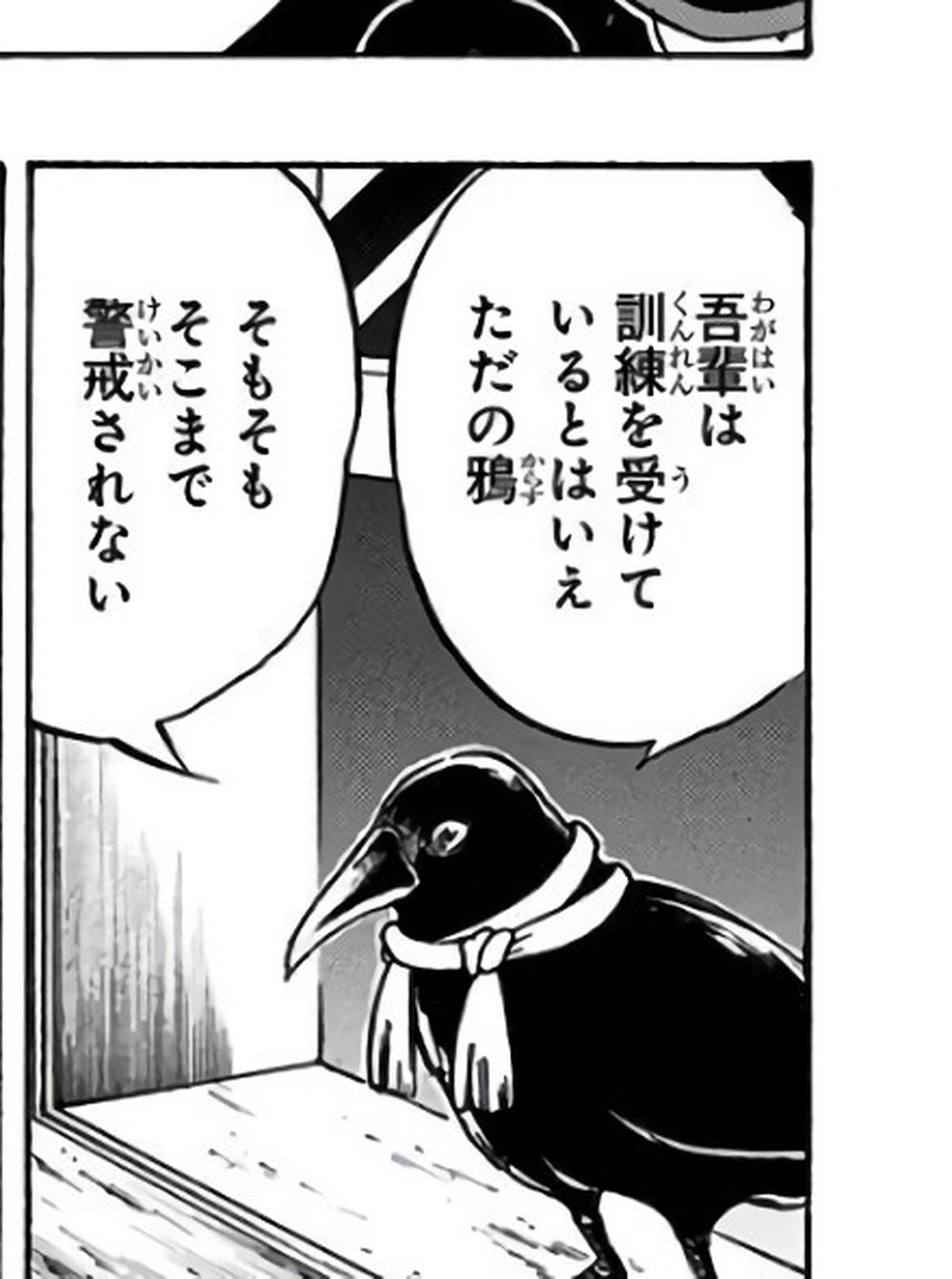
「吾輩は訓練を受けているとはいえただの鴉」
Wagahai wa kunren o ukete iru to wa ie, tada no karasu.
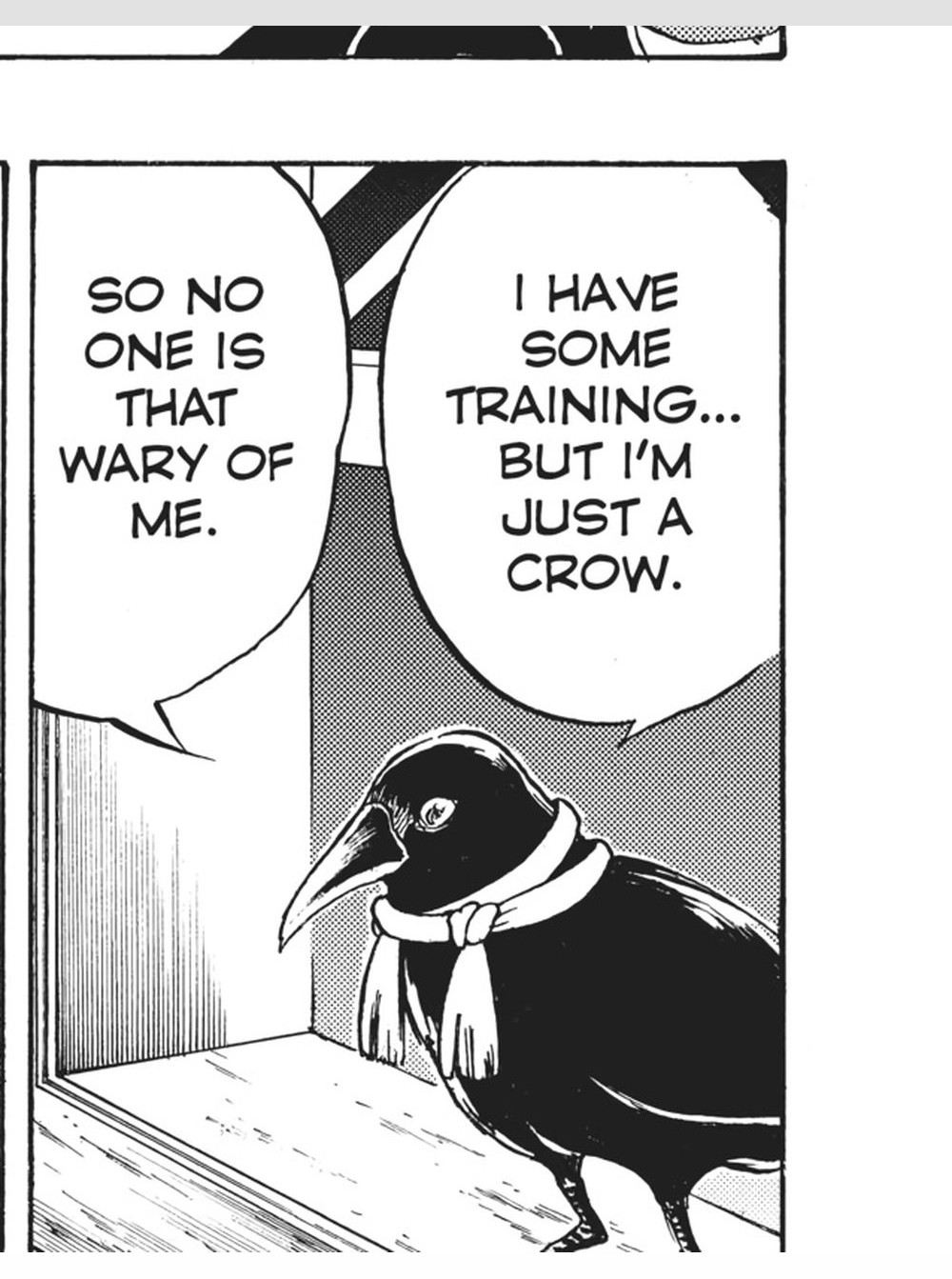
VIZ's English edition prints: "I HAVE SOME TRAINING... BUT I'M JUST A CROW." (Vol. 15, p.147.)
Grant the rendering its due: every one of these lines is fluent, natural English, and the crow's slightly formal, businesslike manner survives fully intact — "let me introduce myself," "I have some training," it's exactly how a Corps official, avian or otherwise, ought to talk. What doesn't survive is the joke sitting inside one repeated word. Three times across these two pages, this crow refers to itself with 吾輩 (wagahai) — Japanese's single most self-important first-person pronoun, the one immortalized by a cat.
The Original
吾輩 splits into two characters worth taking apart separately. 吾 (go/ware) is a classical, literary word for "I, self" — cognate with 我 (ware), the same root behind 我々 (wareware, "we"). 輩 (hai) means "fellows, companions, people of a class" — the same character sitting inside 先輩 (senpai, "senior") and 後輩 (kōhai, "junior"). Put together, 吾輩 reads literally as something like "we of our fellows" or "our generation" — imported wholesale from Classical Chinese 吾輩 (wúbèi), a genuine first-person plural. Somewhere across the Edo-to-Meiji transition, Japanese narrowed that plural down to a singular: one speaker borrowing the weight of "we" to describe himself — the identical royal-"we" trick English performs in "We are not amused," except 吾輩 kept circulating as an everyday (if grandiose) singular "I," available to any speaker self-important enough to reach for it.
And reach for it they did — right up until one novel made the pronoun impossible to use straight-faced again. Natsume Sōseki's serialized 1905–06 novel 吾輩は猫である (Wagahai wa Neko de Aru, "I Am a Cat") opens with what may be the single most quoted sentence in modern Japanese literature: 吾輩は猫である。名前はまだ無い。("I am a cat. As yet I have no name.") The joke of that line, and of the satirical novel that follows, is the collision between the pronoun's borrowed grandeur and the narrator's actual station: a nameless stray cat living under a schoolteacher's floorboards, condescending to comment on the follies of the humans around it. A century later, 吾輩 cannot be spoken or printed in Japanese without at least a flicker of that cat trailing behind it. As vocabulary it sits outside any tidy JLPT bracket — treat it as N1-adjacent recognition vocabulary, the kind most learners meet in a single famous book title long before they ever hear it spoken aloud. Grammatically it is nothing special: 吾輩は, 吾輩が, 吾輩の all inflect exactly like わたし or 僕. The entire charge of the word is register, and the register is, unmistakably, pompous.
VIZ's Choice
All three of the crow's 吾輩's, across the two pages of this scene:
| Vol. / p. | Japanese | VIZ English |
|---|---|---|
| 15 / 146 | 初めまして吾輩は | LET ME INTRODUCE MYSELF... |
| 15 / 147 | 吾輩は訓練を受けているとはいえただの鴉 | I HAVE SOME TRAINING... BUT I'M JUST A CROW. |
| 15 / 148 | 吾輩が炭治郎のように貴女から信用を得るのは難しいですねやはり.. | IT WILL BE TOUGH TO WIN YOUR TRUST... LIKE TANJIRO DID. |
Three appearances, and the pronoun survives cleanly only once — the middle row, where it becomes an unmarked "I." The first occurrence dissolves into the idiom "let me introduce myself," which needs no explicit subject at all; the third dissolves into an impersonal "it will be tough," again with no "I" anywhere in the English sentence. So the actual scoreline for wagahai in this scene isn't "flattened to 'I'" — it's flattened to "I" once, and simply deleted twice. A word doing character work in every one of its three appearances in Japanese shows up in English exactly once, in its most neutral possible form.
A note on the corpus for the curious: a raw keyword search for 吾輩 across the whole bilingual database turns up nearly a dozen more "hits," clustered in the small-print author's-note omake pages that close out many volumes (Vol. 1, 4, 7, 10, 13, 14, 18, 19, 21, 22). Every one of them is a false positive. Volume 1's page 110, for instance, is corpus-tagged 「どうもコンこう、吾輩です」— but the printed page (confirmed directly against the scan) actually reads 「どうもコンニチハ 吾峠です」, "Hello, I'm Gotouge" — the mangaka signing off in his own surname, 吾峠 (Gotouge), misread by the OCR pass as the visually similar-looking 吾輩. None of those omake pages are genuine occurrences of this pronoun; the crow's scene in Volume 15 is the confirmed, verified source for everything in this article.
The Gap
English's "I" carries no grandiosity marker. A pompous "I" and a plain "I" are typographically and phonetically identical, so whatever inflation 吾輩 performs simply has nowhere to register once the sentence becomes English. A reader cannot hear a bird talking like a professor through a pronoun that sounds the same coming from anyone.
The self-deflating structure goes quiet. Three times on two pages, this crow announces itself with the same swollen pronoun, immediately undercut each time by a humbling fact — "just a crow," a trust that's "tough" to earn. That repetition is the joke's actual engine: a Japanese reader clocks 吾輩 recurring and feels the gap between the word's self-importance and the bird's actual modesty widen with each use. Two of the three repetitions vanish in English, so the pattern that makes the joke a pattern — not just one line, but three chiming against each other — is simply inaudible.
The Sōseki echo cannot cross without a shared memory. No English-only reader can hear "wagahai" quietly gesturing at Japan's most famous fictional cat, because the word and the book are fused in Japanese in a way no English pronoun is fused to any book. Even a fully deliberate authorial wink — and the scene's neighboring line about a beautiful moon, echoing the (unverifiable, but famous) Sōseki-and-the-English-student anecdote, suggests this one might be deliberate — has no vehicle to survive translation. The reference depends on cultural furniture that simply isn't in the English reader's room.
What If
No fix here is free; the menu and its costs:
- "I dare say I have had SOME training... though I remain, at heart, but a common crow." — archaic, self-consciously formal phrasing gestures at 吾輩's pomp. Cost: reads Victorian-English rather than Meiji-Japanese — the wrong country's antique pronoun standing in for the right one.
- "THIS HUMBLE MESSENGER has had some training... but is, after all, only a crow." — a title-based distancing move to mimic self-reference from outside. Cost: inverts the joke exactly backwards — 吾輩 is grandiose, not humble, and this reads as false modesty instead of overblown confidence.
- Restore "I" to all three bubbles instead of dropping it twice — "Let me — I — introduce myself... I have some training, but I'm just a crow... it will be tough for me to win your trust." Cost: a purely structural fix; it restores the repetition pattern but still can't make an English "I" sound pompous on its own.
- A first-appearance translator's gloss: keep VIZ's clean lines, footnote wagahai on its first use as "a pompous, old-fashioned 'I' — the pronoun of Sōseki's talking cat." Cost: explains the joke instead of landing it, and breaks the scene's quiet comedy with a lecture.
Take-away
吾輩 is proof that Japanese's first-person pronoun system can run in both directions at once: where 小生 and 拙者 lower a speaker, 吾輩 inflates one — and inflation is exactly what a Corps messenger crow needs for a joke that deflates a sentence later in the very same breath.
Three rules of thumb to carry off this page:
- A first-person pronoun can be a citation, not just a register. After 1905, 吾輩 doesn't just mean "pompous" in the abstract — it specifically means "that cat," the way quoting "to be or not to be" specifically means Hamlet. Watch for pronouns that function like literary allusions.
- When a self-important pronoun meets a humble noun, that collision is the whole joke. 吾輩...ただの鴉 ("I... just a crow") is structurally identical to 吾輩は猫である...名前はまだ無い ("I am a cat... I have no name yet") — grandeur promised, then immediately withdrawn.
- Count the repetitions before judging a translation. A single dropped pronoun is a minor smoothing; three drops in one short scene erase a pattern the original was clearly building on purpose.
This pronoun completes a set: for the opposite, self-lowering half of the same wardrobe, see This Insignificant Self's Prey: 小生 and A Trainful of Country Boys: おいら; for the age-coded register next door, see One Pronoun, Every Old Man: 儂・わし. Naruto's own author has staged a structurally similar joke about archaic role language — a bonus-page confession that Kakashi very nearly spoke entirely in でござる, the fossil samurai copula — worth a look for anyone who enjoyed watching a manga briefly test-drive a register everyone else only knows from parody. Or browse the Demon Slayer translation notes index.
Every Japanese and English line quoted above is a byte-exact capture from the cited editions — 鬼滅の刃 Vol. 1 & 15 (Japanese) and Demon Slayer: Kimetsu no Yaiba Vol. 1 & 15 (VIZ Media) at the corresponding panels — via our bilingual page database, with one noted OCR correction (the Volume 1 omake caption, verified directly against the printed page image); see Sources below.