The Moment
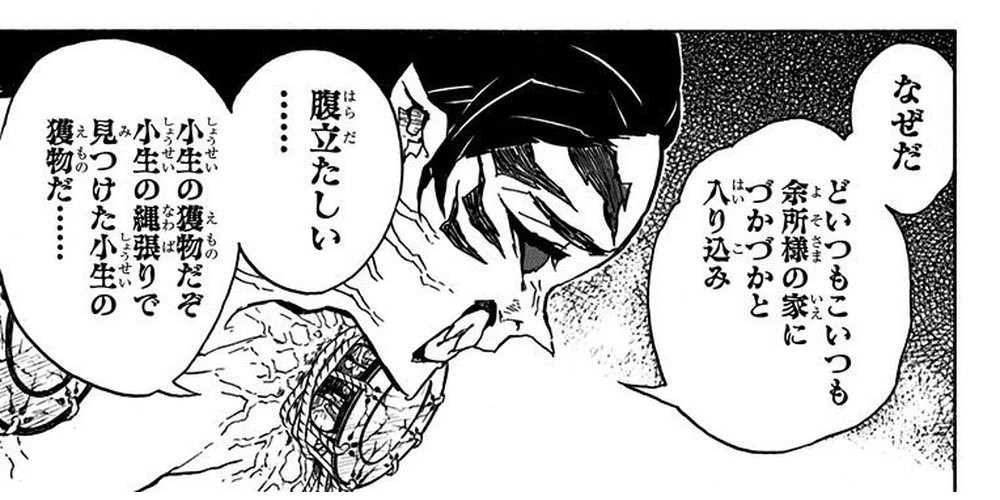
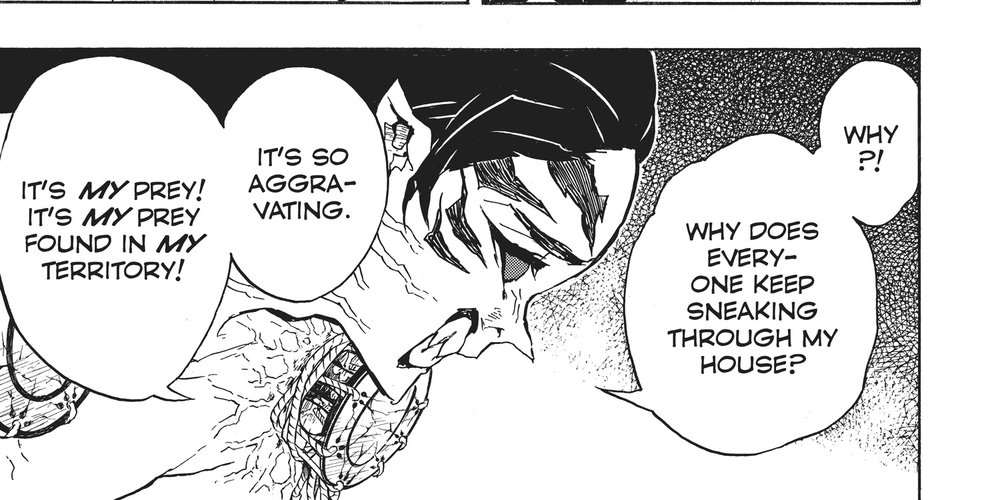
Volume 3. Somewhere in the mountains sits a mansion that isn't quite a mansion — a maze of rooms that rotate and swap at the beat of drums, some of them stitched into the shoulders and joints of the demon who lives there. Tanjiro has already told Nezuko and a terrified girl named Teruko to hide behind the shelves and stay out of the halls, because "THE ROOM WILL MOVE." It does. And somewhere inside that turning house, a demon with drum-lobed ears and a mouthful of needle teeth is having the same thought on repeat, the demon's face lit only by the small round eye and the bared teeth in an otherwise black panel:
「‥‥‥腹立たしい 小生の獲物だぞ小生の縄張りで見つけた小生の獲物だ‥‥‥」
…Haradatashii. Shōsei no emono da zo, shōsei no nawabari de mitsuketa shōsei no emono da…
VIZ's English edition prints: "AGGRAVATING. IT'S MY PREY! IT'S MY PREY FOUND IN MY TERRITORY!" (Vol. 3, p.101), with "MY" set in italics all three times, as if the letterer could feel the line straining against something the plain word wasn't quite carrying.
Grant the rendering its due: the repetition survives intact, syllable for syllable — three claims of ownership in the Japanese, three claims of ownership in the English, and the italics are a real attempt to mark the obsessive stress in the original. Read the line cold, as a demon defending his turf, and it works exactly as intended: territorial, aggravated, absolute. What it can't do is tell you how that demon talks — because the word doing all three repetitions, 小生, isn't ordinary aggression vocabulary at all. It's the pronoun of a Meiji-era man writing a letter.
The Original
小生 (shōsei) splits into two kanji, and both are worth sitting with. 小 (shō) means "small, minor, insignificant" — the same 小 that shrinks 小心 (shōshin, "faint of heart, timid") and 小人 (shōnin, "a lesser person"). 生 (sei) means "life; one's own being" — the root inside 先生 (sensei, literally "one born before," i.e. "teacher") and, confusingly, inside the near-homophone 書生 (shosei, "a live-in student," a completely different word with a shorter first vowel — しょせい, not しょうせい). Put the two together and 小生 reads, literally, "this insignificant life" or "this small self" — a pronoun that performs its own modesty in the act of naming itself.
That move — lowering the speaker grammatically while using the word with total self-assurance — is the same trick 拙者 (sessha, "this unskilled one") pulls in Naruto, where Kakashi's ninja dogs bark it like retired samurai. But 小生's home turf was never the sword. It was the writing desk. 小生 is the signature pronoun of 書簡体 (shokantai), formal epistolary Japanese — the "I" an educated man signed beneath a letter, an essay, or a manuscript, from the Edo period through the early Shōwa era. If 拙者 is a warrior's humility, 小生 is a scholar's: the pronoun of a doctor writing to a colleague, a professor addressing a committee, a novelist introducing his own work.
Grammatically there is nothing exotic about it — 小生 takes の, は, が exactly like わたし or 僕 (小生の獲物, "this insignificant self's prey," behaves like any possessive). All of the word's charge sits in register, not syntax: say it out loud in casual conversation and you sound like you're doing a bit, deliberately reaching backward a century or more. That reach is exactly what makes it yakuwarigo — role language, in Satoshi Kinsui's term — the moment it's aimed at a character rather than a real letter. And here it's aimed at a demon with drums for shoulder blades, defending a rotating house from a teenager with a sword.
VIZ's Choice
小生 appears seven times across Kyogai's dialogue in Volume 3 — every appearance we have on file. Here is each occurrence, side by side with VIZ's official English:
| Vol. / p. | Japanese | VIZ English |
|---|---|---|
| 3 / 101 | 小生の獲物だぞ小生の縄張りで見つけた小生の獲物だ‥‥‥ | IT'S MY PREY! IT'S MY PREY FOUND IN MY TERRITORY! |
| 3 / 111 | 小生の家で騒ぐ虫共 | INSECTS INFESTING MY HOUSE! |
| 3 / 145 | そうしたら小生は | THEN I CAN RETURN... |
| 3 / 150 | 小生は以前と比べものにならぬ度合いで強くなり | MY NEW STRENGTH WAS INCOMPARABLE TO HOW I WAS BEFORE. |
| 3 / 179 | 血鬼術は小生の‥‥‥ | WAS MY... ...BLOOD DEMON ART... |
| 3 / 181 | 小生の‥‥‥書いた物は | MY... WRITING... |
| 3 / 182 | 小生の血鬼術も‥‥‥ | MY BLOOD DEMON ART... |
Seven appearances, and the English column is almost hypnotically uniform: "my" five times, "I" once outright (Vol. 3/145), and once split across both "my" and "I" in the same sentence (Vol. 3/150, where 小生は does double duty as the possessor of the new strength and the subject of how I was before). This is the mirror opposite of the scatter we usually flag in this column — one Japanese word landing on five or six unrelated English words. Here it's total convergence: the same flat, unmarked pronoun, every single time, because English genuinely has nothing else in the drawer. "My" is the correct word and the only word on offer; the translator never had a real second option to weigh.
The Vol. 3/101 row is the set piece — three repetitions in one breath, the closest the corpus gets to the character shouting his own signature. But the quieter rows matter just as much. By Vol. 3/150, 小生 has moved out of dialogue entirely and into an inner-monologue caption, a flashback to how Muzan's blood transformed him: 「小生は以前と比べものにならぬ度合いで強くなり」, narrated in the same bookish first person he uses to threaten intruders. And by Vol. 3/181–182, with Kyogai reduced to a severed, crumbling head, the pronoun is still there — 小生の‥‥‥書いた物は ("MY… WRITING…"), 小生の血鬼術も‥‥‥ ("MY BLOOD DEMON ART…") — carried all the way to his final breath. Whatever 小生 is doing for this character, it isn't decorative. It's the one constant across every register he speaks in: fury, memory, and death.
The Gap
English pronouns carry no register. "My" and "I" are used identically by a toddler, a general, and a house-haunting demon; there is no everyday English word that announces "this speaker writes like it's 1910" the instant it's spoken, the way 小生 does on contact. The entire signal — bookish, old-world, pedantic — simply has nowhere to go in the pronoun system, and unlike a noun or a verb, there's no synonym to reach for instead. It just isn't there.
The self-lowering irony collapses. 小生 grammatically diminishes its speaker even as Kyogai uses it, three times in one line, to claim absolute ownership of a boy's life: "MY prey… MY territory… MY prey." That collision — this insignificant self asserting total dominion — is close to the whole comic-tragic key of the character, and it survives in the Japanese purely because the pronoun keeps insisting on its own smallness while the sentence around it insists on the opposite. Flattened to "my," the repetition still reads as aggravation, but the specific friction — humility in the word, greed in the sentence — is gone.
The biography hiding in the grammar goes dark. Two pages after Kyogai dies, the manga reveals what "MY... WRITING..." was actually about: a demon who was, in life, a writer whose pages were once trampled, now moved almost to peace because a boy chose not to step on his manuscript. A reader who had clocked 小生 as literary-man's diction would feel that reveal land a beat early — of course this demon talks like a Meiji novelist, because he was one. The English reader gets the same plot beat with none of the grammatical foreshadowing; "my" told them nothing about who they'd been listening to for eighty pages.
What If
No fix here is free. The menu, and what each option costs:
- "That's THIS one's prey — found on THIS one's ground — THIS one's prey, I say!" — the self-naming distance of "this one" gestures at 小生's habit of referring to the self almost in the third person. Cost: sounds stilted and mechanical rather than literary; a reader is more likely to hear a robot than a Meiji-era letter-writer.
- "That is MY prey, if you please — MY prey, found on MY own territory!" — "if you please" injects the fussy, self-consciously formal diction 小生 carries. Cost: the politeness marker reads British-drawing-room, not Japanese-literary — a real archaism, just the wrong one.
- A running small-caps or period-typeface tag across every Kyogai line in the volume, the way a translator might mark a character's consistent verbal tic. Cost: only pays off if sustained across all seven of his appearances — which the actual English edition never attempts — and does nothing at all for a reader who meets him in a single panel.
- "This unworthy self's prey — found on this unworthy self's own ground — this unworthy self's prey!" — mirrors the fix our sister piece proposes for Pakkun's 拙者: self-lowering language stacked directly against territorial fury. Cost: three repetitions of a five-word phrase turn a punchy manga bark into a mouthful, and the menace drains out through the sheer length of the archaism.
Take-away
小生 is a small, precise instance of a problem bigger than one demon's dialogue: Japanese fiction can hand a character an entire biography through pronoun choice alone, and English simply doesn't stock the part. Kyogai's seven "my"s are correct, readable, and completely silent about the fact that a failed novelist is speaking through a monster's mouth.
Three rules of thumb to carry off this page:
- A self-deprecating pronoun making a big claim is the joke (or the tragedy). When "this insignificant self" turns out to be shouting about my prey, my territory, watch for the gap between the pronoun's grammar and the sentence's ambition — that gap is usually the point.
- Register-marked "I"s are a Japanese-specific tool. 拙者, 小生, 我輩, 某, 儂 — each cuts a different character silhouette, and English's one general-purpose "I" cannot be subdivided to match. Expect total, not partial, loss whenever a pronoun alone is doing the characterizing.
- A pronoun can foreshadow a backstory. 小生 flagged "literary man" seven times before the manga confirmed Kyogai had been a writer — watch for word choices that seem oddly specific for a monster; they're often planting a reveal.
For the prayer said over this exact demon two pages after his last 小生 — Tanjiro's 成仏してください and the epitaph that points the wrong way — see Praying the Demon Onward. For the same Buddhist send-off snarled instead of prayed, by a very different demon-slayer, see Temple Word, Gutter Grammar: 往生しやがれ. Or browse the Demon Slayer translation notes index. This pronoun also has a martial-register cousin one work over: Naruto's Pakkun snarls 拙者, the samurai-era humble "I," out of a scowling ninja dog — the bookish self-effacement here, the same self-effacement pitched to the sword there.
Every Japanese and English line quoted above is a byte-exact capture from the cited editions — 鬼滅の刃 Vol. 3 (Japanese) and Demon Slayer: Kimetsu no Yaiba Vol. 3 (VIZ Media) at the corresponding panels — via our bilingual page database; see Sources below.